SKC Accelerates Portfolio Reengineering: Anchoring Future Growth on AI Semiconductors and Green Materials
Date : 2026-01-15
Reading : 1216
Amid a rapidly evolving global industrial landscape, SKC is aggressively reshaping its business portfolio, transitioning from a traditional film and chemical manufacturer into a global materials powerhouse focused on secondary batteries, semiconductors, and eco-friendly solutions. According to the latest analysis by HDIN Research, this strategic pivot, defined by a "Select and Focus" approach, is poised to capitalize on the booming demand for Artificial Intelligence (AI) and Electric Vehicles (EVs), despite short-term transitional financial pressures.
Deep Transformation Driven by Divestiture and Investment
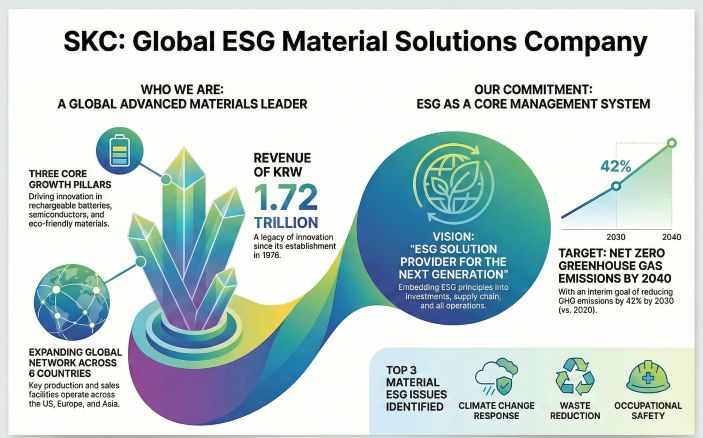
SKC is currently executing a high-stakes structural overhaul. To fund its expansion into high-value sectors, the company has systematically divested non-core assets, including its industrial film business, SK pucore, and the fine ceramics division of SK enpulse. This asset slimming strategy has allowed SKC to manage its leverage ratios effectively while channeling substantial capital into three core growth engines: copper foil for batteries, glass substrates for chip packaging, and biodegradable materials.
According to HDIN Research, while the company reported an operating loss in Q3 2025 due to heavy restructuring costs and depreciation, the underlying indicators point to a robust recovery trajectory starting in 2026. The company has successfully utilized cash form divestitures to keep its debt-to-equity ratio manageable, reinforcing its capacity to endure the investment phase.
Figure SKC Global ESG Material Solutions
The Three Pillars of Future Growth
1. Secondary Battery Materials: Operational Turnaround in Malaysia
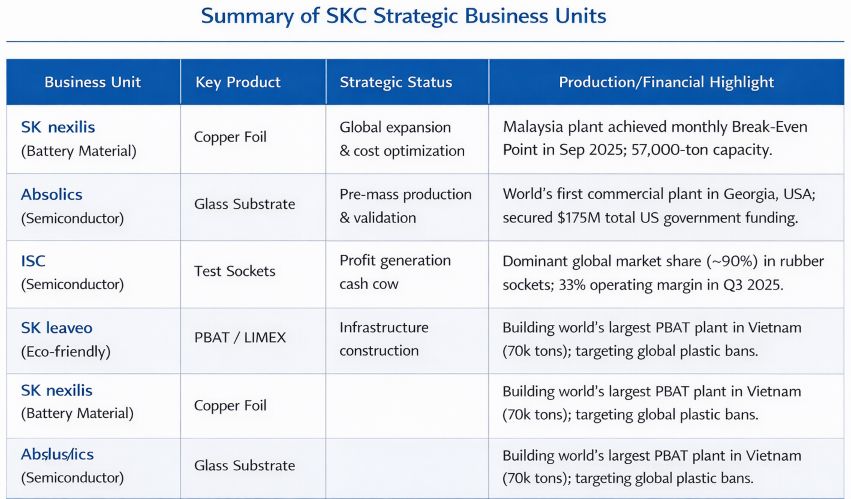
The flagship of SKC’s battery material business, SK nexilis, is witnessing a pivotal turnaround at its Malaysian production hub. In September 2025, the Kota Kinabalu copper foil factory achieved a monthly break-even point (BEP), driven by significant improvements in yield rates and capacity utilization. With a production capacity of 57,000 tons between Plant 1 and Plant 2, the Malaysian facility has surpassed domestic Korean sites in cost competitiveness. As Plant 2 ramps up for full operations by late 2025, SKC aims to capture the recovering demand from North American and European EV manufacturers.
2. Semiconductor Materials: A Leap into Glass Substrates
SKC’s subsidiary, Absolics, is positioning itself at the forefront of the AI hardware revolution with the commercialization of the world’s first semiconductor glass substrate. Located in Covington, Georgia, the Absolics plant has moved from research to prototype production as of 2025. This technology, which offers superior thermal resistance and power efficiency compared to traditional plastic substrates, has garnered significant backing from the U.S. government, securing $75 million under the CHIPS Act and an additional $100 million for R&D. Simultaneously, SKC’s test socket subsidiary, ISC, continues to deliver high margins (reaching 33% operating profit in Q3 2025), driven by the surge in High Bandwidth Memory (HBM) and AI chip testing demand.
3. Eco-friendly Materials: Scaling Biodegradable Solutions
In response to global plastic regulations, SKC’s subsidiary SK leaveo is constructing the world’s largest monomaterial PBAT (biodegradable plastic) factory in Hai Phong, Vietnam. Set for completion in 2025 with an annual capacity of 70,000 tons, this facility will produce high-strength "rf-PBAT" materials suitable for industrial and agricultural applications. The integration of limestone-based LIMEX technology further enhances the company’s ability to offer cost-effective, sustainable alternatives to conventional plastics.
Figure Summary of SKC Strategic Business Units
Outlook: Navigating the J-Curve
HDIN Research notes that SKC’s transformation resembles a "J-curve" trajectory. While the immediate financial statements reflect the friction costs of restructuring—such as operational losses and increased depreciation from new facilities—the fundamentals are strengthening. The successful stabilization of the Malaysian copper foil plant and the imminent commercialization of glass substrates suggest that the company is nearing the inflection point of its business reorganization.
By aligning its portfolio with the irreversible trends of AI computing power, electrification, and sustainability, SKC is shedding its legacy identity to emerge as a specialized ESG materials solutions provider.
Please click to watch the YouTube video of the report presentation.
About HDIN Research
HDIN Research focuses on providing market consulting services. As an independent third-party consulting firm, it is committed to providing in-depth market research and analysis reports.
Media Contact
Company Name: HDIN Research
Contact Person: Sales Team
Email: sales@hdinresearch.com
Website: www.hdinresearch.com
Deep Transformation Driven by Divestiture and Investment
SKC is currently executing a high-stakes structural overhaul. To fund its expansion into high-value sectors, the company has systematically divested non-core assets, including its industrial film business, SK pucore, and the fine ceramics division of SK enpulse. This asset slimming strategy has allowed SKC to manage its leverage ratios effectively while channeling substantial capital into three core growth engines: copper foil for batteries, glass substrates for chip packaging, and biodegradable materials.
According to HDIN Research, while the company reported an operating loss in Q3 2025 due to heavy restructuring costs and depreciation, the underlying indicators point to a robust recovery trajectory starting in 2026. The company has successfully utilized cash form divestitures to keep its debt-to-equity ratio manageable, reinforcing its capacity to endure the investment phase.
Figure SKC Global ESG Material Solutions
The Three Pillars of Future Growth
1. Secondary Battery Materials: Operational Turnaround in Malaysia
The flagship of SKC’s battery material business, SK nexilis, is witnessing a pivotal turnaround at its Malaysian production hub. In September 2025, the Kota Kinabalu copper foil factory achieved a monthly break-even point (BEP), driven by significant improvements in yield rates and capacity utilization. With a production capacity of 57,000 tons between Plant 1 and Plant 2, the Malaysian facility has surpassed domestic Korean sites in cost competitiveness. As Plant 2 ramps up for full operations by late 2025, SKC aims to capture the recovering demand from North American and European EV manufacturers.
2. Semiconductor Materials: A Leap into Glass Substrates
SKC’s subsidiary, Absolics, is positioning itself at the forefront of the AI hardware revolution with the commercialization of the world’s first semiconductor glass substrate. Located in Covington, Georgia, the Absolics plant has moved from research to prototype production as of 2025. This technology, which offers superior thermal resistance and power efficiency compared to traditional plastic substrates, has garnered significant backing from the U.S. government, securing $75 million under the CHIPS Act and an additional $100 million for R&D. Simultaneously, SKC’s test socket subsidiary, ISC, continues to deliver high margins (reaching 33% operating profit in Q3 2025), driven by the surge in High Bandwidth Memory (HBM) and AI chip testing demand.
3. Eco-friendly Materials: Scaling Biodegradable Solutions
In response to global plastic regulations, SKC’s subsidiary SK leaveo is constructing the world’s largest monomaterial PBAT (biodegradable plastic) factory in Hai Phong, Vietnam. Set for completion in 2025 with an annual capacity of 70,000 tons, this facility will produce high-strength "rf-PBAT" materials suitable for industrial and agricultural applications. The integration of limestone-based LIMEX technology further enhances the company’s ability to offer cost-effective, sustainable alternatives to conventional plastics.
Figure Summary of SKC Strategic Business Units
Outlook: Navigating the J-Curve
HDIN Research notes that SKC’s transformation resembles a "J-curve" trajectory. While the immediate financial statements reflect the friction costs of restructuring—such as operational losses and increased depreciation from new facilities—the fundamentals are strengthening. The successful stabilization of the Malaysian copper foil plant and the imminent commercialization of glass substrates suggest that the company is nearing the inflection point of its business reorganization.
By aligning its portfolio with the irreversible trends of AI computing power, electrification, and sustainability, SKC is shedding its legacy identity to emerge as a specialized ESG materials solutions provider.
Please click to watch the YouTube video of the report presentation.
About HDIN Research
HDIN Research focuses on providing market consulting services. As an independent third-party consulting firm, it is committed to providing in-depth market research and analysis reports.
Media Contact
Company Name: HDIN Research
Contact Person: Sales Team
Email: sales@hdinresearch.com
Website: www.hdinresearch.com