Omega-3 Fish Oil Market Insights 2026: Industry Growth and Strategic Outlook
Date : 2026-02-02
Reading : 94
HDIN Research has announced the release of its latest research report titled Global Omega-3 Fish Oil Market Insights 2026, providing a comprehensive analysis of the industry landscape, value chain dynamics, and future growth projections through 2031. The report highlights the critical role of Omega-3 fatty acids in the global nutritional ingredients sector, driven by expanding applications in dietary supplements, pharmaceuticals, and animal nutrition.
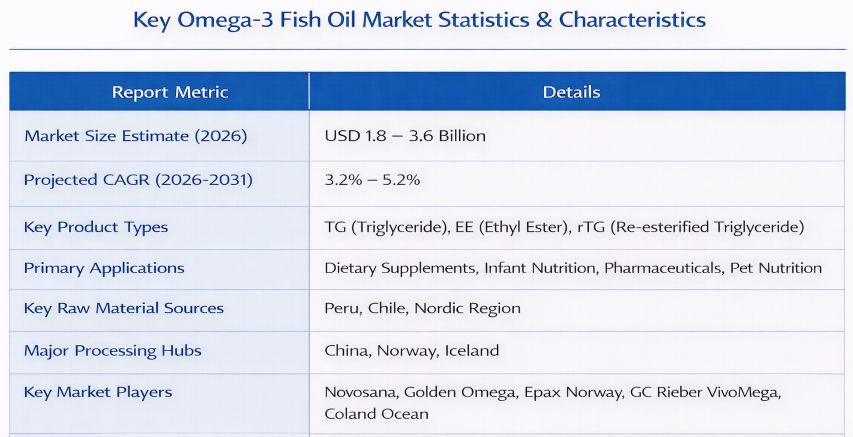
According to the latest data from HDIN Research, the global Omega-3 fish oil market valuation is estimated to range between USD 1.8 billion and USD 3.6 billion in 2026. The market is projected to expand at a Compound Annual Growth Rate (CAGR) of 3.2% to 5.2% during the forecast period of 2026 to 2031. This steady growth trajectory is underpinned by rising global health consciousness, an aging population in developed markets, and increasing awareness of the benefits of EPA (eicosapentaenoic acid) and DHA (docosahexaenoic acid) for cardiovascular, cognitive, and eye health.
The report details the segmentation of the market into three primary product types based on their chemical structure: Triglyceride (TG), Ethyl Ester (EE), and Re-esterified Triglyceride (rTG). While TG forms maintain the natural structure of fish oil and offer excellent bioavailability, EE forms allow for higher concentrations suitable for pharmaceutical applications. The rTG segment is identified as a premium category, combining high concentration with superior bioavailability.
Market dynamics are heavily influenced by the upstream supply chain, particularly the availability of raw materials from marine fisheries in South America. The report notes that Peru and Chile remain the primary sources for crude fish oil, while midstream processing and refining capabilities have seen significant concentration in Asia-Pacific, particularly China, and Europe. Recent climatic events, such as El Nino, have highlighted the vulnerability of the supply chain to environmental factors, impacting raw material costs and availability.
Application analysis reveals that dietary supplements remain the largest end-use segment. However, the report identifies significant growth potential in infant nutrition, where DHA is a critical ingredient, and in the premium pet nutrition sector. The medical nutrition segment, utilizing pharmaceutical-grade fish oil with purity levels exceeding 84%, represents a high-value niche driven by clinical demand for cardiovascular disease management.
The following table summarizes the key market statistics and characteristics identified in the report:
Regional analysis indicates that North America continues to lead in consumption due to a well-established dietary supplement industry. The Asia-Pacific region is recognized as the fastest-growing market, driven by rising disposable incomes and urbanization in China and Southeast Asia. Europe remains a stronghold for high-quality, sustainably sourced products, with stringent regulatory oversight regarding purity and environmental impact.
HDIN Research emphasizes that the competitive landscape is evolving, with companies increasingly focusing on vertical integration and advanced purification technologies to ensure product stability and sensory quality. Sustainability certifications and traceability have becoming non-negotiable requirements for market entry in developed regions.
For more information regarding this report, please visit our website or contact our sales team.
About HDIN Research
HDIN Research focuses on providing market consulting services. As an independent third-party consulting firm, it is committed to providing in-depth market research and analysis reports.
Contact:
HDIN Research
Website: www.hdinresearch.com
Email: sales@hdinresearch.com
According to the latest data from HDIN Research, the global Omega-3 fish oil market valuation is estimated to range between USD 1.8 billion and USD 3.6 billion in 2026. The market is projected to expand at a Compound Annual Growth Rate (CAGR) of 3.2% to 5.2% during the forecast period of 2026 to 2031. This steady growth trajectory is underpinned by rising global health consciousness, an aging population in developed markets, and increasing awareness of the benefits of EPA (eicosapentaenoic acid) and DHA (docosahexaenoic acid) for cardiovascular, cognitive, and eye health.
The report details the segmentation of the market into three primary product types based on their chemical structure: Triglyceride (TG), Ethyl Ester (EE), and Re-esterified Triglyceride (rTG). While TG forms maintain the natural structure of fish oil and offer excellent bioavailability, EE forms allow for higher concentrations suitable for pharmaceutical applications. The rTG segment is identified as a premium category, combining high concentration with superior bioavailability.
Market dynamics are heavily influenced by the upstream supply chain, particularly the availability of raw materials from marine fisheries in South America. The report notes that Peru and Chile remain the primary sources for crude fish oil, while midstream processing and refining capabilities have seen significant concentration in Asia-Pacific, particularly China, and Europe. Recent climatic events, such as El Nino, have highlighted the vulnerability of the supply chain to environmental factors, impacting raw material costs and availability.
Application analysis reveals that dietary supplements remain the largest end-use segment. However, the report identifies significant growth potential in infant nutrition, where DHA is a critical ingredient, and in the premium pet nutrition sector. The medical nutrition segment, utilizing pharmaceutical-grade fish oil with purity levels exceeding 84%, represents a high-value niche driven by clinical demand for cardiovascular disease management.
The following table summarizes the key market statistics and characteristics identified in the report:
Regional analysis indicates that North America continues to lead in consumption due to a well-established dietary supplement industry. The Asia-Pacific region is recognized as the fastest-growing market, driven by rising disposable incomes and urbanization in China and Southeast Asia. Europe remains a stronghold for high-quality, sustainably sourced products, with stringent regulatory oversight regarding purity and environmental impact.
HDIN Research emphasizes that the competitive landscape is evolving, with companies increasingly focusing on vertical integration and advanced purification technologies to ensure product stability and sensory quality. Sustainability certifications and traceability have becoming non-negotiable requirements for market entry in developed regions.
For more information regarding this report, please visit our website or contact our sales team.
About HDIN Research
HDIN Research focuses on providing market consulting services. As an independent third-party consulting firm, it is committed to providing in-depth market research and analysis reports.
Contact:
HDIN Research
Website: www.hdinresearch.com
Email: sales@hdinresearch.com