Green Hydrogen Electrolyzer Market Insights 2026: Industry Trends and Forecast
Date : 2026-02-03
Reading : 820
HDIN Research has announced the release of its latest research report titled "Green Hydrogen Electrolyzer Market Insights 2026," providing a comprehensive analysis of the technology landscape, regional dynamics, and future growth projections through 2031. As the foundational technology for producing carbon-free hydrogen, electrolyzers are becoming critical for decarbonizing hard-to-abate sectors such as steel manufacturing, chemical production, and heavy transportation.
According to the latest data from HDIN Research, the global green hydrogen electrolyzer market valuation is estimated to range between USD 2 billion and USD 4 billion in 2026. The market is projected to expand at a compound annual growth rate (CAGR) of 12% to 24% during the forecast period of 2026 to 2031. This rapid growth is driven by national hydrogen strategies established by over 60 countries and the increasing economic competitiveness of renewable energy sources.
The report highlights a significant capacity-demand imbalance in the current market. Global manufacturing capacity has exceeded 60 GW, while annual installed volume remains below 6 GW. This overcapacity reflects aggressive expansion by manufacturers anticipating future demand surges fueled by policy mandates in the European Union, the United States, and China.
Geographically, the Asia-Pacific region dominates both production and consumption, with China alone accounting for over 50% of global activity. This is supported by vertically integrated supply chains and strong government industrial policy. Europe ranks as the second-largest consumption region, driven by the REPowerEU plan and ambitious import targets, followed by North America, where the Inflation Reduction Act is creating investment momentum.
In terms of technology, Alkaline (ALK) and Proton Exchange Membrane (PEM) electrolyzers continue to dominate the market. Alkaline systems currently represent the most cost-effective and mature solution, making them suitable for large-scale industrial baseload projects. PEM systems, while capital-intensive, offer superior dynamic response, making them ideal for integration with variable renewable energy sources. Emerging technologies such as Anion Exchange Membrane (AEM) and Solid Oxide Electrolysis Cells (SOEC) remain in the demonstration phase but offer promise for future efficiency gains.
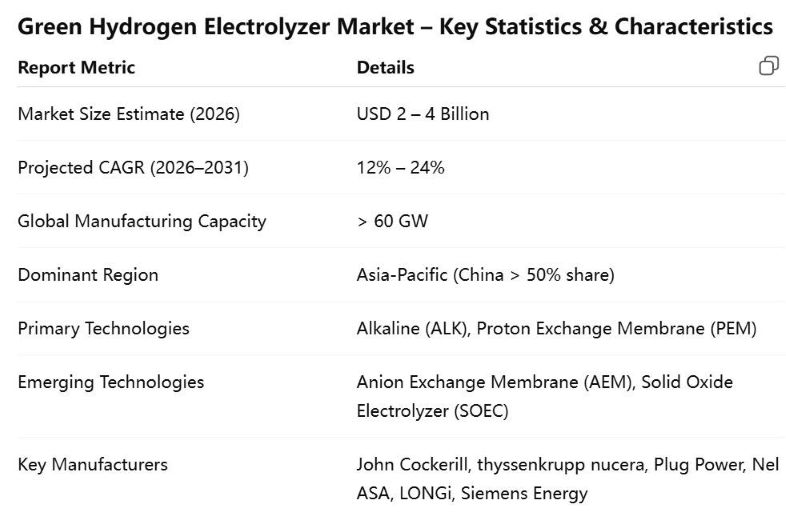
The following table summarizes the key market statistics and characteristics identified in the report:
HDIN Research notes that while policy support is accelerating, the industry faces challenges related to infrastructure limitations and the high cost of green hydrogen relative to fossil-fuel-derived alternatives. However, technological advancements in stack efficiency and manufacturing automation are expected to drive down costs, facilitating broader commercial adoption over the next decade.
For more information regarding this report, please visit our website or contact our sales team.
About HDIN Research
HDIN Research focuses on providing market consulting services. As an independent third-party consulting firm, it is committed to providing in-depth market research and analysis reports.
Contact:
HDIN Research
Website: www.hdinresearch.com
Email: sales@hdinresearch.com
According to the latest data from HDIN Research, the global green hydrogen electrolyzer market valuation is estimated to range between USD 2 billion and USD 4 billion in 2026. The market is projected to expand at a compound annual growth rate (CAGR) of 12% to 24% during the forecast period of 2026 to 2031. This rapid growth is driven by national hydrogen strategies established by over 60 countries and the increasing economic competitiveness of renewable energy sources.
The report highlights a significant capacity-demand imbalance in the current market. Global manufacturing capacity has exceeded 60 GW, while annual installed volume remains below 6 GW. This overcapacity reflects aggressive expansion by manufacturers anticipating future demand surges fueled by policy mandates in the European Union, the United States, and China.
Geographically, the Asia-Pacific region dominates both production and consumption, with China alone accounting for over 50% of global activity. This is supported by vertically integrated supply chains and strong government industrial policy. Europe ranks as the second-largest consumption region, driven by the REPowerEU plan and ambitious import targets, followed by North America, where the Inflation Reduction Act is creating investment momentum.
In terms of technology, Alkaline (ALK) and Proton Exchange Membrane (PEM) electrolyzers continue to dominate the market. Alkaline systems currently represent the most cost-effective and mature solution, making them suitable for large-scale industrial baseload projects. PEM systems, while capital-intensive, offer superior dynamic response, making them ideal for integration with variable renewable energy sources. Emerging technologies such as Anion Exchange Membrane (AEM) and Solid Oxide Electrolysis Cells (SOEC) remain in the demonstration phase but offer promise for future efficiency gains.
The following table summarizes the key market statistics and characteristics identified in the report:
HDIN Research notes that while policy support is accelerating, the industry faces challenges related to infrastructure limitations and the high cost of green hydrogen relative to fossil-fuel-derived alternatives. However, technological advancements in stack efficiency and manufacturing automation are expected to drive down costs, facilitating broader commercial adoption over the next decade.
For more information regarding this report, please visit our website or contact our sales team.
About HDIN Research
HDIN Research focuses on providing market consulting services. As an independent third-party consulting firm, it is committed to providing in-depth market research and analysis reports.
Contact:
HDIN Research
Website: www.hdinresearch.com
Email: sales@hdinresearch.com