Battery Energy Storage System (BESS) Market Projected to Reach 65 Billion USD in 2026 Driven by Grid Modernization and AI Demands
Date : 2026-02-04
Reading : 685
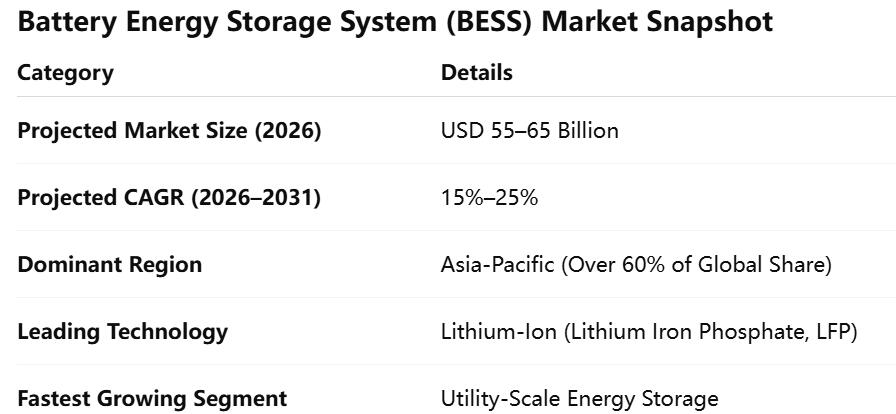
According to the latest strategic analysis report released by HDIN Research, the global Battery Energy Storage System (BESS) market is entering a phase of rapid expansion and transformation. The report projects that by 2026, the global market value will reach between 55 and 65 billion USD. This surge is underpinned by the accelerating global energy transition, critical requirements for power grid flexibility, and emerging power demands from artificial intelligence data centers.
The market has witnessed transformative growth over the past year, exceeding 40 billion USD in 2025 with deployment volumes approaching 300 GWh. HDIN Research forecasts that the industry will maintain a robust compound annual growth rate (CAGR) of 15-25% through 2031. This trajectory is supported by declining lithium-ion battery costs, which have benefited from scale-up in the electric vehicle industry, and supportive policy frameworks across major economies.
Figure Market Data Summary of BESS
Regional Dynamics and China's Dominance
The Asia-Pacific region continues to command the dominant position in the global BESS landscape, accounting for over 60% of worldwide installations in 2025. China leads this expansion, driven by aggressive government targets for 180 GW of new-type energy storage capacity by 2027. The report notes that nine of the top ten global BESS integrators are now Chinese companies, including industry leaders like Sungrow, BYD, and CRRC Zhuzhou. This concentration highlights China's manufacturing dominance and complete supply chain capabilities.
North America remains the second-largest market, fueled by the Inflation Reduction Act and state-level mandates in the United States. Europe faces a more fragmented landscape but continues to grow due to energy security needs and renewable integration targets, despite some policy headwinds in specific nations.
Technology Evolution and New Demand Vectors
Technologically, Lithium-Ion batteries, particularly Lithium Iron Phosphate (LFP) chemistries, retain undisputed market leadership due to safety profiles and established supply chains. However, the report highlights the emergence of Vanadium Flow Batteries for long-duration storage applications, led by players like Shandong Electrical Engineering & Equipment Group.
A significant new driver identified by HDIN Research is the proliferation of generative AI. The massive power consumption and reliability requirements of AI data centers are creating urgent demand for BESS solutions to ensure power quality and backup capacity. This trend was underscored in late 2025 by Ford Motor Company's strategic pivot to invest 2 billion USD in BESS, targeting data center and grid infrastructure markets.
Industry Challenges
Despite the positive outlook, the market faces consolidation pressures. The bankruptcy filing of major integrator Powin in mid-2025 and the exit of NGK Insulators from the sodium-sulfur battery market illustrate the intense competitive environment and the risks associated with alternative technologies that lack commercial scale. HDIN Research advises stakeholders to closely monitor policy shifts and supply chain dependencies as the market matures.
For more detailed insights, the full report "Battery Energy Storage System (BESS) Market Insights 2026" is available upon request.
About HDIN Research
HDIN Research focuses on providing market consulting services. As an independent third-party consulting firm, it is committed to providing in-depth market research and analysis reports.
Website: www.hdinresearch.com
Contact: sales@hdinresearch.com
The market has witnessed transformative growth over the past year, exceeding 40 billion USD in 2025 with deployment volumes approaching 300 GWh. HDIN Research forecasts that the industry will maintain a robust compound annual growth rate (CAGR) of 15-25% through 2031. This trajectory is supported by declining lithium-ion battery costs, which have benefited from scale-up in the electric vehicle industry, and supportive policy frameworks across major economies.
Figure Market Data Summary of BESS
Regional Dynamics and China's Dominance
The Asia-Pacific region continues to command the dominant position in the global BESS landscape, accounting for over 60% of worldwide installations in 2025. China leads this expansion, driven by aggressive government targets for 180 GW of new-type energy storage capacity by 2027. The report notes that nine of the top ten global BESS integrators are now Chinese companies, including industry leaders like Sungrow, BYD, and CRRC Zhuzhou. This concentration highlights China's manufacturing dominance and complete supply chain capabilities.
North America remains the second-largest market, fueled by the Inflation Reduction Act and state-level mandates in the United States. Europe faces a more fragmented landscape but continues to grow due to energy security needs and renewable integration targets, despite some policy headwinds in specific nations.
Technology Evolution and New Demand Vectors
Technologically, Lithium-Ion batteries, particularly Lithium Iron Phosphate (LFP) chemistries, retain undisputed market leadership due to safety profiles and established supply chains. However, the report highlights the emergence of Vanadium Flow Batteries for long-duration storage applications, led by players like Shandong Electrical Engineering & Equipment Group.
A significant new driver identified by HDIN Research is the proliferation of generative AI. The massive power consumption and reliability requirements of AI data centers are creating urgent demand for BESS solutions to ensure power quality and backup capacity. This trend was underscored in late 2025 by Ford Motor Company's strategic pivot to invest 2 billion USD in BESS, targeting data center and grid infrastructure markets.
Industry Challenges
Despite the positive outlook, the market faces consolidation pressures. The bankruptcy filing of major integrator Powin in mid-2025 and the exit of NGK Insulators from the sodium-sulfur battery market illustrate the intense competitive environment and the risks associated with alternative technologies that lack commercial scale. HDIN Research advises stakeholders to closely monitor policy shifts and supply chain dependencies as the market matures.
For more detailed insights, the full report "Battery Energy Storage System (BESS) Market Insights 2026" is available upon request.
About HDIN Research
HDIN Research focuses on providing market consulting services. As an independent third-party consulting firm, it is committed to providing in-depth market research and analysis reports.
Website: www.hdinresearch.com
Contact: sales@hdinresearch.com