Adaptive Driving Beam (ADB) Module Market Size to Surge Past 430 Million USD in 2026 Driven by Safety Regulations and EV Adoption
Date : 2026-02-04
Reading : 432
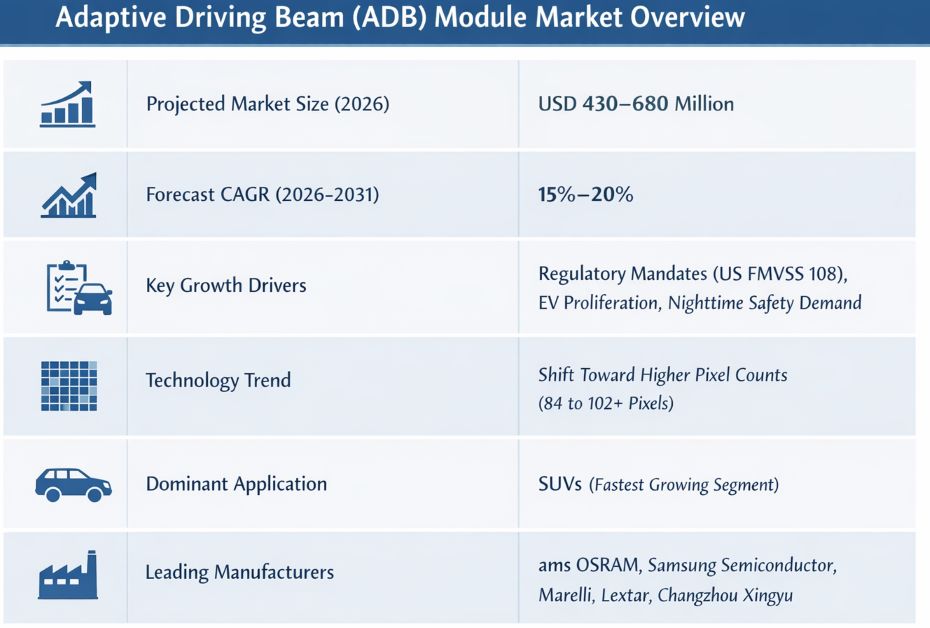
HDIN Research has released its latest strategic analysis titled "Adaptive Driving Beam Module Global Market Insights 2026," projecting a significant expansion in the advanced automotive lighting sector. The report estimates that the global market for Adaptive Driving Beam (ADB) modules will reach a valuation between 430 and 680 million USD in 2026. This growth trajectory is expected to continue with a robust Compound Annual Growth Rate (CAGR) of 15-20% through 2031, fueled by stringent safety regulations, the proliferation of electric vehicles (EVs), and advancements in Matrix LED technology.
ADB systems, which utilize cameras and sensors to dynamically adjust headlight patterns and prevent glare for other road users while maintaining high visibility, are rapidly transitioning from niche luxury features to standard safety equipment. The market growth is heavily influenced by the enforcement of standards such as the UN ECE R149 in Europe and the recent adoption of FMVSS 108 standards in the United States, which effectively cleared the regulatory path for ADB deployment in North America as of February 2024.
Figure Market Data Summary of Adaptive Driving Beam (ADB) modules
Technological Evolution and Application
The industry is witnessing a technological shift toward higher resolution systems. While entry-level modules utilize 24 or 48 pixels, the premium segment is moving rapidly toward 84 and 102+ pixel configurations. These high-definition systems allow for precise light distribution control, enabling features such as lane projection and communication with pedestrians. The report highlights recent innovations, such as the ams OSRAM OSLON Compact RM, which supports advanced ADB LED matrix systems with high luminance, and the strategic partnership between Valeo and Appotronics to integrate laser video projection into front lighting systems.
In terms of application, SUVs represent the fastest-growing segment due to their rising global popularity and the specific need for precise beam control given their elevated headlamp mounting positions. Electric vehicles also serve as a primary catalyst, with manufacturers utilizing advanced lighting designs as a key differentiator in brand identity and energy efficiency.
Regional Landscape
Asia-Pacific remains a manufacturing stronghold, supported by China's massive vehicle production output and a robust supply chain of LED components and electronics. Japan and South Korea continue to lead in technical innovation. North America is experiencing accelerated growth following the regulatory approval of ADB systems, with major OEMs and EV startups integrating the technology to enhance safety ratings. Europe maintains its position as a mature market with high penetration rates in the premium sedan and SUV categories, driven by a long history of adaptive lighting adoption.
Industry Challenges
Despite the positive outlook, the market faces hurdles regarding cost and complexity. The high initial cost of ADB modules, estimated between 500 and 2000 USD per vehicle depending on resolution, currently limits mass-market adoption in entry-level segments. Additionally, the technical complexity of integrating optical engineering with real-time sensor fusion requires significant R&D investment. However, as manufacturing scales and semiconductor costs stabilize, these barriers are expected to diminish over the forecast period.
About HDIN Research
HDIN Research focuses on providing market consulting services. As an independent third-party consulting firm, it is committed to providing in-depth market research and analysis reports.
Contact: sales@hdinresearch.com
Website: www.hdinresearch.com
ADB systems, which utilize cameras and sensors to dynamically adjust headlight patterns and prevent glare for other road users while maintaining high visibility, are rapidly transitioning from niche luxury features to standard safety equipment. The market growth is heavily influenced by the enforcement of standards such as the UN ECE R149 in Europe and the recent adoption of FMVSS 108 standards in the United States, which effectively cleared the regulatory path for ADB deployment in North America as of February 2024.
Figure Market Data Summary of Adaptive Driving Beam (ADB) modules
Technological Evolution and Application
The industry is witnessing a technological shift toward higher resolution systems. While entry-level modules utilize 24 or 48 pixels, the premium segment is moving rapidly toward 84 and 102+ pixel configurations. These high-definition systems allow for precise light distribution control, enabling features such as lane projection and communication with pedestrians. The report highlights recent innovations, such as the ams OSRAM OSLON Compact RM, which supports advanced ADB LED matrix systems with high luminance, and the strategic partnership between Valeo and Appotronics to integrate laser video projection into front lighting systems.
In terms of application, SUVs represent the fastest-growing segment due to their rising global popularity and the specific need for precise beam control given their elevated headlamp mounting positions. Electric vehicles also serve as a primary catalyst, with manufacturers utilizing advanced lighting designs as a key differentiator in brand identity and energy efficiency.
Regional Landscape
Asia-Pacific remains a manufacturing stronghold, supported by China's massive vehicle production output and a robust supply chain of LED components and electronics. Japan and South Korea continue to lead in technical innovation. North America is experiencing accelerated growth following the regulatory approval of ADB systems, with major OEMs and EV startups integrating the technology to enhance safety ratings. Europe maintains its position as a mature market with high penetration rates in the premium sedan and SUV categories, driven by a long history of adaptive lighting adoption.
Industry Challenges
Despite the positive outlook, the market faces hurdles regarding cost and complexity. The high initial cost of ADB modules, estimated between 500 and 2000 USD per vehicle depending on resolution, currently limits mass-market adoption in entry-level segments. Additionally, the technical complexity of integrating optical engineering with real-time sensor fusion requires significant R&D investment. However, as manufacturing scales and semiconductor costs stabilize, these barriers are expected to diminish over the forecast period.
About HDIN Research
HDIN Research focuses on providing market consulting services. As an independent third-party consulting firm, it is committed to providing in-depth market research and analysis reports.
Contact: sales@hdinresearch.com
Website: www.hdinresearch.com