Sportswear Market Projected to Reach USD 560 Billion by 2031, Driven by Athleisure and Asian Market Expansion
Date : 2026-02-10
Reading : 251
HDIN Research, an independent market consulting firm, has released its latest in-depth analysis titled "Sportswear Global Market Insights 2026." The report provides a comprehensive evaluation of the industry's recovery following global economic shifts and outlines a steady growth trajectory for the forecast period of 2027 to 2031. According to the findings, the global sportswear market is entering a phase of measured expansion, characterized by a baseline market size of 400-430 billion USD in 2026.
The study highlights that the industry has demonstrated significant resilience. Following the disruptions of previous years, the market reached 386.8 billion USD in 2024, achieving a year-over-year growth of 3.1 percent. HDIN Research projects a Compound Annual Growth Rate (CAGR) of 3 to 5 percent through 2031, potentially driving the market valuation to between 475 and 560 billion USD. This growth is underpinned by geographic diversity, channel innovation, and the evolving consumer preference for "athleisure"—the convergence of athletic performance wear and everyday fashion.
Regional Dynamics and Growth Engines
The report identifies distinct regional characteristics that are shaping the global landscape. North America currently commands the largest market share, valued at 165.3 billion USD in 2024. This mature market is driven by high per-capita consumption and a strong preference for premium, technology-integrated products. The United States accounts for approximately 85 percent of North American sales.
However, the most dynamic growth is observed in the Asia-Pacific region. Valued at 104.5 billion USD in 2024, this region is projected to experience a CAGR of 4 to 7 percent through 2031, outpacing the global average. The expansion is fueled by rising disposable incomes, urbanization, and government initiatives promoting sports participation in China, India, and Southeast Asian nations. China serves as a critical strategic priority for international brands, while domestic powerhouses like Anta and Li-Ning continue to gain market share.
Product Segmentation and Innovation
The sportswear market is categorized into three primary segments: apparel, footwear, and accessories. Apparel maintains the dominant position, accounting for 55 to 60 percent of the total market. This segment is heavily influenced by the athleisure trend, where consumers integrate performance wear into daily wardrobes.
Footwear, representing 40 to 45 percent of the market, is projected to see marginally higher growth rates than apparel over the forecast period. This is attributed to continuous innovation in cushioning technologies, carbon fiber plates, and sustainable materials. The report notes that footwear growth is further supported by the "casualization" of workplace attire and the sneaker culture phenomenon.
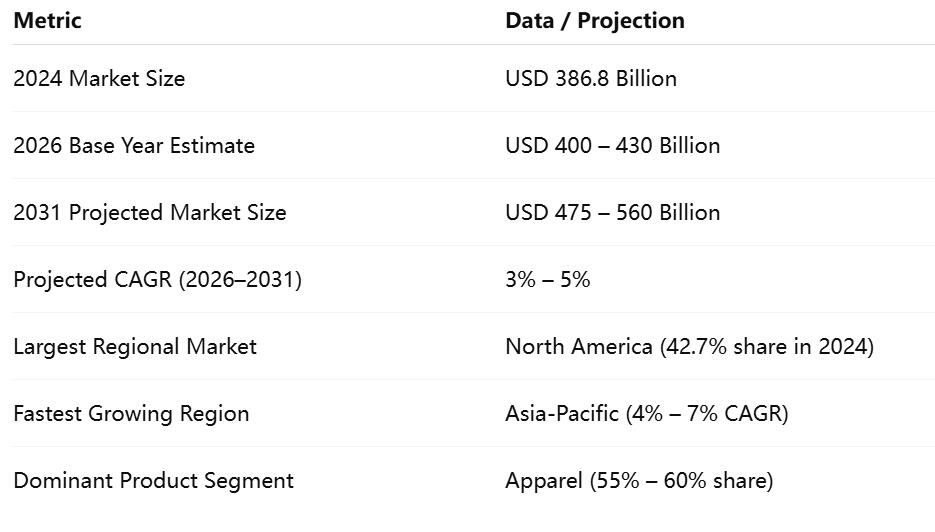
The following table summarizes the key market data and projections from the HDIN Research report:
Strategic Trends and Competitive Landscape
HDIN Research emphasizes that sustainability has transitioned from a niche marketing tactic to a fundamental operational requirement. Brands are increasingly investing in circular economy models, recycled materials, and supply chain transparency to meet consumer demands and regulatory pressures in Western Europe and North America.
The competitive landscape remains tiered but dynamic. Global leaders such as Nike and Adidas retain significant market share through scale and innovation. However, the report highlights the rise of challenger brands and regional specialists. Companies like Lululemon have successfully capitalized on community-driven marketing and the premium yoga segment, while Hoka and On have disrupted the traditional running footwear market through specialized product design.
Furthermore, the industry is witnessing a structural shift in distribution. Brands are aggressively pursuing Direct-to-Consumer (DTC) strategies to capture retail margins and own customer data, although wholesale partnerships remain vital for scale. The integration of digital technology, including wearable integration and data-driven manufacturing, presents new opportunities for value creation through 2031.
About HDIN Research
HDIN Research focuses on providing market consulting services. As an independent third-party consulting firm, it is committed to providing in-depth market research and analysis reports. HDIN Research assists companies in understanding market mechanisms and making informed strategic decisions.
Media Contact:
Website: www.hdinresearch.com
Email: sales@hdinresearch.com
The study highlights that the industry has demonstrated significant resilience. Following the disruptions of previous years, the market reached 386.8 billion USD in 2024, achieving a year-over-year growth of 3.1 percent. HDIN Research projects a Compound Annual Growth Rate (CAGR) of 3 to 5 percent through 2031, potentially driving the market valuation to between 475 and 560 billion USD. This growth is underpinned by geographic diversity, channel innovation, and the evolving consumer preference for "athleisure"—the convergence of athletic performance wear and everyday fashion.
Regional Dynamics and Growth Engines
The report identifies distinct regional characteristics that are shaping the global landscape. North America currently commands the largest market share, valued at 165.3 billion USD in 2024. This mature market is driven by high per-capita consumption and a strong preference for premium, technology-integrated products. The United States accounts for approximately 85 percent of North American sales.
However, the most dynamic growth is observed in the Asia-Pacific region. Valued at 104.5 billion USD in 2024, this region is projected to experience a CAGR of 4 to 7 percent through 2031, outpacing the global average. The expansion is fueled by rising disposable incomes, urbanization, and government initiatives promoting sports participation in China, India, and Southeast Asian nations. China serves as a critical strategic priority for international brands, while domestic powerhouses like Anta and Li-Ning continue to gain market share.
Product Segmentation and Innovation
The sportswear market is categorized into three primary segments: apparel, footwear, and accessories. Apparel maintains the dominant position, accounting for 55 to 60 percent of the total market. This segment is heavily influenced by the athleisure trend, where consumers integrate performance wear into daily wardrobes.
Footwear, representing 40 to 45 percent of the market, is projected to see marginally higher growth rates than apparel over the forecast period. This is attributed to continuous innovation in cushioning technologies, carbon fiber plates, and sustainable materials. The report notes that footwear growth is further supported by the "casualization" of workplace attire and the sneaker culture phenomenon.
The following table summarizes the key market data and projections from the HDIN Research report:
Strategic Trends and Competitive Landscape
HDIN Research emphasizes that sustainability has transitioned from a niche marketing tactic to a fundamental operational requirement. Brands are increasingly investing in circular economy models, recycled materials, and supply chain transparency to meet consumer demands and regulatory pressures in Western Europe and North America.
The competitive landscape remains tiered but dynamic. Global leaders such as Nike and Adidas retain significant market share through scale and innovation. However, the report highlights the rise of challenger brands and regional specialists. Companies like Lululemon have successfully capitalized on community-driven marketing and the premium yoga segment, while Hoka and On have disrupted the traditional running footwear market through specialized product design.
Furthermore, the industry is witnessing a structural shift in distribution. Brands are aggressively pursuing Direct-to-Consumer (DTC) strategies to capture retail margins and own customer data, although wholesale partnerships remain vital for scale. The integration of digital technology, including wearable integration and data-driven manufacturing, presents new opportunities for value creation through 2031.
About HDIN Research
HDIN Research focuses on providing market consulting services. As an independent third-party consulting firm, it is committed to providing in-depth market research and analysis reports. HDIN Research assists companies in understanding market mechanisms and making informed strategic decisions.
Media Contact:
Website: www.hdinresearch.com
Email: sales@hdinresearch.com