Superabsorbent Polymer (SAP) Market Insights 2026 - Acrylic Acid Industry Value Chain Series Report (6)
Date : 2026-01-22
Reading : 555
HDIN Research has announced the release of its latest in-depth industry analysis, "Superabsorbent Polymer Market Insights 2026." The report provides a comprehensive evaluation of the global Superabsorbent Polymer (SAP) sector, detailing the supply chain dynamics, capacity challenges, and consumption trends reshaping the hygiene industry.
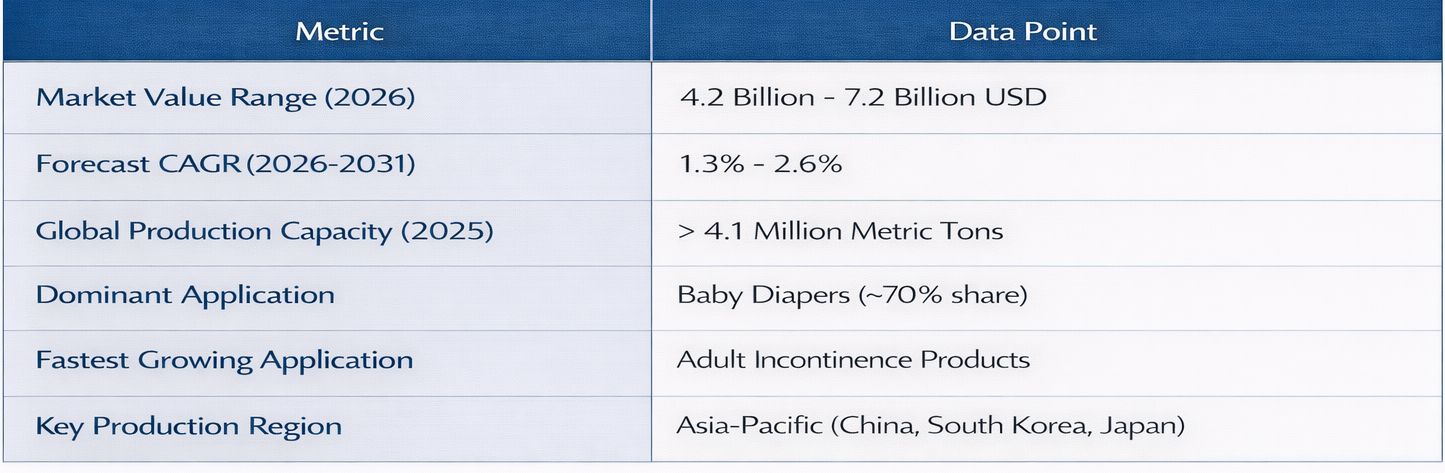
According to the study, the global SAP market is exhibiting characteristics of a mature specialty chemicals sector. As of 2026, the market is valued between 4.2 billion and 7.2 billion USD. The industry is projected to expand at a Compound Annual Growth Rate (CAGR) of 1.3% to 2.6% through 2031. While the market faces structural challenges from declining birth rates in developed economies, significant growth opportunities remain in the adult incontinence segment and developing regions with rising hygiene standards.
Market Drivers and Demographic Transitions
Superabsorbent polymers (CAS No. 9003-04-7) are essential materials in the production of disposable hygiene products due to their ability to absorb hundreds of times their weight in fluids. Historically, the baby diaper segment has dominated consumption, currently accounting for approximately 70% of the market. However, the report highlights a critical pivot in demand drivers.
Declining fertility rates in major markets, including China, Western Europe, and North America, have dampened the growth trajectory for baby diapers. Conversely, global population aging is accelerating the demand for adult incontinence products. This segment is experiencing robust growth, particularly in Japan, Europe, and China, where the proportion of the population aged 65 and above is increasing. HDIN Research notes that the adult incontinence category is vital for offsetting volume pressures in the infant care sector.
Geographically, the Asia-Pacific region remains the epicenter of the industry, serving as both the largest production base and consumption market. While China holds the largest production capacity, future consumption growth is increasingly shifting toward Southeast Asia, South Asia, and the Middle East and Africa. These regions benefit from a "demographic dividend," characterized by higher birth rates and improving economic conditions that support market penetration for hygiene products.
Production Capacity and Industry Consolidation
The report identifies structural overcapacity as a defining feature of the current market landscape. Global production capacity surpassed 4.1 million metric tons in 2025, substantially exceeding current demand levels. This imbalance has intensified competitive pressures and triggered industry consolidation, as major producers seek to optimize asset utilization and divest underperforming facilities.
The competitive landscape is led by major Tier 1 producers such as Nippon Shokubai, BASF, Stockhausen (Evonik), Sumitomo Seika, and LG Chem, each possessing production capacities exceeding 500,000 metric tons. The report also tracks the activities of growing Chinese producers like Satellite Chemical and Yixing Danson Technology, which have expanded rapidly to serve domestic needs.
Figure Market Data Summary of SAP
Value Chain and Future Outlook
The SAP value chain is heavily influenced by upstream petrochemical dynamics, specifically the availability and pricing of acrylic acid feedstocks. The report emphasizes that integrated producers with captive raw material supplies are better positioned to manage cost volatility.
Looking toward 2031, HDIN Research forecasts that the industry will continue to evolve through specialized product innovation. Manufacturers are increasingly focusing on premium SAP grades that allow for thinner, more efficient hygiene products. Additionally, niche applications in agriculture (water retention) and construction (moisture management) offer diversification opportunities beyond the core personal care market.
About HDIN Research
HDIN Research focuses on providing market consulting services. As an independent third-party consulting firm, it is committed to providing in-depth market research and analysis reports. The firm assists clients in navigating complex industrial environments by offering granular data on capacity, production, and competitive landscapes.
Media Contact:
Company Name: HDIN Research
Contact Person: Sales Department
Email: sales@hdinresearch.com
Website: www.hdinresearch.com
According to the study, the global SAP market is exhibiting characteristics of a mature specialty chemicals sector. As of 2026, the market is valued between 4.2 billion and 7.2 billion USD. The industry is projected to expand at a Compound Annual Growth Rate (CAGR) of 1.3% to 2.6% through 2031. While the market faces structural challenges from declining birth rates in developed economies, significant growth opportunities remain in the adult incontinence segment and developing regions with rising hygiene standards.
Market Drivers and Demographic Transitions
Superabsorbent polymers (CAS No. 9003-04-7) are essential materials in the production of disposable hygiene products due to their ability to absorb hundreds of times their weight in fluids. Historically, the baby diaper segment has dominated consumption, currently accounting for approximately 70% of the market. However, the report highlights a critical pivot in demand drivers.
Declining fertility rates in major markets, including China, Western Europe, and North America, have dampened the growth trajectory for baby diapers. Conversely, global population aging is accelerating the demand for adult incontinence products. This segment is experiencing robust growth, particularly in Japan, Europe, and China, where the proportion of the population aged 65 and above is increasing. HDIN Research notes that the adult incontinence category is vital for offsetting volume pressures in the infant care sector.
Geographically, the Asia-Pacific region remains the epicenter of the industry, serving as both the largest production base and consumption market. While China holds the largest production capacity, future consumption growth is increasingly shifting toward Southeast Asia, South Asia, and the Middle East and Africa. These regions benefit from a "demographic dividend," characterized by higher birth rates and improving economic conditions that support market penetration for hygiene products.
Production Capacity and Industry Consolidation
The report identifies structural overcapacity as a defining feature of the current market landscape. Global production capacity surpassed 4.1 million metric tons in 2025, substantially exceeding current demand levels. This imbalance has intensified competitive pressures and triggered industry consolidation, as major producers seek to optimize asset utilization and divest underperforming facilities.
The competitive landscape is led by major Tier 1 producers such as Nippon Shokubai, BASF, Stockhausen (Evonik), Sumitomo Seika, and LG Chem, each possessing production capacities exceeding 500,000 metric tons. The report also tracks the activities of growing Chinese producers like Satellite Chemical and Yixing Danson Technology, which have expanded rapidly to serve domestic needs.
Figure Market Data Summary of SAP
Value Chain and Future Outlook
The SAP value chain is heavily influenced by upstream petrochemical dynamics, specifically the availability and pricing of acrylic acid feedstocks. The report emphasizes that integrated producers with captive raw material supplies are better positioned to manage cost volatility.
Looking toward 2031, HDIN Research forecasts that the industry will continue to evolve through specialized product innovation. Manufacturers are increasingly focusing on premium SAP grades that allow for thinner, more efficient hygiene products. Additionally, niche applications in agriculture (water retention) and construction (moisture management) offer diversification opportunities beyond the core personal care market.
About HDIN Research
HDIN Research focuses on providing market consulting services. As an independent third-party consulting firm, it is committed to providing in-depth market research and analysis reports. The firm assists clients in navigating complex industrial environments by offering granular data on capacity, production, and competitive landscapes.
Media Contact:
Company Name: HDIN Research
Contact Person: Sales Department
Email: sales@hdinresearch.com
Website: www.hdinresearch.com