MEMS Microbolometer Market Insights 2026: Automotive and Industrial Applications Drive Industry Growth
Date : 2026-02-11
Reading : 122
HDIN Research has announced the release of its latest comprehensive industry report, "MEMS Microbolometer Global Market Insights 2026." The report provides a detailed analysis of the uncooled infrared sensor industry, covering technological advancements, regional trends, and the competitive landscape for the forecast period of 2026 to 2031.
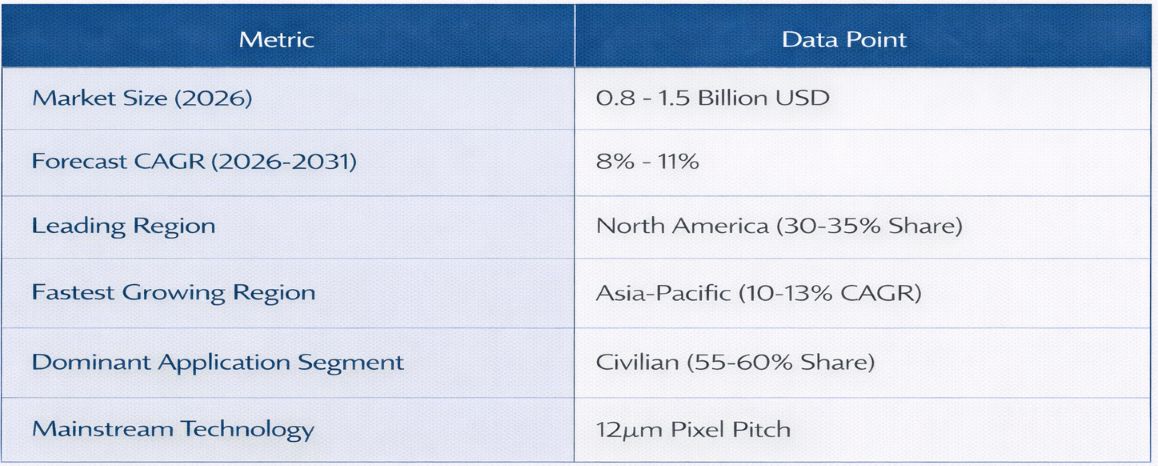
According to the study, the global MEMS microbolometer market has reached an estimated valuation of 0.8 to 1.5 billion USD in 2026. The market is projected to expand at a compound annual growth rate (CAGR) of 8% to 11% through 2031. This growth trajectory is primarily fueled by the expanding adoption of thermal imaging technologies in civilian sectors, particularly in automotive Advanced Driver Assistance Systems (ADAS), industrial process monitoring, and consumer electronics.
Market Drivers and Technological Trends
The report highlights a significant shift in application dominance. While military applications historically led the market and still account for approximately 40-45% of demand, civilian applications have captured 55-60% of the market share and are exhibiting higher growth rates. The automotive sector is identified as a key transformation driver, with thermal sensors increasingly integrated into vehicles for pedestrian detection and adverse-weather driving assistance.
Technologically, the industry is witnessing a transition in pixel pitch standards. While 17-micron pixel technology remains mature and widely used, 12-micron technology has emerged as the mainstream standard, offering an optimal balance between resolution and cost. The report also notes the advancement of 10-micron and smaller pixel sizes, enabling ultra-high-resolution thermal imaging for premium applications.
Regional Analysis
Geographically, North America currently maintains the leading position, holding approximately 30-35% of the global market share, driven by strong defense spending and early adoption of advanced automotive safety systems. However, the Asia-Pacific region is projected to register the fastest growth, with a CAGR of 10-13% through 2031. This expansion is supported by growing manufacturing capabilities in China, increasing defense budgets, and the rising adoption of smart home technologies across the region.
Competitive Landscape
The global market features a mix of established Western manufacturers and emerging Asian players. Key market participants identified in the report include Lynred, Raytheon, Teledyne FLIR, L3Harris, and rapidly growing Chinese manufacturers such as Raytron Technology and Hikmicro. The industry is characterized by strategic consolidation and vertical integration, as companies seek to control the value chain from detector fabrication to complete camera module production.
Figure Market Data Summary of MEMS Microbolometer
About HDIN Research
HDIN Research focuses on providing market consulting services. As an independent third-party consulting firm, it is committed to providing in-depth market research and analysis reports. HDIN Research helps clients navigate complex market environments by delivering accurate data and actionable insights.
Media Contact:
Company Name: HDIN Research
Contact Person: Sales Department
Email: sales@hdinresearch.com
Website: www.hdinresearch.com
According to the study, the global MEMS microbolometer market has reached an estimated valuation of 0.8 to 1.5 billion USD in 2026. The market is projected to expand at a compound annual growth rate (CAGR) of 8% to 11% through 2031. This growth trajectory is primarily fueled by the expanding adoption of thermal imaging technologies in civilian sectors, particularly in automotive Advanced Driver Assistance Systems (ADAS), industrial process monitoring, and consumer electronics.
Market Drivers and Technological Trends
The report highlights a significant shift in application dominance. While military applications historically led the market and still account for approximately 40-45% of demand, civilian applications have captured 55-60% of the market share and are exhibiting higher growth rates. The automotive sector is identified as a key transformation driver, with thermal sensors increasingly integrated into vehicles for pedestrian detection and adverse-weather driving assistance.
Technologically, the industry is witnessing a transition in pixel pitch standards. While 17-micron pixel technology remains mature and widely used, 12-micron technology has emerged as the mainstream standard, offering an optimal balance between resolution and cost. The report also notes the advancement of 10-micron and smaller pixel sizes, enabling ultra-high-resolution thermal imaging for premium applications.
Regional Analysis
Geographically, North America currently maintains the leading position, holding approximately 30-35% of the global market share, driven by strong defense spending and early adoption of advanced automotive safety systems. However, the Asia-Pacific region is projected to register the fastest growth, with a CAGR of 10-13% through 2031. This expansion is supported by growing manufacturing capabilities in China, increasing defense budgets, and the rising adoption of smart home technologies across the region.
Competitive Landscape
The global market features a mix of established Western manufacturers and emerging Asian players. Key market participants identified in the report include Lynred, Raytheon, Teledyne FLIR, L3Harris, and rapidly growing Chinese manufacturers such as Raytron Technology and Hikmicro. The industry is characterized by strategic consolidation and vertical integration, as companies seek to control the value chain from detector fabrication to complete camera module production.
Figure Market Data Summary of MEMS Microbolometer
About HDIN Research
HDIN Research focuses on providing market consulting services. As an independent third-party consulting firm, it is committed to providing in-depth market research and analysis reports. HDIN Research helps clients navigate complex market environments by delivering accurate data and actionable insights.
Media Contact:
Company Name: HDIN Research
Contact Person: Sales Department
Email: sales@hdinresearch.com
Website: www.hdinresearch.com