Sulfur Market Report 2020-2026: Supply Shortages and Price Trends in the New Energy Era
Date : 2026-01-28
Reading : 6081
HDIN Research, an independent market consulting firm, has officially released its in-depth analysis report titled "Global Sulfur Industry Chain Depth Survey 2020-2026." The report details a historic structural shift in the global sulfur market, highlighting its evolution from a petroleum refining by-product to a strategic mineral resource critical for energy transition and food security.
The study indicates that the period between 2020 and 2026 represents a core cycle of structural reshaping for the sulfur industry. This era is characterized by low supply elasticity, geopolitical trade shifts, and an explosion in demand from the new energy sector, particularly nickel smelting and battery manufacturing.
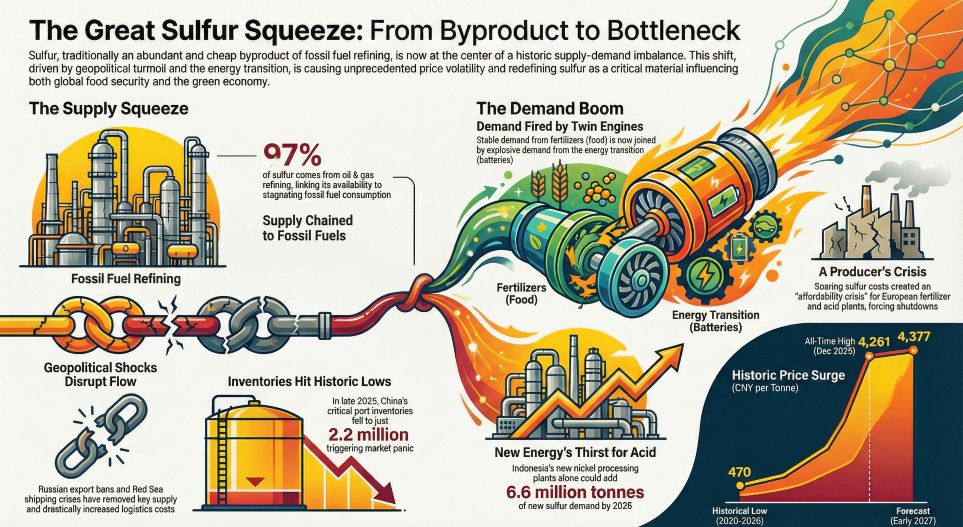
Figure The Great Sulfur Squeeze From Byproduct to Bottleneck
Supply Constraints in an Era of Energy Transition
The report emphasizes the extreme rigidity of sulfur supply. Over 90% of global elemental sulfur is recovered as a by-product of oil refining and natural gas extraction. Consequently, supply volumes are not determined by sulfur prices but are constrained by fossil fuel processing rates.
HDIN Research analysts point out a critical paradox: as the global energy transition suppresses traditional refinery utilization rates to reduce carbon emissions, the production of sulfur faces a "ceiling effect." This structural limit coincides with supply disruptions, such as Russian export restrictions and logistics challenges in the Red Sea, which have increased transit times and freight costs.
New Energy Sector Drives Demand Explosion
While the phosphate fertilizer industry remains the cornerstone of sulfur consumption, the report identifies the new energy sector as the primary driver for future growth. The industrialization of Indonesia's nickel resources is reshaping the demand map.
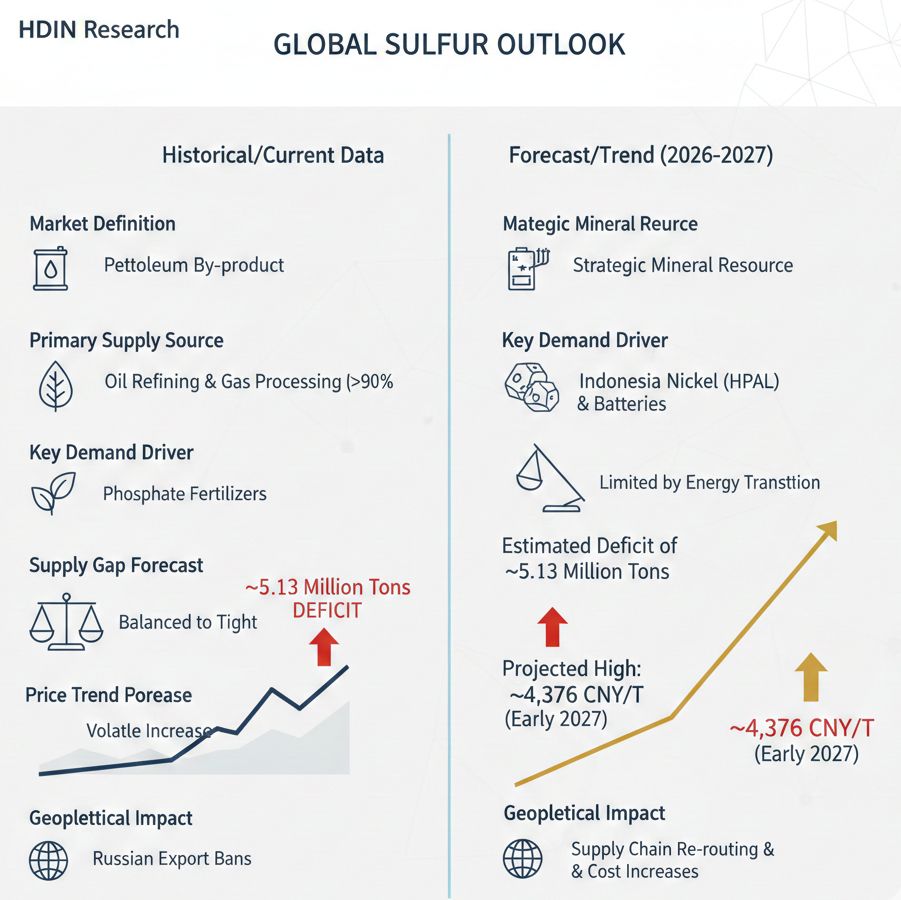
The rapid expansion of High Pressure Acid Leach (HPAL) projects in Indonesia, which require significant amounts of sulfuric acid to process nickel ore, is creating an exponential increase in consumption. The report estimates that by 2026, the global sulfur supply gap could reach approximately 5.13 million tons, largely driven by the battery materials sector, including Lithium Iron Phosphate (LFP) chains.
Market Outlook and Pricing Trends
The analysis suggests that the era of cheap sulfur is ending. Control over pricing has increasingly consolidated among major Middle Eastern National Oil Companies (NOCs), who are shifting strategies from waste disposal to profit optimization.
According to the report's forecast models, sulfur prices are expected to maintain high volatility and upward momentum through 2027. The systemic elevation in price centers is driven by the disconnect between shrinking fossil fuel-based supply and expanding industrial demand.
Figure Key Market Data Summary of Sulfur
Please click to watch the YouTube video of the report presentation.
About HDIN Research
HDIN Research focuses on providing market consulting services. As an independent third-party consulting firm, it is committed to providing in-depth market research and analysis reports. The firm assists clients in navigating complex industrial chains, offering data-driven insights to support strategic decision-making in volatile global markets.
Media Contact:
HDIN Research
Website: www.hdinresearch.com
Email: sales@hdinresearch.com
The study indicates that the period between 2020 and 2026 represents a core cycle of structural reshaping for the sulfur industry. This era is characterized by low supply elasticity, geopolitical trade shifts, and an explosion in demand from the new energy sector, particularly nickel smelting and battery manufacturing.
Figure The Great Sulfur Squeeze From Byproduct to Bottleneck
Supply Constraints in an Era of Energy Transition
The report emphasizes the extreme rigidity of sulfur supply. Over 90% of global elemental sulfur is recovered as a by-product of oil refining and natural gas extraction. Consequently, supply volumes are not determined by sulfur prices but are constrained by fossil fuel processing rates.
HDIN Research analysts point out a critical paradox: as the global energy transition suppresses traditional refinery utilization rates to reduce carbon emissions, the production of sulfur faces a "ceiling effect." This structural limit coincides with supply disruptions, such as Russian export restrictions and logistics challenges in the Red Sea, which have increased transit times and freight costs.
New Energy Sector Drives Demand Explosion
While the phosphate fertilizer industry remains the cornerstone of sulfur consumption, the report identifies the new energy sector as the primary driver for future growth. The industrialization of Indonesia's nickel resources is reshaping the demand map.
The rapid expansion of High Pressure Acid Leach (HPAL) projects in Indonesia, which require significant amounts of sulfuric acid to process nickel ore, is creating an exponential increase in consumption. The report estimates that by 2026, the global sulfur supply gap could reach approximately 5.13 million tons, largely driven by the battery materials sector, including Lithium Iron Phosphate (LFP) chains.
Market Outlook and Pricing Trends
The analysis suggests that the era of cheap sulfur is ending. Control over pricing has increasingly consolidated among major Middle Eastern National Oil Companies (NOCs), who are shifting strategies from waste disposal to profit optimization.
According to the report's forecast models, sulfur prices are expected to maintain high volatility and upward momentum through 2027. The systemic elevation in price centers is driven by the disconnect between shrinking fossil fuel-based supply and expanding industrial demand.
Figure Key Market Data Summary of Sulfur
Please click to watch the YouTube video of the report presentation.
About HDIN Research
HDIN Research focuses on providing market consulting services. As an independent third-party consulting firm, it is committed to providing in-depth market research and analysis reports. The firm assists clients in navigating complex industrial chains, offering data-driven insights to support strategic decision-making in volatile global markets.
Media Contact:
HDIN Research
Website: www.hdinresearch.com
Email: sales@hdinresearch.com