Bio-based Monoethylene Glycol Market Valued at 15-30 Million USD in 2026 as Sustainability Drives Demand in Textiles and Packaging
Date : 2026-02-19
Reading : 418
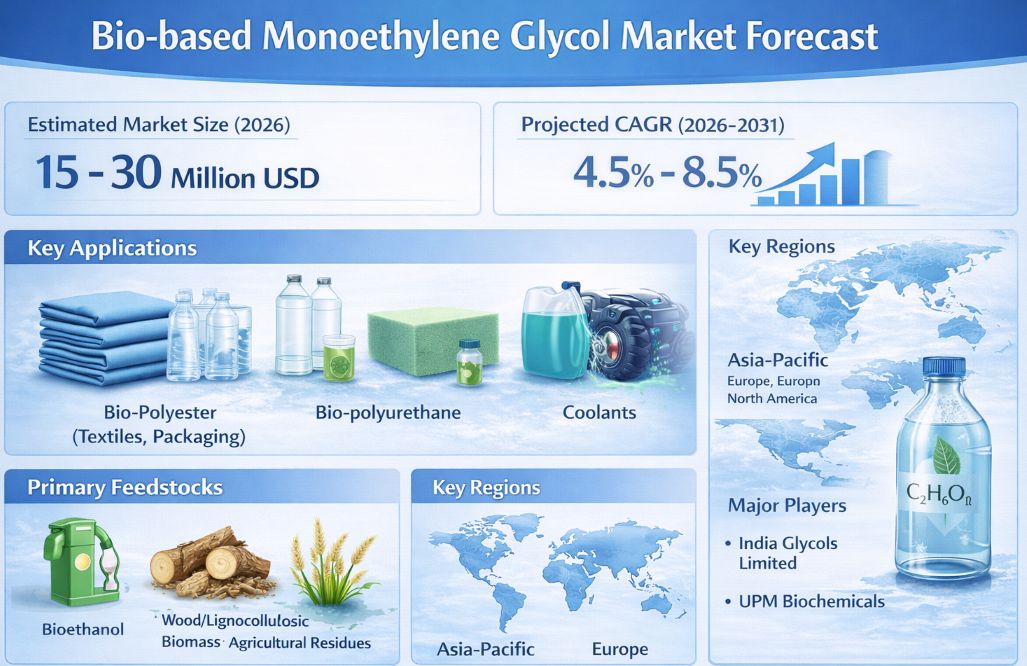
HDIN Research has announced the release of a new market research report titled Global Bio-based Monoethylene Glycol Market Insights 2026. The comprehensive study analyzes the current landscape of the sustainable chemicals industry, forecasting a market valuation between 15 million and 30 million USD for the current year. The sector is projected to expand at a compound annual growth rate (CAGR) of 4.5% to 8.5% through 2031.
The report highlights that Bio-based Monoethylene Glycol (Bio-MEG) is entering a critical phase of commercialization. Produced from renewable feedstocks such as bioethanol, agricultural residues, and industrial wood, Bio-MEG offers a molecularly equivalent alternative to fossil-based MEG, which is traditionally derived from petroleum. This "drop-in" capability allows downstream manufacturers to reduce their carbon footprint without altering existing production infrastructure.
Market Drivers and Trends
According to HDIN Research, the primary catalyst for market growth is the increasing commitment from global fashion and packaging brands to decarbonize their supply chains. The textile industry, which consumes the majority of global MEG supply for polyester production, is actively seeking renewable alternatives to meet consumer demand for sustainable apparel. Similarly, the packaging sector is exploring Bio-PET bottles to complement recycled content strategies.
However, the industry faces headwinds from the macroeconomic environment. Persistently low crude oil prices have kept conventional MEG prices depressed, widening the cost differential between bio-based and fossil-based alternatives. Furthermore, policy shifts in North America and Europe that prioritize mechanical recycling have created a competitive landscape where recycled PET competes with virgin bio-polyester for market share.
Regional Landscape and Key Players
The report identifies the Asia-Pacific region as the current leader in adoption, largely driven by India Glycols Limited. As the world's first commercial-scale producer, India Glycols utilizes bioethanol feedstocks to serve global textile markets.
Europe is poised for significant growth with the ramp-up of UPM Biochemicals' biorefinery in Leuna, Germany. This facility utilizes a novel wood-to-sugars technology and represents a major scale-up in regional capacity. Meanwhile, North American development is centered on future projects like the Sustainea joint venture, targeting commercialization later in the decade.
Application Segments
The market is segmented primarily into Bio-Polyester, Bio-polyurethane, and other applications such as coolants. Bio-Polyester dominates the market share due to its extensive use in textiles and PET packaging. Bio-polyurethane is emerging as a niche growth area for automotive and construction applications seeking lower embodied carbon materials.
Figure Market Data Summary of Bio-based Monoethylene Glycol
About HDIN Research
HDIN Research focuses on providing market consulting services. As an independent third-party consulting firm, it is committed to providing in-depth market research and analysis reports.
Media Contact
Company Name: HDIN Research
Website: www.hdinresearch.com
Email: sales@hdinresearch.com
The report highlights that Bio-based Monoethylene Glycol (Bio-MEG) is entering a critical phase of commercialization. Produced from renewable feedstocks such as bioethanol, agricultural residues, and industrial wood, Bio-MEG offers a molecularly equivalent alternative to fossil-based MEG, which is traditionally derived from petroleum. This "drop-in" capability allows downstream manufacturers to reduce their carbon footprint without altering existing production infrastructure.
Market Drivers and Trends
According to HDIN Research, the primary catalyst for market growth is the increasing commitment from global fashion and packaging brands to decarbonize their supply chains. The textile industry, which consumes the majority of global MEG supply for polyester production, is actively seeking renewable alternatives to meet consumer demand for sustainable apparel. Similarly, the packaging sector is exploring Bio-PET bottles to complement recycled content strategies.
However, the industry faces headwinds from the macroeconomic environment. Persistently low crude oil prices have kept conventional MEG prices depressed, widening the cost differential between bio-based and fossil-based alternatives. Furthermore, policy shifts in North America and Europe that prioritize mechanical recycling have created a competitive landscape where recycled PET competes with virgin bio-polyester for market share.
Regional Landscape and Key Players
The report identifies the Asia-Pacific region as the current leader in adoption, largely driven by India Glycols Limited. As the world's first commercial-scale producer, India Glycols utilizes bioethanol feedstocks to serve global textile markets.
Europe is poised for significant growth with the ramp-up of UPM Biochemicals' biorefinery in Leuna, Germany. This facility utilizes a novel wood-to-sugars technology and represents a major scale-up in regional capacity. Meanwhile, North American development is centered on future projects like the Sustainea joint venture, targeting commercialization later in the decade.
Application Segments
The market is segmented primarily into Bio-Polyester, Bio-polyurethane, and other applications such as coolants. Bio-Polyester dominates the market share due to its extensive use in textiles and PET packaging. Bio-polyurethane is emerging as a niche growth area for automotive and construction applications seeking lower embodied carbon materials.
Figure Market Data Summary of Bio-based Monoethylene Glycol
About HDIN Research
HDIN Research focuses on providing market consulting services. As an independent third-party consulting firm, it is committed to providing in-depth market research and analysis reports.
Media Contact
Company Name: HDIN Research
Website: www.hdinresearch.com
Email: sales@hdinresearch.com