Navigating the Deep Water Zone: Market Strategies for China's Electronic Gas Industry in the AI Era
Date : 2026-02-06
Reading : 1251
From the perspective of professional market analysts, the Chinese electronic gas (ESG) industry is currently facing a multidimensional challenge as it attempts to enter the advanced process supply chain (7nm, 5nm, and below). The transition is no longer just about supply availability; it has evolved into a complex contest involving extreme purity technologies, intellectual property barriers, and comprehensive service capabilities.
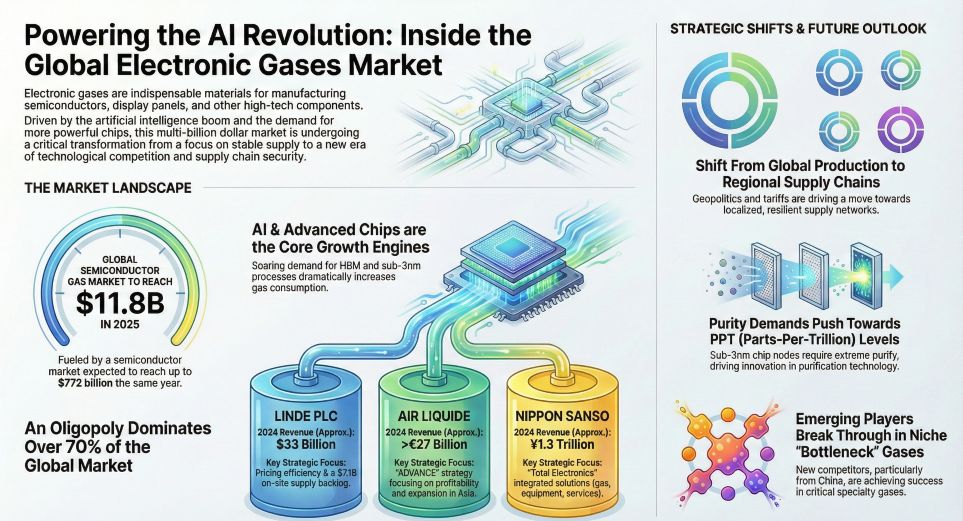
Figure Powering the Al Revolution inside the Global Electronic Gases Market
 The Pressure of the Paradigm Shift
As chip manufacturing evolves toward the 3nm and 2nm nodes, electronic gaseswhich constitute the second largest consumable in semiconductor manufacturingare reaching physical limits. The industry is witnessing a shift in impurity tolerance from the parts-per-billion (ppb) level to the parts-per-trillion (ppt) level. HDIN Research analysis indicates that for every order of magnitude improvement in purity, the complexity of purification, filling, and analysis increases geometrically. Currently, while international leaders have achieved 8N to 9N purity levels, much of the domestic technology remains at the 6N level, creating a technical generation gap that restricts application in ultra-large-scale integrated circuits.
Furthermore, the rise of AI computing power has triggered an explosion in demand for High Bandwidth Memory (HBM) and advanced logic chips. This has placed new demands on Atomic Layer Deposition (ALD) and Chemical Vapor Deposition (CVD) processes, requiring the rapid development of high-performance precursors and etching gases.
The Oligopoly and the TGCM Service Gap
The global market remains heavily concentrated. The four major giantsLinde, Air Liquide, Air Products, and Nippon Sanso Holdings (NSHD)control over 70 percent of the global market share and more than 80 percent of the Chinese market. Their dominance is secured not only by technology but by a business model transition from simple product sales to Total Gas and Chemical Management (TGCM).
Leading global players have integrated AI and data technology into their operations, moving toward Materials Intelligence. For instance, companies like Merck and Linde utilize generative AI and digital simulations to accelerate R&D efficiency and optimize gas ratios for yield prediction. In contrast, while Chinese enterprises are making strides in 5G smart factories and digital monitoring, there remains a significant gap in the ability to provide full-lifecycle TGCM services compared to the decades of operational data accumulated by international competitors.
Strategies for Indigenization and Resilience
Despite these barriers, local Chinese firms are breaking through by shifting their strategy from single-product imitation to systematic patent layouts. Companies have successfully synthesized difficult products like electronic-grade Chlorine Trifluoride (ClF3) and Nitrogen Trifluoride (NF3), breaking long-standing foreign monopolies. The strategy has evolved into a sequence of patenting core technologies, pooling patents, leading industry standards, and finally achieving international certification with major lithography players like ASML.
Supply chain resilience has also become a critical strategic focus. Amidst geopolitical uncertainties, the industry is moving from globalized concentration to a local-for-local supply strategy. This involves locking in scarce resources such as Helium through long-term contracts and developing closed-loop recycling systems to meet green manufacturing standards.
Market Landscape and Financial Insights
The following table provides a comparative analysis of key global and domestic players, highlighting their market positioning and strategic focus based on recent financial data and industry research.
Table 1: Comparative Analysis of Major Electronic Gas Suppliers
Conclusion
The electronic gas market is entering a trillion-dollar cycle driven by the AI revolution. For enterprises, the competitive edge is shifting from simple purity metrics to a combination of global resource locking capabilities, ppt-level technical precision, and digitalized TGCM services. As the industry navigates the deep water zone of indigenization, the ability to bridge the gap between technical innovation and commercial ecosystem management will determine the future market leaders.
About HDIN Research
HDIN Research focuses on providing market consulting services. As an independent third-party consulting firm, it is committed to providing in-depth market research and analysis reports.
Website: www.hdinresearch.com
Contact: sales@hdinresearch.com
Figure Powering the Al Revolution inside the Global Electronic Gases Market
The Pressure of the Paradigm ShiftAs chip manufacturing evolves toward the 3nm and 2nm nodes, electronic gaseswhich constitute the second largest consumable in semiconductor manufacturingare reaching physical limits. The industry is witnessing a shift in impurity tolerance from the parts-per-billion (ppb) level to the parts-per-trillion (ppt) level. HDIN Research analysis indicates that for every order of magnitude improvement in purity, the complexity of purification, filling, and analysis increases geometrically. Currently, while international leaders have achieved 8N to 9N purity levels, much of the domestic technology remains at the 6N level, creating a technical generation gap that restricts application in ultra-large-scale integrated circuits.
Furthermore, the rise of AI computing power has triggered an explosion in demand for High Bandwidth Memory (HBM) and advanced logic chips. This has placed new demands on Atomic Layer Deposition (ALD) and Chemical Vapor Deposition (CVD) processes, requiring the rapid development of high-performance precursors and etching gases.
The Oligopoly and the TGCM Service Gap
The global market remains heavily concentrated. The four major giantsLinde, Air Liquide, Air Products, and Nippon Sanso Holdings (NSHD)control over 70 percent of the global market share and more than 80 percent of the Chinese market. Their dominance is secured not only by technology but by a business model transition from simple product sales to Total Gas and Chemical Management (TGCM).
Leading global players have integrated AI and data technology into their operations, moving toward Materials Intelligence. For instance, companies like Merck and Linde utilize generative AI and digital simulations to accelerate R&D efficiency and optimize gas ratios for yield prediction. In contrast, while Chinese enterprises are making strides in 5G smart factories and digital monitoring, there remains a significant gap in the ability to provide full-lifecycle TGCM services compared to the decades of operational data accumulated by international competitors.
Strategies for Indigenization and Resilience
Despite these barriers, local Chinese firms are breaking through by shifting their strategy from single-product imitation to systematic patent layouts. Companies have successfully synthesized difficult products like electronic-grade Chlorine Trifluoride (ClF3) and Nitrogen Trifluoride (NF3), breaking long-standing foreign monopolies. The strategy has evolved into a sequence of patenting core technologies, pooling patents, leading industry standards, and finally achieving international certification with major lithography players like ASML.
Supply chain resilience has also become a critical strategic focus. Amidst geopolitical uncertainties, the industry is moving from globalized concentration to a local-for-local supply strategy. This involves locking in scarce resources such as Helium through long-term contracts and developing closed-loop recycling systems to meet green manufacturing standards.
Market Landscape and Financial Insights
The following table provides a comparative analysis of key global and domestic players, highlighting their market positioning and strategic focus based on recent financial data and industry research.
Table 1: Comparative Analysis of Major Electronic Gas Suppliers
| Company Name | Recent Financial Highlights / Status | Key Product Focus | Strategic Direction |
|---|---|---|---|
| Linde | High backlog of orders; Electronic segment contributes ~9% of revenue | Full portfolio: Electronic bulk gases, Helium, High-purity Nitrogen | Leveraging long-term on-site contracts and efficient pricing management; Focus on global operational efficiency. |
| Air Liquide | Revenue >27 billion EUR (Group); Strong focus on electronics | Carrier gases, Electronic specialty gases | Implementation of the ADVANCE plan; Deepening industrial networks in Asia and ensuring profitable expansion. |
| Merck | Electronics business significant contributor; Organic growth focused | Precursor materials, Etching/Cleaning gases | Heavily investing in R&D; Utilizing AI for Materials Intelligence to accelerate advanced process material discovery. |
| Peric (China) | Significant NF3 capacity; High gross margins (~36%) | Nitrogen Trifluoride (NF3), Tungsten Hexafluoride (WF6) | Aiming for full-category domestic substitution; Building a national brand with strong independent IP. |
| Huate Gas | Successful international certifications (ASML/Gigaphoton) | Lithography gases, Fluorocarbon gases, Hydrides | Focusing on advanced process products; Moving from distributor to direct terminal sales and expanding overseas. |
| NanDa Optoelectronic | Strong R&D investment; Synergy with precursors | Phosphine, Arsine, Nitrogen Trifluoride | Integrating precursor materials with specialty gases; Utilizing green energy to consolidate cost advantages in fluorinated gases. |
| Guanggang Gases | Leader in new on-site orders in China | Electronic bulk gases (High-purity Nitrogen), Helium | Building an autonomous and controllable helium supply chain; Focusing on new fab construction projects. |
Conclusion
The electronic gas market is entering a trillion-dollar cycle driven by the AI revolution. For enterprises, the competitive edge is shifting from simple purity metrics to a combination of global resource locking capabilities, ppt-level technical precision, and digitalized TGCM services. As the industry navigates the deep water zone of indigenization, the ability to bridge the gap between technical innovation and commercial ecosystem management will determine the future market leaders.
About HDIN Research
HDIN Research focuses on providing market consulting services. As an independent third-party consulting firm, it is committed to providing in-depth market research and analysis reports.
Website: www.hdinresearch.com
Contact: sales@hdinresearch.com