Global Portable Power and Home Green Energy Market Set for Paradigm Shift Toward Home Infrastructure by 2026
Date : 2026-02-27
Reading : 607
The global portable power station (PPS) and home green energy industry is currently undergoing a significant generational leap. Once viewed primarily as outdoor accessories for camping and recreation, these devices are rapidly evolving into critical home energy infrastructure. According to the latest market insights, the industry is witnessing a shift toward integrated light-storage-charging solutions, driven by energy cost anxieties and a global push for energy independence.
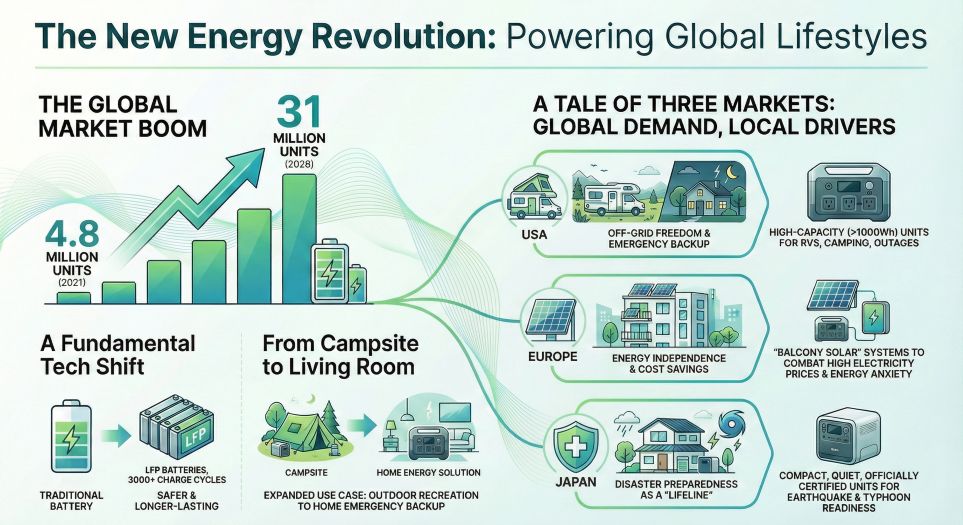
Figure The New Energy Revolution Powering Global Lifestyles
 Market Growth and Technical Evolution
The global market for portable power is exhibiting resilient growth. Shipments are projected to reach 31.1 million units by 2026, with the total market size expected to exceed 88 billion RMB. This expansion is accompanied by a technical paradigm shift from ternary lithium to Lithium Iron Phosphate (LFP) battery systems. LFP technology has become the industry standard due to its high safety profile and superior cycle life, often exceeding 3,000 cycles, which significantly reduces the cost per kilowatt-hour over the lifetime of the device.
In addition to battery chemistry, the integration of Gallium Nitride (GaN) inverters is revolutionizing product design. GaN components allow for a 2 percent increase in energy conversion efficiency while reducing overall device weight by approximately 20 percent. These technical advancements are enabling the transition from low-capacity units to high-capacity systems (1000Wh and 2000Wh+) capable of powering heavy appliances such as portable air conditioners and refrigerators.
Regional Market Dynamics: US, Japan, and Europe
Consumer behavior varies significantly across the three major global markets, shaped by geographical needs and local energy policies:
1. United States: The US remains the largest consumer market, accounting for nearly 60 percent of global demand. While 81 percent of applications are still outdoor-related (camping and RV use), there is a growing reliance on PPS as a lifeline during power outages caused by aging grids and natural disasters. American consumers show a strong preference for high-capacity, high-reliability units.
2. Japan: This is a highly mature market driven by disaster prevention culture. Approximately 78 percent of Japanese households maintain emergency supplies, and over 80 percent of PPS use in Japan is for disaster preparedness. Japanese consumers prioritize compact, silent designs with Uninterruptible Power Supply (UPS) functionality.
3. Europe: Europe is the fastest-growing region, with some major brands reporting over 100 percent year-on-year growth in 2025. Driven by high electricity costs and energy security concerns, European consumers are leading the Balcony Solar movement. These systems combine solar panels with portable storage to allow residents to offset daily electricity costs and maintain energy sovereignty.
The Rise of the M2C Business Model
A critical factor in the success of industry leaders such as Huabao New Energy (Jackery), EcoFlow, and Anker is the adoption of the Manufacturers-to-Consumer (M2C) model. By integrating R&D, manufacturing, branding, and sales, companies can eliminate intermediaries, shorten distribution paths, and reduce channel costs. This direct-to-consumer approach allows brands to gather real-time feedback, enabling rapid product iterations such as ultra-fast charging capabilities.
Huabao New Energy, for instance, generates over 94 percent of its revenue from overseas markets. The company utilizes a three-in-one channel matrix consisting of official websites, third-party e-commerce platforms like Amazon, and large-scale offline retailers such as Costco, Walmart, and Home Depot.
Industry Challenges and Regulatory Standards
Despite the optimistic growth projections, the industry faces tightening regulatory hurdles. The implementation of the new UL 2743 standard in September 2025 serves as a technical watershed. Major platforms like Amazon have indicated that non-compliant products will be removed, raising the entry barrier for manufacturers. Furthermore, trade policies such as the US Inflation Reduction Act (IRA) are prompting Chinese manufacturers to establish localized supply chains and overseas production facilities to mitigate tariff risks.
Table Global Portable Power and Green Energy Industry Summary
Analyst Conclusion
The future of the portable power industry lies beyond simple battery stacking. Success will depend on the ability to integrate smart energy dispatching systems, high-efficiency solar charging, and global supply chain resilience. As the market moves toward full-scenario home green energy solutions, brands that master localized marketing and high-standard technical compliance will dominate the global landscape.
About HDIN Research
Profile: HDIN Research focuses on providing market consulting services. As an independent third-party consulting firm, it is committed to providing in-depth market research and analysis reports.
Website: www.hdinresearch.com
E-mail: sales@hdinresearch.com
Figure The New Energy Revolution Powering Global Lifestyles
Market Growth and Technical EvolutionThe global market for portable power is exhibiting resilient growth. Shipments are projected to reach 31.1 million units by 2026, with the total market size expected to exceed 88 billion RMB. This expansion is accompanied by a technical paradigm shift from ternary lithium to Lithium Iron Phosphate (LFP) battery systems. LFP technology has become the industry standard due to its high safety profile and superior cycle life, often exceeding 3,000 cycles, which significantly reduces the cost per kilowatt-hour over the lifetime of the device.
In addition to battery chemistry, the integration of Gallium Nitride (GaN) inverters is revolutionizing product design. GaN components allow for a 2 percent increase in energy conversion efficiency while reducing overall device weight by approximately 20 percent. These technical advancements are enabling the transition from low-capacity units to high-capacity systems (1000Wh and 2000Wh+) capable of powering heavy appliances such as portable air conditioners and refrigerators.
Regional Market Dynamics: US, Japan, and Europe
Consumer behavior varies significantly across the three major global markets, shaped by geographical needs and local energy policies:
1. United States: The US remains the largest consumer market, accounting for nearly 60 percent of global demand. While 81 percent of applications are still outdoor-related (camping and RV use), there is a growing reliance on PPS as a lifeline during power outages caused by aging grids and natural disasters. American consumers show a strong preference for high-capacity, high-reliability units.
2. Japan: This is a highly mature market driven by disaster prevention culture. Approximately 78 percent of Japanese households maintain emergency supplies, and over 80 percent of PPS use in Japan is for disaster preparedness. Japanese consumers prioritize compact, silent designs with Uninterruptible Power Supply (UPS) functionality.
3. Europe: Europe is the fastest-growing region, with some major brands reporting over 100 percent year-on-year growth in 2025. Driven by high electricity costs and energy security concerns, European consumers are leading the Balcony Solar movement. These systems combine solar panels with portable storage to allow residents to offset daily electricity costs and maintain energy sovereignty.
The Rise of the M2C Business Model
A critical factor in the success of industry leaders such as Huabao New Energy (Jackery), EcoFlow, and Anker is the adoption of the Manufacturers-to-Consumer (M2C) model. By integrating R&D, manufacturing, branding, and sales, companies can eliminate intermediaries, shorten distribution paths, and reduce channel costs. This direct-to-consumer approach allows brands to gather real-time feedback, enabling rapid product iterations such as ultra-fast charging capabilities.
Huabao New Energy, for instance, generates over 94 percent of its revenue from overseas markets. The company utilizes a three-in-one channel matrix consisting of official websites, third-party e-commerce platforms like Amazon, and large-scale offline retailers such as Costco, Walmart, and Home Depot.
Industry Challenges and Regulatory Standards
Despite the optimistic growth projections, the industry faces tightening regulatory hurdles. The implementation of the new UL 2743 standard in September 2025 serves as a technical watershed. Major platforms like Amazon have indicated that non-compliant products will be removed, raising the entry barrier for manufacturers. Furthermore, trade policies such as the US Inflation Reduction Act (IRA) are prompting Chinese manufacturers to establish localized supply chains and overseas production facilities to mitigate tariff risks.
Table Global Portable Power and Green Energy Industry Summary
| Indicator | Data | Strategic Driver |
|---|---|---|
| Projected Global Shipments (2026) | 31.1 million units | Transition from outdoor gadgets to home infrastructure |
| Market Size Forecast (2026) | 88.23 billion RMB | High-capacity unit demand (1000Wh+) |
| Key Battery Technology | Lithium Iron Phosphate (LFP) | 3000+ cycle life and enhanced safety |
| Leading Regional Markets | North America (60% share), Europe (100%+ growth) | Energy independence and disaster prevention |
| Primary Sales Model | M2C (Manufacturers to Consumer) | Full value chain digitization and direct retail |
The future of the portable power industry lies beyond simple battery stacking. Success will depend on the ability to integrate smart energy dispatching systems, high-efficiency solar charging, and global supply chain resilience. As the market moves toward full-scenario home green energy solutions, brands that master localized marketing and high-standard technical compliance will dominate the global landscape.
About HDIN Research
Profile: HDIN Research focuses on providing market consulting services. As an independent third-party consulting firm, it is committed to providing in-depth market research and analysis reports.
Website: www.hdinresearch.com
E-mail: sales@hdinresearch.com