Semiconductor Strategic Audit: TI’s $7.5B IoT Consolidation & GaN Pivots
Date : 2026-02-16
Reading : 114
The fiscal 2025 landscape signals a definitive pivot from cyclical recovery to structural consolidation. The headline event—Texas Instruments’ (TXN) landmark $7.5 billion acquisition of Silicon Laboratories (SLAB)—is not merely a merger; it represents the weaponization of manufacturing scale against fabless innovation in the race for the Intelligent Edge.
At HDIN Research, our latest audit of the semiconductor sector’s FY2025 performance reveals a market bifurcating into two distinct value drivers: massive operational efficiency (TXN) and high-voltage material specialization (Power Integrations). As the industry emerges from the troughs of 2024, the "So What" behind the numbers points to a fundamental reshaping of the competitive moat.
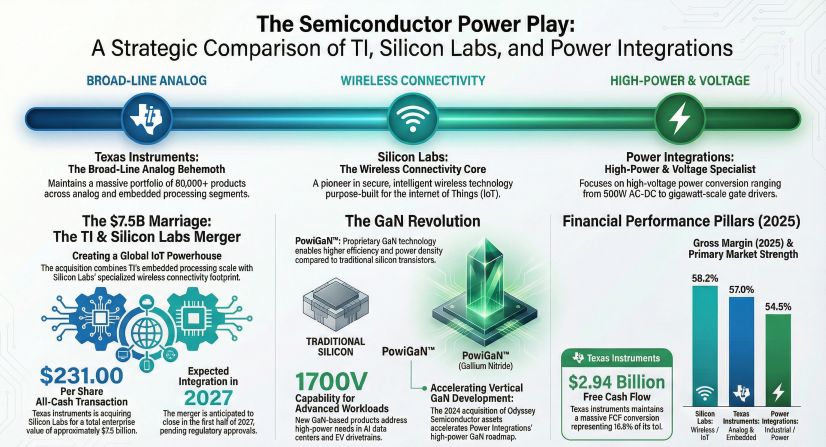
Figure A Strategic Comparison of Tl, Silicon Labs, and Power Integrations
 The 300mm Economic Fortress: Why TI Won the War
While Texas Instruments reported flat revenue growth (~0.3% CAGR) over the last three years, the strategic narrative lies in its capital allocation. TI has effectively completed a $24 billion capital expenditure cycle, cementing a structural cost advantage that smaller peers cannot replicate.
By transitioning production to internal 300mm wafer fabs, TI has achieved an approximate 40% cost reduction per unpackaged chip compared to 200mm alternatives. This is not just margin protection; it is a pricing weapon. With a GAAP Operating Margin of 34.1%—significantly higher than the sector average—TI is utilizing this cash flow to absorb the high fixed costs of its fabs while funding the acquisition of its fastest-growing peer.
Strategic Convergence: The Logic Behind the $7.5B Silicon Labs Deal
The acquisition of Silicon Labs (SLAB) for $231.00 per share solves a critical "make vs. buy" equation for TI. While TI dominates power management, it has historically lagged in the complex, software-heavy wireless connectivity space.
* From Fabless to IDM: SLAB’s weakness was its cost structure—heavily reliant on external foundries like TSMC, resulting in an operating loss in FY2025 due to a massive 45% R&D intensity.
* The Synergy: By acquiring SLAB, TI can eventually "reshore" SLAB’s industry-leading "Series 3" IoT platform into its own 300mm fabs. This move allows TI to capture the foundry margin, transforming SLAB’s innovative but loss-making portfolio into a highly accretive asset within the Embedded Processing segment.
Niche Dominance: Power Integrations’ GaN Bet
While TI chases volume, Power Integrations (POWI) is executing a strategy of vertical specialization. Despite a suppressed operating margin in 2025 due to litigation expenses, POWI remains the most cash-efficient entity in our audit with a 19.6% Free Cash Flow conversion rate.
POWI’s moat is defined by its proprietary PowiGaN™ technology. The company is actively pivoting away from commoditized consumer electronics toward high-margin AI data centers and EV drivetrains. Their July 2024 acquisition of Odyssey Semiconductor’s vertical GaN assets indicates a strategic push to replace Silicon Carbide (SiC) in high-voltage EV applications (1250V+), creating a defensive niche that generalist analog makers struggle to penetrate.
HDIN Viewpoint: The End of the "Middle Market"
HDIN Research believes the FY2025 data confirms the erosion of the mid-sized fabless model. Silicon Labs’ high innovation costs (45% R&D/Sales) proved unsustainable as a standalone entity, necessitating its sale to a capital-rich partner. Conversely, Power Integrations survives by dominating a specific material science niche (GaN) where performance outweighs commoditization.
For investors and strategists, the implication is clear: Alpha in 2026 will be found in companies that control their manufacturing destiny (TI) or those that own proprietary physics at the system level (POWI). The "middle ground"—generic fabless chipmakers without scale or unique IP—faces an existential squeeze.
Presentation Download
For a comprehensive breakdown of the financial forensics, including the detailed "Synergy Impact" of the TI-SLAB merger and our "PowiGaN Market Penetration" models, please access the full report.
Click the PDF download link under “Related Topics” to access the presentation of this report.
About HDIN Research
HDIN Research focuses on providing market consulting services. As an independent third-party consulting firm, it is committed to providing in-depth market research and analysis reports.
Website: www.hdinresearch.com
E-mail: sales@hdinresearch.com
At HDIN Research, our latest audit of the semiconductor sector’s FY2025 performance reveals a market bifurcating into two distinct value drivers: massive operational efficiency (TXN) and high-voltage material specialization (Power Integrations). As the industry emerges from the troughs of 2024, the "So What" behind the numbers points to a fundamental reshaping of the competitive moat.
Figure A Strategic Comparison of Tl, Silicon Labs, and Power Integrations
The 300mm Economic Fortress: Why TI Won the WarWhile Texas Instruments reported flat revenue growth (~0.3% CAGR) over the last three years, the strategic narrative lies in its capital allocation. TI has effectively completed a $24 billion capital expenditure cycle, cementing a structural cost advantage that smaller peers cannot replicate.
By transitioning production to internal 300mm wafer fabs, TI has achieved an approximate 40% cost reduction per unpackaged chip compared to 200mm alternatives. This is not just margin protection; it is a pricing weapon. With a GAAP Operating Margin of 34.1%—significantly higher than the sector average—TI is utilizing this cash flow to absorb the high fixed costs of its fabs while funding the acquisition of its fastest-growing peer.
Strategic Convergence: The Logic Behind the $7.5B Silicon Labs Deal
The acquisition of Silicon Labs (SLAB) for $231.00 per share solves a critical "make vs. buy" equation for TI. While TI dominates power management, it has historically lagged in the complex, software-heavy wireless connectivity space.
* From Fabless to IDM: SLAB’s weakness was its cost structure—heavily reliant on external foundries like TSMC, resulting in an operating loss in FY2025 due to a massive 45% R&D intensity.
* The Synergy: By acquiring SLAB, TI can eventually "reshore" SLAB’s industry-leading "Series 3" IoT platform into its own 300mm fabs. This move allows TI to capture the foundry margin, transforming SLAB’s innovative but loss-making portfolio into a highly accretive asset within the Embedded Processing segment.
Niche Dominance: Power Integrations’ GaN Bet
While TI chases volume, Power Integrations (POWI) is executing a strategy of vertical specialization. Despite a suppressed operating margin in 2025 due to litigation expenses, POWI remains the most cash-efficient entity in our audit with a 19.6% Free Cash Flow conversion rate.
POWI’s moat is defined by its proprietary PowiGaN™ technology. The company is actively pivoting away from commoditized consumer electronics toward high-margin AI data centers and EV drivetrains. Their July 2024 acquisition of Odyssey Semiconductor’s vertical GaN assets indicates a strategic push to replace Silicon Carbide (SiC) in high-voltage EV applications (1250V+), creating a defensive niche that generalist analog makers struggle to penetrate.
HDIN Viewpoint: The End of the "Middle Market"
HDIN Research believes the FY2025 data confirms the erosion of the mid-sized fabless model. Silicon Labs’ high innovation costs (45% R&D/Sales) proved unsustainable as a standalone entity, necessitating its sale to a capital-rich partner. Conversely, Power Integrations survives by dominating a specific material science niche (GaN) where performance outweighs commoditization.
For investors and strategists, the implication is clear: Alpha in 2026 will be found in companies that control their manufacturing destiny (TI) or those that own proprietary physics at the system level (POWI). The "middle ground"—generic fabless chipmakers without scale or unique IP—faces an existential squeeze.
Presentation Download
For a comprehensive breakdown of the financial forensics, including the detailed "Synergy Impact" of the TI-SLAB merger and our "PowiGaN Market Penetration" models, please access the full report.
Click the PDF download link under “Related Topics” to access the presentation of this report.
About HDIN Research
HDIN Research focuses on providing market consulting services. As an independent third-party consulting firm, it is committed to providing in-depth market research and analysis reports.
Website: www.hdinresearch.com
E-mail: sales@hdinresearch.com