Disney Fiscal 2025: The Strategic Pivot from User Acquisition to Unit Economics
Date : 2026-02-20
Reading : 2679
Fiscal 2025 represented a definitive "financial repair" year for The Walt Disney Company. Moving beyond the subscriber-growth-at-all-costs era, the conglomerate successfully executed a strategic pivot toward sustainable unit economics. While the headline figures show a recovery, HDIN Research identifies a deeper structural shift: Disney is aggressively leveraging pricing power in streaming to offset the accelerated erosion of linear networks, while simultaneously deploying a capital-intensive strategy in its Experiences segment to capture high-yield consumer spending.
Figure Disney 2025: A Year of Magic and Growth
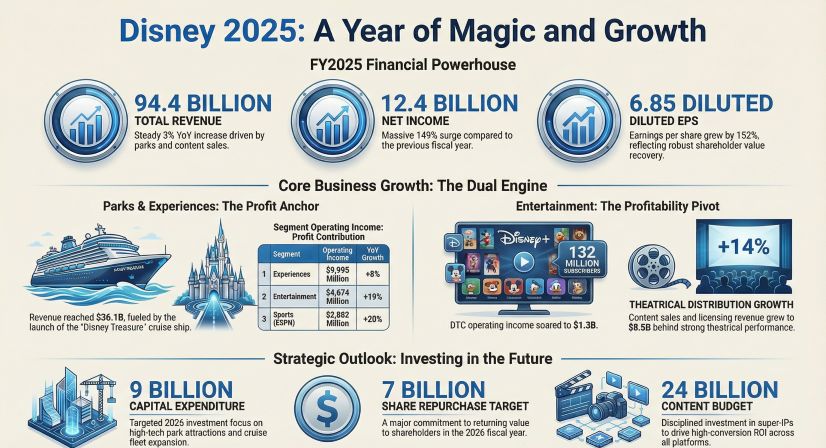 DTC Strategy: From "Land Grab" to "Precision Harvesting"
The most significant operational turnaround in FY2025 was the Direct-to-Consumer (DTC) segment’s shift into profitability. The segment posted an operating income of $1.33 billion—a stark reversal from the previous year’s marginal performance—driven by a sophisticated "precision harvesting" strategy rather than mere volume expansion.
Pricing Power as a Lever: Disney demonstrated significant elasticity in its pricing model. International Disney+ ARPU (Average Revenue Per User) surged 19% to $7.59, while domestic ARPU climbed to $8.06. This confirms the brand's ability to pass costs to consumers without triggering mass exodus, a critical validation of its IP value.
The Churn-Reduction Ecosystem: The integration of Disney+, Hulu, and the upcoming ESPN standalone service creates a "walled garden" effect. With 43.7 million bundle subscribers, Disney is effectively lowering customer acquisition costs (CAC) and reducing churn, proving that deep ecosystem integration is the primary defense against market fragmentation.
Ad-Tier Monetization: Despite fluctuating ad rates, Disney increased ad impressions by 15%, successfully hedging against rate compression and stabilizing the ad-revenue baseline for the streaming portfolio.
Capital Allocation: The "Heavy Asset" Hedge
While media competitors retreat, Disney is doubling down on heavy assets. The "Experiences" segment (Parks and Cruises) remains the company's cash engine, characterized by a "High CapEx, High Yield" logic.
Capacity vs. Yield: A critical divergence appeared in FY2025: while domestic park attendance dipped slightly (1%), per-capita spending rose 5%. This signals a deliberate strategy to prioritize high-value guests over crowd density, utilizing yield management to drive margin expansion.
Aggressive Fleet Expansion: With FY2025 capital expenditures hitting $6.43 billion—and projected to rise to $9 billion in FY2026—Disney is entering a massive investment cycle. The delivery of the Disney Treasure, followed by the Disney Destiny and Disney Adventure, indicates a long-term bet on the cruise line industry as a recession-resistant luxury product.
The AI Paradox: Operational Efficiency vs. IP Risk
In its 2025 filings, Disney officially categorized Generative AI as a material risk factor, highlighting a complex duality. While AI offers potential for operational cost reduction, it poses an existential threat to Disney’s core "Strategic Moat"—its Intellectual Property.
IP Dilution: The proliferation of AI lowers the barrier to entry for content creation, potentially saturating the market with low-cost alternatives that compete for consumer attention.
Legal & Copyright Ambiguity: HDIN Research notes that the lack of clear legal frameworks regarding AI-generated content creates a "compliance vacuum." This threatens the exclusivity of Disney’s assets and raises the cost of legal defense against infringement, potentially eroding the long-term ROI of their content library.
HDIN Viewpoint: The Race Against the "Linear Cliff"
At HDIN Research, we view Disney’s FY2025 not just as a recovery, but as a race against time. The company is currently stuck in a "double squeeze":
1. The Linear Decay: Linear network revenue dropped 12% and operating income fell 14%. This high-margin cash flow is evaporating faster than anticipated.
2. The Capital Call: To replace linear profits, Disney is committed to a $24 billion content spend for FY2026 and a massive infrastructure build-out in Parks.
Our Assessment: Disney has successfully stabilized its financial base. However, the company’s future hinges on its Capital Allocation Efficiency. With net interest expenses at $1.3 billion and significant sports rights obligations ($90B+ long-term), Disney must maintain impeccable execution in its high-margin Experience segment to fund the transition. The risk is no longer about whether streaming can be profitable, but whether it can scale profits fast enough to offset the structural collapse of cable TV economics.
Presentation Download
Click the PDF download link under “Related Topics” to access the presentation of this report.
About HDIN Research
HDIN Research focuses on providing market consulting services. As an independent third-party consulting firm, it is committed to providing in-depth market research and analysis reports.
Website: www.hdinresearch.com
E-mail: sales@hdinresearch.com
Figure Disney 2025: A Year of Magic and Growth
DTC Strategy: From "Land Grab" to "Precision Harvesting"The most significant operational turnaround in FY2025 was the Direct-to-Consumer (DTC) segment’s shift into profitability. The segment posted an operating income of $1.33 billion—a stark reversal from the previous year’s marginal performance—driven by a sophisticated "precision harvesting" strategy rather than mere volume expansion.
Pricing Power as a Lever: Disney demonstrated significant elasticity in its pricing model. International Disney+ ARPU (Average Revenue Per User) surged 19% to $7.59, while domestic ARPU climbed to $8.06. This confirms the brand's ability to pass costs to consumers without triggering mass exodus, a critical validation of its IP value.
The Churn-Reduction Ecosystem: The integration of Disney+, Hulu, and the upcoming ESPN standalone service creates a "walled garden" effect. With 43.7 million bundle subscribers, Disney is effectively lowering customer acquisition costs (CAC) and reducing churn, proving that deep ecosystem integration is the primary defense against market fragmentation.
Ad-Tier Monetization: Despite fluctuating ad rates, Disney increased ad impressions by 15%, successfully hedging against rate compression and stabilizing the ad-revenue baseline for the streaming portfolio.
Capital Allocation: The "Heavy Asset" Hedge
While media competitors retreat, Disney is doubling down on heavy assets. The "Experiences" segment (Parks and Cruises) remains the company's cash engine, characterized by a "High CapEx, High Yield" logic.
Capacity vs. Yield: A critical divergence appeared in FY2025: while domestic park attendance dipped slightly (1%), per-capita spending rose 5%. This signals a deliberate strategy to prioritize high-value guests over crowd density, utilizing yield management to drive margin expansion.
Aggressive Fleet Expansion: With FY2025 capital expenditures hitting $6.43 billion—and projected to rise to $9 billion in FY2026—Disney is entering a massive investment cycle. The delivery of the Disney Treasure, followed by the Disney Destiny and Disney Adventure, indicates a long-term bet on the cruise line industry as a recession-resistant luxury product.
The AI Paradox: Operational Efficiency vs. IP Risk
In its 2025 filings, Disney officially categorized Generative AI as a material risk factor, highlighting a complex duality. While AI offers potential for operational cost reduction, it poses an existential threat to Disney’s core "Strategic Moat"—its Intellectual Property.
IP Dilution: The proliferation of AI lowers the barrier to entry for content creation, potentially saturating the market with low-cost alternatives that compete for consumer attention.
Legal & Copyright Ambiguity: HDIN Research notes that the lack of clear legal frameworks regarding AI-generated content creates a "compliance vacuum." This threatens the exclusivity of Disney’s assets and raises the cost of legal defense against infringement, potentially eroding the long-term ROI of their content library.
HDIN Viewpoint: The Race Against the "Linear Cliff"
At HDIN Research, we view Disney’s FY2025 not just as a recovery, but as a race against time. The company is currently stuck in a "double squeeze":
1. The Linear Decay: Linear network revenue dropped 12% and operating income fell 14%. This high-margin cash flow is evaporating faster than anticipated.
2. The Capital Call: To replace linear profits, Disney is committed to a $24 billion content spend for FY2026 and a massive infrastructure build-out in Parks.
Our Assessment: Disney has successfully stabilized its financial base. However, the company’s future hinges on its Capital Allocation Efficiency. With net interest expenses at $1.3 billion and significant sports rights obligations ($90B+ long-term), Disney must maintain impeccable execution in its high-margin Experience segment to fund the transition. The risk is no longer about whether streaming can be profitable, but whether it can scale profits fast enough to offset the structural collapse of cable TV economics.
Presentation Download
Click the PDF download link under “Related Topics” to access the presentation of this report.
About HDIN Research
HDIN Research focuses on providing market consulting services. As an independent third-party consulting firm, it is committed to providing in-depth market research and analysis reports.
Website: www.hdinresearch.com
E-mail: sales@hdinresearch.com