Eastman Chemical 2025 Analysis: Circular Economy "Moat" Tested by Cyclical Headwinds
Date : 2026-02-21
Reading : 86
For investors and industry observers looking solely at the top-line numbers, Eastman Chemical Company’s 2025 performance—characterized by a 7% revenue decline and a 31% drop in adjusted EPS—might appear to be a standard case of cyclical deterioration. However, HDIN Research identifies a more significant underlying narrative: a structural decoupling of the company’s "Specialty" future from its "Commodity" past. While macroeconomic weakness and aggressive destocking in the fibers market compressed short-term margins, the successful operational ramp-up of the world’s largest molecular recycling facility signals that Eastman’s long-term competitive moat is solidifying just as the cycle bottoms out.
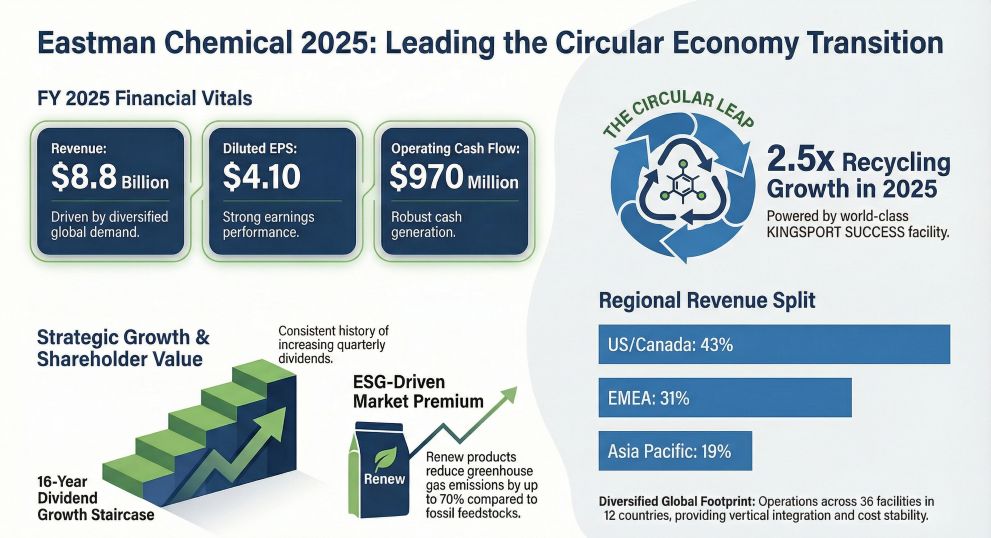
Figure Eastman Chemical 2025 Leading the Circular Economy Transition
 The "Renew" Gamble: Scaling the Technological Moat
The most critical data point in 2025 was not the revenue contraction, but the operational efficiency of the Advanced Materials (AM) segment. Despite a difficult environment for consumer durables, Eastman’s Kingsport molecular recycling facility achieved a 2.5x increase in output compared to 2024.
This is not merely an incremental capacity increase; it validates the scalability of Eastman’s "waste-to-plastic" business model. By converting hard-to-recycle waste (such as carpets and colored bottles) into drop-in monomers with up to 70% lower greenhouse gas emissions, Eastman is creating a product category that commands a regulatory and sustainability premium. HDIN Research notes that while the AM segment faced volume pressure, the "Renew" portfolio acted as a hedge, maintaining flat volumes in specialty plastics by displacing traditional fossil-based competitors. The ability to integrate these streams vertically creates a barrier to entry that mechanical recyclers cannot match.
Pricing Power as a Defensive Shield
The divergence between the Additives & Functional Products (AFP) segment and the Chemical Intermediates (CI) segment perfectly illustrates the value of Eastman’s specialty transformation.
* AFP Resilience: In a year where automotive and construction end-markets softened, the AFP segment managed to grow its Adjusted EBIT by 5%. This was driven by "cost-pass-through" contracts, which allowed Eastman to raise prices by 3% despite falling volumes. This demonstrates a high degree of stickiness and pricing power—key characteristics of a true specialty materials provider.
* The Commodity Drag: Conversely, the Chemical Intermediates (CI) segment reported a $38 million loss, battered by Asian competition and a 5% drop in selling prices. This sharp contrast validates management’s strategy to reduce exposure to volatile merchant ethylene markets and pivot toward internal consumption of intermediates for high-margin derivatives.
Capital Allocation: Investing Through the Trough
Despite the earnings pressure, Eastman’s balance sheet management remained disciplined. The company generated $970 million in operating cash flow, covering its capital expenditures by 1.77x. Crucially, the company did not cut corners on its strategic future; capital was allocated to the completion of the Kingsport ramp-up and the preparation for the France molecular recycling project.
The inventory cycle also tells a story of imminent recovery. While 2024 was characterized by inventory accumulation, 2025 saw significant positive cash flow contribution from inventory consumption. This signals that the painful destocking phase—particularly in the Fibers segment—is largely complete, setting the stage for a cleaner demand signal in 2026.
HDIN Viewpoint: The Pivot Point for Valuation
At HDIN Research, we believe Eastman Chemical is currently undervalued by the market’s fixation on cyclical metrics. The traditional correlation between Eastman’s performance and general GDP growth is weakening as the "Renew" platform gains scale.
The strategic implication for 2026 is clear:
1. Regulatory Tailwinds: With the EU’s PPWR (Packaging and Packaging Waste Regulation) and stricter global carbon taxes, Eastman’s molecular recycling technology is transitioning from a "niche pilot" to a "license to operate" for global consumer brands.
2. Margin Expansion: As the Kingsport facility moves from "ramp-up costs" to "optimized utilization" in 2026, the unit economics of the Advanced Materials segment should see material improvement, decoupled from oil price volatility.
Eastman has effectively paid the "transition tax" in 2025. The company is no longer just a chemical manufacturer; it is becoming a critical infrastructure provider for the circular economy.
Get the Full Picture
This article provides a high-level summary of our deep-dive analysis. For a comprehensive breakdown of Eastman’s segment-by-segment performance, detailed capacity data, and forward-looking risk assessment for 2026:
Click the PDF download link under “Related Topics” to access the presentation of this report.
About HDIN Research
HDIN Research focuses on providing market consulting services. As an independent third-party consulting firm, it is committed to providing in-depth market research and analysis reports.
Website: www.hdinresearch.com
E-mail: sales@hdinresearch.com
Figure Eastman Chemical 2025 Leading the Circular Economy Transition
The "Renew" Gamble: Scaling the Technological MoatThe most critical data point in 2025 was not the revenue contraction, but the operational efficiency of the Advanced Materials (AM) segment. Despite a difficult environment for consumer durables, Eastman’s Kingsport molecular recycling facility achieved a 2.5x increase in output compared to 2024.
This is not merely an incremental capacity increase; it validates the scalability of Eastman’s "waste-to-plastic" business model. By converting hard-to-recycle waste (such as carpets and colored bottles) into drop-in monomers with up to 70% lower greenhouse gas emissions, Eastman is creating a product category that commands a regulatory and sustainability premium. HDIN Research notes that while the AM segment faced volume pressure, the "Renew" portfolio acted as a hedge, maintaining flat volumes in specialty plastics by displacing traditional fossil-based competitors. The ability to integrate these streams vertically creates a barrier to entry that mechanical recyclers cannot match.
Pricing Power as a Defensive Shield
The divergence between the Additives & Functional Products (AFP) segment and the Chemical Intermediates (CI) segment perfectly illustrates the value of Eastman’s specialty transformation.
* AFP Resilience: In a year where automotive and construction end-markets softened, the AFP segment managed to grow its Adjusted EBIT by 5%. This was driven by "cost-pass-through" contracts, which allowed Eastman to raise prices by 3% despite falling volumes. This demonstrates a high degree of stickiness and pricing power—key characteristics of a true specialty materials provider.
* The Commodity Drag: Conversely, the Chemical Intermediates (CI) segment reported a $38 million loss, battered by Asian competition and a 5% drop in selling prices. This sharp contrast validates management’s strategy to reduce exposure to volatile merchant ethylene markets and pivot toward internal consumption of intermediates for high-margin derivatives.
Capital Allocation: Investing Through the Trough
Despite the earnings pressure, Eastman’s balance sheet management remained disciplined. The company generated $970 million in operating cash flow, covering its capital expenditures by 1.77x. Crucially, the company did not cut corners on its strategic future; capital was allocated to the completion of the Kingsport ramp-up and the preparation for the France molecular recycling project.
The inventory cycle also tells a story of imminent recovery. While 2024 was characterized by inventory accumulation, 2025 saw significant positive cash flow contribution from inventory consumption. This signals that the painful destocking phase—particularly in the Fibers segment—is largely complete, setting the stage for a cleaner demand signal in 2026.
HDIN Viewpoint: The Pivot Point for Valuation
At HDIN Research, we believe Eastman Chemical is currently undervalued by the market’s fixation on cyclical metrics. The traditional correlation between Eastman’s performance and general GDP growth is weakening as the "Renew" platform gains scale.
The strategic implication for 2026 is clear:
1. Regulatory Tailwinds: With the EU’s PPWR (Packaging and Packaging Waste Regulation) and stricter global carbon taxes, Eastman’s molecular recycling technology is transitioning from a "niche pilot" to a "license to operate" for global consumer brands.
2. Margin Expansion: As the Kingsport facility moves from "ramp-up costs" to "optimized utilization" in 2026, the unit economics of the Advanced Materials segment should see material improvement, decoupled from oil price volatility.
Eastman has effectively paid the "transition tax" in 2025. The company is no longer just a chemical manufacturer; it is becoming a critical infrastructure provider for the circular economy.
Get the Full Picture
This article provides a high-level summary of our deep-dive analysis. For a comprehensive breakdown of Eastman’s segment-by-segment performance, detailed capacity data, and forward-looking risk assessment for 2026:
Click the PDF download link under “Related Topics” to access the presentation of this report.
About HDIN Research
HDIN Research focuses on providing market consulting services. As an independent third-party consulting firm, it is committed to providing in-depth market research and analysis reports.
Website: www.hdinresearch.com
E-mail: sales@hdinresearch.com