Morgan Stanley 2025: Decoding the Capital-Light Transformation and Synergy Ecosystem
Date : 2026-02-25
Reading : 542
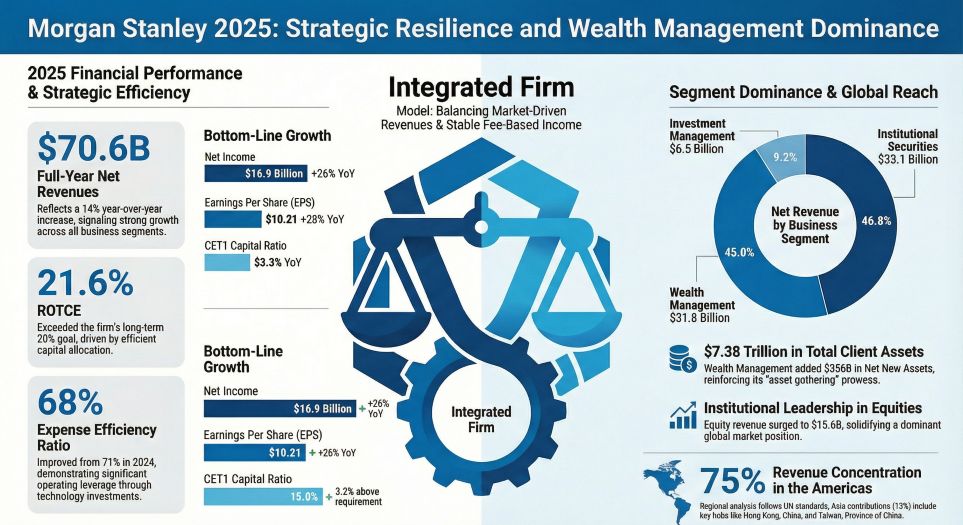
Morgan Stanley’s 2025 financial performance serves as a definitive validation of its decade-long strategic pivot. By successfully engineering an "Integrated Firm" architecture, the institution has structurally mitigated its reliance on volatile market cycles. A synchronized execution across its advisory and asset-gathering divisions catalyzed a 14% revenue surge to $70.64 billion, alongside a 26% leap in net income to $16.86 billion. More importantly, the firm’s Return on Tangible Common Equity (ROTCE) hit an exceptional 21.6%—comfortably eclipsing its 20% long-term target. This indicates a profound shift: Morgan Stanley is no longer just a traditional investment bank, but a capital-light, high-return wealth and asset management compounding machine.
Figure Morgan Stanley 2025: Strategic Resilience and Wealth Management Dominance
 Based on HDIN Research’s analysis of the 2025 Form 10-K, here is our breakdown of the strategic implications behind the data.
Strategic Moats: The Triumph of the "Integrated Firm"
The core narrative of Morgan Stanley’s 2025 success lies in its sector positioning. The firm has masterfully balanced the high-beta Institutional Securities (IS) division with the recurring, fee-driven stability of Wealth Management (WM) and Investment Management (IM). Together, the WM and IM divisions now contribute over 54% of total net revenues, acting as a structural ballast against cyclical headwinds.
This stability is underpinned by a powerful internal synergy ecosystem that deepens client moats. The institutional and wealth divisions no longer operate in silos; they are cross-pollinating engines. For instance, $350 billion of WM client assets are directly invested in IM products, allowing the firm to capture both advisory and management fees on the same capital base. Furthermore, the IS division leverages its structuring capabilities to provide tailored lending solutions to ultra-high-net-worth WM clients, generating $181 billion in loans. This symbiotic relationship not only fortifies client retention but maximizes revenue capture per unit of client asset.
Capital Allocation Efficiency & Financial Health
Morgan Stanley’s transition toward a "fee-driven" model has profoundly optimized its capital allocation efficiency. In 2025, the Wealth Management division demonstrated formidable asset-gathering velocity, securing $356 billion in Net New Assets (NNA) and pushing total client assets to a staggering $7.38 trillion. Crucially, fee-based asset inflows reached $160 billion, cementing a highly predictable revenue stream that requires minimal regulatory capital.
From a balance sheet perspective, the firm operates from a position of undeniable strength. Its Standardized Common Equity Tier 1 (CET1) ratio stands at a robust 15.0%, maintaining a massive 320-basis-point buffer over the 11.8% regulatory minimum (which includes a recently reduced Stress Capital Buffer). This excess capital elasticity empowered Morgan Stanley to aggressively return value to shareholders, executing $4.58 billion in share repurchases while raising its quarterly dividend.
Tech-Driven Operating Leverage & Generative AI
A critical driver behind the firm’s profitability in 2025 was its aggressive yet targeted deployment of technology, specifically Generative AI and tokenization. While non-compensation expenses rose by 8%—largely fueled by technology investments—these expenditures directly translated into superior operating leverage.
The firm’s Expense Efficiency Ratio compressed significantly from 71% in 2024 to an impressive 68% in 2025. By embedding AI-driven advisor tools in Wealth Management and enhancing algorithmic execution platforms in Institutional Securities, Morgan Stanley is successfully converting its technology CapEx into widening margin moats.
Cyclical Headwinds & Risk Mitigation
Despite its structural advantages, Morgan Stanley navigates a complex matrix of cyclical headwinds, notably interest rate sensitivity, geopolitical friction, and systemic credit risks. However, the firm’s Enterprise Risk Management (ERM) framework has proven highly resilient.
Addressing market anxieties surrounding Commercial Real Estate (CRE) exposure, Morgan Stanley adopted a highly prudent provisioning strategy. While the Provision for Credit Losses (PCL) slightly increased to $349 million, it remains a negligible fraction of the firm’s $21.95 billion pre-tax profit. Over 95% of its CRE exposure is heavily collateralized, resulting in a microscopic net charge-off ratio of just 0.08%. Furthermore, acknowledging the escalating threat matrix of cyberattacks—exacerbated by AI misuse—the Board's Operations and Technology Committee (BOTC) has institutionalized rigorous, third-party-audited defense protocols to shield its digital infrastructure.
HDIN Viewpoint
HDIN Research views Morgan Stanley’s 2025 results not merely as a cyclical peak, but as the structural maturation of its capital-light thesis. By directly linking executive compensation (via Performance Stock Units) to ROTCE targets, management has perfectly aligned operational execution with long-term shareholder value creation. Moving forward, the strategic frontier for Morgan Stanley will be defending its 68% efficiency ratio. As the firm continues to scale its $7.38 trillion wealth platform, its ability to leverage Generative AI for mass-customization without linear headcount growth will dictate its next phase of margin expansion.
Presentation Download
Click the PDF download link under “Related Topics” to access the presentation of this report.
About HDIN Research
Profile: HDIN Research focuses on providing market consulting services. As an independent third-party consulting firm, it is committed to providing in-depth market research and analysis reports.
Website: www.hdinresearch.com
E-mail: sales@hdinresearch.com
Figure Morgan Stanley 2025: Strategic Resilience and Wealth Management Dominance
Based on HDIN Research’s analysis of the 2025 Form 10-K, here is our breakdown of the strategic implications behind the data.Strategic Moats: The Triumph of the "Integrated Firm"
The core narrative of Morgan Stanley’s 2025 success lies in its sector positioning. The firm has masterfully balanced the high-beta Institutional Securities (IS) division with the recurring, fee-driven stability of Wealth Management (WM) and Investment Management (IM). Together, the WM and IM divisions now contribute over 54% of total net revenues, acting as a structural ballast against cyclical headwinds.
This stability is underpinned by a powerful internal synergy ecosystem that deepens client moats. The institutional and wealth divisions no longer operate in silos; they are cross-pollinating engines. For instance, $350 billion of WM client assets are directly invested in IM products, allowing the firm to capture both advisory and management fees on the same capital base. Furthermore, the IS division leverages its structuring capabilities to provide tailored lending solutions to ultra-high-net-worth WM clients, generating $181 billion in loans. This symbiotic relationship not only fortifies client retention but maximizes revenue capture per unit of client asset.
Capital Allocation Efficiency & Financial Health
Morgan Stanley’s transition toward a "fee-driven" model has profoundly optimized its capital allocation efficiency. In 2025, the Wealth Management division demonstrated formidable asset-gathering velocity, securing $356 billion in Net New Assets (NNA) and pushing total client assets to a staggering $7.38 trillion. Crucially, fee-based asset inflows reached $160 billion, cementing a highly predictable revenue stream that requires minimal regulatory capital.
From a balance sheet perspective, the firm operates from a position of undeniable strength. Its Standardized Common Equity Tier 1 (CET1) ratio stands at a robust 15.0%, maintaining a massive 320-basis-point buffer over the 11.8% regulatory minimum (which includes a recently reduced Stress Capital Buffer). This excess capital elasticity empowered Morgan Stanley to aggressively return value to shareholders, executing $4.58 billion in share repurchases while raising its quarterly dividend.
Tech-Driven Operating Leverage & Generative AI
A critical driver behind the firm’s profitability in 2025 was its aggressive yet targeted deployment of technology, specifically Generative AI and tokenization. While non-compensation expenses rose by 8%—largely fueled by technology investments—these expenditures directly translated into superior operating leverage.
The firm’s Expense Efficiency Ratio compressed significantly from 71% in 2024 to an impressive 68% in 2025. By embedding AI-driven advisor tools in Wealth Management and enhancing algorithmic execution platforms in Institutional Securities, Morgan Stanley is successfully converting its technology CapEx into widening margin moats.
Cyclical Headwinds & Risk Mitigation
Despite its structural advantages, Morgan Stanley navigates a complex matrix of cyclical headwinds, notably interest rate sensitivity, geopolitical friction, and systemic credit risks. However, the firm’s Enterprise Risk Management (ERM) framework has proven highly resilient.
Addressing market anxieties surrounding Commercial Real Estate (CRE) exposure, Morgan Stanley adopted a highly prudent provisioning strategy. While the Provision for Credit Losses (PCL) slightly increased to $349 million, it remains a negligible fraction of the firm’s $21.95 billion pre-tax profit. Over 95% of its CRE exposure is heavily collateralized, resulting in a microscopic net charge-off ratio of just 0.08%. Furthermore, acknowledging the escalating threat matrix of cyberattacks—exacerbated by AI misuse—the Board's Operations and Technology Committee (BOTC) has institutionalized rigorous, third-party-audited defense protocols to shield its digital infrastructure.
HDIN Viewpoint
HDIN Research views Morgan Stanley’s 2025 results not merely as a cyclical peak, but as the structural maturation of its capital-light thesis. By directly linking executive compensation (via Performance Stock Units) to ROTCE targets, management has perfectly aligned operational execution with long-term shareholder value creation. Moving forward, the strategic frontier for Morgan Stanley will be defending its 68% efficiency ratio. As the firm continues to scale its $7.38 trillion wealth platform, its ability to leverage Generative AI for mass-customization without linear headcount growth will dictate its next phase of margin expansion.
Presentation Download
Click the PDF download link under “Related Topics” to access the presentation of this report.
About HDIN Research
Profile: HDIN Research focuses on providing market consulting services. As an independent third-party consulting firm, it is committed to providing in-depth market research and analysis reports.
Website: www.hdinresearch.com
E-mail: sales@hdinresearch.com