Goodyear 2025 Strategic Review: Navigating Volume Contraction Through Asset-Light Transformation and Premiumization
Date : 2026-02-26
Reading : 568
HDIN Research's extensive analysis of Goodyear's 2025 financial results (10-K) reveals a definitive corporate pivot: a transition from volume preservation to aggressive margin expansion. Amidst a 4.7% global contraction in unit volume (down to 158.7 million tires), the company successfully extracted $370 million in positive Price/Mix benefits. This performance underscores a strategic shift toward an asset-light operating model, prioritizing high-yield premium consumer segments over broad-market scale.
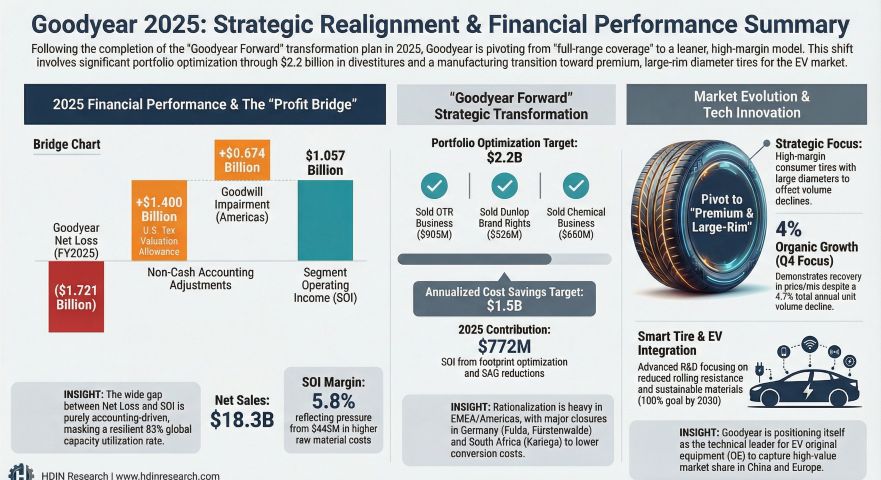
Figure Goodyear 2025 Strategic Realignment & Financial Performance Summary
 Capital Allocation Efficiency and Asset-Light Transition
In 2025, Goodyear executed a masterclass in Capital Allocation Efficiency through the "Goodyear Forward" transformation plan. By divesting non-core, low-return assets, the management team successfully retrieved approximately $2.2 billion in gross proceeds. This structural streamlining included the $905 million sale of the Off-The-Road (OTR) tire business to Yokohama, the $526 million divestment of Dunlop brand rights to Sumitomo Rubber Industries, and the $650 million sale of its polymer chemical operations.
These maneuvers significantly deleveraged the balance sheet, reducing consolidated debt to approximately $6.2 billion. More importantly, this transition signals a departure from the capital-intensive strategies of Tier-1 peers like Michelin and Bridgestone. By liquidating peripheral assets, Goodyear is intensely focusing its capital on the high-margin consumer and commercial tire markets, aiming to elevate its Segment Operating Income (SOI) margin from the current 5.8% baseline toward a targeted Tier-1 benchmark of over 10%.
Strategic Moats: Premiumization and EV Leadership
To counter declining overall volumes, Goodyear has actively fortified its Strategic Moats through brand tiering and technological advancement. The company's premiumization strategy—focused heavily on large-rim diameter consumer tires—proved highly effective in 2025.
Nowhere is this more evident than in the EMEA (Europe, Middle East, and Africa) market. Despite a 7.0% drop in replacement tire volumes, EMEA Consumer Original Equipment (OE) volumes surged by 11.2%. This resilient performance was driven by the acquisition of new fitments and deep technical partnerships with automakers. Furthermore, Goodyear is solidifying its position in the Electric Vehicle (EV) segment. By engineering tires with reduced rolling resistance and optimized weight profiles, Goodyear is directly enabling enhanced EV battery range—a critical differentiator that ensures long-term value accretion in a decarbonizing automotive landscape.
Navigating Cyclical Headwinds and Supply Chain Pressures
Despite structural improvements, Goodyear’s 2025 operational landscape was severely tested by macroeconomic and Cyclical Headwinds. The Americas segment experienced a 21.2% drop in SOI (down to $735 million), primarily battered by a $305 million surge in conversion costs. This margin erosion was directly linked to unabsorbed fixed costs stemming from reduced commercial vehicle production and broader inflationary pressures.
Simultaneously, global raw material volatility inflicted a $443 million cost penalty, nearly negating the company's pricing optimization gains. Furthermore, geopolitical supply chain fragmentation poses a looming threat. Management forecasts that tariffs on finished goods and raw materials will generate an annualized cost burden of approximately $300 million in 2026. In response, Goodyear is rapidly rationalizing its manufacturing footprint, closing high-cost facilities in Germany and South Africa to shift production toward modernized, low-cost geographies.
Sector Positioning and 2026 Outlook
Looking toward 2026, Goodyear's Sector Positioning depends heavily on disciplined execution. The "Goodyear Forward" plan already contributed $772 million to SOI in 2025 through footprint optimization and SG&A reductions. For 2026, management has mapped a clear path for an additional $300 million in structural savings driven by facility closures, operating alongside an anticipated $300 million tailwind from normalizing raw material costs. However, these gains will be heavily contested by the projected $300 million tariff impact and a $185 million SOI gap left by the divested Dunlop and chemical businesses.
HDIN Viewpoint
From an institutional perspective, HDIN Research views Goodyear’s 2025 performance as a necessary, "quality over quantity" structural reset. The reported $1.72 billion net loss is optically severe but fundamentally driven by non-cash accounting necessities—specifically a $1.4 billion deferred tax asset valuation allowance and a $674 million goodwill impairment. These write-downs represent a clearing of the decks rather than an operational failure.
Goodyear has effectively exited the "weight-loss" phase of its turnaround. The ultimate litmus test for the company's return to Tier-1 profitability will be its ability to smoothly transfer production capacity following high-cost plant closures, while simultaneously translating its proven EV tire R&D into dominant market share. Investors and industry stakeholders should closely monitor the company's working capital optimization—specifically its $100 million recovery target via receivables factoring—as the primary indicator of cash flow resilience in 2026.
Presentation Download
Click the PDF download link under “Related Topics” to access the presentation of this report.
About HDIN Research
Profile: HDIN Research focuses on providing market consulting services. As an independent third-party consulting firm, it is committed to providing in-depth market research and analysis reports.
Website: www.hdinresearch.com
E-mail: sales@hdinresearch.com
Figure Goodyear 2025 Strategic Realignment & Financial Performance Summary
Capital Allocation Efficiency and Asset-Light TransitionIn 2025, Goodyear executed a masterclass in Capital Allocation Efficiency through the "Goodyear Forward" transformation plan. By divesting non-core, low-return assets, the management team successfully retrieved approximately $2.2 billion in gross proceeds. This structural streamlining included the $905 million sale of the Off-The-Road (OTR) tire business to Yokohama, the $526 million divestment of Dunlop brand rights to Sumitomo Rubber Industries, and the $650 million sale of its polymer chemical operations.
These maneuvers significantly deleveraged the balance sheet, reducing consolidated debt to approximately $6.2 billion. More importantly, this transition signals a departure from the capital-intensive strategies of Tier-1 peers like Michelin and Bridgestone. By liquidating peripheral assets, Goodyear is intensely focusing its capital on the high-margin consumer and commercial tire markets, aiming to elevate its Segment Operating Income (SOI) margin from the current 5.8% baseline toward a targeted Tier-1 benchmark of over 10%.
Strategic Moats: Premiumization and EV Leadership
To counter declining overall volumes, Goodyear has actively fortified its Strategic Moats through brand tiering and technological advancement. The company's premiumization strategy—focused heavily on large-rim diameter consumer tires—proved highly effective in 2025.
Nowhere is this more evident than in the EMEA (Europe, Middle East, and Africa) market. Despite a 7.0% drop in replacement tire volumes, EMEA Consumer Original Equipment (OE) volumes surged by 11.2%. This resilient performance was driven by the acquisition of new fitments and deep technical partnerships with automakers. Furthermore, Goodyear is solidifying its position in the Electric Vehicle (EV) segment. By engineering tires with reduced rolling resistance and optimized weight profiles, Goodyear is directly enabling enhanced EV battery range—a critical differentiator that ensures long-term value accretion in a decarbonizing automotive landscape.
Navigating Cyclical Headwinds and Supply Chain Pressures
Despite structural improvements, Goodyear’s 2025 operational landscape was severely tested by macroeconomic and Cyclical Headwinds. The Americas segment experienced a 21.2% drop in SOI (down to $735 million), primarily battered by a $305 million surge in conversion costs. This margin erosion was directly linked to unabsorbed fixed costs stemming from reduced commercial vehicle production and broader inflationary pressures.
Simultaneously, global raw material volatility inflicted a $443 million cost penalty, nearly negating the company's pricing optimization gains. Furthermore, geopolitical supply chain fragmentation poses a looming threat. Management forecasts that tariffs on finished goods and raw materials will generate an annualized cost burden of approximately $300 million in 2026. In response, Goodyear is rapidly rationalizing its manufacturing footprint, closing high-cost facilities in Germany and South Africa to shift production toward modernized, low-cost geographies.
Sector Positioning and 2026 Outlook
Looking toward 2026, Goodyear's Sector Positioning depends heavily on disciplined execution. The "Goodyear Forward" plan already contributed $772 million to SOI in 2025 through footprint optimization and SG&A reductions. For 2026, management has mapped a clear path for an additional $300 million in structural savings driven by facility closures, operating alongside an anticipated $300 million tailwind from normalizing raw material costs. However, these gains will be heavily contested by the projected $300 million tariff impact and a $185 million SOI gap left by the divested Dunlop and chemical businesses.
HDIN Viewpoint
From an institutional perspective, HDIN Research views Goodyear’s 2025 performance as a necessary, "quality over quantity" structural reset. The reported $1.72 billion net loss is optically severe but fundamentally driven by non-cash accounting necessities—specifically a $1.4 billion deferred tax asset valuation allowance and a $674 million goodwill impairment. These write-downs represent a clearing of the decks rather than an operational failure.
Goodyear has effectively exited the "weight-loss" phase of its turnaround. The ultimate litmus test for the company's return to Tier-1 profitability will be its ability to smoothly transfer production capacity following high-cost plant closures, while simultaneously translating its proven EV tire R&D into dominant market share. Investors and industry stakeholders should closely monitor the company's working capital optimization—specifically its $100 million recovery target via receivables factoring—as the primary indicator of cash flow resilience in 2026.
Presentation Download
Click the PDF download link under “Related Topics” to access the presentation of this report.
About HDIN Research
Profile: HDIN Research focuses on providing market consulting services. As an independent third-party consulting firm, it is committed to providing in-depth market research and analysis reports.
Website: www.hdinresearch.com
E-mail: sales@hdinresearch.com