Xinhua Semiconductor: Deciphering the Strategic Anchor of China’s Silicon Supply Chain
Date : 2026-03-02
Reading : 91
By capturing over 50% of China’s domestic market share in high-purity electronic-grade polysilicon in 2024, Jiangsu Xinhua Semiconductor Co., Ltd. has systematically dismantled the historical oligopoly held by Western and Japanese incumbents. Moving beyond mere import substitution, Xinhua Semiconductor has emerged as the sole domestic entity capable of providing large-scale, stable material supply for 12-inch silicon wafers. This capability fundamentally insulates China's advanced semiconductor manufacturing from geopolitical supply chain shocks, shifting the domestic industry from a vulnerable dependency to a resilient, self-sufficient ecosystem.
Figure Xinhua Semiconductor: Leading China's 12-Inch Semiconductor Material Revolution
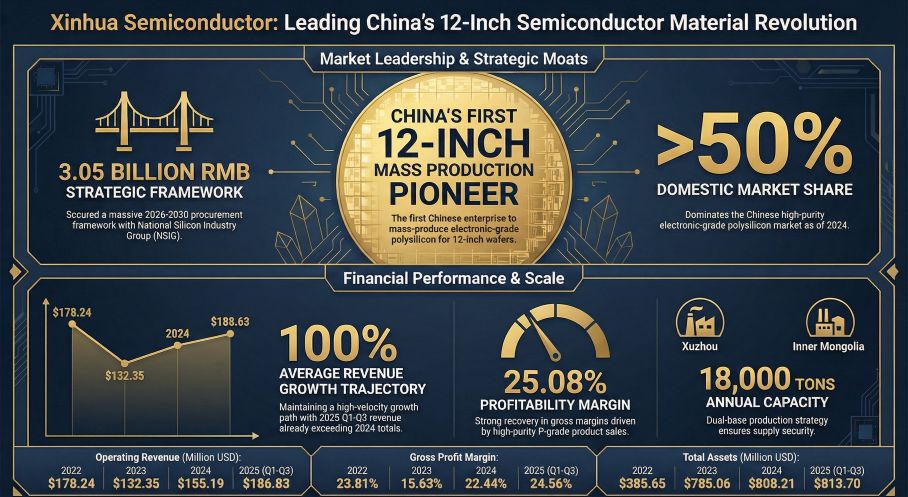 Strategic Moats and Sector Positioning
Xinhua Semiconductor’s market dominance is underpinned by formidable technological barriers and deep customer integration. The global electronic-grade polysilicon market is historically characterized by extreme concentration, with fewer than five mature suppliers globally, such as Germany's Wacker and Japan's Tokuyama. Xinhua has effectively bridged this technological chasm.
Through proprietary ppt-level purification and advanced CVD deposition technologies, the company has stabilized its polysilicon purity above the 11N (99.999999999%) threshold, with ultra-high purity and Float-Zone (FZ) products reaching 13N. By controlling donor and acceptor impurities at the ppta (parts per trillion atomic) level, Xinhua directly enables the structural integrity of advanced nodes (5nm and below), AI chips, silicon photonics, and high-end IGBT power devices.
Furthermore, the semiconductor materials sector demands an arduous validation cycle ranging from three months to three years. Backed by a synergistic governance model integrating state-backed capital (the National Big Fund) and downstream giants (NSIG, TCL), Xinhua has secured profound supply chain stickiness. Once integrated into the manufacturing processes of Tier-1 wafer fabs, the switching costs become prohibitively high, creating an impenetrable commercial moat.
Capital Allocation Efficiency & Capacity Expansion
To leverage its technological parity into global market share, Xinhua Semiconductor is executing an aggressive but calculated capital expenditure strategy. The company has already established an 18,000-ton/year dual-core manufacturing footprint across Xuzhou and Inner Mongolia. This geographical diversification not only optimizes energy costs but establishes a scalable base capable of servicing global Tier-1 wafer suppliers.
With its upcoming IPO targeting a net raise of approximately $186 million (1.32 billion RMB), Xinhua aims to catalyze a 72% capacity surge, elevating total output to 31,000 tons/year. Crucially, the capital allocation is heavily skewed toward high-margin, next-generation technologies: a 1,500-ton ultra-high purity project to secure advanced-node raw materials and a 1,500-ton FZ polysilicon project to fill domestic voids in power device substrates. This lateral and vertical expansion indicates a strategic pivot from a single-product manufacturer to a comprehensive silicon-based materials service provider.
Cyclical Headwinds & Financial Health
While the long-term growth thesis is robust, HDIN Research notes that the company must navigate distinct cyclical and structural headwinds. The polysilicon sector operates on a heavy-asset model; the activation of the Inner Mongolia facility will introduce an estimated $2.2 million in monthly depreciation costs, applying near-term pressure on net profit margins.
Additionally, the company’s profitability in 2023 was disproportionately dragged down by acute price volatility in its solar-grade polysilicon by-products, which saw price contractions of nearly 80%. However, core business resilience is evident: driven by a higher mix of premium P-grade products and optimized power purchasing, the main business gross margin rebounded sharply to 25.08% in the first three quarters of 2025. Furthermore, the company’s commitment to fully expensing its R&D outlays—rather than capitalizing them—reflects a highly conservative accounting policy that underscores the authentic earnings quality of its core operations.
HDIN Viewpoint
From an institutional perspective, HDIN Research views Xinhua Semiconductor not merely as a materials manufacturer, but as the critical "Layer 0" infrastructure of China's semiconductor ecosystem. Its ability to achieve 13N ultra-high purity breaks the final upstream bottleneck in the domestic 12-inch wafer supply chain. While heavy capital expenditures and macroeconomic cyclicality present short-term financial headwinds, Xinhua’s transition toward advanced AI-chip and power-device material ecosystems guarantees its long-term pricing power and strategic indispensability. For industry stakeholders, the company's trajectory from a domestic substitute to a global technical peer offers a compelling blueprint for supply chain resilience.
Presentation Download
Click the PDF download link under “Related Topics” to access the presentation of this report.
About HDIN Research Profile:
HDIN Research focuses on providing market consulting services. As an independent third-party consulting firm, it is committed to providing in-depth market research and analysis reports.
Website: www.hdinresearch.com
E-mail: sales@hdinresearch.com
Figure Xinhua Semiconductor: Leading China's 12-Inch Semiconductor Material Revolution
Strategic Moats and Sector PositioningXinhua Semiconductor’s market dominance is underpinned by formidable technological barriers and deep customer integration. The global electronic-grade polysilicon market is historically characterized by extreme concentration, with fewer than five mature suppliers globally, such as Germany's Wacker and Japan's Tokuyama. Xinhua has effectively bridged this technological chasm.
Through proprietary ppt-level purification and advanced CVD deposition technologies, the company has stabilized its polysilicon purity above the 11N (99.999999999%) threshold, with ultra-high purity and Float-Zone (FZ) products reaching 13N. By controlling donor and acceptor impurities at the ppta (parts per trillion atomic) level, Xinhua directly enables the structural integrity of advanced nodes (5nm and below), AI chips, silicon photonics, and high-end IGBT power devices.
Furthermore, the semiconductor materials sector demands an arduous validation cycle ranging from three months to three years. Backed by a synergistic governance model integrating state-backed capital (the National Big Fund) and downstream giants (NSIG, TCL), Xinhua has secured profound supply chain stickiness. Once integrated into the manufacturing processes of Tier-1 wafer fabs, the switching costs become prohibitively high, creating an impenetrable commercial moat.
Capital Allocation Efficiency & Capacity Expansion
To leverage its technological parity into global market share, Xinhua Semiconductor is executing an aggressive but calculated capital expenditure strategy. The company has already established an 18,000-ton/year dual-core manufacturing footprint across Xuzhou and Inner Mongolia. This geographical diversification not only optimizes energy costs but establishes a scalable base capable of servicing global Tier-1 wafer suppliers.
With its upcoming IPO targeting a net raise of approximately $186 million (1.32 billion RMB), Xinhua aims to catalyze a 72% capacity surge, elevating total output to 31,000 tons/year. Crucially, the capital allocation is heavily skewed toward high-margin, next-generation technologies: a 1,500-ton ultra-high purity project to secure advanced-node raw materials and a 1,500-ton FZ polysilicon project to fill domestic voids in power device substrates. This lateral and vertical expansion indicates a strategic pivot from a single-product manufacturer to a comprehensive silicon-based materials service provider.
Cyclical Headwinds & Financial Health
While the long-term growth thesis is robust, HDIN Research notes that the company must navigate distinct cyclical and structural headwinds. The polysilicon sector operates on a heavy-asset model; the activation of the Inner Mongolia facility will introduce an estimated $2.2 million in monthly depreciation costs, applying near-term pressure on net profit margins.
Additionally, the company’s profitability in 2023 was disproportionately dragged down by acute price volatility in its solar-grade polysilicon by-products, which saw price contractions of nearly 80%. However, core business resilience is evident: driven by a higher mix of premium P-grade products and optimized power purchasing, the main business gross margin rebounded sharply to 25.08% in the first three quarters of 2025. Furthermore, the company’s commitment to fully expensing its R&D outlays—rather than capitalizing them—reflects a highly conservative accounting policy that underscores the authentic earnings quality of its core operations.
HDIN Viewpoint
From an institutional perspective, HDIN Research views Xinhua Semiconductor not merely as a materials manufacturer, but as the critical "Layer 0" infrastructure of China's semiconductor ecosystem. Its ability to achieve 13N ultra-high purity breaks the final upstream bottleneck in the domestic 12-inch wafer supply chain. While heavy capital expenditures and macroeconomic cyclicality present short-term financial headwinds, Xinhua’s transition toward advanced AI-chip and power-device material ecosystems guarantees its long-term pricing power and strategic indispensability. For industry stakeholders, the company's trajectory from a domestic substitute to a global technical peer offers a compelling blueprint for supply chain resilience.
Presentation Download
Click the PDF download link under “Related Topics” to access the presentation of this report.
About HDIN Research Profile:
HDIN Research focuses on providing market consulting services. As an independent third-party consulting firm, it is committed to providing in-depth market research and analysis reports.
Website: www.hdinresearch.com
E-mail: sales@hdinresearch.com