Goldman Sachs 2025: Accelerating the Asset-Light Pivot Amidst Capital Constraint Realities
Date : 2026-03-03
Reading : 110
In 2025, The Goldman Sachs Group delivered a masterclass in strategic recalibration. Fueled by a resurgence in corporate deal-making and a decisive exit from retail banking, the firm drove a 20.3% year-over-year surge in net earnings, bringing Return on Equity (ROE) back to its 15.0% target. However, beneath the headline revenue of $58.28 billion lies a complex narrative of transitioning from balance-sheet-heavy operations toward a highly scalable, third-party capital-driven asset management model.
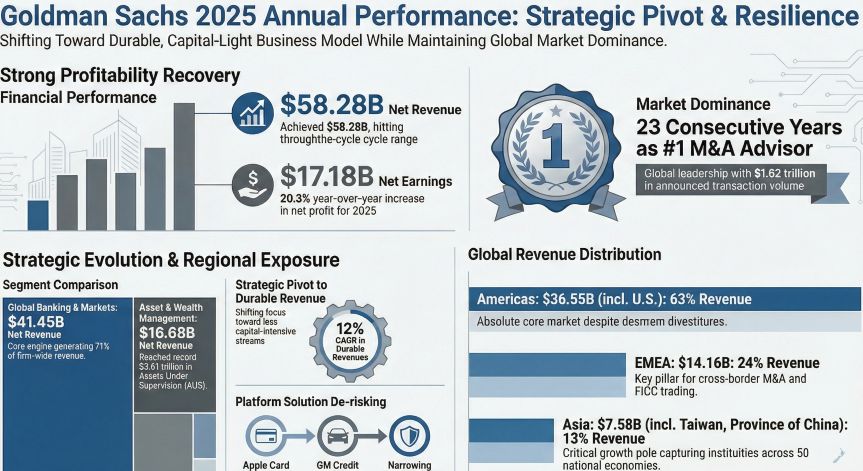
Figure Goldman Sachs 2025 Annual Performance Strategic Pivot & Resilience
 Financial Health & Capital Allocation Efficiency
Goldman Sachs demonstrated robust profitability recovery in 2025, yet operational and regulatory costs are reshaping its capital allocation matrix. The Global Banking & Markets (GBM) division remains the undisputed engine of the firm, generating $41.45 billion—over 71% of total net revenues. This outperformance was heavily driven by a 23% revenue surge in Equities and a 21% jump in Investment Banking fees, underscoring the firm's entrenched position in M&A advisory and global underwriting.
Despite top-line growth, the firm’s Efficiency Ratio ticked upward to 64.4% (from 63.1% in 2024), reflecting an 11% rise in operating expenses driven by performance-based compensation and transaction costs. More critically, capital allocation efficiency is facing headwinds. While Goldman Sachs confidently raised its Q1 2026 dividend to $4.50 per share and maintains a $32 billion share repurchase authorization, its Standardized CET1 ratio compressed by 70 basis points to 14.3%. This contraction was triggered by a $51.1 billion inflation in Risk-Weighted Assets (RWA). As the firm’s G-SIB surcharge scales to 3.5% in 2026—and potentially 4.0% by 2028—aggressive capital returns may face tightening regulatory ceilings.
Strategic Pivots & Moat Strengthening
2025 marked the aggressive execution of Goldman Sachs’ pivot toward recurring, fee-based revenue streams. The Asset & Wealth Management (AWM) division pushed its Assets Under Supervision (AUS) to a historic high of $3.61 trillion, capturing $224 billion in net inflows. By winding down historical principal investments from $9.4 billion to $6.0 billion, the firm is successfully deleveraging its balance sheet to favor third-party fund management, targeting $300 billion in credit alternatives by 2028.
Simultaneously, the firm eliminated the cyclical drag of its consumer finance experiment. The Platform Solutions division saw revenues plummet to $151 million, absorbing a $2.26 billion impairment to migrate the Apple Card portfolio to a "held for sale" status and divesting the GM credit card program. By folding Transaction Banking back into the GBM division, Goldman Sachs is reinforcing its "OneGS" initiative, consolidating its strategic moats around institutional and ultra-high-net-worth (UHNW) clients.
Cyclical Headwinds & Risk Governance
While market conditions remain favorable, Goldman Sachs faces structural and macroeconomic vulnerabilities. The firm's stress-testing models explicitly account for severe recessionary scenarios and escalating geopolitical fragmentation, notably U.S. tariff policies and cross-strait tensions in Asia, which could disrupt global supply chains and cross-border M&A flows.
Furthermore, the impending Basel III "Endgame" and the Fundamental Review of the Trading Book (FRTB) pose significant RWA inflation risks. A heavy reliance on Value at Risk (VaR) modeling—which inherently excludes amortized cost assets and masks intraday trading spread profitability—suggests that non-trading book interest rate sensitivities require stringent monitoring by institutional investors.
HDIN Viewpoint
From an institutional perspective, HDIN Research views Goldman Sachs’ 2025 performance as a successful execution of "addition by subtraction." Exiting the retail credit space has immediately improved earnings quality. However, the structural transition to a true "asset-light" model remains incomplete. With GBM still contributing over 71% of total revenue, the firm’s earnings stability remains highly tethered to capital market volatility. Looking toward 2026, the success of the newly announced "OneGS 3.0" operational efficiency program will be the ultimate determinant of whether Goldman can maintain its 14%-16% ROE target amidst rigid G-SIB capital surcharges and compressing electronic trading margins.
Download & Media Access
Click the PDF download link under “Related Topics” to access the presentation of this report.
Click this link to watch the YouTube video.
About HDIN Research
Profile: HDIN Research focuses on providing market consulting services. As an independent third-party consulting firm, it is committed to providing in-depth market research and analysis reports.
Website: www.hdinresearch.com
E-mail: sales@hdinresearch.com
Figure Goldman Sachs 2025 Annual Performance Strategic Pivot & Resilience
Financial Health & Capital Allocation EfficiencyGoldman Sachs demonstrated robust profitability recovery in 2025, yet operational and regulatory costs are reshaping its capital allocation matrix. The Global Banking & Markets (GBM) division remains the undisputed engine of the firm, generating $41.45 billion—over 71% of total net revenues. This outperformance was heavily driven by a 23% revenue surge in Equities and a 21% jump in Investment Banking fees, underscoring the firm's entrenched position in M&A advisory and global underwriting.
Despite top-line growth, the firm’s Efficiency Ratio ticked upward to 64.4% (from 63.1% in 2024), reflecting an 11% rise in operating expenses driven by performance-based compensation and transaction costs. More critically, capital allocation efficiency is facing headwinds. While Goldman Sachs confidently raised its Q1 2026 dividend to $4.50 per share and maintains a $32 billion share repurchase authorization, its Standardized CET1 ratio compressed by 70 basis points to 14.3%. This contraction was triggered by a $51.1 billion inflation in Risk-Weighted Assets (RWA). As the firm’s G-SIB surcharge scales to 3.5% in 2026—and potentially 4.0% by 2028—aggressive capital returns may face tightening regulatory ceilings.
Strategic Pivots & Moat Strengthening
2025 marked the aggressive execution of Goldman Sachs’ pivot toward recurring, fee-based revenue streams. The Asset & Wealth Management (AWM) division pushed its Assets Under Supervision (AUS) to a historic high of $3.61 trillion, capturing $224 billion in net inflows. By winding down historical principal investments from $9.4 billion to $6.0 billion, the firm is successfully deleveraging its balance sheet to favor third-party fund management, targeting $300 billion in credit alternatives by 2028.
Simultaneously, the firm eliminated the cyclical drag of its consumer finance experiment. The Platform Solutions division saw revenues plummet to $151 million, absorbing a $2.26 billion impairment to migrate the Apple Card portfolio to a "held for sale" status and divesting the GM credit card program. By folding Transaction Banking back into the GBM division, Goldman Sachs is reinforcing its "OneGS" initiative, consolidating its strategic moats around institutional and ultra-high-net-worth (UHNW) clients.
Cyclical Headwinds & Risk Governance
While market conditions remain favorable, Goldman Sachs faces structural and macroeconomic vulnerabilities. The firm's stress-testing models explicitly account for severe recessionary scenarios and escalating geopolitical fragmentation, notably U.S. tariff policies and cross-strait tensions in Asia, which could disrupt global supply chains and cross-border M&A flows.
Furthermore, the impending Basel III "Endgame" and the Fundamental Review of the Trading Book (FRTB) pose significant RWA inflation risks. A heavy reliance on Value at Risk (VaR) modeling—which inherently excludes amortized cost assets and masks intraday trading spread profitability—suggests that non-trading book interest rate sensitivities require stringent monitoring by institutional investors.
HDIN Viewpoint
From an institutional perspective, HDIN Research views Goldman Sachs’ 2025 performance as a successful execution of "addition by subtraction." Exiting the retail credit space has immediately improved earnings quality. However, the structural transition to a true "asset-light" model remains incomplete. With GBM still contributing over 71% of total revenue, the firm’s earnings stability remains highly tethered to capital market volatility. Looking toward 2026, the success of the newly announced "OneGS 3.0" operational efficiency program will be the ultimate determinant of whether Goldman can maintain its 14%-16% ROE target amidst rigid G-SIB capital surcharges and compressing electronic trading margins.
Download & Media Access
Click the PDF download link under “Related Topics” to access the presentation of this report.
Click this link to watch the YouTube video.
About HDIN Research
Profile: HDIN Research focuses on providing market consulting services. As an independent third-party consulting firm, it is committed to providing in-depth market research and analysis reports.
Website: www.hdinresearch.com
E-mail: sales@hdinresearch.com