Eos Energy (EOSE) 2025 Strategic Audit: Capitalizing on AI Grid Constraints Through Zinc-Based LDES
Date : 2026-03-04
Reading : 93
Eos Energy Enterprises (NASDAQ: EOSE) has officially crossed the chasm from technology validation to industrial-scale commercialization. In fiscal year 2025, the company recorded a staggering 632% top-line expansion to $114.2 million, backed by a $1.5 billion capital infusion that successfully eradicated lingering "going concern" risks. However, the strategic imperative has now shifted: Eos must leverage its zinc-based Long-Duration Energy Storage (LDES) technology to capture the explosive energy demands of AI data centers while navigating cyclical lithium price headwinds and intense margin pressures.
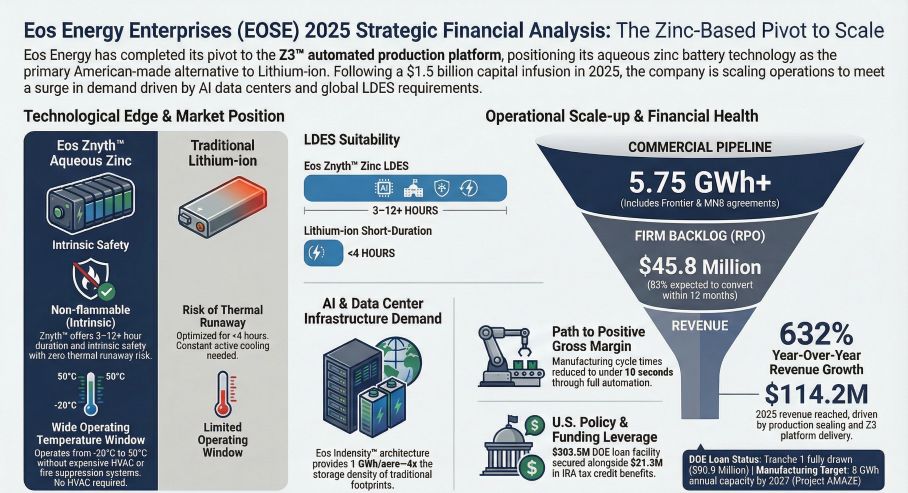
Figure Eos Energy Enterprises (EOSE) 2025 Strategic Financial Analysis The Zinc-Based Pivot to Scale
 Financial Health & Capital Allocation Efficiency
Eos’s 2025 financial posture reflects the classic profile of a capital-intensive hardware disruptor transitioning into operational maturity. The injection of approximately $1.5 billion across equity, convertible notes, and a Department of Energy (DOE) loan fundamentally restructured the company's balance sheet, providing a critical 12-to-24-month liquidity runway.
Crucially, capital allocation efficiency has pivoted sharply from basic R&D toward manufacturing scale. In 2025, over 98% of the $54.7 million in Capital Expenditures (CapEx) was directed toward Property, Plant, and Equipment (PP&E)—specifically the automation of Line 1 at the Turtle Creek facility under "Project AMAZE." By reducing the automated line cycle time to under 10 seconds and successfully drawing the first $90.9 million tranche of the DOE loan, management has proven its ability to execute complex operational milestones.
Despite this, gross margins remain deeply negative, with a 2025 gross loss of $143.8 million. The core financial challenge is no longer liquidity, but rather reversing the "selling one dollar for two dollars in cost" dynamic through economies of scale and reducing non-recurring commissioning expenses.
Strategic Moats & Sector Positioning in the AI Era
The proliferation of Artificial Intelligence (AI) and High-Performance Computing (HPC) has fundamentally altered grid dynamics, creating a structural need for 3-to-12-hour LDES solutions. Eos is strategically positioning its Znyth™ zinc-based chemistry as a critical infrastructure enabler for this sector.
Unlike traditional lithium-ion systems, the Z3 platform possesses an intrinsic safety profile—immune to thermal runaway and capable of operating in extreme temperatures (-20°C to 50°C). This eliminates the need for capital-intensive HVAC and fire-suppression systems, drastically reducing total cost of ownership (TCO) for data centers.
Furthermore, Eos has introduced the "Eos Indensity" architecture, targeting an unprecedented storage density of 1 GWh per acre—roughly four times the industry standard. Combined with the DawnOS software platform for real-time load balancing, Eos has engineered a robust strategic moat for space-constrained, mission-critical AI campuses. The recent strategic partnership with Talen Energy in Pennsylvania validates this aggressive push into the AI utility space.
Cyclical Headwinds & Supply Chain Resilience
By relying on five highly abundant, inexpensive commodity materials (such as zinc), Eos effectively insulates its supply chain from the EV market's bottlenecked competition for lithium, cobalt, and nickel. This domestic manufacturing footprint allowed Eos to capture $21.3 million in Inflation Reduction Act (IRA) 45X Advanced Manufacturing Production Tax Credits (PTC) in 2025, directly offsetting cost of goods sold (COGS).
However, cyclical headwinds remain severe. The continued global oversupply and subsequent price drop of lithium-ion batteries threaten to dilute Eos’s cost-competitiveness. Additionally, the regulatory landscape introduces new hurdles; the newly signed *One Big Beautiful Bill Act* (OBBBA) imposes strict restrictions on Prohibited Foreign Entity (PFE) sourcing, requiring agile supply chain compliance to maintain vital tax credit eligibility. Customer concentration also remains a vulnerability, with the top two clients accounting for over 70% of 2025 revenue.
HDIN Viewpoint: The Drive Toward "Bankability"
From an institutional perspective at HDIN Research, Eos Energy's 2025 trajectory indicates a hyper-focus on commercial "bankability." The C-suite and board reshuffles—transitioning former CFO Nathan Kroeker to Chief Commercial Officer, appointing manufacturing veteran John Mahaz as COO, and onboarding utility heavyweight Joseph Nigro to the Board—are deliberate signals to the market and creditors. The management incentive structure is now directly tethered to Total Shareholder Return (TSR) and debt-covenant milestones.
Eos's core chemistry is settled. The ultimate test of its valuation will be the successful launch of the Warrendale facility in 2026, aiming for an 8 GWh capacity by 2027. If Eos can convert its $45.7 million backlog into positive-margin deliveries before federal subsidies begin their phasedown, it will solidify its position not just as an alternative battery manufacturer, but as a foundational pillar of the next-generation AI energy grid.
Presentation Download & Media Access
Click the PDF download link under “Related Topics” to access the presentation of this report.
Click this link to watch the YouTube video.
About HDIN Research
HDIN Research focuses on providing market consulting services. As an independent third-party consulting firm, it is committed to providing in-depth market research and analysis reports.
Website: www.hdinresearch.com
E-mail: sales@hdinresearch.com
Figure Eos Energy Enterprises (EOSE) 2025 Strategic Financial Analysis The Zinc-Based Pivot to Scale
Financial Health & Capital Allocation EfficiencyEos’s 2025 financial posture reflects the classic profile of a capital-intensive hardware disruptor transitioning into operational maturity. The injection of approximately $1.5 billion across equity, convertible notes, and a Department of Energy (DOE) loan fundamentally restructured the company's balance sheet, providing a critical 12-to-24-month liquidity runway.
Crucially, capital allocation efficiency has pivoted sharply from basic R&D toward manufacturing scale. In 2025, over 98% of the $54.7 million in Capital Expenditures (CapEx) was directed toward Property, Plant, and Equipment (PP&E)—specifically the automation of Line 1 at the Turtle Creek facility under "Project AMAZE." By reducing the automated line cycle time to under 10 seconds and successfully drawing the first $90.9 million tranche of the DOE loan, management has proven its ability to execute complex operational milestones.
Despite this, gross margins remain deeply negative, with a 2025 gross loss of $143.8 million. The core financial challenge is no longer liquidity, but rather reversing the "selling one dollar for two dollars in cost" dynamic through economies of scale and reducing non-recurring commissioning expenses.
Strategic Moats & Sector Positioning in the AI Era
The proliferation of Artificial Intelligence (AI) and High-Performance Computing (HPC) has fundamentally altered grid dynamics, creating a structural need for 3-to-12-hour LDES solutions. Eos is strategically positioning its Znyth™ zinc-based chemistry as a critical infrastructure enabler for this sector.
Unlike traditional lithium-ion systems, the Z3 platform possesses an intrinsic safety profile—immune to thermal runaway and capable of operating in extreme temperatures (-20°C to 50°C). This eliminates the need for capital-intensive HVAC and fire-suppression systems, drastically reducing total cost of ownership (TCO) for data centers.
Furthermore, Eos has introduced the "Eos Indensity" architecture, targeting an unprecedented storage density of 1 GWh per acre—roughly four times the industry standard. Combined with the DawnOS software platform for real-time load balancing, Eos has engineered a robust strategic moat for space-constrained, mission-critical AI campuses. The recent strategic partnership with Talen Energy in Pennsylvania validates this aggressive push into the AI utility space.
Cyclical Headwinds & Supply Chain Resilience
By relying on five highly abundant, inexpensive commodity materials (such as zinc), Eos effectively insulates its supply chain from the EV market's bottlenecked competition for lithium, cobalt, and nickel. This domestic manufacturing footprint allowed Eos to capture $21.3 million in Inflation Reduction Act (IRA) 45X Advanced Manufacturing Production Tax Credits (PTC) in 2025, directly offsetting cost of goods sold (COGS).
However, cyclical headwinds remain severe. The continued global oversupply and subsequent price drop of lithium-ion batteries threaten to dilute Eos’s cost-competitiveness. Additionally, the regulatory landscape introduces new hurdles; the newly signed *One Big Beautiful Bill Act* (OBBBA) imposes strict restrictions on Prohibited Foreign Entity (PFE) sourcing, requiring agile supply chain compliance to maintain vital tax credit eligibility. Customer concentration also remains a vulnerability, with the top two clients accounting for over 70% of 2025 revenue.
HDIN Viewpoint: The Drive Toward "Bankability"
From an institutional perspective at HDIN Research, Eos Energy's 2025 trajectory indicates a hyper-focus on commercial "bankability." The C-suite and board reshuffles—transitioning former CFO Nathan Kroeker to Chief Commercial Officer, appointing manufacturing veteran John Mahaz as COO, and onboarding utility heavyweight Joseph Nigro to the Board—are deliberate signals to the market and creditors. The management incentive structure is now directly tethered to Total Shareholder Return (TSR) and debt-covenant milestones.
Eos's core chemistry is settled. The ultimate test of its valuation will be the successful launch of the Warrendale facility in 2026, aiming for an 8 GWh capacity by 2027. If Eos can convert its $45.7 million backlog into positive-margin deliveries before federal subsidies begin their phasedown, it will solidify its position not just as an alternative battery manufacturer, but as a foundational pillar of the next-generation AI energy grid.
Presentation Download & Media Access
Click the PDF download link under “Related Topics” to access the presentation of this report.
Click this link to watch the YouTube video.
About HDIN Research
HDIN Research focuses on providing market consulting services. As an independent third-party consulting firm, it is committed to providing in-depth market research and analysis reports.
Website: www.hdinresearch.com
E-mail: sales@hdinresearch.com