Navigating the Pivot: Xponential Fitness (XPOF) 2026 Strategic Outlook
Date : 2026-03-10
Reading : 770
Xponential Fitness (XPOF) is entering a profound era of structural detoxification. While top-line revenue is projected to contract by 14%-17% in 2026 (landing between $260 million and $270 million), this numerical decline is not a symptom of market defeat, but a deliberate recalibration. By shifting from aggressive multi-brand acquisition to an asset-light operational model, XPOF is sacrificing scale for business purity. For institutional observers, the critical narrative is no longer about blind footprint expansion, but rather how capital allocation efficiency and brand rationalization will fortify the company’s strategic moats against impending macroeconomic pressures.
Figure Xponential Fitness 2025: Strategic Pivot to a High-Margin Asset-Light Model
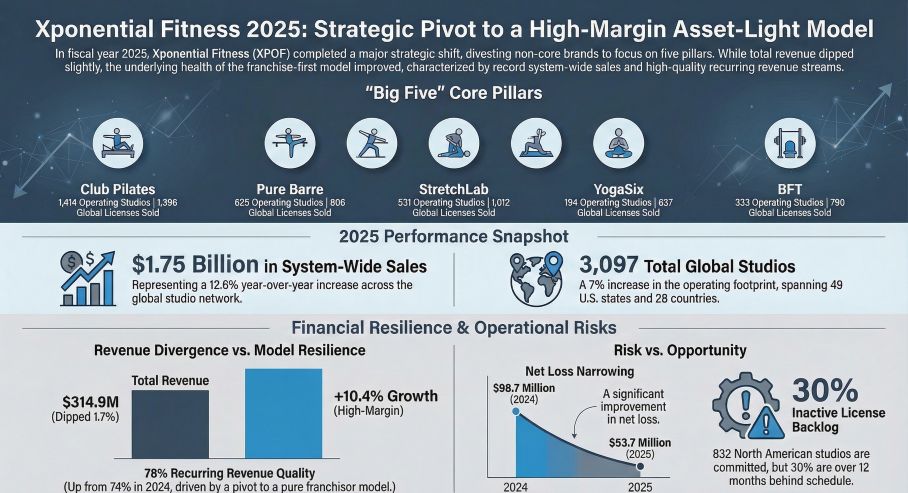 Strategic Pivots: Transitioning to an Asset-Light Moat
In 2025, XPOF underwent a severe transition from "Brand Acquirer" to "Operation Optimizer." Management executed a decisive brand rationalization strategy by divesting underperforming assets, including CycleBar, Rumble, and Lindora. Consequently, capital and operational bandwidth are now heavily concentrated on five core pillars dominating the boutique fitness sector: Club Pilates, Pure Barre, StretchLab, YogaSix, and BFT.
The "So What" Factor:
The most impactful strategic pivot lies in the restructuring of XPOF’s retail business. By outsourcing merchandise operations to Fit Commerce in late 2025, the company transformed a heavy-inventory segment into a high-margin, pure commission stream (projected to generate $50 million over five years). While this removes gross merchandise sales from the 2026 ledger—driving the optical revenue decline—it dramatically enhances capital allocation efficiency, eliminating inventory bloat and protecting core franchise unit economics.
Sector Positioning and Operational Efficiency
Despite maintaining a commanding sector positioning with over 3,000 global studios and 70.4 million paid members, XPOF faces substantial cyclical headwinds in its unit-level operations. Notably, Same-Store Sales (SSS) growth plummeted from 7% in 2024 to 0% in 2025, a glaring indicator that organic momentum within existing studios has plateaued.
To counteract this stagnation, XPOF is leveraging digital transformation to enhance operational efficiency. By integrating AI-driven predictive analytics and data warehouses, the company aims to optimize the top-of-funnel marketing conversion rate and decrease Customer Acquisition Costs (CAC) for its franchisees. Furthermore, 78% of XPOF’s revenue is now recurring, supported by a subscription-centric ecosystem that locks in member lifetime value and fortifies the franchisor-franchisee shared financial moat.
Financial Health: Restructuring Amidst Cyclical Headwinds
An analysis of XPOF's 2025 net loss of $53.67 million reveals a narrative of resilience masked by one-off accounting impacts. The deficit was heavily skewed by non-recurring operational burdens, including a $27.33 million loss on debt extinguishment, $32.72 million in asset impairments, and $30.10 million in legal settlements (including FTC and franchisee agreements). Stripping away these anomalies, the company generated a positive GAAP operating profit of $19.85 million.
However, the company's capital structure introduces tight liquidity constraints. The December 2025 refinancing secured a $525 million term loan, but at a punishing interest rate of 10.92% (SOFR + premium).
The "So What" Factor:
This debt load translates to roughly $53 million in interest obligations for 2026. While the core operations are highly profitable—boasting an Adjusted EBITDA of $111.8 million (a 35.5% margin)—this capital structure leaves negligible margin for error. If inflationary pressures persist or new store openings fail to offset the interest burden, this debt profile will act as a severe cyclical headwind.
HDIN Viewpoint
From the analytical lens of HDIN Research, XPOF in 2026 will emerge as a "smaller, yet structurally sounder" enterprise. The strategic divestitures of capital-heavy, low-margin divisions inherently widen the pathway for long-term Adjusted EBITDA margin expansion.
However, we advise institutional investors to maintain a posture of prudent skepticism regarding two critical risk vectors. First, approximately 30% of XPOF’s North American sold licenses (around 250 studios) are currently classified as "inactive" backlog—a delayed pipeline that threatens future equipment and royalty cash flows. Second, HDIN Research notes a vital discrepancy in operating expenses: 2025 SG&A was artificially cushioned by a $34.8 million non-recurring insurance credit. Without this buffer in 2026, baseline operational costs will appear inflated. Management’s ability to re-ignite Same-Store Sales growth and clear the dormant franchise backlog in Q1 2026 will be the ultimate litmus test for whether this strategic pivot yields a durable competitive advantage.
Presentation Download
Click the PDF download link under “Related Topics” to access the presentation of this report.
Click this link to watch the YouTube video.
About HDIN Research
About HDIN Research Profile: HDIN Research focuses on providing market consulting services. As an independent third-party consulting firm, it is committed to providing in-depth market research and analysis reports.
Website: www.hdinresearch.com
E-mail: sales@hdinresearch.com
Figure Xponential Fitness 2025: Strategic Pivot to a High-Margin Asset-Light Model
Strategic Pivots: Transitioning to an Asset-Light MoatIn 2025, XPOF underwent a severe transition from "Brand Acquirer" to "Operation Optimizer." Management executed a decisive brand rationalization strategy by divesting underperforming assets, including CycleBar, Rumble, and Lindora. Consequently, capital and operational bandwidth are now heavily concentrated on five core pillars dominating the boutique fitness sector: Club Pilates, Pure Barre, StretchLab, YogaSix, and BFT.
The "So What" Factor:
The most impactful strategic pivot lies in the restructuring of XPOF’s retail business. By outsourcing merchandise operations to Fit Commerce in late 2025, the company transformed a heavy-inventory segment into a high-margin, pure commission stream (projected to generate $50 million over five years). While this removes gross merchandise sales from the 2026 ledger—driving the optical revenue decline—it dramatically enhances capital allocation efficiency, eliminating inventory bloat and protecting core franchise unit economics.
Sector Positioning and Operational Efficiency
Despite maintaining a commanding sector positioning with over 3,000 global studios and 70.4 million paid members, XPOF faces substantial cyclical headwinds in its unit-level operations. Notably, Same-Store Sales (SSS) growth plummeted from 7% in 2024 to 0% in 2025, a glaring indicator that organic momentum within existing studios has plateaued.
To counteract this stagnation, XPOF is leveraging digital transformation to enhance operational efficiency. By integrating AI-driven predictive analytics and data warehouses, the company aims to optimize the top-of-funnel marketing conversion rate and decrease Customer Acquisition Costs (CAC) for its franchisees. Furthermore, 78% of XPOF’s revenue is now recurring, supported by a subscription-centric ecosystem that locks in member lifetime value and fortifies the franchisor-franchisee shared financial moat.
Financial Health: Restructuring Amidst Cyclical Headwinds
An analysis of XPOF's 2025 net loss of $53.67 million reveals a narrative of resilience masked by one-off accounting impacts. The deficit was heavily skewed by non-recurring operational burdens, including a $27.33 million loss on debt extinguishment, $32.72 million in asset impairments, and $30.10 million in legal settlements (including FTC and franchisee agreements). Stripping away these anomalies, the company generated a positive GAAP operating profit of $19.85 million.
However, the company's capital structure introduces tight liquidity constraints. The December 2025 refinancing secured a $525 million term loan, but at a punishing interest rate of 10.92% (SOFR + premium).
The "So What" Factor:
This debt load translates to roughly $53 million in interest obligations for 2026. While the core operations are highly profitable—boasting an Adjusted EBITDA of $111.8 million (a 35.5% margin)—this capital structure leaves negligible margin for error. If inflationary pressures persist or new store openings fail to offset the interest burden, this debt profile will act as a severe cyclical headwind.
HDIN Viewpoint
From the analytical lens of HDIN Research, XPOF in 2026 will emerge as a "smaller, yet structurally sounder" enterprise. The strategic divestitures of capital-heavy, low-margin divisions inherently widen the pathway for long-term Adjusted EBITDA margin expansion.
However, we advise institutional investors to maintain a posture of prudent skepticism regarding two critical risk vectors. First, approximately 30% of XPOF’s North American sold licenses (around 250 studios) are currently classified as "inactive" backlog—a delayed pipeline that threatens future equipment and royalty cash flows. Second, HDIN Research notes a vital discrepancy in operating expenses: 2025 SG&A was artificially cushioned by a $34.8 million non-recurring insurance credit. Without this buffer in 2026, baseline operational costs will appear inflated. Management’s ability to re-ignite Same-Store Sales growth and clear the dormant franchise backlog in Q1 2026 will be the ultimate litmus test for whether this strategic pivot yields a durable competitive advantage.
Presentation Download
Click the PDF download link under “Related Topics” to access the presentation of this report.
Click this link to watch the YouTube video.
About HDIN Research
About HDIN Research Profile: HDIN Research focuses on providing market consulting services. As an independent third-party consulting firm, it is committed to providing in-depth market research and analysis reports.
Website: www.hdinresearch.com
E-mail: sales@hdinresearch.com