Rehabilitation Robotics Market: Global Strategic Outlook
- Single User License (1 Users) $ 3,500
- Team License (2~5 Users) $ 4,500
- Corporate License (>5 Users) $ 5,500
The global rehabilitation robotics market size is estimated at between 280 million USD to 480 million USD in 2026 with a compound annual growth rate (CAGR) of 15% to 25% through 2031. This acceleration is propelled by three primary catalysts: the global codification of statutory medical reimbursement (led by Medicare fee schedule finalizations in the United States and social court mandates in Germany), acute labor deficits across clinical physical therapy workforces, and the mechanical evolution from rigid, high-payload frames toward compliant, cable-driven and soft textile architectures. Historically restricted to neurorehabilitation gyms within inpatient rehabilitation facilities (IRFs), the technology now addresses millions of individuals living with chronic stroke-induced hemiparesis, traumatic spinal cord injury (SCI), and degenerative neuromuscular conditions. However, the sector faces substantial friction, marked by acute balance sheet compression among pioneer public firms, multi-year regulatory bottlenecks under the European Union Medical Device Regulation (EU MDR), and prolonged commercial payer prior-authorization cycles.
PRODUCT DEFINITION AND MECHANISTIC RATIONALE
● Regulatory and Clinical Scope
Across dominant regulatory jurisdictions, including the United States Food and Drug Administration (FDA), South Korea's Ministry of Food and Drug Safety (MFDS), the European Union under MDR 2017/745, and Japan's Pharmaceuticals and Medical Devices Agency (PMDA), rehabilitation robotics are governed as active Class II or Class 3 medical devices. These systems combine motorized actuation, bio-electrical sensing, and closed-loop algorithmic control to augment, retrain, or restore neuromuscular function impaired by central nervous system trauma or musculoskeletal degenerative pathology.
Functionally, the market bifurcates into two distinct operational modes:
* Therapeutic Exercise and Motor Retraining Platforms: Systems utilizing variable assistance-as-needed (AAN) algorithms and physiological kinematic guidance to deliver intensive, high-dosage task-specific movements that promote functional motor recovery through neuroplasticity.
* Assistive Ambulation and Daily Living Orthoses: Wearable powered devices engineered for permanent or semi-permanent functional substitution, enabling non-ambulatory or partially paralyzed individuals to independently execute upright standing, overground walking, stair climbing, and multi-planar upper-extremity reaching tasks.
● Mechanistic Foundations: Cortical Reorganization and Secondary Pathology Mitigation
The clinical deployment of robotic systems is underpinned by two primary physiological imperatives:
* Neuroplasticity Induction: Functional recovery following stroke, traumatic brain injury (TBI), or incomplete spinal cord injury depends heavily on the volume, repetition rate, and sensory-motor fidelity of motor retraining. Traditional manual physical therapy cannot reliably sustain the required dosage without inducing therapist fatigue. Closed-loop robotic systems establish continuous sensory feedback loops. By coupling patient-initiated bio-electrical signals (BES) or surface electromyography (sEMG) with immediate mechanical joint displacement, these devices evoke cortical reorganization and retrain spared descending neural tracts.
* Mitigation of Secondary Paraplegia Comorbidities: Prolonged wheelchair confinement triggers cascading systemic deterioration, including bone mineral density depletion (osteoporosis), skeletal muscle atrophy, joint contractures, metabolic syndrome, bowel and bladder dysfunction, cardiovascular decline, and chronic decubitus pressure ulcers. Wearable overground walking robotics provide early vertical weight-bearing and dynamic axial skeletal loading, directly countering long-term systemic degeneration and lowering secondary hospitalization costs.
* Ergonomic and Economic Optimization for Clinical Staff: Conventional body-weight-supported gait therapy requires up to three therapists to manually lift, stabilize, and guide paretic limbs, resulting in high rates of work-related musculoskeletal injuries among clinical personnel. Robotic automation guarantees kinematic repeatability, captures objective patient telemetry, and enables a single therapist to manage intensive, high-repetition rehabilitation sessions safely.
PRODUCT CLASSIFICATION BY KINEMATIC AND MECHANICAL ARCHITECTURE
1. Exoskeleton Robotics (Rigid Wearable Powered Orthoses)
Mechanical and Kinematic Characteristics:
Rigid exoskeletons utilize external structural links fabricated from high-strength aerospace aluminum alloys, titanium, and carbon-fiber composite shells. The motorized joints are engineered to align co-axially with human anatomical axes (hip, knee, ankle, or shoulder, elbow, wrist) to deliver direct rotational torque via brushless DC motors and strain-wave gearing.
● Representative Platforms:
* EksoNR and Ekso Indego (Ekso Bionics): Overground lower-limb powered systems integrating modular structural sections, onboard microprocessors, and lithium-ion batteries. EksoNR utilizes dynamic variable assistance software for inpatient multi-etiology neuro-training, while Indego emphasizes modular multi-segment transportability for institutional and personal mobility.
* ReWalk Personal 6.0 and ReWalk 7 (Lifeward): Rigid lower-extremity bipedal orthoses utilizing patented trunk-tilt sensors and multi-axis servomotors at the hip and knee joints to facilitate overground ambulation, sitting, standing, and curb navigation.
* Walkbot Series (P&S Robotics): Institutional robotic gait systems (Walkbot_S, Walkbot_K, Walkbot_G) featuring synchronized three-joint active motor actuation (hip, knee, and ankle) with automated one-millimeter-increment anatomical joint length adjustment.
* Angel Legs M20 (Angel Robotics): Wearable overground exoskeleton utilizing series elastic actuators and human intention estimation algorithms to eliminate backdrive friction during unassisted movement phases.
* Hybrid Assistive Limb / HAL (CYBERDYNE): Lower-limb and single-joint cybernic devices actuated via skin-surface detection of action potentials (bio-electrical signals), synchronizing direct torque delivery with motor intent.
● Operational Trade-offs:
Rigid exoskeletons offer unmatched vertical stability, permitting complete motor-complete paraplegic individuals to stand and walk overground without suspension gantries. However, they carry substantial mass (typically 12 to 26 kg for untethered personal platforms), require significant donning and doffing time, and introduce risks of joint shear forces if mechanical and biological axes are misaligned.
2. End-Effector Robotics and Kinetic Displacement Systems
● Mechanical and Kinematic Characteristics:
End-effector systems apply assistive and resistive forces exclusively at distal anatomical points (e.g., footplates, pedals, handgrips). Unlike rigid exoskeletons, no motorized links are strapped directly across biological joints. Proximal joint trajectories (hip, knee, shoulder) are dictated indirectly through distal kinetic manipulation and the patient's intrinsic biomechanical degrees of freedom.
● Representative Platforms:
* MediTouch BalanceTutor (distributed by Ekso Bionics): A dynamic perturbation treadmill utilizing multi-directional carriage translations to elicit unexpected postural perturbations during standing or walking, targeting dynamic reactive balance recovery.
* Differential Air Pressure (DAP) Systems / AlterG Anti-Gravity (Lifeward): While not an articulated joint robot, this platform utilizes positive differential air pressure within an airtight chamber to exert calibrated unweighting in one-percent increments (up to 80% body-weight reduction), enabling low-impact early gait therapy.
* Stationary Distal Gait Trainers (e.g., Hocoma/DIH systems): Footplate-driven stepping devices designed for high-repetition acute-stage rehabilitation.
● Operational Trade-offs:
End-effector platforms significantly shorten patient setup times and naturally adapt to diverse patient limb lengths without mechanical link modifications. However, they provide minimal direct control over proximal joint kinematics, allowing abnormal compensatory patterns (such as knee hyperextension or lateral pelvic drop) to persist unless corrected manually by an attending therapist.
3. Cable-Driven Robotics (Bowden Cable / Tendon Actuation)
● Mechanical and Kinematic Characteristics:
Cable-driven systems decouple heavy motor drives and power electronics from biological limbs. Actuation assemblies are mounted on a central chassis (typically a pelvic harness or backpack unit), transmitting mechanical tension to distal joint interfaces via flexible Bowden cable conduits or synthetic polymer tendons.
● Representative Platforms:
* ReStore Exo-Suit (Lifeward): A lightweight soft gait training system incorporating a waist-mounted actuator and Bowden cables extending down the lower extremity to actuate the ankle joint, delivering synchronized tensile assistance during plantigrade propulsion and dorsiflexion ground clearance.
* Advanced Soft Wearable Prototypes (Angel Robotics): Modular tendon-driven transmission platforms engineered for stroke survivors to provide low-inertia assistive torque across hip, knee, and ankle joints.
● Operational Trade-offs:
Cable-driven mechanics drastically reduce distal limb inertia, preserving physiological limb swing dynamics and minimizing patient metabolic fatigue. However, Bowden cables are unidirectional actuators capable only of pulling; generating bidirectional joint torque requires complex agonist-antagonist cable routing or mechanical spring returns, while internal cable friction introduces non-linearities into real-time control algorithms.
4. Soft Exosuit Robotics (Textile and Elastomeric Systems)
● Mechanical and Kinematic Characteristics:
Soft exosuits completely discard rigid metallic links and hinged mechanical joints. They utilize functional textiles, precision webbing, and elastomeric wraps to transmit assistive forces directly through the patient's soft tissue and skeletal framework.
● Representative Platforms:
* ReBoot (Lifeward): A personalized battery-powered soft wearable exo-suit designed for community ambulation among stroke survivors, cleared under FDA Breakthrough Device Designation to target foot drop and propulsion deficits.
* Angel Suit H10 (Angel Robotics): A soft wearable hip-assistive suit engineered for subacute gait retraining, orthopedic recovery, and elderly mobility, prioritizing rapid donning, lightweight form factor, and low backdrive resistance.
● Operational Trade-offs:
Soft exosuits are exceptionally lightweight, compact, and comfortable, creating near-zero donning resistance and eliminating joint-axis mismatch risks. However, they provide zero direct structural load-bearing capacity, making them entirely unsuitable for complete spinal cord injuries or individuals lacking the voluntary skeletal stability required to remain upright.
PRODUCT CLASSIFICATION BY ANATOMICAL TARGET
1. Upper-Limb Rehabilitation Robotics
● Clinical Objectives:
Restoration of multi-planar reaching, forearm supination/pronation, and functional hand grasp/release configurations to enable basic activities of daily living (ADLs), such as feeding, grooming, and object manipulation.
● Representative Systems and Technological Frameworks:
* Myomo MyoPro Platform (MyoPro 2, MyoPro 2x): Custom-fabricated myoelectric elbow-wrist-hand orthoses (EWHO). The system utilizes non-invasive surface electromyography (sEMG) sensors placed over agonist and antagonist muscle groups. Propelling onboard microprocessors, it detects faint voluntary motor commands (down to microvolt thresholds in paretic muscle) to drive brushless micro-motors across the elbow and hand. The platform operates under continuous user agency: if active muscular effort stops, device actuation ceases immediately. Models include the Motion W (powered elbow with passive multi-position wrist) and Motion G (powered elbow with motorized terminal grasp).
* P&S Robotics Healerbot and BABYBOT: Dedicated upper-extremity systems focused on multi-axis shoulder joint mobilization and active/passive resistive rehabilitation for orthopedic and neurological impairments, complemented by micro-motorized hand-and-finger therapy modules.
* CYBERDYNE HAL Single Joint: Modular bio-electrical signal-guided cybernic actuator designed for targeted single-joint flexion and extension training at the elbow or shoulder.
* Hocoma/DIH Armeo Line: A comprehensive institutional upper-limb continuum ranging from the ArmeoPower (an exoskeleton for acute, severe arm paralysis) to the ArmeoSpring (spring-based passive arm offloading) and ArmeoSenso (sensor-based distal hand training).
* HKK Bionics and Vincent Systems: High-precision bionic hand orthoses and micro-actuated motorized finger orthoses designed to restore anatomical grasp patterns for patients with flaccid distal paralysis or peripheral nerve lesions.
2. Lower-Limb Rehabilitation Robotics
● Clinical Objectives:
Lower-limb robotics represent the largest market segment by revenue and clinical deployment. The target is the recovery of rhythmic lower-extremity gait cycles, stance-phase knee stability, swing-phase foot clearance, symmetrical pelvic rotation, and ground propulsion.
● Institutional and Body-Weight-Supported Platforms:
* EksoNR (Ekso Bionics): FDA-cleared clinical exoskeleton utilized across stroke, acquired brain injury, spinal cord injury, and multiple sclerosis. Incorporates adaptive SmartAssist algorithms to independently modulate assistance levels (0% to 100%) on each paretic limb in real time.
* Walkbot System (P&S Robotics): Stationary robotic gait platform coupling an instrumented dynamic body-weight support gantry with an articulated three-joint motorized exoskeleton. The Walkbot differentiates through active motorized ankle actuation (plantarflexion and dorsiflexion synchronized with knee and hip motions) and its Natural Gait Pattern Generation (NGPG) software, which calculates individual anatomical trajectories based on patient limb dimensions and walking velocity.
* Lokomat (Hocoma / DIH): The clinical gold standard for stationary body-weight-supported gait orthosis therapy, utilized extensively across global academic trauma and neurorehabilitation centers.
● Personal Ambulation and Community Mobility Systems:
* ReWalk Personal 6.0 and ReWalk 7 (Lifeward): Rigid lower-extremity powered orthoses cleared for individuals with paraplegia due to SCI (neurological levels T7 to L5 for personal community use; T4 to L5 in clinical settings). Utilizes body-posture tilt sensors to initiate steps, crutch-integrated push-button interfaces, and specialized mechanical clearance for ascending and descending curbs and stairs.
* Ekso Indego Personal: Modular, lightweight lower-limb powered orthosis configured for SCI populations (T3 to L5), enabling community and home ambulation alongside a trained companion.
* Atalante X and Eve (Wandercraft): Hands-free, self-balancing robotic exoskeletons driven by dynamic physical-AI balance algorithms, permitting multi-directional walking and pelvic mobility without the need for forearm crutches.
3. Trunk and Spine Balance Robotics
● Clinical Objectives:
Enhancement of dynamic core stability, rehabilitation of center-of-mass (COM) regulation, reduction of fall risks, and axial offloading of the lumbar spine.
● Representative Systems:
* CYBERDYNE HAL Lumbar Type: Wearable pelvic-lumbar cybernic orthosis that non-invasively captures lumbar motor nerve potentials to assist trunk extension and pelvic tilt. Deployed across geriatric institutions for fall-prevention training and in occupational healthcare to mitigate spine compression during heavy patient handling.
* MediTouch BalanceTutor: Kinetic platform delivering multi-directional translational perturbations to the base of support, stimulating balance recovery and deep spinal postural reactions.
* Dynamic Body-Weight Support Pelvic Modules (Walkbot Dynamic Gantry): Integrated pelvic balance suspension mechanisms that mitigate vertical inertia and stabilize center-of-mass oscillations during intensive early-stage gait retraining.
DOWNSTREAM CLINICAL APPLICATIONS AND CARE CONTINUUM DYNAMICS
● Primary Clinical Indications and Target Demographics
Stroke and Cerebrovascular Accidents (CVA):
Stroke accounts for the largest addressable patient population. In the United States, approximately 800,000 individuals experience an acute stroke annually. Roughly 60% of long-term stroke survivors (approaching 3.8 million people in the U.S.) exhibit persistent moderate-to-severe upper-extremity motor dysfunction, while 30% to 40% suffer chronic lower-extremity gait deficits. The addressable population eligible for custom upper-limb myoelectric systems is estimated at 40,000 to 80,000 new candidates each year in the U.S. alone. Concurrently, hundreds of thousands of post-stroke patients require progressive ambulatory intervention following discharge, underpinning the shift toward lightweight outpatient and home devices.
● Spinal Cord Injury (SCI):
Traumatic spinal cord injuries represent the cornerstone demographic for rigid lower-limb exoskeletons. According to National Spinal Cord Injury Statistical Center (NSCISC) registries, 308,000 to 309,000 individuals live with SCI in the United States, with 18,000 new traumatic incidents annually. Traumatic incidents are predominantly driven by motor vehicle collisions (37%) and falls (32%).
Approximately 40% of the SCI population sustain neurological lesions between vertebral levels T4 and L5. Factoring in medical contraindications such as joint contractures, severe spasticity, compromised bone mineral density, and upper-limb functional limits, multi-center clinical evaluations identify approximately 20% of the total SCI pool (~61,000 individuals in the U.S.) as direct candidates for personal overground exoskeletons. The direct economic cost of managing paraplegia reaches roughly 670,000 USD per patient in the first year alone, underscoring the health-economic justification for devices that mitigate secondary medical complications.
● Neurodegenerative, Pediatric, and Orthopedic Extensions:
* Pediatric Indications: Cerebral palsy (CP) affects approximately 70,000 school-aged children in the United States. Pediatric-specific robotic solutions, such as Trexo Robotics' dynamic wheeled gait trainers (Trexo Plus and Trexo Home) and the Walkbot_K platform, address this segment with high-repetition stepping therapy.
* Progressive Neuromuscular Pathology: Systemic indications include multiple sclerosis (MS), amyotrophic lateral sclerosis (ALS), spinal muscular atrophy (SMA), and muscular dystrophies. In Japan, statutory coverage applies to eight designated rare neuromuscular diseases via CYBERDYNE's HAL Medical Lower Limb.
* Orthopedic and Sports Medicine Pathologies: Expanding beyond traditional neurology, platforms like Lifeward's AlterG, P&S Robotics' Healerbot, and Angel Robotics' Angel Suit H10 increasingly treat post-operative total knee/hip arthroplasties, rotator cuff reconstructions, and athletic joint unweighting.
● Care Delivery Continuum
The delivery architecture for robotic rehabilitation operates across three distinct operational tiers:
* Acute and Inpatient Rehabilitation Facilities (IRFs and LTACHs): Encompasses roughly 1,200 certified IRFs in the United States and over 3,500 acute rehabilitation hospitals globally. Characterized by capital purchases of high-payload, multi-patient stationary gait orthoses (e.g., Walkbot, Lokomat) and adaptive institutional exoskeletons (EksoNR).
* Outpatient Physical Therapy Practices: The largest and most fragmented institutional network, comprising over 54,000 outpatient facilities in the United States and 100,000 worldwide. Outpatient clinics prioritize compact footprints, high patient throughput, and modular equipment (such as AlterG unweighting treadmills and mobile therapy suits).
* Direct-to-Patient (D2P) and Home Ambulation: The fastest-growing market tier by volume, driven by personal units (MyoPro, ReWalk Personal, Indego Personal, Trexo Home, Angel Suit H10) funded via third-party statutory payers. Over 87% of SCI patients are discharged to private homes, driving demand for personal mobility technology.
COMMERCIALIZATION ARCHITECTURE AND REIMBURSEMENT LANDSCAPE
1. Commercial Distribution Models
● Enterprise Capital Sales:
Historically dominant in acute-care facilities, this model involves direct capital equipment sales with 8- to 12-month enterprise procurement cycles. Placements are often bundled with multi-year preventative maintenance agreements (such as EksoCare), software license subscriptions, and proprietary consumables (such as AlterG differential air pressure seals).
● Direct-to-Patient (D2P) and Direct Payer Billing:
Myomo has demonstrated an integrated commercial shift by establishing itself as an accredited healthcare provider in the United States. Rather than solely selling hardware to clinics, Myomo manages the entire patient journey: patient recruitment via direct-to-consumer outreach, telehealth clinical assessments, physician prescription coordination, insurance prior-authorization submission, custom digital fabrication, and direct claim billing.
● Orthotic and Prosthetic (O&P) and Durable Medical Equipment (DME) Networks:
Ekso Bionics distributes the Indego Personal largely through specialized DME suppliers and regional O&P clinics (~3,000 facilities in the U.S.). The DME partner purchases the device, assumes billing responsibilities with Medicare or commercial payers, and coordinates custom fitting.
2. Rental-to-Purchase Models:
Common in European markets, especially Germany. Statutory health insurance funds (GKV) often mandate an initial 3- to 6-month trial rental period. Insurers only convert the contract into a permanent lump-sum capital purchase once the patient demonstrates measurable functional improvement, consistent usage compliance, and independent donning proficiency.
REGIONAL MARKET DYNAMICS
● Europe: The Largest Global Adoption Base
Europe holds the largest share of the global rehabilitation robotics market. Adoption is anchored by centralized healthcare reimbursement frameworks, extensive public neurorehabilitation infrastructure, and well-established clinical guidelines supporting early mobilization.
Germany serves as the regional anchor, driven by the Federal Social Court's landmark classification of exoskeletons as direct disability compensation. This legal clarity has enabled manufacturers to sign direct framework contracts with public statutory sickness funds such as BARMER and industrial trauma insurers (DGUV). Outside Germany, adoption across Italy, France, Switzerland, and the United Kingdom remains active, though navigating country-specific reimbursement pathways requires targeted health-economic validation.
Despite strong clinical integration, regulatory headwinds under EU MDR have tightened operational margins, prompting manufacturers to pause lower-margin product lines to prioritize MDR compliance for core platforms (such as ReWalk 7 and Indego Therapy). Prominent European competitors include DIH/Hocoma (Switzerland), Wandercraft (France), and specialized German developers such as Vincent Systems and HKK Bionics.
● North America: The Fast-Growing, High-Value Commercial Market
North America represents the second-largest global market, characterized by high healthcare expenditure, dense institutional infrastructure, and the world's most lucrative reimbursement fee structures.
The market has been accelerated by the finalized CMS Medicare fee schedules for personal lower-limb exoskeletons (K1007 at ~$91,000) and upper-limb myoelectric orthoses (L8701 and L8702 at ~$35,000 and ~$68,800, respectively). With 57% of SCI individuals in the United States enrolled in Medicare or Medicaid within five years of injury, these fee schedules unlock immediate commercial access for roughly 61,000 medically qualified SCI candidates and hundreds of thousands of stroke survivors with chronic upper-extremity hemiparesis.
Adoption is further bolstered by the Veterans Health Administration, which fully funds robotic orthoses for eligible veterans, and a network of roughly 1,200 Inpatient Rehabilitation Facilities and 54,000 outpatient clinics. North America acts as the primary headquarters and revenue base for key industry leaders, including Ekso Bionics, Lifeward, and Myomo.
● Asia-Pacific: The Fastest-Growing Regional Market
The Asia-Pacific region is the fastest-growing geographical market globally and the third-largest by total revenue. Growth is driven by rapid demographic aging in Japan, South Korea, and China, accompanied by dedicated national development programs supporting medical robotics and expanding public insurance reimbursement.
South Korea has established itself as an innovative commercial hub. The Ministry of Health and Welfare's 2022 enactment of statutory health insurance coverage (code A67080.01) for robotic gait retraining in early stroke has driven rapid institutional adoption across tertiary teaching hospitals. Domestic manufacturers Angel Robotics and P&S Robotics dominate the local landscape, heavily insulating the domestic market from foreign imports through localized pricing and clinical references.
Japan operates as a pioneer in cybernetic neurorehabilitation, supported by statutory reimbursement for CYBERDYNE's Medical HAL across multiple degenerative neuromuscular disorders. CYBERDYNE is also driving large-scale institutional expansions across Southeast Asia. In Malaysia, through a public-private partnership with the Social Security Organization (PERKESO), CYBERDYNE completed the deployment of 65 Medical HAL units to the National Neuro-Robotics and Cybernics Rehabilitation Centre in late 2025—the largest single-site robotic deployment globally. Concurrently, regional players are expanding across Thailand, Vietnam, and Singapore.
● Latin America: Emerging Specialty Territory
Latin America remains an emerging market, defined by low public reimbursement penetration and high reliance on out-of-pocket spending or private commercial insurance within premium neurological centers.
Commercial activities are centralized around regional hubs. In Mexico, P&S Robotics established a wholly owned subsidiary in Mexico City in late 2025 to coordinate distribution, maintenance, and clinical support across Latin America for its Walkbot and Healerbot platforms. In parallel, Lifeward finalized an exclusive regional distribution agreement with Verita Neuro to place personal exoskeletons in specialized neurological clinics. In Brazil, regulatory access is facilitated via the Medical Device Single Audit Program (MDSAP), granting companies like Myomo a structured pathway for registration.
● Middle East and Africa (MEA): Sovereign Investments and Clinical Hubs
The Middle East and Africa market is split between advanced healthcare infrastructure in the Gulf Cooperation Council (GCC) and underserved, donor-reliant regions.
GCC sovereign wealth funds and health ministries in the United Arab Emirates and Saudi Arabia are investing in world-class neurological centers, driving demand for advanced rehabilitation robotics. Lifeward entered into distribution agreements with Verita Neuro in late 2025 to expand personal exoskeleton sales within the UAE. In Israel, the ecosystem benefits from deep domestic biomechatronic innovation, serving as the historical engineering base for Lifeward. In international humanitarian contexts, CYBERDYNE partnered with UNIDO and JICA in late 2025 to supply HAL robotic systems to rehabilitation hospitals in Ukraine to support wounded veterans and trauma patients.
● KEY INDUSTRY COMPETITORS covered in the report: Ekso Bionics, Lifeward (Formerly ReWalk Robotics), CYBERDYNE Inc., Angel Robotics, P&S Robotics, Myomo, Inc., Wandercraft, Hocoma / DIH, Cosmo Robotics (ExoAtlet), FREE Bionics, Rex Bionics, Hexa HumanCare, FRT Robotics, WIRobotics, Trexo Robotics, SS SAICHI Corporation, HKK Bionics, Vincent Systems, Neurolutions, Mobia Medical.
OPPORTUNITIES AND STRUCTURAL INHIBITORS
● Strategic Opportunities
1. Decentralization to the Direct-to-Patient (D2P) Continuum:
The primary strategic frontier in rehabilitation robotics is the decentralization of care from institutional gymnasiums to outpatient clinics and private homes. While the addressable market for inpatient robotic gantries is constrained to approximately 4,700 acute centers globally, the population of homebound individuals with stroke-induced hemiparesis, multiple sclerosis, and spinal cord injuries exceeds tens of millions. The commercial models established by Myomo (integrated billing) and the CMS K1007/L8701/L8702 codes lay the groundwork for high-volume personal device adoption.
2. Transition from Neurology into High-Volume Orthopedics:
Neurological conditions are clinically severe but present relatively lower patient incidence compared to degenerative musculoskeletal disorders. The strategic pivot toward post-operative orthopedic recovery (total joint replacements, rotator cuff tears, hip fractures, and elderly frailty) massively expands procedural TAM. Devices engineered for rapid setup and high patient turnover (e.g., AlterG NEO, Angel Suit H10, and P&S Healerbot) target this high-volume space.
3. Integration of Artificial Intelligence and Real-Time Biomechanical Sensor Fusion:
The convergence of physical robotics with advanced edge computing is transforming adaptive therapy. Systems are evolving from rigid kinematic position-control machines to intelligent co-robotic partners. Using machine learning to analyze surface electromyography, mechanomyography, and multi-axis IMU data, these devices anticipate user intent, calculate real-time ground reaction forces, and adapt joint impedance dynamically. This decreases the cognitive and physical burden on clinical therapists while ensuring optimized assistance-as-needed delivery.
● Industry Inhibitors and Structural Headwinds
1. Capital Market Distress and Balance Sheet Insolvency:
Despite clinical and technological validation, the rehabilitation robotics sector faces severe financial stress among pioneer commercial entities. The capital-intensive nature of medical device engineering, paired with prolonged reimbursement execution timelines, has resulted in massive cumulative deficits. Lifeward's accumulated deficit of roughly 285 million USD and its 2026 reverse stock split, coupled with Ekso Bionics' equity-diluting transaction with Applied Digital Cloud Corporation, illustrate how early commercial leaders struggle to reach standalone operational profitability. Maintaining sustainable operations demands strict working capital management and gross margin discipline.
2. Regulatory Inflation and EU MDR Clearance Barriers:
The transition from Europe's Medical Devices Directive to EU MDR 2017/745 represents an ongoing operational bottleneck. The elevated demands for multi-center clinical trials, rigorous post-market surveillance, and notified-body audit backlogs have drastically inflated compliance costs. As evidenced by Lifeward's abandonment of the ReStore soft exo-suit in Europe, manufacturers are forced to abandon niche products and delay new product introductions, dampening European market revenue realization.
3. Reimbursement Friction and Administrative Denial Cycles:
While the formalization of CMS codes (K1007, L8701, L8702) provides a transparent statutory basis for claims in the United States, commercial realization is still subject to aggressive prior-authorization scrutiny. Private Medicare Advantage organizations, commercial HMOs, and private insurers frequently issue initial medical-necessity denials, demanding extensive peer-to-peer appeals and clinical documentation. Navigating these bureaucratic hurdles requires significant investment in internal billing infrastructure and dedicated patient advocacy support to prevent order cancellation rates from degrading conversion funnels.
1.1 Study Scope and Medical Robotics Taxonomy 1
1.2 Research Methodology and Triangulated Modeling Architecture 2
1.2.1 Primary Physician and Clinical Director Delphi Interviews 2
1.2.2 Secondary Clearance Registries and Trade Matrix Verification 3
1.3 Pricing, Currency Standardization, and Currency Conversion Parameters 4
1.4 Standard Assumptions and Diagnostic Boundaries 5
1.5 Nomenclature and Medical Abbreviations 6
Chapter 2 Global Rehabilitation Robotics Market Overview and Macroeconomic Drivers 7
2.1 Global Rehabilitation Robotics Market Value and Trajectory (2021-2031) 7
2.2 Neurological and Musculoskeletal Disease Prevalence Trends 8
2.3 Clinical Labor Constraints and Physical Therapist Deficits 10
2.4 Healthcare Payer Reforms, CPT Codes, and Inpatient Prospective Payment Systems 11
Chapter 3 Upstream Supply Chain, Value Chain Architecture, and Technological Infrastructure 12
3.1 Upstream Component Architecture and Precision Motion Subsystems 12
3.2 Embedded Edge Computing, Microcontrollers, and Kinematic Algorithmic Stacks 15
3.3 Original Equipment Manufacturing (OEM) vs. In-House Assembly Ecosystems 16
Chapter 4 Global Trade Dynamics, Regulatory Frameworks, and Reimbursement Trajectories 17
4.1 Global Flow of Rehabilitation Robotics Hardware and Componentry 17
4.2 Transpacific and Transatlantic Import/Export Tariff Schedules 18
4.3 Regulatory Pathways: US FDA 510(k), De Novo, and EU MDR Class IIa/IIb Compliance 19
4.4 National Reimbursement Paradigms: US CMS Coverage, German DiGA, and East Asian Systems 20
4.5 Supply Chain Vulnerabilities, Geopolitical Friction, and Strategic Sourcing 21
Chapter 5 Global Rehabilitation Robotics Market by Kinematic & Mechanical Architecture 22
5.1 Exoskeleton Robotics 22
5.1.1 Wearable Powered Anthropomorphic Exoskeletons 23
5.1.2 Rigid Exoskeletal Linkages and Joint Alignment Mechanics 24
5.2 End-Effector Robotics 25
5.2.1 Distal Interface Mechanics and Virtual Guidance Trajectories 25
5.2.2 Clinical Adaptability in Severe Post-Stroke Upper-Limb Rehabilitation 26
5.3 Cable-Driven Robotics 26
5.3.1 Lightweight Tension-Based Actuation and Biomimetic Force Vectors 27
5.3.2 Parallel Cable Platforms for Multi-Degree-of-Freedom Mobilization 27
5.4 Soft Exosuit Robotics 28
5.4.1 Textile-Integrated Elastomeric Actuators and Bowden Cable Arrays 28
5.4.2 Community-Dwelling Gait Assistance and Minimally Restrictive Compliance 29
Chapter 6 Global Rehabilitation Robotics Market by Anatomical Target 30
6.1 Upper-Limb Robots 30
6.2 Lower-Limb Robots 33
6.3 Trunk & Spine Balance Robots 35
Chapter 7 Global Rehabilitation Robotics Market by Clinical Application & Care Setting 37
7.1 Inpatient Neurorehabilitation Hospitals and Specialized Polytrauma Centers 37
7.2 Outpatient Physical Therapy Clinics and Orthopedic Subacute Facilities 38
7.3 Pediatric Neurodevelopmental Therapy Centers 39
7.4 Home-Based Tele-Rehabilitation and Personal Mobility Maintenance 40
Chapter 8 North America Rehabilitation Robotics Market Analysis 41
8.1 Regional Market Dynamics and Technology Commercialization Milestones 41
8.2 United States 42
8.3 Canada 45
Chapter 9 Europe Rehabilitation Robotics Market Analysis 48
9.1 European Regulatory Environment Under EU MDR and Cross-Border Standards 48
9.2 Germany 49
9.3 France 51
9.4 Switzerland 52
9.5 United Kingdom, Italy & Rest of Europe 53
Chapter 10 Asia-Pacific Rehabilitation Robotics Market Analysis 54
10.1 Regional Demographics, Rapid Geriatric Expansion, and Local Production Hubs 54
10.2 Japan 55
10.3 South Korea 56
10.4 China 57
10.5 Taiwan (China) 59
Chapter 11 Latin America, Middle East & Africa Rehabilitation Robotics Market Analysis 60
11.1 Latin America 60
11.2 Middle East & Africa 61
Chapter 12 Global Competitive Benchmarking, Industry Concentration, and Strategic Moats 64
12.1 Competitive Landscape Heatmap and Global Capacity Concentration (CR4, CR8) 64
12.2 Intellectual Property Moats: Actuation Patents, sEMG Decoding, and Sensory Feedback 65
12.3 Distribution Models: Direct Capital Sales vs. Robotics-as-a-Service (RaaS) Leasing 66
12.4 Mergers, Acquisitions, Clinical Partnerships, and Co-Development Ventures 67
Chapter 13 Corporate Intelligence & Financial Profiles: Americas Market Players 68
13.1 Ekso Bionics 68
13.1.1 Corporate Structure, Operational Footprint, and Clinical Indications 68
13.1.2 Ekso Bionics Rehabilitation Robotics Product Portfolio and Algorithmic Differentiation 69
13.1.3 SWOT Analysis 70
13.1.4 Product-Specific Financial Performance and Revenue Metrics 71
13.2 Lifeward 72
13.2.1 Corporate Structure, Operational Footprint, and Clinical Indications 72
13.2.2 Lifeward Rehabilitation Robotics Product Portfolio and Algorithmic Differentiation 73
13.2.3 SWOT Analysis 74
13.2.4 Product-Specific Financial Performance and Revenue Metrics 75
13.3 Trexo Robotics 76
13.3.1 Corporate Structure, Operational Footprint, and Clinical Indications 76
13.3.2 Trexo Robotics Rehabilitation Robotics Product Portfolio and Algorithmic Differentiation 77
13.3.3 SWOT Analysis 78
13.3.4 Product-Specific Financial Performance and Revenue Metrics 79
13.4 Myomo 80
13.4.1 Corporate Structure, Operational Footprint, and Clinical Indications 80
13.4.2 Myomo Rehabilitation Robotics Product Portfolio and Algorithmic Differentiation 81
13.4.3 SWOT Analysis 82
13.4.4 Product-Specific Financial Performance and Revenue Metrics 83
13.5 Indego 84
13.5.1 Corporate Structure, Operational Footprint, and Clinical Indications 84
13.5.2 Indego Rehabilitation Robotics Product Portfolio and Algorithmic Differentiation 85
13.5.3 SWOT Analysis 86
13.5.4 Product-Specific Financial Performance and Revenue Metrics 87
13.6 Neurolutions 88
13.6.1 Corporate Structure, Operational Footprint, and Clinical Indications 88
13.6.2 Neurolutions Rehabilitation Robotics Product Portfolio and Algorithmic Differentiation 89
13.6.3 SWOT Analysis 90
13.6.4 Product-Specific Financial Performance and Revenue Metrics 91
Chapter 14 Corporate Intelligence & Financial Profiles: European Market Players 92
14.1 Rex Bionics 92
14.1.1 Corporate Structure, Operational Footprint, and Clinical Indications 92
14.1.2 Rex Bionics Rehabilitation Robotics Product Portfolio and Algorithmic Differentiation 93
14.1.3 SWOT Analysis 94
14.1.4 Product-Specific Financial Performance and Revenue Metrics 95
14.2 Wandercraft 96
14.2.1 Corporate Structure, Operational Footprint, and Clinical Indications 96
14.2.2 Wandercraft Rehabilitation Robotics Product Portfolio and Algorithmic Differentiation 97
14.2.3 SWOT Analysis 98
14.2.4 Product-Specific Financial Performance and Revenue Metrics 99
14.3 Hocoma/DIH 100
14.3.1 Corporate Structure, Operational Footprint, and Clinical Indications 100
14.3.2 Hocoma/DIH Rehabilitation Robotics Product Portfolio and Algorithmic Differentiation 101
14.3.3 SWOT Analysis 102
14.3.4 Product-Specific Financial Performance and Revenue Metrics 103
14.4 Vincent Systems 104
14.4.1 Corporate Structure, Operational Footprint, and Clinical Indications 104
14.4.2 Vincent Systems Rehabilitation Robotics Product Portfolio and Algorithmic Differentiation 105
14.4.3 SWOT Analysis 106
14.4.4 Product-Specific Financial Performance and Revenue Metrics 107
14.5 HKK Bionics 108
14.5.1 Corporate Structure, Operational Footprint, and Clinical Indications 108
14.5.2 HKK Bionics Rehabilitation Robotics Product Portfolio and Algorithmic Differentiation 109
14.5.3 SWOT Analysis 110
14.5.4 Product-Specific Financial Performance and Revenue Metrics 111
Chapter 15 Corporate Intelligence & Financial Profiles: Asia-Pacific Market Players 112
15.1 Cyberdyne 112
15.1.1 Corporate Structure, Operational Footprint, and Clinical Indications 112
15.1.2 Cyberdyne Rehabilitation Robotics Product Portfolio and Algorithmic Differentiation 113
15.1.3 SWOT Analysis 114
15.1.4 Product-Specific Financial Performance and Revenue Metrics 115
15.2 Angel Robotics 116
15.2.1 Corporate Structure, Operational Footprint, and Clinical Indications 116
15.2.2 Angel Robotics Rehabilitation Robotics Product Portfolio and Algorithmic Differentiation 117
15.2.3 SWOT Analysis 118
15.2.4 Product-Specific Financial Performance and Revenue Metrics 119
15.3 P&S Robotics 120
15.3.1 Corporate Structure, Operational Footprint, and Clinical Indications 120
15.3.2 P&S Robotics Rehabilitation Robotics Product Portfolio and Algorithmic Differentiation 121
15.3.3 SWOT Analysis 122
15.3.4 Product-Specific Financial Performance and Revenue Metrics 123
15.4 SS SAICHI Corporation 124
15.4.1 Corporate Structure, Operational Footprint, and Clinical Indications 124
15.4.2 SS SAICHI Corporation Rehabilitation Robotics Product Portfolio and Algorithmic Differentiation 125
15.4.3 SWOT Analysis 126
15.4.4 Product-Specific Financial Performance and Revenue Metrics 127
15.5 FREE Bionics 128
15.5.1 Corporate Structure, Operational Footprint, and Clinical Indications 128
15.5.2 FREE Bionics Rehabilitation Robotics Product Portfolio and Algorithmic Differentiation 129
15.5.3 SWOT Analysis 130
15.5.4 Product-Specific Financial Performance and Revenue Metrics 131
15.6 Cosmo Robotics 132
15.6.1 Corporate Structure, Operational Footprint, and Clinical Indications 132
15.6.2 Cosmo Robotics Rehabilitation Robotics Product Portfolio and Algorithmic Differentiation 133
15.6.3 SWOT Analysis 134
15.6.4 Product-Specific Financial Performance and Revenue Metrics 135
15.7 Hexa HumanCare 136
15.7.1 Corporate Structure, Operational Footprint, and Clinical Indications 136
15.7.2 Hexa HumanCare Rehabilitation Robotics Product Portfolio and Algorithmic Differentiation 137
15.7.3 SWOT Analysis 138
15.7.4 Product-Specific Financial Performance and Revenue Metrics 139
15.8 FRT Robotics 140
15.8.1 Corporate Structure, Operational Footprint, and Clinical Indications 140
15.8.2 FRT Robotics Rehabilitation Robotics Product Portfolio and Algorithmic Differentiation 141
15.8.3 SWOT Analysis 142
15.8.4 Product-Specific Financial Performance and Revenue Metrics 143
15.9 WIRobotics 144
15.9.1 Corporate Structure, Operational Footprint, and Clinical Indications 144
15.9.2 WIRobotics Rehabilitation Robotics Product Portfolio and Algorithmic Differentiation 145
15.9.3 SWOT Analysis 146
15.9.4 Product-Specific Financial Performance and Revenue Metrics 147
15.10 Mobia Medical Inc. 148
15.10.1 Corporate Structure, Operational Footprint, and Clinical Indications 148
15.10.2 Mobia Medical Inc. Rehabilitation Robotics Product Portfolio and Algorithmic Differentiation 149
15.10.3 SWOT Analysis 150
15.10.4 Product-Specific Financial Performance and Revenue Metrics 151
Table 2 Primary Definitions and Lexicon of Rehabilitation Robotics Systems 6
Table 3 Global Rehabilitation Robotics Market Size by Value (USD Million) and Volume (Units), 2021-2031 7
Table 4 Global Post-Stroke and Traumatic Spinal Cord Injury Incidence by Key Region (2021-2026) 9
Table 5 Bills of Materials and Cost Breakdown for Medical Exoskeleton Actuation Systems 13
Table 6 Regulatory Clearance Pathways and Clinical Trial Timelines by Key Geography 19
Table 7 Global Rehabilitation Robotics Market by Kinematic Architecture, 2021-2031 (USD Million) 22
Table 8 Global Exoskeleton Robotics Market by Sub-Segment, 2021-2031 (USD Million) 24
Table 9 Global End-Effector Robotics Market by Sub-Segment, 2021-2031 (USD Million) 25
Table 10 Global Cable-Driven Robotics Market by Sub-Segment, 2021-2031 (USD Million) 27
Table 11 Global Soft Exosuit Robotics Market by Sub-Segment, 2021-2031 (USD Million) 28
Table 12 Global Rehabilitation Robotics Market by Anatomical Target, 2021-2031 (USD Million) 30
Table 13 Global Upper-Limb Rehabilitation Robotics Market by Joint Focus, 2021-2031 (USD Million) 31
Table 14 Global Lower-Limb Rehabilitation Robotics Market by Joint Focus, 2021-2031 (USD Million) 33
Table 15 Global Trunk & Spine Balance Robotics Market by Platform Type, 2021-2031 (USD Million) 35
Table 16 Global Rehabilitation Robotics Market by End-Use Setting, 2021-2031 (USD Million) 37
Table 17 North America Rehabilitation Robotics Market by Architecture, 2021-2031 (USD Million) 41
Table 18 North America Rehabilitation Robotics Market by Country, 2021-2031 (USD Million) 42
Table 19 United States Rehabilitation Robotics Market by Care Setting, 2021-2031 (USD Million) 44
Table 20 Canada Rehabilitation Robotics Market by Care Setting, 2021-2031 (USD Million) 46
Table 21 Europe Rehabilitation Robotics Market by Architecture, 2021-2031 (USD Million) 48
Table 22 Europe Rehabilitation Robotics Market by Country, 2021-2031 (USD Million) 49
Table 23 Germany Rehabilitation Robotics Market by Care Setting, 2021-2031 (USD Million) 50
Table 24 France Rehabilitation Robotics Market by Care Setting, 2021-2031 (USD Million) 51
Table 25 Switzerland Rehabilitation Robotics Market by Care Setting, 2021-2031 (USD Million) 53
Table 26 Asia-Pacific Rehabilitation Robotics Market by Architecture, 2021-2031 (USD Million) 54
Table 27 Asia-Pacific Rehabilitation Robotics Market by Country/Region, 2021-2031 (USD Million) 55
Table 28 Japan Rehabilitation Robotics Market by Care Setting, 2021-2031 (USD Million) 56
Table 29 South Korea Rehabilitation Robotics Market by Care Setting, 2021-2031 (USD Million) 57
Table 30 China Rehabilitation Robotics Market by Care Setting, 2021-2031 (USD Million) 58
Table 31 Taiwan (China) Rehabilitation Robotics Market by Care Setting, 2021-2031 (USD Million) 59
Table 32 Latin America, Middle East & Africa Rehabilitation Robotics Market by Region, 2021-2031 (USD Million) 61
Table 33 Global Key Players Market Concentration Ratios (CR4, CR8) and Revenue Share (2026) 65
Table 34 Ekso Bionics Rehabilitation Robotics Revenue, Cost and Gross Margin (2021-2026) 71
Table 35 Lifeward Rehabilitation Robotics Revenue, Cost and Gross Margin (2021-2026) 75
Table 36 Trexo Robotics Rehabilitation Robotics Revenue, Cost and Gross Margin (2021-2026) 79
Table 37 Myomo Rehabilitation Robotics Revenue, Cost and Gross Margin (2021-2026) 83
Table 38 Indego Rehabilitation Robotics Revenue, Cost and Gross Margin (2021-2026) 87
Table 39 Neurolutions Rehabilitation Robotics Revenue, Cost and Gross Margin (2021-2026) 91
Table 40 Rex Bionics Rehabilitation Robotics Revenue, Cost and Gross Margin (2021-2026) 95
Table 41 Wandercraft Rehabilitation Robotics Revenue, Cost and Gross Margin (2021-2026) 99
Table 42 Hocoma/DIH Rehabilitation Robotics Revenue, Cost and Gross Margin (2021-2026) 103
Table 43 Vincent Systems Rehabilitation Robotics Revenue, Cost and Gross Margin (2021-2026) 107
Table 44 HKK Bionics Rehabilitation Robotics Revenue, Cost and Gross Margin (2021-2026) 111
Table 45 Cyberdyne Rehabilitation Robotics Revenue, Cost and Gross Margin (2021-2026) 115
Table 46 Angel Robotics Rehabilitation Robotics Revenue, Cost and Gross Margin (2021-2026) 119
Table 47 P&S Robotics Rehabilitation Robotics Revenue, Cost and Gross Margin (2021-2026) 123
Table 48 SS SAICHI Corporation Rehabilitation Robotics Revenue, Cost and Gross Margin (2021-2026) 127
Table 49 FREE Bionics Rehabilitation Robotics Revenue, Cost and Gross Margin (2021-2026) 131
Table 50 Cosmo Robotics Rehabilitation Robotics Revenue, Cost and Gross Margin (2021-2026) 135
Table 51 Hexa HumanCare Rehabilitation Robotics Revenue, Cost and Gross Margin (2021-2026) 139
Table 52 FRT Robotics Rehabilitation Robotics Revenue, Cost and Gross Margin (2021-2026) 143
Table 53 WIRobotics Rehabilitation Robotics Revenue, Cost and Gross Margin (2021-2026) 147
Table 54 Mobia Medical Inc. Rehabilitation Robotics Revenue, Cost and Gross Margin (2021-2026) 151
Figure 1 Research Process Flow and Data Synthesis Triangulation 3
Figure 2 Global Rehabilitation Robotics Market Size and Growth Rate Forecast (2021-2031) 8
Figure 3 Global Physical Therapist Ratio per 10,000 Population Across Key Markets 10
Figure 4 Complete Value Chain Architecture of Medical Rehabilitation Robotics 12
Figure 5 Sensor, Actuator, and Microcontroller Interfacing Topology 14
Figure 6 Cross-Border Trade Flows and Distribution Channels for Rehabilitation Robotics 18
Figure 7 Global Rehabilitation Robotics Market Share by Kinematic Architecture (2026 vs. 2031) 23
Figure 8 Global Rehabilitation Robotics Market Share by Anatomical Target (2026 vs. 2031) 31
Figure 9 Global Rehabilitation Robotics Market Share by Clinical Care Setting (2026) 38
Figure 10 North America Rehabilitation Robotics Market Revenue by Country (2021-2031) 42
Figure 11 United States Rehabilitation Robotics Adoption Trajectory in Inpatient vs Outpatient Facilities 43
Figure 12 Europe Rehabilitation Robotics Market Revenue by Country (2021-2031) 49
Figure 13 Asia-Pacific Rehabilitation Robotics Market Revenue Share by Country/Region (2026) 55
Figure 14 Latin America, Middle East & Africa Market Dynamics and Capital Allocation 61
Figure 15 Competitive Matrix and Strategic Positioning Map of Rehabilitation Robotics Players (2026) 66
Figure 16 Ekso Bionics Rehabilitation Robotics Market Share (2021-2026) 71
Figure 17 Lifeward Rehabilitation Robotics Market Share (2021-2026) 75
Figure 18 Trexo Robotics Rehabilitation Robotics Market Share (2021-2026) 79
Figure 19 Myomo Rehabilitation Robotics Market Share (2021-2026) 83
Figure 20 Indego Rehabilitation Robotics Market Share (2021-2026) 87
Figure 21 Neurolutions Rehabilitation Robotics Market Share (2021-2026) 91
Figure 22 Rex Bionics Rehabilitation Robotics Market Share (2021-2026) 95
Figure 23 Wandercraft Rehabilitation Robotics Market Share (2021-2026) 99
Figure 24 Hocoma/DIH Rehabilitation Robotics Market Share (2021-2026) 103
Figure 25 Vincent Systems Rehabilitation Robotics Market Share (2021-2026) 107
Figure 26 HKK Bionics Rehabilitation Robotics Market Share (2021-2026) 111
Figure 27 Cyberdyne Rehabilitation Robotics Market Share (2021-2026) 115
Figure 28 Angel Robotics Rehabilitation Robotics Market Share (2021-2026) 119
Figure 29 P&S Robotics Rehabilitation Robotics Market Share (2021-2026) 123
Figure 30 SS SAICHI Corporation Rehabilitation Robotics Market Share (2021-2026) 127
Figure 31 FREE Bionics Rehabilitation Robotics Market Share (2021-2026) 131
Figure 32 Cosmo Robotics Rehabilitation Robotics Market Share (2021-2026) 135
Figure 33 Hexa HumanCare Rehabilitation Robotics Market Share (2021-2026) 139
Figure 34 FRT Robotics Rehabilitation Robotics Market Share (2021-2026) 143
Figure 35 WIRobotics Rehabilitation Robotics Market Share (2021-2026) 147
Figure 36 Mobia Medical Inc. Rehabilitation Robotics Market Share (2021-2026) 151
Research Methodology
- Market Estimated Methodology:
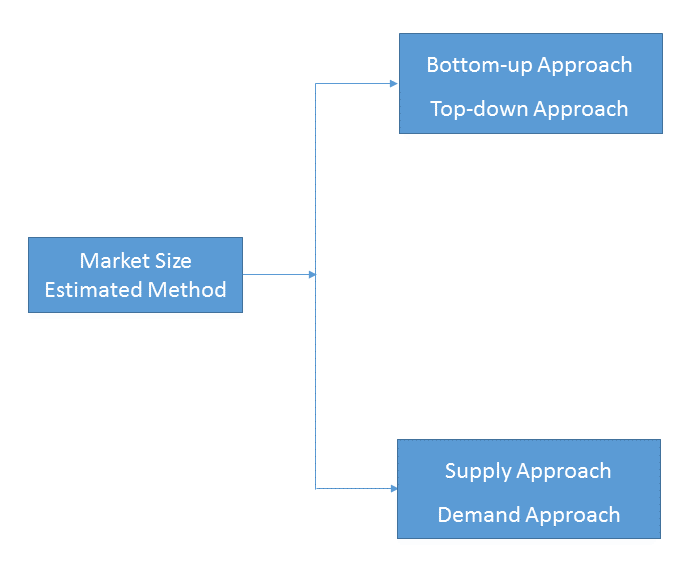
Bottom-up & top-down approach, supply & demand approach are the most important method which is used by HDIN Research to estimate the market size.
1)Top-down & Bottom-up Approach
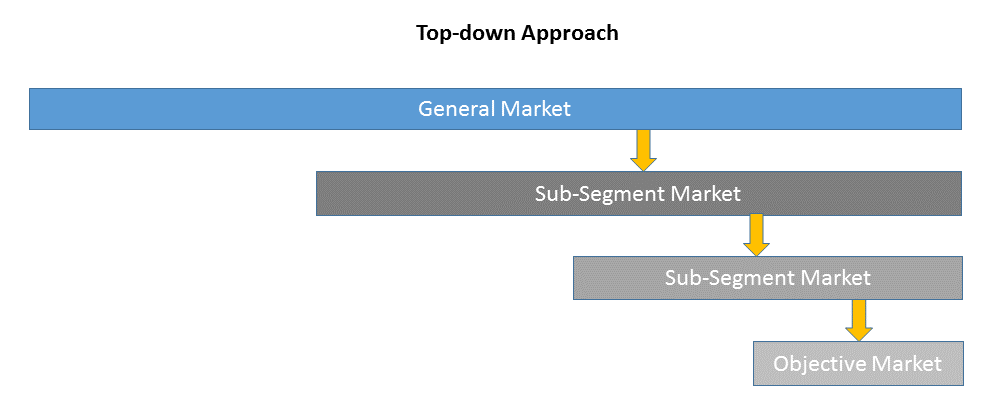
Top-down approach uses a general market size figure and determines the percentage that the objective market represents.
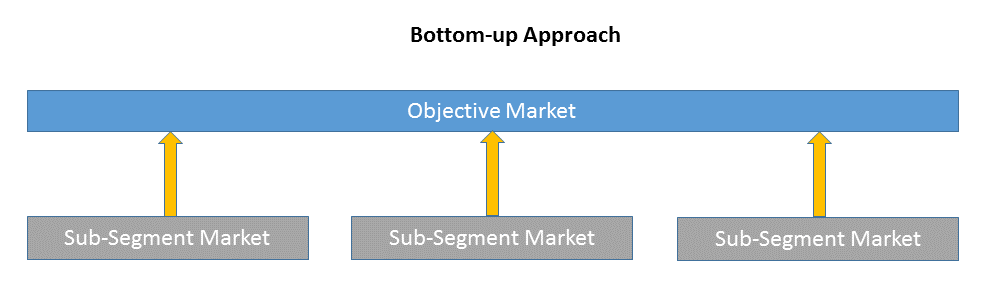
Bottom-up approach size the objective market by collecting the sub-segment information.
2)Supply & Demand Approach
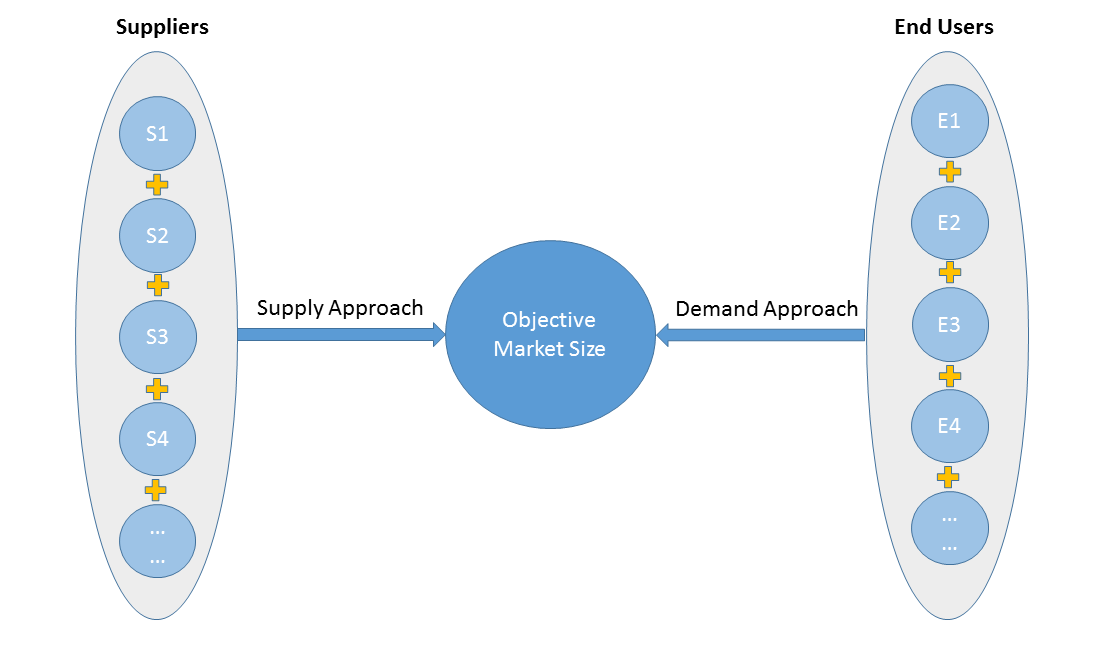
Supply approach is based on assessments of the size of each competitor supplying the objective market.
Demand approach combine end-user data within a market to estimate the objective market size. It is sometimes referred to as bottom-up approach.
- Forecasting Methodology
- Numerous factors impacting the market trend are considered for forecast model:
- New technology and application in the future;
- New project planned/under contraction;
- Global and regional underlying economic growth;
- Threatens of substitute products;
- Industry expert opinion;
- Policy and Society implication.
- Analysis Tools
1)PEST Analysis
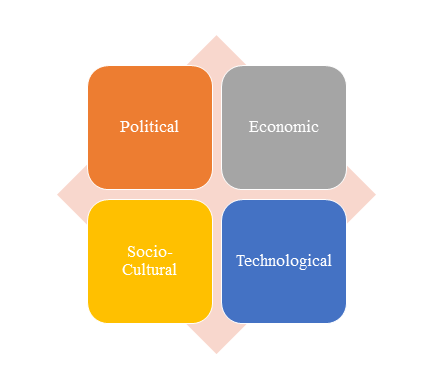
PEST Analysis is a simple and widely used tool that helps our client analyze the Political, Economic, Socio-Cultural, and Technological changes in their business environment.
- Benefits of a PEST analysis:
- It helps you to spot business opportunities, and it gives you advanced warning of significant threats.
- It reveals the direction of change within your business environment. This helps you shape what you’re doing, so that you work with change, rather than against it.
- It helps you avoid starting projects that are likely to fail, for reasons beyond your control.
- It can help you break free of unconscious assumptions when you enter a new country, region, or market; because it helps you develop an objective view of this new environment.
2)Porter’s Five Force Model Analysis
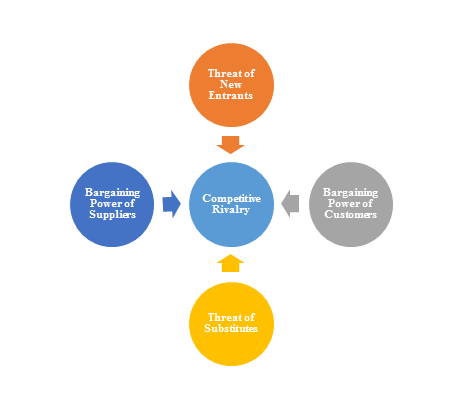
The Porter’s Five Force Model is a tool that can be used to analyze the opportunities and overall competitive advantage. The five forces that can assist in determining the competitive intensity and potential attractiveness within a specific area.
- Threat of New Entrants: Profitable industries that yield high returns will attract new firms.
- Threat of Substitutes: A substitute product uses a different technology to try to solve the same economic need.
- Bargaining Power of Customers: the ability of customers to put the firm under pressure, which also affects the customer's sensitivity to price changes.
- Bargaining Power of Suppliers: Suppliers of raw materials, components, labor, and services (such as expertise) to the firm can be a source of power over the firm when there are few substitutes.
- Competitive Rivalry: For most industries the intensity of competitive rivalry is the major determinant of the competitiveness of the industry.
3)Value Chain Analysis
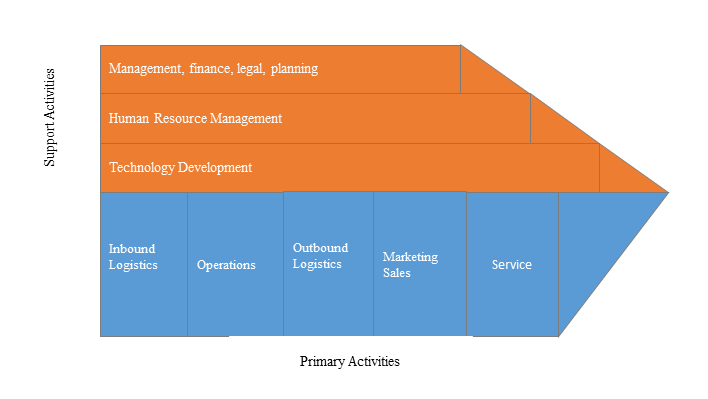
Value chain analysis is a tool to identify activities, within and around the firm and relating these activities to an assessment of competitive strength. Value chain can be analyzed by primary activities and supportive activities. Primary activities include: inbound logistics, operations, outbound logistics, marketing & sales, service. Support activities include: technology development, human resource management, management, finance, legal, planning.
4)SWOT Analysis
SWOT analysis is a tool used to evaluate a company's competitive position by identifying its strengths, weaknesses, opportunities and threats. The strengths and weakness is the inner factor; the opportunities and threats are the external factor. By analyzing the inner and external factors, the analysis can provide the detail information of the position of a player and the characteristics of the industry.
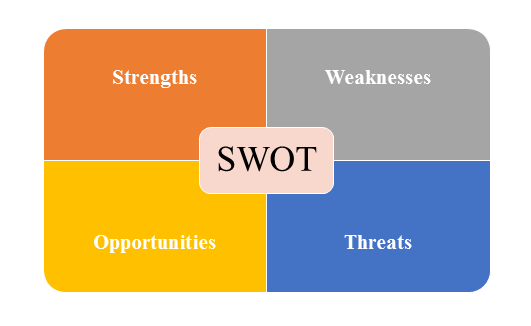
- Strengths describe what the player excels at and separates it from the competition
- Weaknesses stop the player from performing at its optimum level.
- Opportunities refer to favorable external factors that the player can use to give it a competitive advantage.
- Threats refer to factors that have the potential to harm the player.
- Data Sources
| Primary Sources | Secondary Sources |
|---|---|
| Face to face/Phone Interviews with market participants, such as: Manufactures; Distributors; End-users; Experts. Online Survey |
Government/International Organization Data: Annual Report/Presentation/Fact Book Internet Source Information Industry Association Data Free/Purchased Database Market Research Report Book/Journal/News |