Global Angled Gripper Market Strategic Outlook 2026-2031 Industrial Robotics Expansion and End-of-Arm Tooling Precision Analysis
- Single User License (1 Users) $ 3,500
- Team License (2~5 Users) $ 4,500
- Corporate License (>5 Users) $ 5,500
The global angled gripper market in 2026 represents a vital mechanical and mechatronic sub-sector of the End-of-Arm Tooling (EOAT) ecosystem, directly governing the cycle speed, spatial agility, and gripping precision of industrial robots and automated assembly cells. Engineered with pivoting jaws—commonly capable of opening up to 180 degrees—angled grippers allow robotic arms to clear complex workpieces laterally without requiring extra vertical Z-axis withdrawal strokes. This geometric efficiency makes them indispensable in confined machine-tending environments, high-speed packaging stations, and intricate electronic sub-assembly lines. As of 2026, the global angled gripper market is valued between 360 million USD and 680 million USD, projected to expand at a compound annual growth rate (CAGR) ranging from 3.8 percent to 6.7 percent through 2031.
The fundamental growth trajectory of angled grippers is inextricably anchored to the rapid expansion of the global industrial robot fleet. According to data from the International Federation of Robotics (IFR) World Robotics 2026 report, the global operational stock of industrial robots reached 5 million units in 2025—a 9 percent year-over-year increase—while annual new robot installations surpassed 600,000 units, marking an 11 percent annual surge. Correspondingly, the broader global industrial robotics market expanded from approximately 21.94 billion USD in 2025 to a projected 24.43 billion USD in 2026. Because every newly commissioned articulated, SCARA, or delta robot requires task-specific EOAT—and mature robotic fleets undergo frequent multi-tooling changeovers and maintenance replacement cycles across 5 million active arms—demand for precision angled grippers is experiencing sustained compounding leverage.
Technologically, the 2026 strategic landscape is characterized by the gradual electrification and digitalization of gripping mechanics. While pneumatic angled grippers remain the volume foundation due to their exceptional force-to-weight ratios, ruggedness, and low unit cost, mechatronic electric angled grippers integrated with IO-Link communication protocols are capturing the highest margin expansion. In smart factories across automotive and electronics manufacturing, plant engineers increasingly demand programmable gripping force, real-time jaw-position telemetry, and predictive wear diagnostics to handle mixed-model production lines without manual tooling swaps.
Regional Market Analysis
The geographical distribution of the angled gripper market mirrors the global concentration of automated factory floors, reflecting sharp structural shifts in national robot deployment rankings.
● Asia Pacific commands the overwhelming share of global volume, estimated between 52 percent and 56 percent. Regional dominance is spearheaded by China, which recorded 354,000 new industrial robot installations in 2025—accounting for an extraordinary 59 percent of global installations—and is projected to sustain 5 percent to 10 percent annual robotics growth through 2029. Japan remains a premier robotics powerhouse despite a cyclical 19 percent contraction to 36,200 new installations in 2025, placing third globally while retaining immense EOAT replacement demand across its mature domestic automotive and electronics base. Within Taiwan(China), demand is heavily concentrated in ultra-cleanroom, miniature electric angled grippers engineered for advanced semiconductor backend packaging, optical module assembly, and high-density server manufacturing.
● Europe accounts for a highly technical market share ranging from 20 percent to 24 percent. Centered in Germany, Switzerland, Sweden, and Northern Italy, Europe serves as the global epicenter for high-precision mechatronic EOAT engineering, home to leaders such as SCHUNK, Zimmer Group, Festo, and Robot System Products. European demand in 2026 is propelled by electric vehicle (EV) powertrain retooling, stringent industrial energy-efficiency mandates driving pneumatic-to-electric transitions, and strict hygienic design regulations within pharmaceutical and food packaging plants.
● North America captures an estimated market share of 16 percent to 20 percent, demonstrating accelerating momentum. In 2025, the United States overtook Japan to become the world’s second-largest robotics market, adding nearly 38,500 new industrial robots—a robust 12 percent year-over-year increase. This resurgence is fueled by domestic manufacturing reshoring, massive capital deployment into North American EV battery plants, and acute factory labor shortages driving rapid adoption of automated packaging and warehouse fulfillment cells. High-velocity distribution models and heavy-duty automotive EOAT define regional procurement.
● South America and the Middle East and Africa (MEA) collectively represent 5 percent to 9 percent of global revenue. Growth in Latin America is anchored by automotive and consumer goods packaging facilities in Brazil and nearshoring industrial corridors in Mexico tied to North American supply chains. In the MEA region, sovereign industrial diversification initiatives in the GCC nations are gradually introducing automated food processing and logistics centers requiring durable, heat-resilient pneumatic gripping components.
Application and Segmentation Analysis
Angled gripper adoption varies sharply across end-user verticals according to payload weight, cleanroom tolerance, and required cycle velocity.
● Automotive represents the largest historical revenue vertical, demanding heavy-duty, high-torque angled grippers capable of withstanding harsh machining coolants, weld spatter, and continuous multi-shift operation. Within EV battery module assembly, die-casting extraction, and powertrain CNC tending, 180-degree opening angled grippers allow robots to reach into dense clamping jigs and swing jaws completely clear of part geometry during extraction. Sealed housings (IP67) and hardened steel pivot cams are non-negotiable procurement criteria in this sector.
● Packaging constitutes a high-velocity growth segment spanning food and beverage, consumer packaged goods, and pharmaceuticals. High-speed delta and SCARA robots utilize lightweight, anodized aluminum or stainless-steel angled grippers for secondary carton loading, pouch manipulation, and bottle capping. In 2026, packaging OEMs prioritize FDA-compliant H1 food-grade lubrication, washdown-resistant corrosion protection, and low-inertia jaw profiles that enable over 100 picks per minute while minimizing compressed air consumption.
● Electronics and Semiconductor Manufacturing drive the highest technical specifications for miniaturization and precision force control. Handling delicate printed circuit boards (PCBs), camera sensors, and smartphone casings requires compact micro-angled grippers with repeatable positioning tolerances measured in microns. This vertical leads the transition away from pneumatic actuation toward electric servo-driven angular grippers, eliminating oil-mist contamination risks in ISO Class cleanrooms and allowing dynamic force adjustments for fragile components.
Value Chain Analysis
Value capture in the angled gripper industry has steadily migrated from basic metal machining toward precision tribology, embedded sensor integration, and robotic ecosystem compatibility.
Upstream Materials and Precision Components: Value creation initiates with aerospace-grade hard-anodized aluminum alloys for weight reduction, precision-ground hardened tool steels for internal cam and toggle linkages, high-cycle Viton or HNBR elastomeric seals, miniature brushless DC motors, and compact Hall-effect or inductive position sensors. Maintaining ultra-low friction across pivot pins over 10 million to 30 million actuation cycles depends heavily on upstream metallurgical consistency.
Core Engineering and OEM Fabrication: Leading manufacturers differentiate through internal kinematic design—specifically wedge-hook, rack-and-pinion, and toggle-lever mechanisms—that maximize gripping moment while minimizing backlash and physical footprint. High-precision CNC grinding and automated assembly lines allow tier-one OEMs to guarantee tight repeatability and drop-in interchangeability.
High-Margin Mechatronic Integration and Tooling Ecosystems (Primary Value Pool): The highest profit pools in 2026 sit at the intersection of smart mechatronics and modular EOAT systems. Electric angled grippers equipped with IO-Link interfaces, integrated gripping-force retention during power loss, and pre-engineered robot adapter flanges command substantial price premiums over standard pneumatic units. Similarly, custom finger-tooling engineering and automatic tool-changer bundles generate sticky, high-margin systems revenue.
Downstream Distribution and Integration: Market access flows through three primary channels: direct partnerships with industrial robot OEMs, specialized Tier-1 factory automation integrators designing turnkey cells, and agile digital industrial MRO distributors providing off-the-shelf standardized grippers for rapid plant maintenance and SME automation retrofits.
Key Market Player Deep Profiles
● Destaco: Operating as a premier automation subsidiary of Dover Corporation, Destaco commands deep institutional authority in heavy-duty clamping and robotic End-of-Arm Tooling, anchored by its renowned Robohand angular gripper series (such as the RGA and RPL lines). Destaco’s core engineering competency lies in high-rigidity, 180-degree opening pneumatic angled grippers built specifically for unforgiving environments including automotive body-in-white welding, foundry die-casting, and heavy machine tending. Utilizing hardened steel internal cam mechanisms and shielded bearings, Destaco units deliver high gripping moments with exceptional resistance to lateral shock loads. In 2026, Destaco’s strategic dynamic emphasizes global modular EOAT standardization, leveraging its entrenched North American automotive relationships while expanding rapid-delivery engineering support across European and Asian EV manufacturing corridors.
● SCHUNK: Headquartered in Germany, SCHUNK is widely recognized as the global benchmark for precision clamping technology and robotic gripping systems. Its extensive angular gripper portfolio spans heavy-duty pneumatic modules (such as the SWG and PWG series) alongside cutting-edge mechatronic electric grippers integrated seamlessly with IO-Link, PROFINET, and EtherCAT industrial networks. SCHUNK’s decisive competitive edge stems from its massive R&D investment into "Smart Gripping"—embedding intelligent sensors and AI-assisted grasp planning directly into compact EOAT hardware to handle high-mix, low-volume production without mechanical retooling. In 2026, SCHUNK is aggressively scaling its collaborative robot (cobot) plug-and-play ecosystems and expanding regional technical centers across China and the United States to capture the surge in global robot installations.
● Zimmer Group: Known globally as "The Know-How Factory," German engineering specialist Zimmer Group offers one of the industry’s broadest and most mechanically sophisticated ranges of angled grippers, including its high-performance GP, GH, and GWR series. Zimmer’s technical core competency rests on precision steel-in-steel linear and angular guideways combined with robust wedge-hook kinematics that guarantee minimal wear across tens of millions of cycles. The company excels in specialized harsh-environment engineering, offering high-temperature, corrosion-resistant, and IP67-sealed angular grippers tailored for metalworking, packaging, and cleanroom electronics. Strategically in 2026, Zimmer Group is capitalizing on its MATCH end-of-arm ecosystem—co-developed with J. Schmalz—providing universal mechanical and digital interfaces that allow rapid swapping between angled grippers and vacuum tooling on any major robot brand.
● Effecto USA: Representing the North American operational spearhead of the Effecto Group (integrating deep heritage from Applied Robotics and specialized EOAT engineering), Effecto USA focuses squarely on ruggedized industrial gripping, automatic tool changers, and collision-detection hardware. Their angled gripper offerings are engineered for maximum uptime in high-impact automotive stamping, palletizing, and heavy industrial automation cells where unplanned downtime carries severe financial penalties. Effecto USA’s competitive advantage lies in high-touch custom application engineering and rapid domestic responsiveness, tailoring jaw geometries, stroke clearances, and sensor packages to complex Tier-1 North American automotive and aerospace assembly lines. In 2026, the company is directly benefiting from the 12 percent surge in US industrial robot installations driven by domestic manufacturing reshoring.
● Festo: As a global titan in pneumatic and electric factory automation, Germany-based Festo wields unmatched commercial scale across the electronics, packaging, and automotive assembly verticals. Festo’s angular gripper range—featuring stalwarts such as the HGWC and DHWS pneumatic series alongside sleek electric actuators—is celebrated for ultra-compact envelopes, crisp cycle speeds, and seamless integration into Festo’s wider valve terminal and motion-control architecture. Festo’s 2026 strategic layout centers on "Controlled Pneumatics" and energy-saving piezo technologies, enabling factories to dramatically cut compressed air waste while maintaining pneumatic cost advantages. Backed by world-class digital sizing tools, global logistics reach across over 170 countries, and Bionic Learning Network innovations, Festo remains a default specification standard for multinational packaging and electronics OEMs.
● AutomationDirect: Operating as a disruptive, high-velocity direct-to-engineer industrial automation e-commerce powerhouse in North America, AutomationDirect has reshaped the SME and MRO segments of the angled gripper market. Through its proprietary NITRA pneumatic brand, AutomationDirect supplies reliable, drop-in replacement 180-degree and standard angular grippers featuring transparent online pricing, comprehensive CAD downloads, and same-day shipping from its massive US distribution hub. Their core competitive moat lies in eliminating multi-tier distributor markups and opaque lead times, empowering small systems integrators, custom machine builders, and plant maintenance teams to deploy cost-effective robotic cells rapidly. In 2026, AutomationDirect continues to expand its pneumatic and sensor-integrated EOAT catalog to capture surging North American automation adoption outside the Fortune 500 tier.
● SMC Corporation: Headquartered in Japan, SMC Corporation stands as the world’s largest pneumatic components manufacturer, commanding formidable market share across Asia Pacific, North America, and Europe. SMC’s iconic MHY2 (180-degree opening) and MHW2/MHC2 angular gripper series are ubiquitous across global electronics assembly, semiconductor handling, and high-speed packaging machinery. SMC’s core competitive competency lies in extreme miniaturization, rigorous Japanese manufacturing consistency, and colossal global inventory availability that guarantees rapid localized replenishment. In 2026, SMC is actively executing a dual strategic push: rolling out ultra-lightweight, low-air-consumption pneumatic angular grippers aligned with corporate carbon-neutrality goals, while rapidly expanding its LEH/LEHZ electric actuator and wireless IO-Link EOAT product families to address cleanroom and smart-factory electrification trends.
● Robot System Products: Based in Sweden with a global footprint serving major robot OEM ecosystems (including ABB, FANUC, KUKA, and Yaskawa), Robot System Products (RSP) specializes in high-reliability robotic peripheral equipment designed to maximize robot arm utilization. Rather than competing strictly as a catalog component vendor, RSP focuses on engineered integration—combining high-duty tool changers, swivel units, dress packs, and robust robotic gripping modules into unified, crash-resilient EOAT assemblies. Their technical competency lies in managing complex internal air, electrical, and data routing directly through the wrist interface, eliminating external hose snagging during high-angle 180-degree robotic maneuvers. In 2026, RSP’s strategic dynamic targets multi-tasking automotive and metalworking cells where rapid automated EOAT switching maximizes return on capital across expensive 6-axis industrial robots.
Opportunities and Challenges
The angled gripper market sits at a strategic inflection point, balancing powerful automation tailwinds against evolving technical and cost pressures.
● Opportunities: The rapid proliferation of collaborative robots (cobots) across SMEs and logistics opens a lucrative growth frontier for lightweight, force-limited electric angled grippers featuring rounded pinch-free exteriors and simple teach-pendant software integration. Simultaneously, corporate decarbonization mandates are accelerating factory audits of inefficient compressed-air networks, creating a high-margin retrofit opportunity for servo-electric angled grippers and intelligent low-leakage pneumatic valves. Furthermore, China’s sustained 5 percent to 10 percent annual robotics growth projection through 2029 and the United States’ 12 percent installation surge provide a massive, multi-year expansion of the global host-robot base requiring both initial EOAT commissioning and aftermarket wear-part replacements.
● Challenges: Market incumbents face intensifying price compression in the standard pneumatic angled gripper segment as agile Asian component manufacturers scale precision CNC machining at significantly lower unit costs. Technically, integrating delicate position sensors, power lines, and industrial Ethernet cabling onto compact, high-speed 180-degree pivoting jaws without suffering rapid cable fatigue remains an ongoing engineering hurdle. Additionally, the higher upfront unit cost of electric angular grippers compared to traditional pneumatic alternatives continues to slow full electrification in price-sensitive packaging and general-industry plants where compressed air infrastructure is already sunk capital.
Macroeconomic and Geopolitical Influences
The 2026 angled gripper market operates within a macroeconomic paradox where elevated borrowing costs coexist with urgent structural labor scarcity. While high interest rates have prompted stricter capital expenditure discipline across general manufacturing, acute skilled-labor shortages and persistent wage inflation across the United States, Western Europe, Japan, and coastal China have transformed robotic automation from an optional productivity upgrade into an operational survival imperative. This dynamic directly explains why global industrial robot installations surged 11 percent to exceed 600,000 units in 2025—pushing the robot market toward 24.43 billion USD in 2026—and ensures resilient baseline consumption for angled grippers across both new builds and maintenance cycles.
Geopolitically, global supply chain restructuring and "China Plus One" manufacturing strategies are acting as a structural demand multiplier for End-of-Arm Tooling. Rather than reducing aggregate industrial output, trade tariffs, semiconductor export controls, and regional industrial policies (such as US domestic manufacturing incentives and European strategic autonomy initiatives) are forcing multinationals to construct parallel, highly automated factory capacity across the United States, Mexico, Southeast Asia, India, and Eastern Europe. Each greenfield facility requires fresh fleets of industrial robots outfitted with precision angled grippers. Concurrently, geopolitical friction over rare-earth magnets used in electric servo motors and specialized bearing steels is pushing European, Japanese, and American EOAT leaders to regionalize component sourcing and establish localized assembly hubs close to major customer corridors, solidifying supply resilience through 2031.
1.1 Study Scope 1
1.2 Research Methodology 2
1.2.1 Data Sources 2
1.2.2 Assumptions 4
1.3 Abbreviations and Acronyms 5
Chapter 2 Global Angled Gripper Market Context and Macroeconomic Impact 6
2.1 Product Development Background 6
2.2 Global Macroeconomic Environment Analysis 7
2.2.1 Global GDP Trends and Factory Automation Investment 7
2.2.2 Impact of Inflation and Precision Metal Component Costs 8
2.3 Impact of Geopolitical Conflicts on the Angled Gripper Market 9
2.3.1 Supply Chain Disruptions for Pneumatic Valves, Motors, and Sensors 9
2.3.2 Regional Manufacturing Reshoring and Industrial Robotics Demand 10
2.4 Global Angled Gripper Market Volume and Market Size (2021-2026) 11
Chapter 3 Global Angled Gripper Market by Type 12
3.1 Market Volume and Size Analysis by Type (2021-2026) 12
3.2 Pneumatic Angled Grippers 13
3.3 Electric Angled Grippers 14
3.4 Hydraulic Angled Grippers 15
Chapter 4 Global Angled Gripper Market by Application 16
4.1 Market Volume and Size Analysis by Application (2021-2026) 16
4.2 Automotive 17
4.3 Packaging 18
4.4 Electronics 19
Chapter 5 Global Angled Gripper Market by Region 20
5.1 Market Volume and Size Analysis by Region (2021-2026) 20
5.2 North America Angled Gripper Market Analysis 21
5.2.1 North America Market Volume and Market Size (2021-2026) 21
5.2.2 North America Market by Key Regions (United States, Canada, Mexico) 22
5.3 Europe Angled Gripper Market Analysis 24
5.3.1 Europe Market Volume and Market Size (2021-2026) 24
5.3.2 Europe Market by Key Regions (Germany, United Kingdom, France, Italy, Sweden) 25
5.4 Asia-Pacific Angled Gripper Market Analysis 28
5.4.1 Asia-Pacific Market Volume and Market Size (2021-2026) 28
5.4.2 Asia-Pacific Market by Key Regions (China, Japan, India, South Korea, Taiwan (China)) 29
5.5 Latin America Angled Gripper Market Analysis 31
5.5.1 Latin America Market Volume and Market Size (2021-2026) 31
5.5.2 Latin America Market by Key Regions (Brazil, Argentina) 32
5.6 Middle East & Africa Angled Gripper Market Analysis 33
5.6.1 Middle East & Africa Market Volume and Market Size (2021-2026) 33
5.6.2 Middle East & Africa Market by Key Regions (UAE, Saudi Arabia, South Africa) 34
Chapter 6 Angled Gripper Manufacturing Process and Patent Analysis 35
6.1 Production Flow: CNC Machining, Anodizing, and Actuator Assembly 35
6.2 Core Technologies: 180-Degree Opening Angles, Force Feedback, and Durability 36
6.3 Global Angled Gripper Patent Landscape Analysis 38
Chapter 7 Industry Chain and Value Chain Analysis 39
7.1 Value Chain Overview 39
7.2 Upstream Raw Materials and Components (Aluminum Alloys, Seals, Sensors, Servo Motors) 40
7.3 Midstream Manufacturing and End-of-Arm Tooling (EOAT) Integration 41
7.4 Downstream System Integrators and Industrial OEMs 42
Chapter 8 Global Angled Gripper Import and Export Analysis 43
8.1 Global Import Volume and Value (2021-2026) 43
8.2 Global Export Volume and Value (2021-2026) 44
Chapter 9 Competitive Landscape and Concentration Rate 46
9.1 Market Concentration Rate (CR3, CR5) 46
9.2 Competitive Ranking of Key Players (2025) 47
9.3 Strategic Alliances, Mergers, and Portfolio Expansions 49
Chapter 10 Key Players Analysis 50
10.1 Destaco 50
10.1.1 Company Overview and Product Portfolio 50
10.1.2 SWOT Analysis 51
10.1.3 Destaco Angled Gripper Sales, Price, Cost and Gross Profit Margin (2021-2026) 52
10.1.4 R&D Investment and Automation Solutions Strategy 53
10.2 SCHUNK 54
10.2.1 Company Overview and Clamping/Gripping Portfolio 54
10.2.2 SWOT Analysis 55
10.2.3 SCHUNK Angled Gripper Sales, Price, Cost and Gross Profit Margin (2021-2026) 56
10.2.4 Mechatronic Innovation and Global Marketing Strategy 57
10.3 Zimmer Group 58
10.3.1 Company Overview and Handling Technology Portfolio 58
10.3.2 SWOT Analysis 59
10.3.3 Zimmer Group Angled Gripper Sales, Price, Cost and Gross Profit Margin (2021-2026) 60
10.3.4 Collaborative Robotics Integration Strategy 61
10.4 Effecto USA 62
10.4.1 Company Overview and Product Portfolio 62
10.4.2 SWOT Analysis 63
10.4.3 Effecto USA Angled Gripper Sales, Price, Cost and Gross Profit Margin (2021-2026) 64
10.4.4 Tool Changing and Gripping Synergy 65
10.5 Festo 66
10.5.1 Company Overview and Pneumatic Automation Portfolio 66
10.5.2 SWOT Analysis 67
10.5.3 Festo Angled Gripper Sales, Price, Cost and Gross Profit Margin (2021-2026) 68
10.5.4 Digitalization and Smart Factory Strategy 69
10.6 AutomationDirect 70
10.6.1 Company Overview and Product Portfolio 70
10.6.2 SWOT Analysis 71
10.6.3 AutomationDirect Angled Gripper Sales, Price, Cost and Gross Profit Margin (2021-2026) 72
10.6.4 Direct-to-Customer E-Commerce Distribution Strategy 73
10.7 SMC Corporation 74
10.7.1 Company Overview and Pneumatic Control Portfolio 74
10.7.2 SWOT Analysis 75
10.7.3 SMC Corporation Angled Gripper Sales, Price, Cost and Gross Profit Margin (2021-2026) 76
10.7.4 Global Manufacturing Footprint and Supply Chain Strategy 77
10.8 Robot System Products 78
10.8.1 Company Overview and EOAT Portfolio 78
10.8.2 SWOT Analysis 79
10.8.3 Robot System Products Angled Gripper Sales, Price, Cost and Gross Profit Margin (2021-2026) 80
10.8.4 European Robotics Ecosystem Strategy 81
Chapter 11 Global Angled Gripper Market Forecast (2027-2031) 82
11.1 Market Volume and Size Forecast 82
11.2 Forecast by Type (2027-2031) 83
11.3 Forecast by Application (2027-2031) 85
11.4 Forecast by Key Regions (2027-2031) 86
Chapter 12 Market Dynamics 88
12.1 Industry Drivers (Industrial Robotics Adoption, High-Speed Assembly Needs) 88
12.2 Industry Restraints (High Integration Costs, Competition from Parallel and Vacuum Grippers) 89
12.3 Industry Opportunities and Trends (Electric Actuation, IoT-Enabled Predictive Maintenance) 90
Chapter 13 Research Findings and Conclusion 91
Table 2 Global Angled Gripper Market Volume by Type (2021-2026) 12
Table 3 Global Angled Gripper Market Size by Type (2021-2026) 13
Table 4 Global Angled Gripper Market Volume by Application (2021-2026) 16
Table 5 Global Angled Gripper Market Size by Application (2021-2026) 17
Table 6 North America Angled Gripper Market Volume and Size by Key Regions (2021-2026) 23
Table 7 Europe Angled Gripper Market Volume and Size by Key Regions (2021-2026) 27
Table 8 Asia-Pacific Angled Gripper Market Volume and Size by Key Regions (2021-2026) 30
Table 9 Latin America Angled Gripper Market Volume and Size by Key Regions (2021-2026) 32
Table 10 Middle East & Africa Angled Gripper Market Volume and Size by Key Regions (2021-2026) 34
Table 11 Global Angled Gripper Major Patents List 38
Table 12 Global Angled Gripper Import and Export Data (2021-2026) 43
Table 13 Competitive Ranking of Key Players by Revenue (2025) 47
Table 14 Destaco Angled Gripper Sales, Price, Cost and Gross Profit Margin (2021-2026) 52
Table 15 SCHUNK Angled Gripper Sales, Price, Cost and Gross Profit Margin (2021-2026) 56
Table 16 Zimmer Group Angled Gripper Sales, Price, Cost and Gross Profit Margin (2021-2026) 60
Table 17 Effecto USA Angled Gripper Sales, Price, Cost and Gross Profit Margin (2021-2026) 64
Table 18 Festo Angled Gripper Sales, Price, Cost and Gross Profit Margin (2021-2026) 68
Table 19 AutomationDirect Angled Gripper Sales, Price, Cost and Gross Profit Margin (2021-2026) 72
Table 20 SMC Corporation Angled Gripper Sales, Price, Cost and Gross Profit Margin (2021-2026) 76
Table 21 Robot System Products Angled Gripper Sales, Price, Cost and Gross Profit Margin (2021-2026) 80
Table 22 Global Angled Gripper Market Volume Forecast by Type (2027-2031) 83
Table 23 Global Angled Gripper Market Size Forecast by Application (2027-2031) 85
Table 24 Global Angled Gripper Market Size Forecast by Key Regions (2027-2031) 87
Figure 1 Global Angled Gripper Market Size Growth Rate (2021-2026) 11
Figure 2 Impact of Geopolitical Conflicts on Industrial Automation Supply Chain 10
Figure 3 Global Angled Gripper Market Size Share by Type (2021-2026) 13
Figure 4 Global Angled Gripper Market Size Share by Application (2021-2026) 17
Figure 5 Global Angled Gripper Market Size Share by Region (2021-2026) 20
Figure 6 Angled Gripper Manufacturing Process Flowchart 35
Figure 7 Angled Gripper Industry Chain Mapping 39
Figure 8 Global Market Concentration Rate (CR5) in 2025 46
Figure 9 Destaco Angled Gripper Market Share (2021-2026) 53
Figure 10 SCHUNK Angled Gripper Market Share (2021-2026) 57
Figure 11 Zimmer Group Angled Gripper Market Share (2021-2026) 61
Figure 12 Effecto USA Angled Gripper Market Share (2021-2026) 65
Figure 13 Festo Angled Gripper Market Share (2021-2026) 69
Figure 14 AutomationDirect Angled Gripper Market Share (2021-2026) 73
Figure 15 SMC Corporation Angled Gripper Market Share (2021-2026) 77
Figure 16 Robot System Products Angled Gripper Market Share (2021-2026) 81
Figure 17 Global Angled Gripper Market Size Forecast (2027-2031) 82
Research Methodology
- Market Estimated Methodology:
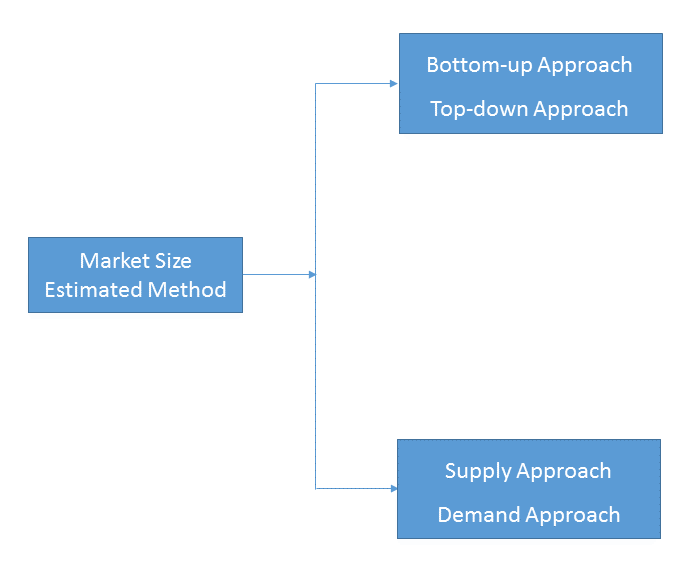
Bottom-up & top-down approach, supply & demand approach are the most important method which is used by HDIN Research to estimate the market size.
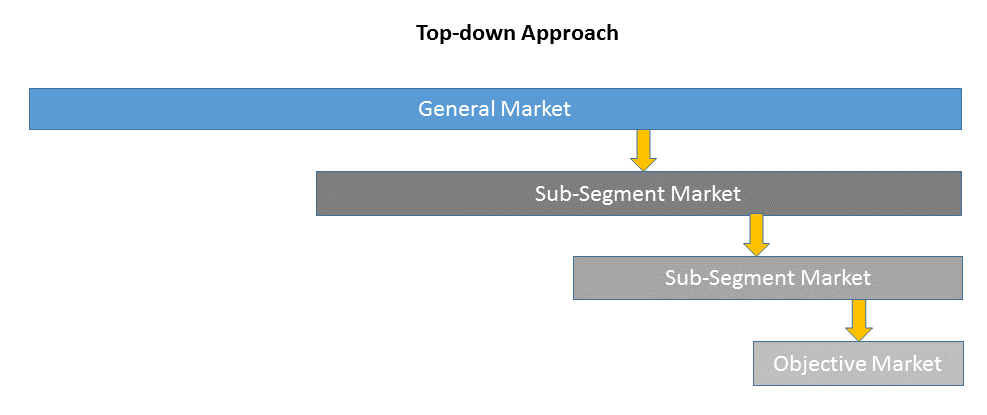
1)Top-down & Bottom-up Approach
Top-down approach uses a general market size figure and determines the percentage that the objective market represents.
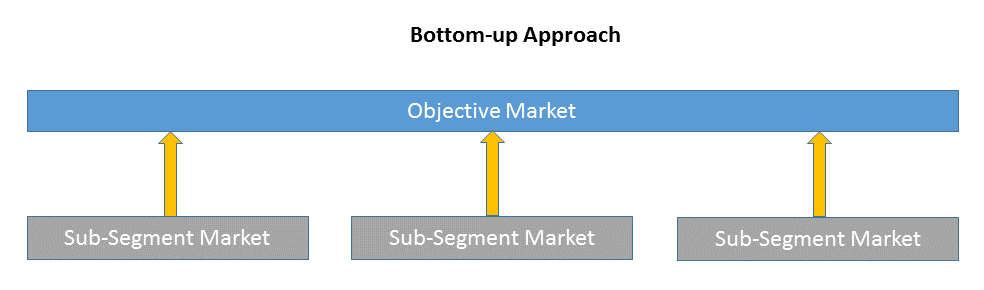
Bottom-up approach size the objective market by collecting the sub-segment information.
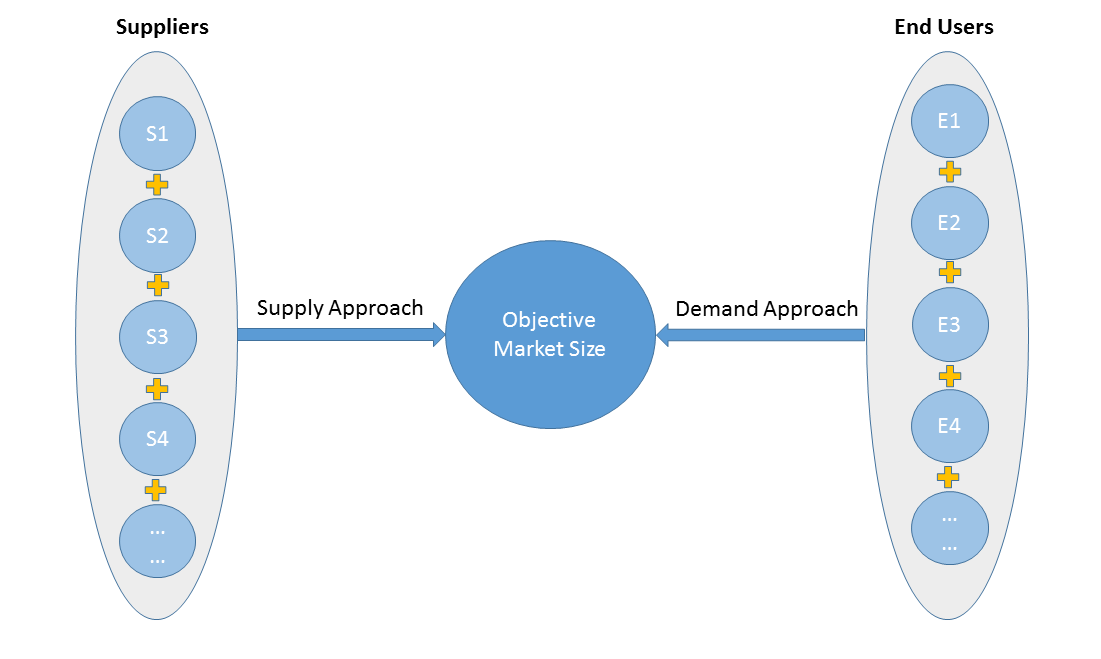
2)Supply & Demand Approach
Supply approach is based on assessments of the size of each competitor supplying the objective market.
Demand approach combine end-user data within a market to estimate the objective market size. It is sometimes referred to as bottom-up approach.
- Forecasting Methodology
- Numerous factors impacting the market trend are considered for forecast model:
- New technology and application in the future;
- New project planned/under contraction;
- Global and regional underlying economic growth;
- Threatens of substitute products;
- Industry expert opinion;
- Policy and Society implication.
- Analysis Tools
1)PEST Analysis
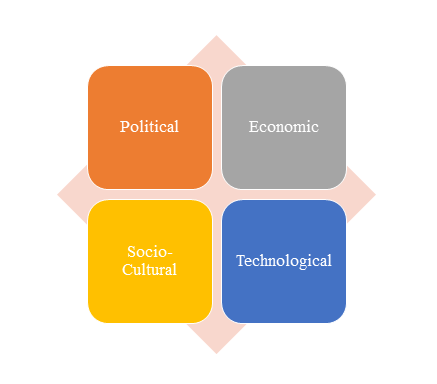
PEST Analysis is a simple and widely used tool that helps our client analyze the Political, Economic, Socio-Cultural, and Technological changes in their business environment.
- Benefits of a PEST analysis:
- It helps you to spot business opportunities, and it gives you advanced warning of significant threats.
- It reveals the direction of change within your business environment. This helps you shape what you’re doing, so that you work with change, rather than against it.
- It helps you avoid starting projects that are likely to fail, for reasons beyond your control.
- It can help you break free of unconscious assumptions when you enter a new country, region, or market; because it helps you develop an objective view of this new environment.
2)Porter’s Five Force Model Analysis
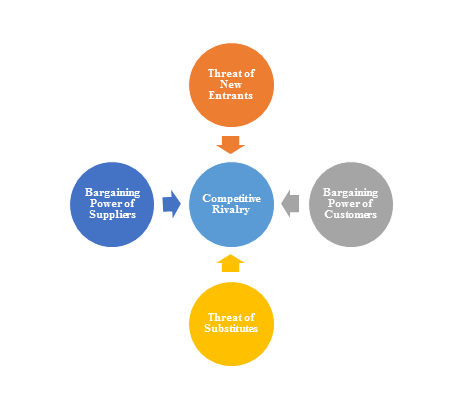
The Porter’s Five Force Model is a tool that can be used to analyze the opportunities and overall competitive advantage. The five forces that can assist in determining the competitive intensity and potential attractiveness within a specific area.
- Threat of New Entrants: Profitable industries that yield high returns will attract new firms.
- Threat of Substitutes: A substitute product uses a different technology to try to solve the same economic need.
- Bargaining Power of Customers: the ability of customers to put the firm under pressure, which also affects the customer's sensitivity to price changes.
- Bargaining Power of Suppliers: Suppliers of raw materials, components, labor, and services (such as expertise) to the firm can be a source of power over the firm when there are few substitutes.
- Competitive Rivalry: For most industries the intensity of competitive rivalry is the major determinant of the competitiveness of the industry.
3)Value Chain Analysis
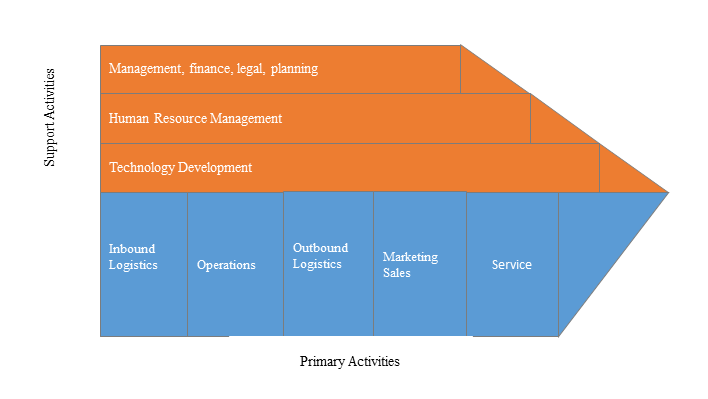
Value chain analysis is a tool to identify activities, within and around the firm and relating these activities to an assessment of competitive strength. Value chain can be analyzed by primary activities and supportive activities. Primary activities include: inbound logistics, operations, outbound logistics, marketing & sales, service. Support activities include: technology development, human resource management, management, finance, legal, planning.
4)SWOT Analysis
SWOT analysis is a tool used to evaluate a company's competitive position by identifying its strengths, weaknesses, opportunities and threats. The strengths and weakness is the inner factor; the opportunities and threats are the external factor. By analyzing the inner and external factors, the analysis can provide the detail information of the position of a player and the characteristics of the industry.
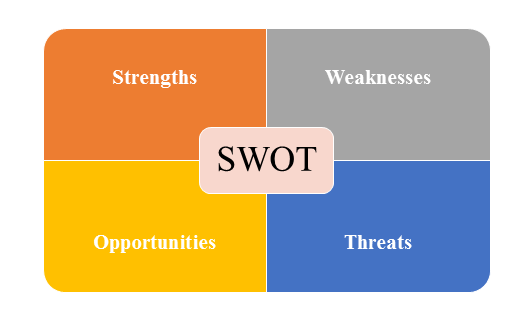
- Strengths describe what the player excels at and separates it from the competition
- Weaknesses stop the player from performing at its optimum level.
- Opportunities refer to favorable external factors that the player can use to give it a competitive advantage.
- Threats refer to factors that have the potential to harm the player.
- Data Sources
| Primary Sources | Secondary Sources |
|---|---|
| Face to face/Phone Interviews with market participants, such as: Manufactures; Distributors; End-users; Experts. Online Survey |
Government/International Organization Data: Annual Report/Presentation/Fact Book Internet Source Information Industry Association Data Free/Purchased Database Market Research Report Book/Journal/News |