Global Pulse Amplifier Market Strategic Outlook 2026-2031 GaN-on-SiC Phased-Array Radar and High-Energy Pulsed Power Analysis
- Single User License (1 Users) $ 3,500
- Team License (2~5 Users) $ 4,500
- Corporate License (>5 Users) $ 5,500
The global pulse amplifier market in 2026 occupies a mission-critical technological tier spanning radio-frequency (RF) microwave defense hardware, clinical diagnostic imaging, ultrafast photonics, and high-energy industrial pulsed power. Engineered to amplify brief, high-peak-power electrical, microwave, or optical pulses with minimal pulse droop, ultra-fast rise times, and stringent phase linearity, pulse amplifiers form the active core of active electronically scanned array (AESA) radars, magnetic resonance imaging (MRI) scanners, satellite uplinks, and advanced LiDAR platforms. As of 2026, the global market is valued between 240 million USD and 380 million USD. Fueled by global defense modernization, low-Earth orbit (LEO) satellite expansion, and solid-state wide-bandgap semiconductor adoption, the sector is projected to expand at a compound annual growth rate (CAGR) ranging from 5.3 percent to 9.7 percent through 2031.
The strategic landscape of 2026 is defined by two transformative technical vectors: the migration of high-frequency Gallium Nitride on Silicon Carbide (GaN-on-SiC) into upper millimeter-wave bands, and vertical supply-chain consolidation in high-energy pulsed-power storage. On June 10, 2026, United Monolithic Semiconductors (UMS) released a next-generation Ka-band (26–40 GHz) GaN High Power Amplifier (HPA) series fabricated on an advanced 0.15 μm GaN-on-SiC process. Delivering 10 W to 50 W of output power while supporting both pulsed and continuous-wave (CW) operating modes, this release directly targets satellite uplinks and phased-array radar transmitters—accelerating the displacement of bulky, high-voltage legacy Traveling Wave Tube Amplifiers (TWTAs) with compact solid-state modules.
Concurrently, upstream energy-storage integration has emerged as a decisive competitive differentiator in extreme peak-power applications. On March 18, 2026, I-Pulse—the global leader in high pulsed-power technologies led by Co-Founder, Chairman, and CEO Robert Friedland and Co-Founder and CTO Laurent Frescaline—announced the acquisition of California-based CSI Technologies, Inc., a premier manufacturer of high-energy, high-voltage capacitors serving industrial, medical, and defense markets. This acquisition underscores an essential engineering reality in 2026: scaling pulsed power density requires tight co-optimization between the semiconductor or optical amplification stage and the upstream high-voltage capacitive discharge architecture governing pulse shape and energy delivery.
Regional Market Analysis
The geographical distribution of the pulse amplifier market mirrors global defense electronics expenditure, compound semiconductor foundry capacity, and advanced medical imaging clusters.
● North America commands the largest market share, estimated between 38 percent and 42 percent. Regional leadership is anchored by substantial United States defense procurement for next-generation AESA airborne and naval radars, electronic warfare (EW) suites, and counter-unmanned aerial system (C-UAS) platforms, supported by specialized domestic manufacturers such as Spectrum Control, Empower RF Systems, CPI, and Narda-MITEQ. The March 2026 acquisition of California-based CSI Technologies by I-Pulse further highlights North America’s unmatched concentration of high-voltage pulsed-power engineering talent serving defense, medical radiotherapy, and industrial testing.
● Europe accounts for a technologically dense market share ranging from 24 percent to 28 percent. Europe leads in specialized wide-bandgap MMIC fabrication—exemplified by UMS’s June 2026 Ka-band GaN-on-SiC HPA launch—as well as European defense rearmament initiatives upgrading continental air-defense radar networks. Additionally, Northern and Western Europe represent global innovation hubs for optical and fiber pulse amplification, led by photonics specialists such as France’s Keopsys Group and Finland’s Ampliconyx serving aerospace LiDAR and precision industrial micromachining.
● Asia Pacific represents the fastest-growing regional market, capturing an estimated share between 22 percent and 26 percent. Demand is propelled by expanding indigenous radar, satellite communications, and industrial laser ecosystems across China, Japan, South Korea, and India. Chinese optoelectronics and fiber-laser specialists—such as Techwin and Beijing Rofea Optoelectronics—are scaling high-peak-power optical pulse amplifiers rapidly for autonomous LiDAR and sensing. Within Taiwan(China), the market holds pivotal strategic weight within the global compound semiconductor value chain, providing premier GaN and GaAs foundry fabrication, high-frequency RF IC packaging, and defense-grade microwave sub-assembly capabilities.
● South America and the Middle East and Africa (MEA) collectively account for 6 percent to 10 percent of global revenue. Growth in the MEA region is driven primarily by sovereign defense investments in integrated air-and-missile defense radar systems across the GCC nations alongside tertiary medical center expansions requiring high-field MRI RF pulse hardware. South America’s demand centers on geophysical pulsed-power exploration, telecommunications testing, and urban hospital diagnostic upgrades in Brazil and Chile.
Application and Segmentation Analysis
Pulse amplifier engineering requirements diverge markedly across end-user verticals depending on pulse width, duty cycle, peak-to-average power ratio, and spectral purity.
● Radar Systems represent the largest revenue-generating and highest-margin vertical. Modern military AESA radars, maritime surveillance arrays, weather radar networks, and electronic countermeasure systems demand compact solid-state transmit/receive modules capable of delivering high peak pulsed power across X-band, Ku-band, and Ka-band frequencies. The rollout of 0.15 μm GaN-on-SiC architectures (as demonstrated by UMS in June 2026) enables higher power-added efficiency, graceful system degradation without single-point tube failure, and agile pulse-compression waveforms resistant to jamming.
● Medical applications require ultra-linear, low-noise pulse amplification across two core sub-segments: magnetic resonance imaging (MRI/NMR) and radiation oncology. High-field 3-Tesla and 7-Tesla MRI systems rely on specialized multi-kilowatt linear RF pulse amplifiers (championed by players like CPC) to excite nuclear spins with exact phase fidelity, while linear accelerators (LINACs) for cancer radiotherapy utilize high-energy pulsed microwave power and high-voltage discharge capacitors to generate targeted X-ray beams. Pulsed medical fiber amplifiers also underpin precision ophthalmic surgery and laser lithotripsy.
● Communications applications are rapidly expanding at the convergence of satellite networking and free-space optical links. Ka-band pulsed/CW solid-state amplifiers power high-throughput LEO/MEO satellite uplinks and tactical burst-mode military radios, while high-peak-power Erbium-doped optical pulse amplifiers facilitate deep-space optical communications, long-range atmospheric LiDAR, and coherent optical time-domain reflectometry (OTDR) fiber monitoring.
● Industrial applications span electromagnetic compatibility (EMC/EMI) radiated susceptibility testing for aerospace and automotive electronics, pulsed-plasma semiconductor etching, high-energy pulsed-power mineral fragmentation and forming (I-Pulse’s core frontier), and ultrafast laser micromachining of brittle glass and semiconductor wafers.
Value Chain Analysis
The pulse amplifier value chain exhibits concentrated profit pools in wide-bandgap semiconductor fabrication, thermal-pulse circuit engineering, and mission-critical defense/medical qualification.
Upstream Semiconductors, Optical Fibers, and Energy Storage: Value originates with high-purity Silicon Carbide (SiC) substrates, sub-micron GaN-on-SiC MMIC wafers, rare-earth-doped double-clad optical fibers, and specialized high-energy, high-voltage pulse-discharge capacitors (illustrated by I-Pulse’s acquisition of CSI Technologies). Material defects or dielectric breakdown at this tier immediately cap downstream peak-power ceilings.
Midstream Subsystem Design and Thermal Management: Amplifier OEMs create differentiation through low-loss spatial and planar power-combining networks, ultra-fast drain-bias switching circuits that suppress inter-pulse noise, and precision cold-plate liquid cooling architectures engineered to eliminate thermal pulse droop across long pulse widths.
High-Margin Software-Defined Solid-State Modules and Qualification (Primary Value Pool): The deepest profit pools in 2026 reside in software-defined, digitally monitored solid-state RF/microwave amplifier assemblies and space/defense-qualified integrated modules. Achieving MIL-STD shock/vibration endurance, ITAR compliance, or FDA/IEC medical electromagnetic safety creates formidable switching costs and multi-decade lifecycle sustainment annuities.
Downstream Integration and Test Equipment Access: Systems flow directly to Tier-1 defense primes, medical OEMs, and scientific national laboratories, complemented by specialized test-and-measurement rental enterprises (such as Advanced Test Equipment) that monetize flexible access to high-CAPEX pulsed amplifiers for periodic compliance testing.
Key Market Player Deep Profiles
● Spectrum Control: Formerly operating as APITech before rebranding to highlight its sharpened focus on the electromagnetic spectrum, Spectrum Control is a premier United States provider of solid-state RF, microwave, and millimeter-wave pulse amplifiers and integrated microwave assemblies (IMAs). Serving top-tier aerospace, defense, and space primes, their technical core competency lies in miniaturized GaN power amplifier modules, high-density system-in-package (SiP) integration, and ruggedized electronic warfare subsystems engineered for extreme thermal and shock profiles. In 2026, Spectrum Control’s strategic layout focuses on software-defined, open-architecture (SOSA-aligned) pulsed RF hardware that accelerates radar and EW upgrade cycles while ensuring domestic supply-chain security.
● Empower RF Systems: Headquartered in Inglewood, California, Empower RF Systems has established itself as a disruptive leader in high-power solid-state RF and microwave amplifiers spanning 10 kHz to 40 GHz in both pulsed and CW formats. Their flagship "Next Generation" modular architecture embeds FPGA-based digital control, real-time web-browser telemetry, and automatic fault recovery directly into compact liquid- and air-cooled chassis—directly displacing legacy vacuum TWTAs in military radar testbeds, EW threat simulation, and high-field EMC testing. In 2026, Empower RF’s strategic dynamic focuses on scalable multi-kilowatt solid-state pulsed power combining, enabling defense and industrial users to reconfigure output waveforms dynamically via software rather than swapping hardware.
● Advanced Test Equipment: Operating as ATEC from San Diego, California, Advanced Test Equipment serves as a vital commercial facilitator within the North American and global pulse amplifier ecosystem through specialized test-and-measurement equipment rental, sales, and calibration. Stocking high-power pulsed RF/microwave amplifiers from industry leaders spanning kilohertz to millimeter-wave bands, ATEC solves a major capital-allocation dilemma for aerospace, automotive, and medical device manufacturers requiring transient high-field pulsed testing for MIL-STD-461, DO-160, and IEC compliance. In 2026, ATEC’s strategic focus emphasizes rapid technical deployment, NIST-traceable calibration accuracy, and flexible short-term access to cutting-edge GaN pulsed EMC amplifiers amid elevated corporate borrowing costs.
● Keopsys Group: Operating as the specialized optical amplification pillar within France’s Lumibird Group, Keopsys Group is a world-renowned leader in pulsed fiber lasers and high-peak-power optical pulse amplifiers (Erbium and Ytterbium doped). Their patented VSP (Very Short Pulse) technology enables compact, ruggedized optical pulse amplifiers delivering multi-kilowatt peak powers at nanosecond pulse durations with exceptional beam quality. Serving autonomous vehicle LiDAR, defense rangefinding, wind-sensing Doppler LiDAR, and free-space optical communications, Keopsys Group’s 2026 strategic layout prioritizes high-volume manufacturability, SWaP (Size, Weight, and Power) reduction, and aerospace-grade environmental hardening across European, North American, and Asian photonics markets.
● Avtech: Widely recognized across global research, defense, and semiconductor test laboratories, the Avtech brand represents a benchmark for precision fast-pulse generation and modular electrical pulse amplification. Spanning compact benchtop instruments and OEM rack-mounted pulse amplifiers, the brand addresses demanding applications including electro-optic modulator driving, radar receiver testing, automated semiconductor stress characterization, and acoustic transducer excitation. Avtech’s enduring competitive advantage rests on ultra-clean waveform fidelity—minimizing ringing, overshoot, and timing jitter across nanosecond and sub-nanosecond transitions. In 2026, ongoing adoption across quantum computing control labs and silicon photonics testbeds sustains strong global demand across academia and high-tech industry.
● Techwin: Based in China, Techwin has emerged as a prominent Asian innovator in high-precision fiber lasers and optical pulse amplifiers, specializing in narrow-linewidth, single-frequency, and high-peak-power pulsed amplification across 1.0 μm, 1.5 μm, and 2.0 μm wavelength bands. Their engineering core competency lies in mitigating stimulated Brillouin scattering (SBS) and nonlinear optical distortions during high-peak-power nanosecond amplification, making their modules highly effective for long-range coherent LiDAR, atmospheric remote sensing, and optical fiber acoustic monitoring. In 2026, Techwin is capitalizing on booming Asian autonomous sensing and industrial metrology ecosystems while expanding international technical distribution into European and North American research markets.
● Narda-MITEQ: Combining deep microwave heritage across the United States and Germany under the Narda Safety Test Solutions umbrella, Narda-MITEQ is an entrenched tier-one supplier of ultra-low-noise amplifiers, high-power pulsed microwave amplifiers, and SATCOM/radar RF subsystems. Their pulsed solid-state amplifiers are widely deployed in defense radar receivers/transmitters, electronic intelligence (ELINT), and satellite ground-station uplinks requiring stringent phase noise stability and wide bandwidth operation up to millimeter-wave frequencies. In 2026, Narda-MITEQ’s strategic roadmap emphasizes space-qualified and Ka-band GaN-enabled RF assemblies, leveraging long-standing defense prime relationships and rigorous quality certifications to capture high-reliability aerospace modernization contracts.
● IFI: Headquartered in Ronkonkoma, New York, Instruments for Industry (IFI) holds decades of institutional authority in high-power RF and microwave pulsed and CW amplification, spanning both solid-state GaN/LDMOS platforms and specialized high-power Traveling Wave Tube (TWT) amplifiers. IFI’s pulsed amplifier families are deeply embedded in military radar simulation, high-intensity radiated field (HIRF) aerospace testing, scientific particle accelerators, and automotive EMC chambers. Their core technical competency lies in rugged over-engineered protection circuitry capable of surviving severe load-VSWR mismatches during high-energy pulsed testing without catastrophic stage failure. In 2026, IFI continues migrating legacy defense test labs toward modular solid-state pulsed architectures while supporting extensive installed TWT infrastructure.
● Beijing Rofea Optoelectronics: Operating from Beijing’s photonics and optoelectronics hub, Beijing Rofea Optoelectronics specializes in high-speed electro-optic modulators, ultrashort optical pulse amplifiers, and broadband RF pulse driver amplifiers tailored for optical communications, quantum information science, and high-resolution LiDAR. Their technical strength lies in vertically integrating electro-optic modulation chips with precision high-speed RF pulse drivers and optical fiber amplifiers to deliver turnkey pulse-shaping subsystems. In 2026, Beijing Rofea Optoelectronics is capturing rapid domestic Chinese growth in coherent optical sensing, satellite laser communications, and university quantum-optics infrastructure, steadily expanding export footprints across Asia Pacific and Europe.
● Ampliconyx: Based in Tampere, Finland, Ampliconyx is a high-tech photonics pioneer specializing in high-peak-power ultrashort-pulse (picosecond and femtosecond) optical fiber amplifiers. Their proprietary Tapered Double-Clad Fiber (T-DCF) technology overcomes fundamental nonlinear power ceilings in conventional step-index fibers, allowing compact all-fiber pulse amplifiers to achieve megawatt-class peak powers with near-diffraction-limited beam quality without bulky free-space chirped-pulse optics. In 2026, Ampliconyx’s strategic dynamic targets high-precision industrial micromachining of brittle display glass and semiconductors, nonlinear bio-imaging, and defense/medical ultrafast laser OEMs across Europe, North America, and East Asia seeking maintenance-free solid-state pulse power.
● Highland Technology: Headquartered in San Francisco, California, Highland Technology is an elite precision instrumentation engineer specializing in ultra-low-jitter digital delay/pulse generators, arbitrary optical/electrical pulse shapers, and high-speed pulse amplifiers. Serving national ignition/fusion laboratories, aerospace radar calibration facilities, synchrotron accelerators, and defense photonics contractors, Highland Technology’s competitive moat rests on picosecond timing resolution, exceptionally low phase noise, and custom ruggedized VME/PXI/rack electronics. In 2026, rising global investment in inertial fusion energy research, directed-energy laser timing, and next-generation phased-array synchronization fuels steady high-margin demand for Highland’s specialized pulse shaping and amplification platforms.
● Advanced Research Instruments: Based in the United States, Advanced Research Instruments (ARI) concentrates on ultra-fast, low-noise nuclear and scientific signal amplification—providing fast pulse preamplifiers, discriminator-amplifiers, and precision pulse-processing electronics for photon counting, mass spectrometry, medical radiation detection, and high-energy physics. Unlike multi-kilowatt radar transmitter vendors, ARI’s technical mastery centers on preserving faint, sub-nanosecond detector pulses above the thermal noise floor with ultra-high count-rate linearity. In 2026, growing investment in medical nuclear imaging (PET/SPECT), quantum single-photon detection, and industrial radiation monitoring sustains ARI’s specialized niche across research institutes and scientific OEMs.
● Avtech Electrosystems: Headquartered in Ottawa, Canada, Avtech Electrosystems Ltd. stands as one of the world’s premier pure-play engineering specialists in ultra-fast, high-voltage pulse generators and linear pulse amplifiers, maintaining a catalog exceeding 500 specialized models. Capable of delivering clean electrical pulses ranging from sub-nanosecond picosecond edges up to kilovolt amplitudes and hundreds of amperes, Avtech Electrosystems’ instruments are indispensable for high-power laser diode characterization, radar component qualification, electro-optic Pockels cell switching, and pulsed medical/industrial research. Their 2026 strategic dynamic emphasizes customizable, computer-controlled GPIB/Ethernet benchtop modules backed by deep in-house analog circuit engineering and rapid global fulfillment.
● Communications & Power Industries: Known globally as CPI, Communications & Power Industries is a formidable industrial titan bridging high-power vacuum electron devices (klystrons, magnetrons, gyrotrons, TWTAs) and advanced solid-state GaN/SiC pulsed RF power amplifiers. CPI’s pulsed amplification hardware powers mission-critical air-traffic and military phased-array radars, Ka-band satellite communications uplinks, clinical linear accelerators (LINACs) for cancer therapy, and fusion energy heating systems. In 2026, CPI’s strategic layout focuses on hybrid leadership—defending massive multi-decade aftermarket tube replacement annuities while aggressively expanding solid-state GaN pulsed transmitters and integrated SATCOM amplifiers to match the industry shift highlighted by UMS’s Ka-band breakthroughs.
● Entegra: Operating as a specialized engineering and RF/pulsed-power systems provider, Entegra delivers customized microwave and pulse amplification assemblies, power-conditioning interfaces, and signal-processing subsystems tailored for demanding communications, industrial, and defense electronics platforms. Rather than competing strictly in commoditized catalog amplifiers, Entegra’s core competency centers on application-specific electromechanical integration—adapting thermal layouts, pulse-modulation timing, and impedance matching to tight customer chassis envelopes. In 2026, Entegra capitalizes on increasing OEM outsourcing of specialized RF front-end modules across North American and international industrial automation and tactical communications programs.
● CPC: Headquartered in Hauppauge, New York, Communication Power Corporation (CPC) is a globally respected specialist in high-power, ultra-linear solid-state RF pulse amplifiers tailored explicitly for magnetic resonance imaging (MRI), nuclear magnetic resonance (NMR) spectroscopy, and industrial RF plasma/heating systems. MRI pulse amplification imposes brutal technical constraints—requiring multi-kilowatt peak pulses with near-zero phase distortion, ultra-low blanking noise, and rapid recovery times to avoid corrupting diagnostic anatomical images. In 2026, CPC’s strategic layout capitalizes on global upgrades toward 3-Tesla and ultra-high-field 7-Tesla clinical and research MRI systems alongside specialized solid-state industrial plasma generation, sustaining strong OEM partnerships across North America, Europe, and Asia.
Opportunities and Challenges
The pulse amplifier market sits at the convergence of historic semiconductor leaps and intensifying thermal-mechanical engineering constraints.
● Opportunities: The rapid maturation of sub-micron GaN-on-SiC MMICs into Ka-band and higher frequencies—explicitly validated by UMS’s June 2026 10–50 W pulsed/CW launch—opens a massive replacement wave displacing legacy vacuum TWTAs across LEO satellite constellations and compact AESA radars. Simultaneously, industrial and medical pulsed-power expansion (highlighted by I-Pulse’s acquisition of CSI Technologies) creates entirely new non-defense revenue vectors in pulsed mineral fragmentation, medical oncology, and semiconductor plasma processing. Expanding adoption of autonomous LiDAR and free-space optical satellite links further accelerates demand for high-peak-power nanosecond and picosecond optical fiber pulse amplifiers.
● Challenges: Managing extreme heat flux density inside miniaturized high-frequency GaN-on-SiC dies remains the foremost physical bottleneck; inadequate thermal dissipation induces pulse droop, amplitude sag, and premature device degradation under long pulse widths or high duty cycles. Upstream supply dependencies for defect-free SiC wafers, high-voltage pulse-discharge capacitors, and specialized doped optical fibers create periodic lead-time vulnerabilities. Furthermore, heavy defense concentration exposes RF/microwave pulse amplifier suppliers to stringent ITAR and dual-use export licensing regimes that restrict cross-border commercialization and add administrative overhead.
Macroeconomic and Geopolitical Influences
The 2026 pulse amplifier market exhibits robust counter-cyclical resilience despite persistent macroeconomic headwinds and elevated global interest rates. While tighter monetary conditions have tempered discretionary capital outlays in general commercial manufacturing—driving greater reliance on test-equipment rental providers like ATEC for intermittent EMC compliance—sovereign defense rearmament budgets and non-discretionary clinical healthcare investments insulate core demand. Multi-year NATO defense modernization, Indo-Pacific maritime radar upgrades, and sustained capital deployment into oncology radiotherapy and 3T/7T MRI installations ensure predictable baseline order books through 2031.
Geopolitically, wide-bandgap compound semiconductors (GaN-on-SiC) and high-energy pulsed-power technologies lie squarely at the center of great-power strategic competition. Export controls on advanced RF MMICs, high-purity SiC substrates, and high-voltage triggering switches have structurally bifurcated global supply chains into allied Western ecosystems and self-sufficient Asian ecosystems. Western defense and space primes are aggressively securing sovereign component access—driving vertical acquisitions like I-Pulse’s purchase of California-based CSI Technologies, European investment in UMS’s Ka-band GaN lines, and strategic reliance on Taiwan(China)’s premier compound semiconductor foundry infrastructure. Concurrently, China’s sustained investment in indigenous optoelectronics, phased-array radars, and LiDAR propulsion accelerates domestic scaling among specialists like Techwin and Beijing Rofea Optoelectronics. Across both geopolitical blocs, pulse amplifiers have evolved from discrete laboratory instruments into foundational enablers of sovereign radar, orbital communications, and next-generation pulsed energy infrastructure.
1.1 Study Scope 1
1.2 Research Methodology 2
1.2.1 Data Sources 2
1.2.2 Assumptions 4
1.3 Abbreviations and Acronyms 5
Chapter 2 Global Pulse Amplifier Market Context and Macroeconomic Impact 6
2.1 Product Development Background 6
2.2 Global Macroeconomic Environment Analysis 7
2.2.1 Global GDP Trends and Defense/Industrial Electronics Investment 7
2.2.2 Impact of Inflation and Wide-Bandgap Semiconductor Cost Volatility 8
2.3 Impact of Geopolitical Conflicts on the Pulse Amplifier Market 9
2.3.1 Defense Radar Modernization and Electronic Warfare Procurement 9
2.3.2 Export Controls and Supply Chain Resilience for RF/Optical Components 10
2.4 Global Pulse Amplifier Market Volume and Market Size (2021-2026) 11
Chapter 3 Global Pulse Amplifier Market by Type 12
3.1 Market Volume and Size Analysis by Type (2021-2026) 12
3.2 Solid-State Pulse Amplifiers (GaN/SiC/LDMOS) 13
3.3 Traveling Wave Tube (TWT) Pulse Amplifiers 14
3.4 Optical and Fiber Pulse Amplifiers 15
3.5 High-Voltage Electronic Pulse Amplifiers 16
Chapter 4 Global Pulse Amplifier Market by Application 17
4.1 Market Volume and Size Analysis by Application (2021-2026) 17
4.2 Radar Systems 18
4.3 Medical (MRI, Particle Therapy, Diagnostic Imaging) 19
4.4 Communications (Satellite, 5G/6G Testing, Telemetry) 20
4.5 Industrial (EMC Testing, Laser Processing, NDT) 21
Chapter 5 Global Pulse Amplifier Market by Region 22
5.1 Market Volume and Size Analysis by Region (2021-2026) 22
5.2 North America Pulse Amplifier Market Analysis 23
5.2.1 North America Market Volume and Market Size (2021-2026) 23
5.2.2 North America Market by Key Regions (United States, Canada, Mexico) 24
5.3 Europe Pulse Amplifier Market Analysis 26
5.3.1 Europe Market Volume and Market Size (2021-2026) 26
5.3.2 Europe Market by Key Regions (Germany, United Kingdom, France, Italy, Sweden) 27
5.4 Asia-Pacific Pulse Amplifier Market Analysis 30
5.4.1 Asia-Pacific Market Volume and Market Size (2021-2026) 30
5.4.2 Asia-Pacific Market by Key Regions (China, Japan, India, South Korea, Taiwan (China)) 31
5.5 Latin America Pulse Amplifier Market Analysis 33
5.5.1 Latin America Market Volume and Market Size (2021-2026) 33
5.5.2 Latin America Market by Key Regions (Brazil, Argentina) 34
5.6 Middle East & Africa Pulse Amplifier Market Analysis 35
5.6.1 Middle East & Africa Market Volume and Market Size (2021-2026) 35
5.6.2 Middle East & Africa Market by Key Regions (UAE, Saudi Arabia, South Africa) 36
Chapter 6 Pulse Amplifier Manufacturing Process and Patent Analysis 37
6.1 Production Flow: RF/Optical Module Integration, Thermal Management, and Calibration 37
6.2 Core Technologies: Pulse Width Fidelity, Peak Power Efficiency, and Impedance Matching 38
6.3 Global Pulse Amplifier Patent Landscape Analysis 40
Chapter 7 Industry Chain and Value Chain Analysis 41
7.1 Value Chain Overview 41
7.2 Upstream Raw Materials and Components (GaN Wafers, Vacuum Tubes, Rare-Earth Fibers, High-Voltage Capacitors) 42
7.3 Midstream Manufacturing and Rigorous Environmental Testing 43
7.4 Downstream Distribution Channels (Defense Prime Contractors, MedTech OEMs, Test Labs) 44
Chapter 8 Global Pulse Amplifier Import and Export Analysis 45
8.1 Global Import Volume and Value (2021-2026) 45
8.2 Global Export Volume and Value (2021-2026) 46
Chapter 9 Competitive Landscape and Concentration Rate 48
9.1 Market Concentration Rate (CR3, CR5) 48
9.2 Competitive Ranking of Key Players (2025) 49
9.3 Strategic Alliances, Mergers, and Technological Collaborations 51
Chapter 10 Key Players Analysis 52
10.1 Spectrum Control 52
10.1.1 Company Overview and RF/Microwave Portfolio 52
10.1.2 SWOT Analysis 53
10.1.3 Spectrum Control Pulse Amplifier Sales, Price, Cost and Gross Profit Margin (2021-2026) 54
10.1.4 Defense and Aerospace Integration Strategy 55
10.2 Empower RF Systems 56
10.2.1 Company Overview and High-Power Amplifier Portfolio 56
10.2.2 SWOT Analysis 57
10.2.3 Empower RF Systems Pulse Amplifier Sales, Price, Cost and Gross Profit Margin (2021-2026) 58
10.2.4 Next-Generation Solid-State R&D Strategy 59
10.3 Advanced Test Equipment 60
10.3.1 Company Overview 60
10.3.2 SWOT Analysis 61
10.3.3 Advanced Test Equipment Pulse Amplifier Sales, Price, Cost and Gross Profit Margin (2021-2026) 62
10.4 Keopsys Group 63
10.4.1 Company Overview and Fiber Laser/Amplifier Portfolio 63
10.4.2 SWOT Analysis 64
10.4.3 Keopsys Group Pulse Amplifier Sales, Price, Cost and Gross Profit Margin (2021-2026) 65
10.4.4 LiDAR and Optical Sensing Market Strategy 66
10.5 Avtech 67
10.5.1 Company Overview 67
10.5.2 SWOT Analysis 68
10.5.3 Avtech Pulse Amplifier Sales, Price, Cost and Gross Profit Margin (2021-2026) 69
10.6 Techwin 70
10.6.1 Company Overview 70
10.6.2 SWOT Analysis 71
10.6.3 Techwin Pulse Amplifier Sales, Price, Cost and Gross Profit Margin (2021-2026) 72
10.7 Narda-MITEQ 73
10.7.1 Company Overview and RF Component Portfolio 73
10.7.2 SWOT Analysis 74
10.7.3 Narda-MITEQ Pulse Amplifier Sales, Price, Cost and Gross Profit Margin (2021-2026) 75
10.7.4 Radar and Satellite Communication Strategy 76
10.8 IFI 77
10.8.1 Company Overview 77
10.8.2 SWOT Analysis 78
10.8.3 IFI Pulse Amplifier Sales, Price, Cost and Gross Profit Margin (2021-2026) 79
10.9 Beijing Rofea Optoelectronics 80
10.9.1 Company Overview 80
10.9.2 SWOT Analysis 81
10.9.3 Beijing Rofea Optoelectronics Pulse Amplifier Sales, Price, Cost and Gross Profit Margin (2021-2026) 82
10.10 Ampliconyx 83
10.10.1 Company Overview 83
10.10.2 SWOT Analysis 84
10.10.3 Ampliconyx Pulse Amplifier Sales, Price, Cost and Gross Profit Margin (2021-2026) 85
10.11 Highland Technology 86
10.11.1 Company Overview and Precision Pulse Electronics 86
10.11.2 SWOT Analysis 87
10.11.3 Highland Technology Pulse Amplifier Sales, Price, Cost and Gross Profit Margin (2021-2026) 88
10.11.4 Scientific and Industrial Instrumentation Strategy 89
10.12 Advanced Research Instruments 90
10.12.1 Company Overview 90
10.12.2 SWOT Analysis 91
10.12.3 Advanced Research Instruments Pulse Amplifier Sales, Price, Cost and Gross Profit Margin (2021-2026) 92
10.13 Avtech Electrosystems 93
10.13.1 Company Overview and High-Speed Pulse Solutions 93
10.13.2 SWOT Analysis 94
10.13.3 Avtech Electrosystems Pulse Amplifier Sales, Price, Cost and Gross Profit Margin (2021-2026) 95
10.13.4 Direct Engineering Support and Catalog Strategy 96
10.14 Communications & Power Industries 97
10.14.1 Company Overview and High-Power Microwave Portfolio 97
10.14.2 SWOT Analysis 98
10.14.3 Communications & Power Industries Pulse Amplifier Sales, Price, Cost and Gross Profit Margin (2021-2026) 99
10.14.4 Medical and Defense Systems Strategy 100
10.15 Entegra 101
10.15.1 Company Overview 101
10.15.2 SWOT Analysis 102
10.15.3 Entegra Pulse Amplifier Sales, Price, Cost and Gross Profit Margin (2021-2026) 103
10.16 CPC 104
10.16.1 Company Overview and High-Voltage RF Portfolio 104
10.16.2 SWOT Analysis 105
10.16.3 CPC Pulse Amplifier Sales, Price, Cost and Gross Profit Margin (2021-2026) 106
10.16.4 MRI and Medical Gradient Amplifier Strategy 107
Chapter 11 Global Pulse Amplifier Market Forecast (2027-2031) 108
11.1 Market Volume and Size Forecast 108
11.2 Forecast by Type (2027-2031) 109
11.3 Forecast by Application (2027-2031) 111
11.4 Forecast by Key Regions (2027-2031) 112
Chapter 12 Market Dynamics 114
12.1 Industry Drivers (Phased Array Radar Upgrades, Medical MRI Expansion, Ultrafast Lasers) 114
12.2 Industry Restraints (Export Licensing Hurdles, Thermal Dissipation Limits) 115
12.3 Industry Opportunities and Trends (GaN-on-SiC Integration, Software-Defined Pulse Control) 116
Chapter 13 Research Findings and Conclusion 117
Table 2 Global Pulse Amplifier Market Volume by Type (2021-2026) 12
Table 3 Global Pulse Amplifier Market Size by Type (2021-2026) 13
Table 4 Global Pulse Amplifier Market Volume by Application (2021-2026) 17
Table 5 Global Pulse Amplifier Market Size by Application (2021-2026) 18
Table 6 North America Pulse Amplifier Market Volume and Size by Key Regions (2021-2026) 24
Table 7 Europe Pulse Amplifier Market Volume and Size by Key Regions (2021-2026) 28
Table 8 Asia-Pacific Pulse Amplifier Market Volume and Size by Key Regions (2021-2026) 32
Table 9 Latin America Pulse Amplifier Market Volume and Size by Key Regions (2021-2026) 34
Table 10 Middle East & Africa Pulse Amplifier Market Volume and Size by Key Regions (2021-2026) 36
Table 11 Global Pulse Amplifier Major Patents List 40
Table 12 Global Pulse Amplifier Import and Export Data (2021-2026) 45
Table 13 Competitive Ranking of Key Players by Revenue (2025) 49
Table 14 Spectrum Control Pulse Amplifier Sales, Price, Cost and Gross Profit Margin (2021-2026) 54
Table 15 Empower RF Systems Pulse Amplifier Sales, Price, Cost and Gross Profit Margin (2021-2026) 58
Table 16 Advanced Test Equipment Pulse Amplifier Sales, Price, Cost and Gross Profit Margin (2021-2026) 62
Table 17 Keopsys Group Pulse Amplifier Sales, Price, Cost and Gross Profit Margin (2021-2026) 65
Table 18 Avtech Pulse Amplifier Sales, Price, Cost and Gross Profit Margin (2021-2026) 69
Table 19 Techwin Pulse Amplifier Sales, Price, Cost and Gross Profit Margin (2021-2026) 72
Table 20 Narda-MITEQ Pulse Amplifier Sales, Price, Cost and Gross Profit Margin (2021-2026) 75
Table 21 IFI Pulse Amplifier Sales, Price, Cost and Gross Profit Margin (2021-2026) 79
Table 22 Beijing Rofea Optoelectronics Pulse Amplifier Sales, Price, Cost and Gross Profit Margin (2021-2026) 82
Table 23 Ampliconyx Pulse Amplifier Sales, Price, Cost and Gross Profit Margin (2021-2026) 85
Table 24 Highland Technology Pulse Amplifier Sales, Price, Cost and Gross Profit Margin (2021-2026) 88
Table 25 Advanced Research Instruments Pulse Amplifier Sales, Price, Cost and Gross Profit Margin (2021-2026) 92
Table 26 Avtech Electrosystems Pulse Amplifier Sales, Price, Cost and Gross Profit Margin (2021-2026) 95
Table 27 Communications & Power Industries Pulse Amplifier Sales, Price, Cost and Gross Profit Margin (2021-2026) 99
Table 28 Entegra Pulse Amplifier Sales, Price, Cost and Gross Profit Margin (2021-2026) 103
Table 29 CPC Pulse Amplifier Sales, Price, Cost and Gross Profit Margin (2021-2026) 106
Table 30 Global Pulse Amplifier Market Volume Forecast by Type (2027-2031) 109
Table 31 Global Pulse Amplifier Market Size Forecast by Application (2027-2031) 111
Table 32 Global Pulse Amplifier Market Size Forecast by Key Regions (2027-2031) 113
Figure 1 Global Pulse Amplifier Market Size Growth Rate (2021-2026) 11
Figure 2 Impact of Geopolitical Conflicts on Defense and RF Semiconductor Supply Chain 10
Figure 3 Global Pulse Amplifier Market Size Share by Type (2021-2026) 13
Figure 4 Global Pulse Amplifier Market Size Share by Application (2021-2026) 17
Figure 5 Global Pulse Amplifier Market Size Share by Region (2021-2026) 22
Figure 6 Pulse Amplifier Manufacturing Process Flowchart 37
Figure 7 Pulse Amplifier Industry Chain Mapping 41
Figure 8 Global Market Concentration Rate (CR5) in 2025 48
Figure 9 Spectrum Control Pulse Amplifier Market Share (2021-2026) 55
Figure 10 Empower RF Systems Pulse Amplifier Market Share (2021-2026) 59
Figure 11 Advanced Test Equipment Pulse Amplifier Market Share (2021-2026) 62
Figure 12 Keopsys Group Pulse Amplifier Market Share (2021-2026) 66
Figure 13 Avtech Pulse Amplifier Market Share (2021-2026) 69
Figure 14 Techwin Pulse Amplifier Market Share (2021-2026) 72
Figure 15 Narda-MITEQ Pulse Amplifier Market Share (2021-2026) 76
Figure 16 IFI Pulse Amplifier Market Share (2021-2026) 79
Figure 17 Beijing Rofea Optoelectronics Pulse Amplifier Market Share (2021-2026) 82
Figure 18 Ampliconyx Pulse Amplifier Market Share (2021-2026) 85
Figure 19 Highland Technology Pulse Amplifier Market Share (2021-2026) 89
Figure 20 Advanced Research Instruments Pulse Amplifier Market Share (2021-2026) 92
Figure 21 Avtech Electrosystems Pulse Amplifier Market Share (2021-2026) 96
Figure 22 Communications & Power Industries Pulse Amplifier Market Share (2021-2026) 100
Figure 23 Entegra Pulse Amplifier Market Share (2021-2026) 103
Figure 24 CPC Pulse Amplifier Market Share (2021-2026) 107
Figure 25 Global Pulse Amplifier Market Size Forecast (2027-2031) 108
Research Methodology
- Market Estimated Methodology:
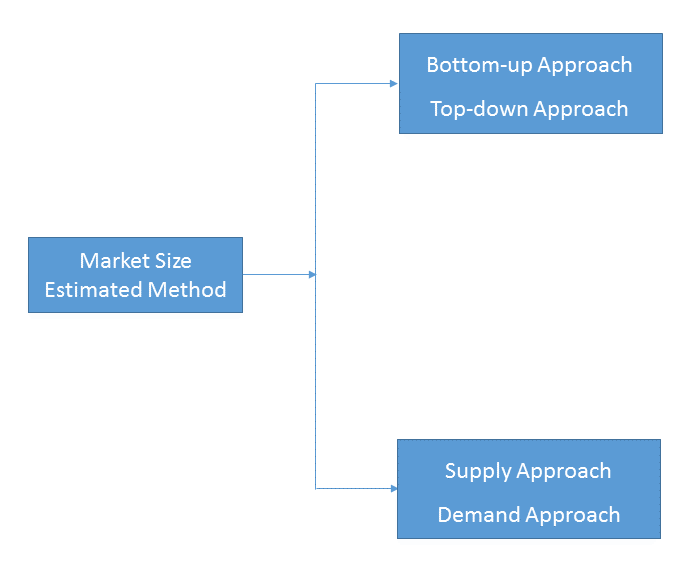
Bottom-up & top-down approach, supply & demand approach are the most important method which is used by HDIN Research to estimate the market size.
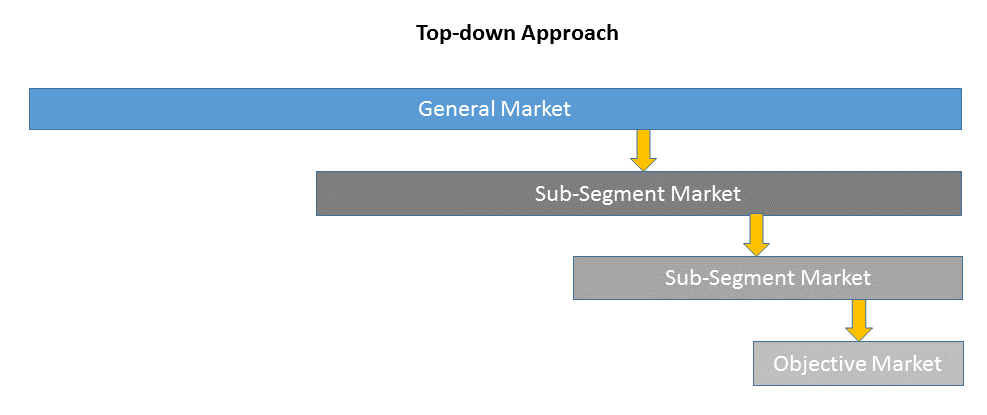
1)Top-down & Bottom-up Approach
Top-down approach uses a general market size figure and determines the percentage that the objective market represents.
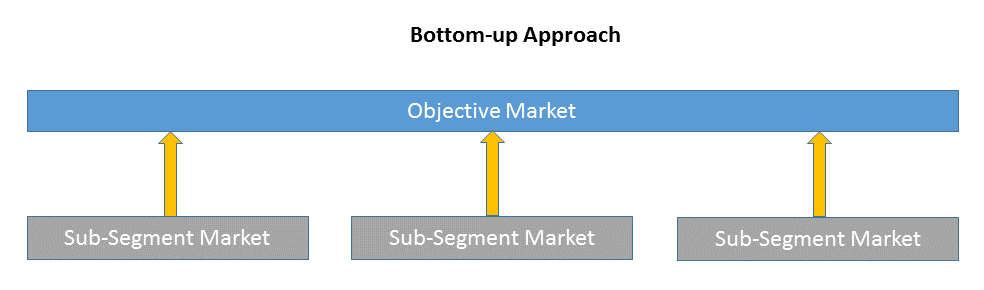
Bottom-up approach size the objective market by collecting the sub-segment information.
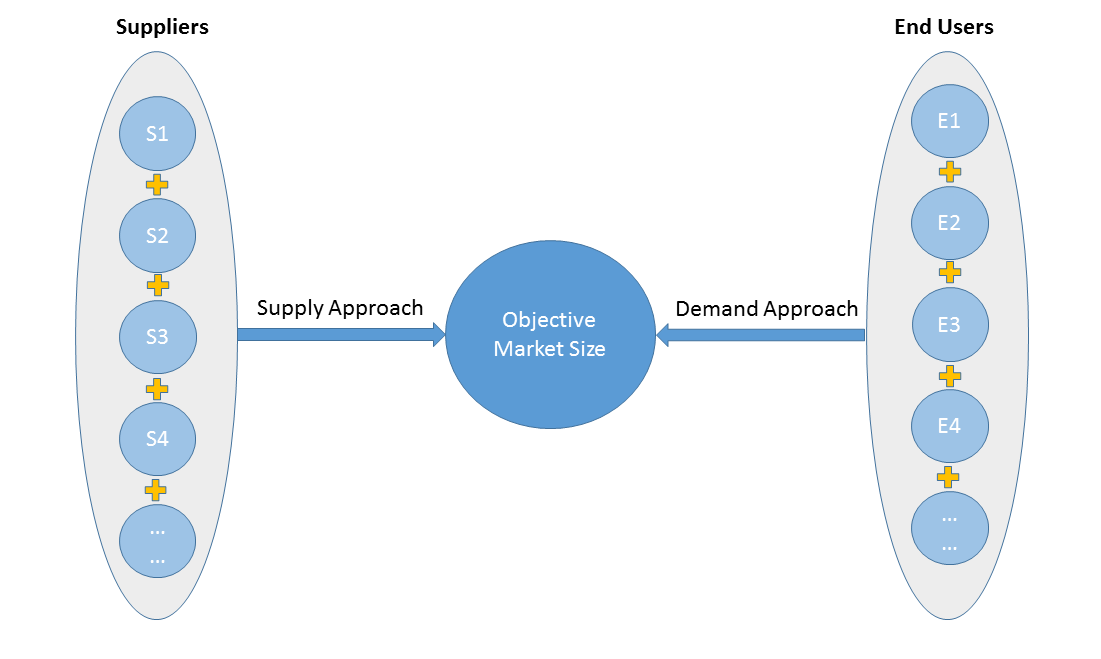
2)Supply & Demand Approach
Supply approach is based on assessments of the size of each competitor supplying the objective market.
Demand approach combine end-user data within a market to estimate the objective market size. It is sometimes referred to as bottom-up approach.
- Forecasting Methodology
- Numerous factors impacting the market trend are considered for forecast model:
- New technology and application in the future;
- New project planned/under contraction;
- Global and regional underlying economic growth;
- Threatens of substitute products;
- Industry expert opinion;
- Policy and Society implication.
- Analysis Tools
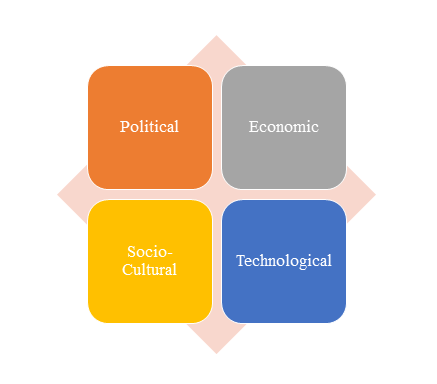
1)PEST Analysis
PEST Analysis is a simple and widely used tool that helps our client analyze the Political, Economic, Socio-Cultural, and Technological changes in their business environment.
- Benefits of a PEST analysis:
- It helps you to spot business opportunities, and it gives you advanced warning of significant threats.
- It reveals the direction of change within your business environment. This helps you shape what you’re doing, so that you work with change, rather than against it.
- It helps you avoid starting projects that are likely to fail, for reasons beyond your control.
- It can help you break free of unconscious assumptions when you enter a new country, region, or market; because it helps you develop an objective view of this new environment.
2)Porter’s Five Force Model Analysis
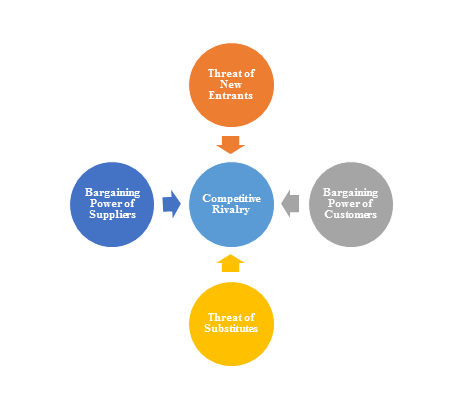
The Porter’s Five Force Model is a tool that can be used to analyze the opportunities and overall competitive advantage. The five forces that can assist in determining the competitive intensity and potential attractiveness within a specific area.
- Threat of New Entrants: Profitable industries that yield high returns will attract new firms.
- Threat of Substitutes: A substitute product uses a different technology to try to solve the same economic need.
- Bargaining Power of Customers: the ability of customers to put the firm under pressure, which also affects the customer's sensitivity to price changes.
- Bargaining Power of Suppliers: Suppliers of raw materials, components, labor, and services (such as expertise) to the firm can be a source of power over the firm when there are few substitutes.
- Competitive Rivalry: For most industries the intensity of competitive rivalry is the major determinant of the competitiveness of the industry.
3)Value Chain Analysis
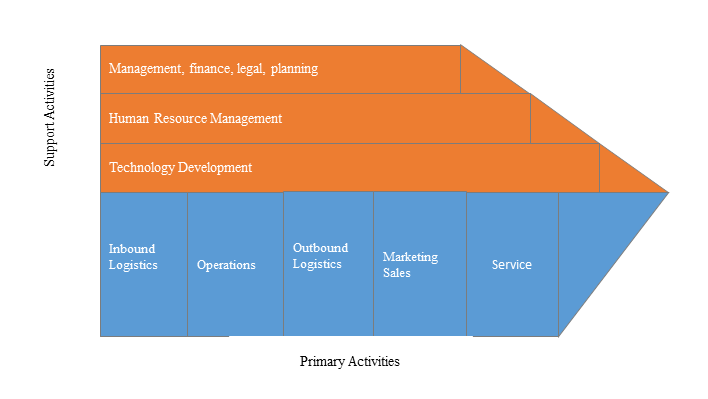
Value chain analysis is a tool to identify activities, within and around the firm and relating these activities to an assessment of competitive strength. Value chain can be analyzed by primary activities and supportive activities. Primary activities include: inbound logistics, operations, outbound logistics, marketing & sales, service. Support activities include: technology development, human resource management, management, finance, legal, planning.
4)SWOT Analysis
SWOT analysis is a tool used to evaluate a company's competitive position by identifying its strengths, weaknesses, opportunities and threats. The strengths and weakness is the inner factor; the opportunities and threats are the external factor. By analyzing the inner and external factors, the analysis can provide the detail information of the position of a player and the characteristics of the industry.
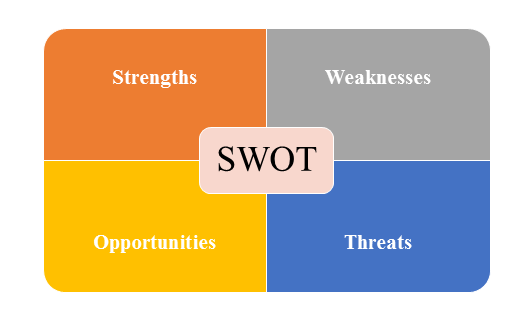
- Strengths describe what the player excels at and separates it from the competition
- Weaknesses stop the player from performing at its optimum level.
- Opportunities refer to favorable external factors that the player can use to give it a competitive advantage.
- Threats refer to factors that have the potential to harm the player.
- Data Sources
| Primary Sources | Secondary Sources |
|---|---|
| Face to face/Phone Interviews with market participants, such as: Manufactures; Distributors; End-users; Experts. Online Survey |
Government/International Organization Data: Annual Report/Presentation/Fact Book Internet Source Information Industry Association Data Free/Purchased Database Market Research Report Book/Journal/News |