Global Beam Collimator Market Strategic Outlook 2026-2031 Free-Space Optical Testing and High-Power Laser Beam Shaping Analysis
- Single User License (1 Users) $ 3,500
- Team License (2~5 Users) $ 4,500
- Corporate License (>5 Users) $ 5,500
The global beam collimator market in 2026 forms an indispensable optical-engineering layer underlying high-power industrial laser machining, defense electro-optical metrology, free-space optical (FSO) communications, advanced medical instrumentation, and high-efficiency solid-state lighting. By transforming divergent radiation emitted from optical fibers, laser diodes, or point light sources into tightly parallel, low-divergence beams with controlled wavefront precision, beam collimators directly govern system power density, measurement accuracy, and link budgets. As of 2026, the global market is valued between 570 million USD and 820 million USD, projected to expand at a compound annual growth rate (CAGR) ranging from 4.9 percent to 8.4 percent through 2031.
The strategic landscape of the second half of 2026 has been marked by rapid application specialization across extreme spectral bands, thermal power loads, and field-alignment simplicity. On August 14, 2026, UK precision-optics leader Optical Surfaces launched its Modular Pre-Aligned Large-Aperture Beam Collimator Kit, engineered specifically to simplify field alignment and long-path optical qualification for Free-Space Optical (FSO) communications networks. Shortly thereafter, on November 17, 2026, Optical Surfaces secured a major repeat order from a leading European defense contractor for three COL/120/750 off-axis all-reflective beam collimators—including two custom extended field-of-view systems—incorporating zero-expansion glass-ceramic parabolic mirrors with aluminum and magnesium fluoride (Al/MgF2) coatings for broadband ultraviolet-to-infrared (UV-to-IR) Modulation Transfer Function (MTF) testing of military thermal imagers and electro-optical payloads.
Concurrently, industrial laser processing and specialty spectroscopy pushed refractive and fiber-coupled collimation boundaries on November 18, 2026, when AdlOptica, Micro Laser Systems, and MÖLLER-WEDEL rolled out a concentrated wave of high-precision solutions. Highlights included AdlOptica’s water-cooled sapphire zoom collimator (trioFokus 50/80/150_1070) built to eliminate thermal focus shift in high-brightness fiber laser cutting, welding, and metal additive manufacturing, alongside Micro Laser Systems’ FC5-MIR1-FC mid-infrared (2.5–6 µm) fiber collimator tailored explicitly for trace gas sensing. Together, these late-2026 milestones demonstrate that competitive value in collimation has migrated decisively from basic spherical lenses toward athermal, broadband reflective architectures, sapphire-optic thermal stability, and specialized mid-infrared photonics.
Regional Market Analysis
The geographical distribution of the beam collimator market reflects entrenched clusters of precision optical glass polishing, defense aerospace testing, and high-volume semiconductor/photonics manufacturing.
● North America holds the largest global revenue share, estimated between 35 percent and 39 percent. Regional dominance is sustained by global photonics catalog and industrial giants—including Thorlabs, Edmund Optics, Newport Corporation (MKS Instruments), Coherent, and IPG Photonics—alongside agile specialty innovators such as Avantier, Silicon Lightwave Technology, and Micro Laser Systems. Demand in 2026 is propelled by United States defense EO/IR qualification, proliferated low-Earth orbit (LEO) satellite FSO terminal testing, hyperscale AI data-center optical transceivers, and automated metal additive manufacturing.
● Europe accounts for a technically premier market share ranging from 27 percent to 31 percent. Anchored by world-class optical metrology and laser engineering hubs across Germany, the United Kingdom, and France—featuring Optical Surfaces, PowerPhotonic, TOPTICA Photonics, Frankfurt Laser, Laser Components, Gaggione, AdlOptica, and MÖLLER-WEDEL—Europe leads in large-aperture all-reflective defense test collimators, wafer-level freeform micro-optics, and high-brightness water-cooled laser heads. Elevated European defense budgets directly reinforce multi-unit repeat procurement for broadband military MTF testing platforms.
● Asia Pacific represents the fastest-growing regional market and global volume manufacturing hub, capturing an estimated share between 26 percent and 30 percent. Mainland China leads global volume in diode-laser Fast-Axis and Slow-Axis Collimators (FAC/SAC) and polarization-maintaining fiber collimators (championed by Focuslight Technologies, CSRayzer, and Sherlan Optics), while Japan’s OptoSigma anchors precision semiconductor and scientific opto-mechanics. Within Taiwan(China), regional competitiveness centers on silicon photonics packaging, high-density optical collimator arrays serving global AI server transceivers, and precision molded aspheric optics.
● South America and the Middle East and Africa (MEA) collectively account for 5 percent to 9 percent of global revenue. Growth is concentrated in sovereign defense electro-optical testing facilities across the GCC nations, industrial petrochemical mid-infrared gas-sensing infrastructure in the Middle East, and expanding fiber-laser metal fabrication workshops across Brazil and Mexico.
Application and Segmentation Analysis
Beam collimator engineering requirements diverge sharply across five core industrial and scientific end-user verticals depending on optical power density, wavelength spectrum, and beam-divergence tolerances.
● Laser Systems represent the largest high-growth industrial revenue vertical, spanning multi-kilowatt fiber laser cutting, electric vehicle (EV) battery welding, metal additive manufacturing, and diode-laser pumping. Operating at extreme optical brightness creates severe thermal lensing risks in conventional fused-silica optics. Consequently, 2026 adoption favors water-cooled sapphire zoom collimators (exemplified by AdlOptica’s trioFokus 50/80/150_1070) paired with wafer-level freeform micro-optic FAC/SAC arrays (Focuslight, PowerPhotonic) to stabilize focal spot geometry across variable beam profiles.
● Optical Instruments constitute the highest-precision, diffraction-limited metrology tier. Military thermal imagers, hyperspectral satellites, autonomous LiDAR receivers, and precision optical benches require broadband, chromatic-aberration-free reference beams. All-reflective off-axis parabolic (OAP) collimators utilizing zero-expansion glass-ceramic mirrors (such as Optical Surfaces’ COL/120/750) anchor UV-to-IR MTF testing, while specialized mid-IR fiber collimators covering 2.5–6 µm (Micro Laser Systems’ FC5-MIR1-FC) unlock compact quantum-cascade laser (QCL) spectroscopy for methane and industrial trace-gas monitoring.
● Fiber Optic Communications leverage collimators across two distinct tiers: ultra-compact micro-collimators and collimator arrays embedded inside WSS (wavelength selective switches), optical isolators, and AI data-center transceivers; and large-aperture pre-aligned collimator kits (Optical Surfaces’ August 2026 release) facilitating alignment and atmospheric propagation testing for terrestrial and space-based Free-Space Optical (FSO) laser links.
● Lighting Systems constitute a high-volume, cost-optimized segment utilizing injection-molded PMMA, polycarbonate, and optical-grade liquid silicone rubber (LSR) Total Internal Reflection (TIR) collimators (led by Gaggione). Applications span adaptive automotive LED matrix headlights, architectural facade spotlights, stage entertainment fixtures, and horticultural grow lighting requiring precise beam-angle control and superior color mixing.
● Medical Equipment integrates miniature, sterilization-compatible optical and fiber collimators into ophthalmic surgical lasers, optical coherence tomography (OCT) retinal scanners, confocal fluorescence microscopes, flow cytometers, and dermatological laser handpieces—demanding tight alignment stability across visible, UV, and near-IR medical wavelengths.
Value Chain Analysis
The beam collimator value chain exhibits high margin concentration in exotic optical material synthesis, ultra-precision deterministic polishing, and specialized thin-film spectral coatings.
Upstream Optical Substrates and Coatings: Value creation begins with ultra-low-absorption synthetic fused silica, crystalline sapphire (critical for kW thermal conductivity), zero-expansion glass-ceramics (Zerodur/ULE), mid-IR crystals (ZnSe, CaF2, Ge), and optical-grade silicones. Applying high-laser-induced-damage-threshold (LIDT) ion-beam sputtered (IBS) coatings or broadband UV-to-IR Al/MgF2 metallic-dielectric mirrors defines peak optical throughput.
Midstream Fabrication and Opto-Mechanical Assembly: Optical elements undergo deterministic CNC grinding/polishing, single-point diamond turning (SPDT), wafer-level laser ablation, or precision glass molding before integration into thermally compensated invar, titanium, or anodized aluminum housings engineered to maintain sub-arcsecond alignment under vibration and temperature swings.
Application-Specific Beam Shaping and Pre-Aligned Systems (Primary Value Pool): The deepest profit pools in 2026 reside in zero-thermal-shift water-cooled industrial zoom collimators, large-aperture pre-aligned reflective test benches for defense and FSO metrology, and wafer-level freeform micro-optics arrays—where proprietary optical design IP and interferometric certification command substantial premiums over catalog singlets.
Downstream Channels: Market access splits between direct custom-engineering contracts with defense primes, fiber-laser OEMs, and medical device makers, and high-velocity digital catalog ecosystems (Thorlabs, Edmund Optics, Newport, OptoSigma) supplying global R&D and rapid prototyping labs.
Key Market Player Deep Profiles
● SpaceTech: Headquartered in Immenstaad, Germany, SpaceTech is an elite aerospace and space-optics engineering specialist designing mission-critical optical payload assemblies, satellite laser-communication terminal optics, and high-stability reflective collimators. Operating under rigorous European Space Agency (ESA) and institutional spaceflight qualification standards, SpaceTech’s technical competency centers on ultra-lightweight, thermally invariant opto-mechanical structures engineered to survive rocket launch vibration and extreme orbital thermal cycling without losing wavefront alignment. In 2026, rapid expansion of European orbital FSO constellations and Earth-observation hyperspectral satellites fuels steady high-margin demand for SpaceTech’s bespoke space-grade collimation and beam-steering subsystems.
● Avantier: Based in Foothill Ranch, California, Avantier is a rapidly scaling United States precision optical engineering and custom manufacturing firm delivering tailored beam collimators, off-axis parabolic mirrors, and multi-element achromatic assemblies. Catering to defense electro-optics, aerospace FSO communications, life-science diagnostics, and semiconductor metrology, Avantier differentiates itself through end-to-end optical-mechanical co-design—guiding OEMs seamlessly from Zemax optical simulation and rapid prototyping to ISO-certified production runs. In 2026, Avantier’s strategic dynamic captures strong North American reshoring demand from defense and medical device primes seeking agile, domestic precision-optics fabrication with strict interferometric quality assurance.
● Edmund Optics: Headquartered in Barrington, New Jersey, Edmund Optics stands as one of the world’s premier suppliers of off-the-shelf and custom optical components, maintaining an expansive global portfolio of TECHSPEC fiber-coupled, laser-line, achromatic, and reflective beam collimators. Combining massive inventory depth across North America, Europe, and Asia with vertically integrated optical fabrication and high-LIDT thin-film coating facilities, Edmund Optics bridges laboratory R&D prototyping directly into volume industrial OEM supply. In 2026, the company emphasizes high-power ultrafast laser optics, low-wavefront-distortion imaging collimators, and streamlined digital optical-design support accelerating time-to-market for global automation and medical OEMs.
● PowerPhotonic: Based in Dalgety Bay, Scotland (UK), PowerPhotonic is a globally recognized disruptor in wafer-level freeform fused-silica micro-optics fabricated via proprietary direct-write laser ablation. Unlike conventional molding or polishing constrained to rotational symmetry, PowerPhotonic’s freeform micro-collimators correct complex smile errors and asymmetric divergence directly at the laser-diode bar face—delivering superior brightness and efficiency for high-power industrial fiber-laser pumping, defense directed-energy platforms, and autonomous LiDAR. In 2026, PowerPhotonic’s strategic layout focuses on expanding United States and European defense qualification while scaling high-volume automated wafer manufacturing for next-generation industrial beam shaping.
● TOPTICA Photonics: Headquartered near Munich, Germany, TOPTICA Photonics is a world-renowned leader in high-end tunable diode lasers, ultrafast fiber lasers, and terahertz systems used across quantum computing, biophotonics, and precision metrology. Supporting its flagship laser engines, TOPTICA engineers ultra-stable single-mode and polarization-maintaining (PM) fiber couplers and precision beam collimators (such as its FiberDock series) optimized for sub-micron pointing stability and ultra-low wavefront aberration across UV, visible, and near-IR wavelengths. In 2026, accelerating sovereign investment in neutral-atom and trapped-ion quantum computers across Europe and North America drives robust demand for TOPTICA’s high-stability collimation optics.
● Frankfurt Laser: Operating from Friedrichsdorf, Germany, Frankfurt Laser Company serves as a specialized European developer and technical distributor of laser diodes, DPSS lasers, and customized optical collimation modules spanning UV to mid-infrared wavelengths. Their technical core competency centers on agile integration—matching specialized semiconductor laser chips with precision glass aspheric lenses, cylindrical fast-axis correctors, and fiber-coupled collimators tailored to medical diagnostics, industrial alignment, and environmental gas spectroscopy. In 2026, Frankfurt Laser capitalizes on expanding European demand for mid-IR sensing (2–6 µm) and compact medical laser subsystems through responsive custom optical engineering.
● Focuslight Technologies: Headquartered in Xi’an, China, Focuslight Technologies has transformed through organic R&D and landmark European acquisitions (including LIMO and SUSS MicroOptics) into a global superpower in high-power diode-laser micro-optics and beam shaping. Dominating worldwide volume in wafer-level Fast-Axis Collimators (FAC), Slow-Axis Collimators (SAC), and micro-lens arrays, Focuslight supplies critical beam-collimation front-ends for industrial fiber lasers, automotive solid-state LiDAR transmitters, semiconductor annealing, and aesthetic medical devices. In 2026, Focuslight’s multi-continental manufacturing footprint spanning China, Germany, and Switzerland insulates its supply chain while cementing global leadership in precision micro-collimation.
● DPM Photonics: DPM Photonics operates as a specialized photonics component and sub-assembly provider concentrating on precision optical fiber collimators, micro-optic beam-conditioning modules, and passive optical packaging tailored for telecommunications and industrial sensing. Emphasizing low insertion loss, high return loss, and compact mechanical form factors suitable for dense optical switches and coherent transceiver modules, DPM Photonics addresses the strict cost-and-reliability targets of optical networking equipment makers. In 2026, heightened bandwidth expansion across regional telecom backbones and AI data-center optical switching sustains steady OEM pull for DPM Photonics’ tailored collimation assemblies.
● IPG Photonics: Headquartered in Marlborough, Massachusetts, IPG Photonics is the global pioneer and industrial titan of high-power ytterbium fiber lasers, maintaining deep vertical integration across active fibers, pump diodes, and high-power beam-delivery optics. IPG engineers rugged, water-cooled laser cutting, welding, and cleaning collimator heads capable of safely handling tens of kilowatts of continuous optical power without thermal focal drift—deployed across global automotive EV battery assembly, shipbuilding, and heavy metal fabrication. In 2026, IPG’s strategic roadmap emphasizes intelligent, sensor-monitored optical processing heads integrating real-time weld quality monitoring and automated focal adjustment to counter intense Asian fiber-laser competition.
● Sherlan Optics: Operating within Asia’s precision optics manufacturing ecosystem, Sherlan Optics supplies custom spherical, cylindrical, and aspheric collimator lenses alongside fiber-coupled collimation assemblies for industrial lasers, analytical optical instruments, and machine vision systems. Their core competitive advantage lies in flexible small-to-medium batch optical fabrication—delivering tight surface figure tolerances, custom anti-reflective laser coatings, and competitive landed costs for global OEM integrators. In 2026, Sherlan Optics continues upgrading automated CNC polishing and spectrophotometric quality inspection to serve expanding Asian industrial metrology and medical device customers.
● Vulcan: Vulcan operates as a specialized photonics and precision optical systems supplier serving demanding industrial laser processing, aerospace optical testing, and ruggedized illumination applications. Focusing on high-durability opto-mechanical beam collimators engineered to maintain alignment stability under shop-floor thermal fluctuations and mechanical shock, Vulcan bridges precision optical glass fabrication with robust industrial housing design. In 2026, Vulcan’s strategic dynamic targets industrial automation retrofits and specialized optical instrumentation buyers seeking reliable, long-lifecycle collimation assemblies backed by responsive engineering support.
● Silicon Lightwave Technology: Based in the United States, Silicon Lightwave Technology specializes in high-reliability passive fiber-optic components, precision single-fiber and multi-fiber collimator arrays, and custom optical subassemblies for telecommunications, defense sensing, and optical instrumentation. Their technical mastery centers on ultra-low-loss GRIN (graded-index) and C-lens fiber collimation featuring precision epoxy-free or high-temperature hermetic bonding capable of surviving harsh aerospace and industrial environments. In 2026, expanding investment in defense fiber-optic gyroscopes, optical switching fabrics, and AI data-center interconnect testing underpins steady high-reliability demand for Silicon Lightwave Technology’s collimators.
● Opt Lasers: Headquartered in Poland, Opt Lasers is a dynamic European specialist in compact, high-power blue diode laser heads and precision multi-element beam collimation systems serving CNC engraving, industrial marking, robotics, and polymer/metal additive manufacturing. Because blue multi-mode laser diodes exhibit notoriously asymmetric beam divergence, Opt Lasers’ core technical moat lies in proprietary precision micro-lens beam-shaping and collimation optics that compress optical energy into tightly focused, high-power-density spots within ultra-compact CNC-mountable housings. In 2026, Opt Lasers aggressively scales OEM partnerships across European and North American desktop and industrial CNC machinery ecosystems.
● Optical Surfaces: Headquartered in Kenley, Surrey (UK), Optical Surfaces stands among the world’s premier manufacturers of ultra-high-precision large-aperture mirrors, off-axis paraboloids, and turnkey all-reflective beam collimators. The company captured major industry headlines twice in late 2026: launching its Modular Pre-Aligned Beam Collimator Kit on August 14, 2026 to streamline Free-Space Optical (FSO) alignment and long-path testing, followed on November 17, 2026 by winning a major repeat order from a top European defense contractor for three COL/120/750 off-axis reflective collimators utilizing zero-expansion glass-ceramic mirrors and broadband Al/MgF2 coatings for UV-to-IR MTF testing. Optical Surfaces’ λ/20 wavefront mastery defines the gold standard for sovereign defense and space metrology.
● Gaggione: Headquartered in Montréal-la-Cluse, France, Gaggione is a globally celebrated specialist in precision injection-molded PMMA, polycarbonate, and optical-grade liquid silicone rubber (LSR) LED collimators under its LLC and Color-Mixing product families. Serving high-efficiency architectural lighting, automotive headlamps, museum illumination, and specialized medical/UV curing lamps, Gaggione’s technical competency lies in intricate Total Internal Reflection (TIR) micro-structured optical surfaces that achieve ultra-narrow beam angles and flawless RGBW color homogenization without secondary diffusers. In 2026, Gaggione leads European eco-designed solid-state lighting optics while expanding automotive and UV-LED silicone collimator adoption globally.
● South Manufacturing: Operating as a precision opto-mechanical and specialized photonics component manufacturer, South Manufacturing delivers tight-tolerance collimator barrels, thermally stable optical mounts, and customized beam-delivery assemblies supporting industrial laser, communications, and instrumentation OEMs. Their core competitive proposition rests on precision multi-axis CNC machining of low-expansion alloys and cleanroom opto-mechanical sub-assembly integration—ensuring optical lenses and fibers remain precisely centered across repeated thermal cycles. In 2026, South Manufacturing benefits from heightened OEM demand for agile, customized mechanical-optical integration across North American and international photonics supply chains.
● CSRayzer: Headquartered in Shenzhen, China, CSRayzer Optical Technology is a premier specialist in high-power and polarization-maintaining (PM) fiber-optic passive components, supplying single-mode, PM, and high-power fiber collimators across 400 nm to 2,000 nm+ bands. Serving fiber lasers, coherent wind/autonomous LiDAR, fiber-optic gyroscopes, and optical coherence tomography (OCT) medical imaging, CSRayzer’s technical strength lies in high extinction ratios (>25 dB), high optical power handling, and precision thermal dissipation within miniaturized stainless-steel housings. In 2026, CSRayzer leverages rapid R&D iteration and competitive manufacturing scale to expand aggressively across Asian, European, and North American sensing and fiber-laser OEMs.
● Thorlabs: Headquartered in Newton, New Jersey, Thorlabs stands as the world’s quintessential vertically integrated photonics catalog powerhouse, setting the global R&D and prototyping benchmark for fiber-coupled, aspheric, achromatic, and off-axis parabolic reflective beam collimators. Operating optical fabrication, fiber drawing, coating, and opto-mechanics manufacturing sites globally, Thorlabs delivers unmatched SKU breadth, transparent interferometric test data, and rapid next-day fulfillment. In 2026, Thorlabs continues expanding its high-power laser, mid-infrared (MIR) reflective, and quantum-optics collimation portfolios, systematically capturing early-stage institutional projects that later transition into volume OEM contracts.
● Newport Corporation: Operating as the flagship Photonics Solutions pillar of MKS Instruments from Irvine, California, Newport Corporation commands premier authority in precision laser beam expanders, spatial filters, off-axis reflective collimators, and automated opto-mechanical alignment platforms. Deeply embedded in semiconductor wafer metrology, ultrafast laser physics, defense research, and aerospace optical testing, Newport’s competitive advantage stems from integrated system synergy—pairing high-LIDT optical collimators seamlessly with vibration-isolated optical tables, nanopositioning stages, and beam-profiling diagnostics. In 2026, surging capital expenditure in advanced EUV/DUV semiconductor inspection and high-power industrial lasers sustains robust global demand for Newport’s precision beam-conditioning hardware.
● OptoSigma: Headquartered in Tokyo, Japan (with major operations in the US and Europe), OptoSigma is a globally respected manufacturer of ultra-precision optical elements, laser beam collimators, off-axis parabolic mirrors, and motorized optical alignment stages. Renowned for rigorous Japanese surface-quality consistency, ultra-low scatter coatings, and cleanroom-ready opto-mechanics, OptoSigma commands strong loyalty across semiconductor inspection OEMs, flat-panel display laser processors, and academic quantum laboratories across Japan, Taiwan(China), and Western markets. In 2026, OptoSigma expands its broadband UV-to-IR reflective collimator line and automated alignment modules tailored for compact industrial metrology instruments.
● Coherent: Headquartered in Saxonburg, Pennsylvania, Coherent Corp. (combining legacy II-VI and Coherent Inc.) operates as a colossal vertically integrated photonics titan controlling the entire value chain from exotic optical raw materials (ZnSe, sapphire, fused silica, SiC) to high-power industrial laser processing collimators and hyperscale optical-communications collimation arrays. Serving automotive EV welding, semiconductor lithography/inspection, medical surgery, and AI data-center optical transceivers, Coherent’s unmatched material-science scale provides decisive cost and performance insulation. In 2026, Coherent aggressively scales high-power laser-delivery optics and ultra-dense fiber collimator arrays powering 800G/1.6T AI network switching.
● Laser Components: Based in Olching, Germany with manufacturing across Germany, the UK, France, and the US, Laser Components is a prominent international specialist in custom laser optics, fiber collimators, pulsed laser diodes, and specialized thin-film coatings spanning deep-UV to far-infrared bands. Their core competency lies in tailoring optical substrates and high-damage-threshold dielectric coatings to challenging niche requirements—specifically mid-infrared gas-sensing collimators, medical laser delivery fibers, and defense rangefinding optics. In 2026, Laser Components strengthens its European and North American OEM engineering footprint, acting as a high-trust technical partner for custom collimation modules requiring rapid regulatory and reliability qualification.
Opportunities and Challenges
The beam collimator market is navigating a high-velocity period of spectral diversification and extreme power-handling innovation.
● Opportunities: The rapid commercial and defense deployment of Free-Space Optical (FSO) satellite-to-ground and inter-satellite laser links creates a premier growth frontier for pre-aligned large-aperture collimator kits (explicitly validated by Optical Surfaces’ August 2026 launch). Concurrently, surging defense budgets across Europe and the Indo-Pacific drive multi-unit procurement of broadband UV-to-IR all-reflective MTF test collimators for thermal imagers and targeting pods. In industrial fabrication, the migration toward multi-kilowatt fiber lasers for EV welding and metal additive manufacturing unlocks high-margin upgrades to water-cooled sapphire zoom collimators (AdlOptica), while global environmental methane-monitoring mandates accelerate demand for 2.5–6 µm mid-IR fiber collimators (Micro Laser Systems).
● Challenges: Managing extreme thermal lensing and focal-point shift inside refractive collimators operating above 10 kW to 30 kW remains an acute physics bottleneck, demanding pristine ultra-low-absorption sapphire or fused-silica substrates paired with defect-free IBS coatings. On the reflective metrology side, deterministic polishing of large-aperture zero-expansion glass-ceramic off-axis paraboloids to λ/20 wavefront accuracy requires scarce master opticians and lengthy interferometric test cycles, constraining rapid capacity scaling. Additionally, supply fragility in specialty mid-IR optical crystals (such as Germanium and Zinc Selenide) introduces cost volatility and material substitution challenges.
Macroeconomic and Geopolitical Influences
The 2026 beam collimator market exhibits strong structural resilience despite elevated global interest rates and uneven general manufacturing activity. While tighter industrial borrowing costs have slowed speculative equipment expansion among smaller sheet-metal job shops, four non-cyclical sovereign and hyperscale spending engines—NATO and Indo-Pacific defense EO/IR modernization, LEO satellite FSO constellations, hyperscale AI data-center optical switching, and regulatory environmental gas monitoring—anchor sustained capital commitment across the 570 million USD to 820 million USD market.
Geopolitically, high-precision beam collimators sit directly at the intersection of export controls and critical mineral supply-chain rivalry. Broadband military MTF test collimators, high-power kW diode micro-optics, and space-qualified FSO optics fall squarely under ITAR, EAR, and EU Dual-Use trade regulations, while Chinese export restrictions on Germanium and Gallium impact global mid-IR optics and laser-diode raw materials. In response, Western defense primes and aerospace integrators are actively fortifying sovereign optical supply chains—driving repeat orders to European and North American specialists (such as Optical Surfaces, AdlOptica, Avantier, and Coherent) while relying on allied manufacturing hubs in Japan and Taiwan(China) for silicon-photonics collimator arrays and precision aspheric glass. Simultaneously, China’s globally integrated photonics leaders (such as Focuslight Technologies and CSRayzer) continue leveraging multi-continental fabrication footprints to retain competitive reach across global industrial laser, automotive LiDAR, and optical communications markets through 2031.
1.1 Study Scope 1
1.2 Research Methodology 2
1.2.1 Data Sources 2
1.2.2 Assumptions 4
1.3 Abbreviations and Acronyms 5
Chapter 2 Global Beam Collimator Market Context and Macroeconomic Impact 6
2.1 Product Development Background 6
2.2 Global Macroeconomic Environment Analysis 7
2.2.1 Global GDP Trends and Photonics/Optoelectronics R&D Investment 7
2.2.2 Impact of Inflation and Optical Raw Material Cost Volatility 8
2.3 Impact of Geopolitical Conflicts on the Beam Collimator Market 9
2.3.1 Defense Laser Modernization and Export Control Restrictions 9
2.3.2 Supply Chain Resilience for Specialty Optical Glass and Precision Coatings 10
2.4 Global Beam Collimator Market Volume and Market Size (2021-2026) 11
Chapter 3 Global Beam Collimator Market by Type 12
3.1 Market Volume and Size Analysis by Type (2021-2026) 12
3.2 Fiber-Coupled Beam Collimators 13
3.3 Free-Space and Aspheric Lens Collimators 14
3.4 Reflective and Off-Axis Parabolic Collimators 15
3.5 Adjustable and Zoom Beam Collimators 16
Chapter 4 Global Beam Collimator Market by Application 17
4.1 Market Volume and Size Analysis by Application (2021-2026) 17
4.2 Laser Systems 18
4.3 Optical Instruments 19
4.4 Fiber Optic Communications 20
4.5 Lighting Systems 21
4.6 Medical Equipment 22
Chapter 5 Global Beam Collimator Market by Region 23
5.1 Market Volume and Size Analysis by Region (2021-2026) 23
5.2 North America Beam Collimator Market Analysis 24
5.2.1 North America Market Volume and Market Size (2021-2026) 24
5.2.2 North America Market by Key Regions (United States, Canada, Mexico) 25
5.3 Europe Beam Collimator Market Analysis 27
5.3.1 Europe Market Volume and Market Size (2021-2026) 27
5.3.2 Europe Market by Key Regions (Germany, United Kingdom, France, Italy, Switzerland) 28
5.4 Asia-Pacific Beam Collimator Market Analysis 31
5.4.1 Asia-Pacific Market Volume and Market Size (2021-2026) 31
5.4.2 Asia-Pacific Market by Key Regions (China, Japan, India, South Korea, Taiwan (China)) 32
5.5 Latin America Beam Collimator Market Analysis 34
5.5.1 Latin America Market Volume and Market Size (2021-2026) 34
5.5.2 Latin America Market by Key Regions (Brazil, Argentina) 35
5.6 Middle East & Africa Beam Collimator Market Analysis 36
5.6.1 Middle East & Africa Market Volume and Market Size (2021-2026) 36
5.6.2 Middle East & Africa Market by Key Regions (UAE, Saudi Arabia, South Africa) 37
Chapter 6 Beam Collimator Manufacturing Process and Patent Analysis 38
6.1 Production Flow: Optical Grinding, Polishing, Thin-Film Coating, and Active Alignment 38
6.2 Core Technologies: Low-Wavefront Distortion, High Damage Threshold Coatings, and Athermalization 39
6.3 Global Beam Collimator Patent Landscape Analysis 41
Chapter 7 Industry Chain and Value Chain Analysis 42
7.1 Value Chain Overview 42
7.2 Upstream Raw Materials and Components (Fused Silica, ZnSe, Optical Fibers, Precision Mounts) 43
7.3 Midstream Optical Assembly and Interferometric Testing 44
7.4 Downstream System Integrators and Industrial/Research End-Users 45
Chapter 8 Global Beam Collimator Import and Export Analysis 46
8.1 Global Import Volume and Value (2021-2026) 46
8.2 Global Export Volume and Value (2021-2026) 47
Chapter 9 Competitive Landscape and Concentration Rate 49
9.1 Market Concentration Rate (CR3, CR5) 49
9.2 Competitive Ranking of Key Players (2025) 50
9.3 Strategic Alliances, Mergers, and Photonics Acquisitions 52
Chapter 10 Key Players Analysis 53
10.1 SpaceTech 53
10.1.1 Company Overview and Product Portfolio 53
10.1.2 SWOT Analysis 54
10.1.3 SpaceTech Beam Collimator Sales, Price, Cost and Gross Profit Margin (2021-2026) 55
10.2 Avantier 56
10.2.1 Company Overview and Custom Optics Portfolio 56
10.2.2 SWOT Analysis 57
10.2.3 Avantier Beam Collimator Sales, Price, Cost and Gross Profit Margin (2021-2026) 58
10.3 Edmund Optics 59
10.3.1 Company Overview and Optical Components Portfolio 59
10.3.2 SWOT Analysis 60
10.3.3 Edmund Optics Beam Collimator Sales, Price, Cost and Gross Profit Margin (2021-2026) 61
10.3.4 Global Catalog Distribution and Engineering Strategy 62
10.4 PowerPhotonic 63
10.4.1 Company Overview 63
10.4.2 SWOT Analysis 64
10.4.3 PowerPhotonic Beam Collimator Sales, Price, Cost and Gross Profit Margin (2021-2026) 65
10.5 TOPTICA Photonics 66
10.5.1 Company Overview and Laser Systems Portfolio 66
10.5.2 SWOT Analysis 67
10.5.3 TOPTICA Photonics Beam Collimator Sales, Price, Cost and Gross Profit Margin (2021-2026) 68
10.5.4 Quantum and Scientific Instrumentation Strategy 69
10.6 Frankfurt Laser 70
10.6.1 Company Overview 70
10.6.2 SWOT Analysis 71
10.6.3 Frankfurt Laser Beam Collimator Sales, Price, Cost and Gross Profit Margin (2021-2026) 72
10.7 Focuslight Technologies 73
10.7.1 Company Overview and High-Power Diode Optics Portfolio 73
10.7.2 SWOT Analysis 74
10.7.3 Focuslight Technologies Beam Collimator Sales, Price, Cost and Gross Profit Margin (2021-2026) 75
10.7.4 Fast-Axis Collimator (FAC) R&D Strategy 76
10.8 DPM Photonics 77
10.8.1 Company Overview 77
10.8.2 SWOT Analysis 78
10.8.3 DPM Photonics Beam Collimator Sales, Price, Cost and Gross Profit Margin (2021-2026) 79
10.9 IPG Photonics 80
10.9.1 Company Overview and Fiber Laser Ecosystem 80
10.9.2 SWOT Analysis 81
10.9.3 IPG Photonics Beam Collimator Sales, Price, Cost and Gross Profit Margin (2021-2026) 82
10.9.4 Vertical Integration and Industrial Cutting Strategy 83
10.10 Sherlan Optics 84
10.10.1 Company Overview 84
10.10.2 SWOT Analysis 85
10.10.3 Sherlan Optics Beam Collimator Sales, Price, Cost and Gross Profit Margin (2021-2026) 86
10.11 Vulcan 87
10.11.1 Company Overview 87
10.11.2 SWOT Analysis 88
10.11.3 Vulcan Beam Collimator Sales, Price, Cost and Gross Profit Margin (2021-2026) 89
10.12 Silicon Lightwave Technology 90
10.12.1 Company Overview 90
10.12.2 SWOT Analysis 91
10.12.3 Silicon Lightwave Technology Beam Collimator Sales, Price, Cost and Gross Profit Margin (2021-2026) 92
10.13 Opt Lasers 93
10.13.1 Company Overview 93
10.13.2 SWOT Analysis 94
10.13.3 Opt Lasers Beam Collimator Sales, Price, Cost and Gross Profit Margin (2021-2026) 95
10.14 Optical Surfaces 96
10.14.1 Company Overview 96
10.14.2 SWOT Analysis 97
10.14.3 Optical Surfaces Beam Collimator Sales, Price, Cost and Gross Profit Margin (2021-2026) 98
10.15 Gaggione 99
10.15.1 Company Overview 99
10.15.2 SWOT Analysis 100
10.15.3 Gaggione Beam Collimator Sales, Price, Cost and Gross Profit Margin (2021-2026) 101
10.16 South Manufacturing 102
10.16.1 Company Overview 102
10.16.2 SWOT Analysis 103
10.16.3 South Manufacturing Beam Collimator Sales, Price, Cost and Gross Profit Margin (2021-2026) 104
10.17 CSRayzer 105
10.17.1 Company Overview 105
10.17.2 SWOT Analysis 106
10.17.3 CSRayzer Beam Collimator Sales, Price, Cost and Gross Profit Margin (2021-2026) 107
10.18 Thorlabs 108
10.18.1 Company Overview and Photonics Portfolio 108
10.18.2 SWOT Analysis 109
10.18.3 Thorlabs Beam Collimator Sales, Price, Cost and Gross Profit Margin (2021-2026) 110
10.18.4 Academic Research and Rapid Fulfillment Strategy 111
10.19 Newport Corporation 112
10.19.1 Company Overview and Precision Optics Portfolio 112
10.19.2 SWOT Analysis 113
10.19.3 Newport Corporation Beam Collimator Sales, Price, Cost and Gross Profit Margin (2021-2026) 114
10.19.4 MKS Synergy and Semiconductor Lithography Strategy 115
10.20 OptoSigma 116
10.20.1 Company Overview 116
10.20.2 SWOT Analysis 117
10.20.3 OptoSigma Beam Collimator Sales, Price, Cost and Gross Profit Margin (2021-2026) 118
10.21 Coherent 119
10.21.1 Company Overview and Laser Photonics Portfolio 119
10.21.2 SWOT Analysis 120
10.21.3 Coherent Beam Collimator Sales, Price, Cost and Gross Profit Margin (2021-2026) 121
10.21.4 Optical Communications and Industrial Laser Strategy 122
10.22 Laser Components 123
10.22.1 Company Overview and Specialty Optics Portfolio 123
10.22.2 SWOT Analysis 124
10.22.3 Laser Components Beam Collimator Sales, Price, Cost and Gross Profit Margin (2021-2026) 125
10.22.4 European Manufacturing and Coating Strategy 126
Chapter 11 Global Beam Collimator Market Forecast (2027-2031) 127
11.1 Market Volume and Size Forecast 127
11.2 Forecast by Type (2027-2031) 128
11.3 Forecast by Application (2027-2031) 130
11.4 Forecast by Key Regions (2027-2031) 131
Chapter 12 Market Dynamics 133
12.1 Industry Drivers (High-Power Fiber Lasers, 800G/1.6T Optical Transceivers, LiDAR Expansion) 133
12.2 Industry Restraints (Thermal Lensing Effects, High Precision Manufacturing Costs) 134
12.3 Industry Opportunities and Trends (Freeform Micro-Optics, Silicon Photonics Co-Packaged Optics) 135
Chapter 13 Research Findings and Conclusion 136
Table 2 Global Beam Collimator Market Volume by Type (2021-2026) 12
Table 3 Global Beam Collimator Market Size by Type (2021-2026) 13
Table 4 Global Beam Collimator Market Volume by Application (2021-2026) 17
Table 5 Global Beam Collimator Market Size by Application (2021-2026) 18
Table 6 North America Beam Collimator Market Volume and Size by Key Regions (2021-2026) 26
Table 7 Europe Beam Collimator Market Volume and Size by Key Regions (2021-2026) 30
Table 8 Asia-Pacific Beam Collimator Market Volume and Size by Key Regions (2021-2026) 33
Table 9 Latin America Beam Collimator Market Volume and Size by Key Regions (2021-2026) 35
Table 10 Middle East & Africa Beam Collimator Market Volume and Size by Key Regions (2021-2026) 37
Table 11 Global Beam Collimator Major Patents List 41
Table 12 Global Beam Collimator Import and Export Data (2021-2026) 46
Table 13 Competitive Ranking of Key Players by Revenue (2025) 50
Table 14 SpaceTech Beam Collimator Sales, Price, Cost and Gross Profit Margin (2021-2026) 55
Table 15 Avantier Beam Collimator Sales, Price, Cost and Gross Profit Margin (2021-2026) 58
Table 16 Edmund Optics Beam Collimator Sales, Price, Cost and Gross Profit Margin (2021-2026) 61
Table 17 PowerPhotonic Beam Collimator Sales, Price, Cost and Gross Profit Margin (2021-2026) 65
Table 18 TOPTICA Photonics Beam Collimator Sales, Price, Cost and Gross Profit Margin (2021-2026) 68
Table 19 Frankfurt Laser Beam Collimator Sales, Price, Cost and Gross Profit Margin (2021-2026) 72
Table 20 Focuslight Technologies Beam Collimator Sales, Price, Cost and Gross Profit Margin (2021-2026) 75
Table 21 DPM Photonics Beam Collimator Sales, Price, Cost and Gross Profit Margin (2021-2026) 79
Table 22 IPG Photonics Beam Collimator Sales, Price, Cost and Gross Profit Margin (2021-2026) 82
Table 23 Sherlan Optics Beam Collimator Sales, Price, Cost and Gross Profit Margin (2021-2026) 86
Table 24 Vulcan Beam Collimator Sales, Price, Cost and Gross Profit Margin (2021-2026) 89
Table 25 Silicon Lightwave Technology Beam Collimator Sales, Price, Cost and Gross Profit Margin (2021-2026) 92
Table 26 Opt Lasers Beam Collimator Sales, Price, Cost and Gross Profit Margin (2021-2026) 95
Table 27 Optical Surfaces Beam Collimator Sales, Price, Cost and Gross Profit Margin (2021-2026) 98
Table 28 Gaggione Beam Collimator Sales, Price, Cost and Gross Profit Margin (2021-2026) 101
Table 29 South Manufacturing Beam Collimator Sales, Price, Cost and Gross Profit Margin (2021-2026) 104
Table 30 CSRayzer Beam Collimator Sales, Price, Cost and Gross Profit Margin (2021-2026) 107
Table 31 Thorlabs Beam Collimator Sales, Price, Cost and Gross Profit Margin (2021-2026) 110
Table 32 Newport Corporation Beam Collimator Sales, Price, Cost and Gross Profit Margin (2021-2026) 114
Table 33 OptoSigma Beam Collimator Sales, Price, Cost and Gross Profit Margin (2021-2026) 118
Table 34 Coherent Beam Collimator Sales, Price, Cost and Gross Profit Margin (2021-2026) 121
Table 35 Laser Components Beam Collimator Sales, Price, Cost and Gross Profit Margin (2021-2026) 125
Table 36 Global Beam Collimator Market Volume Forecast by Type (2027-2031) 128
Table 37 Global Beam Collimator Market Size Forecast by Application (2027-2031) 130
Table 38 Global Beam Collimator Market Size Forecast by Key Regions (2027-2031) 132
Figure 1 Global Beam Collimator Market Size Growth Rate (2021-2026) 11
Figure 2 Impact of Geopolitical Conflicts on Photonics and Optical Material Supply Chain 10
Figure 3 Global Beam Collimator Market Size Share by Type (2021-2026) 13
Figure 4 Global Beam Collimator Market Size Share by Application (2021-2026) 18
Figure 5 Global Beam Collimator Market Size Share by Region (2021-2026) 23
Figure 6 Beam Collimator Manufacturing Process Flowchart 38
Figure 7 Beam Collimator Industry Chain Mapping 42
Figure 8 Global Market Concentration Rate (CR5) in 2025 49
Figure 9 SpaceTech Beam Collimator Market Share (2021-2026) 55
Figure 10 Avantier Beam Collimator Market Share (2021-2026) 58
Figure 11 Edmund Optics Beam Collimator Market Share (2021-2026) 62
Figure 12 PowerPhotonic Beam Collimator Market Share (2021-2026) 65
Figure 13 TOPTICA Photonics Beam Collimator Market Share (2021-2026) 69
Figure 14 Frankfurt Laser Beam Collimator Market Share (2021-2026) 72
Figure 15 Focuslight Technologies Beam Collimator Market Share (2021-2026) 76
Figure 16 DPM Photonics Beam Collimator Market Share (2021-2026) 79
Figure 17 IPG Photonics Beam Collimator Market Share (2021-2026) 83
Figure 18 Sherlan Optics Beam Collimator Market Share (2021-2026) 86
Figure 19 Vulcan Beam Collimator Market Share (2021-2026) 89
Figure 20 Silicon Lightwave Technology Beam Collimator Market Share (2021-2026) 92
Figure 21 Opt Lasers Beam Collimator Market Share (2021-2026) 95
Figure 22 Optical Surfaces Beam Collimator Market Share (2021-2026) 98
Figure 23 Gaggione Beam Collimator Market Share (2021-2026) 101
Figure 24 South Manufacturing Beam Collimator Market Share (2021-2026) 104
Figure 25 CSRayzer Beam Collimator Market Share (2021-2026) 107
Figure 26 Thorlabs Beam Collimator Market Share (2021-2026) 111
Figure 27 Newport Corporation Beam Collimator Market Share (2021-2026) 115
Figure 28 OptoSigma Beam Collimator Market Share (2021-2026) 118
Figure 29 Coherent Beam Collimator Market Share (2021-2026) 122
Figure 30 Laser Components Beam Collimator Market Share (2021-2026) 126
Figure 31 Global Beam Collimator Market Size Forecast (2027-2031) 127
Research Methodology
- Market Estimated Methodology:
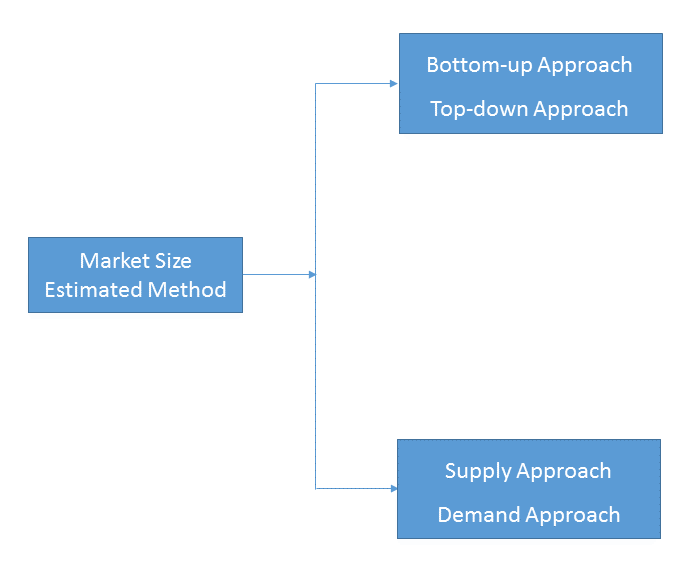
Bottom-up & top-down approach, supply & demand approach are the most important method which is used by HDIN Research to estimate the market size.
1)Top-down & Bottom-up Approach
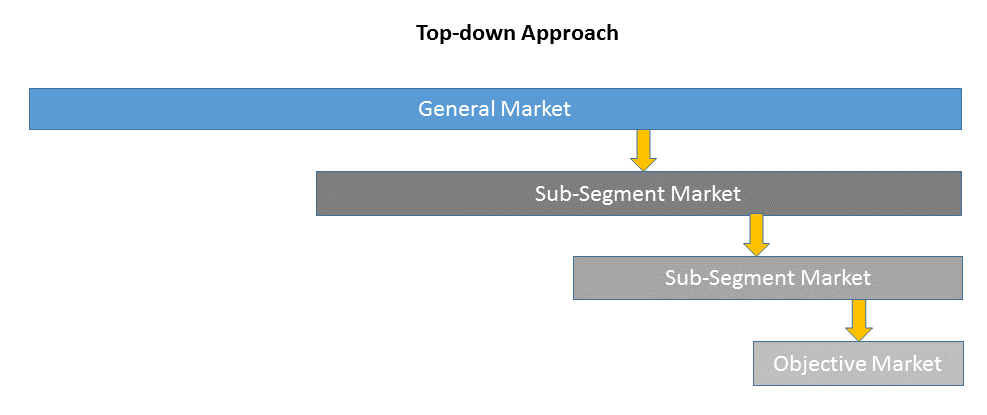
Top-down approach uses a general market size figure and determines the percentage that the objective market represents.
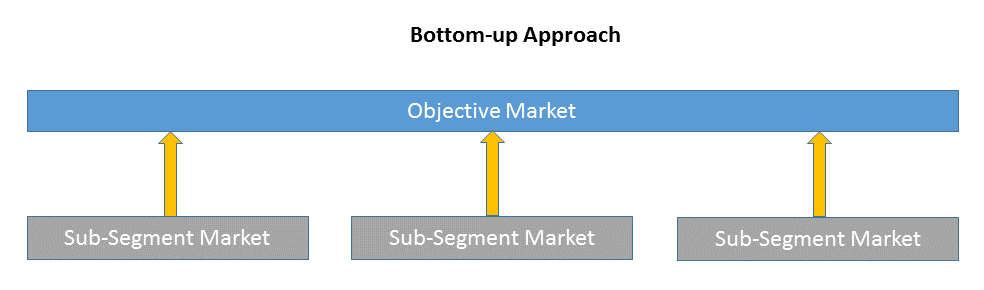
Bottom-up approach size the objective market by collecting the sub-segment information.
2)Supply & Demand Approach
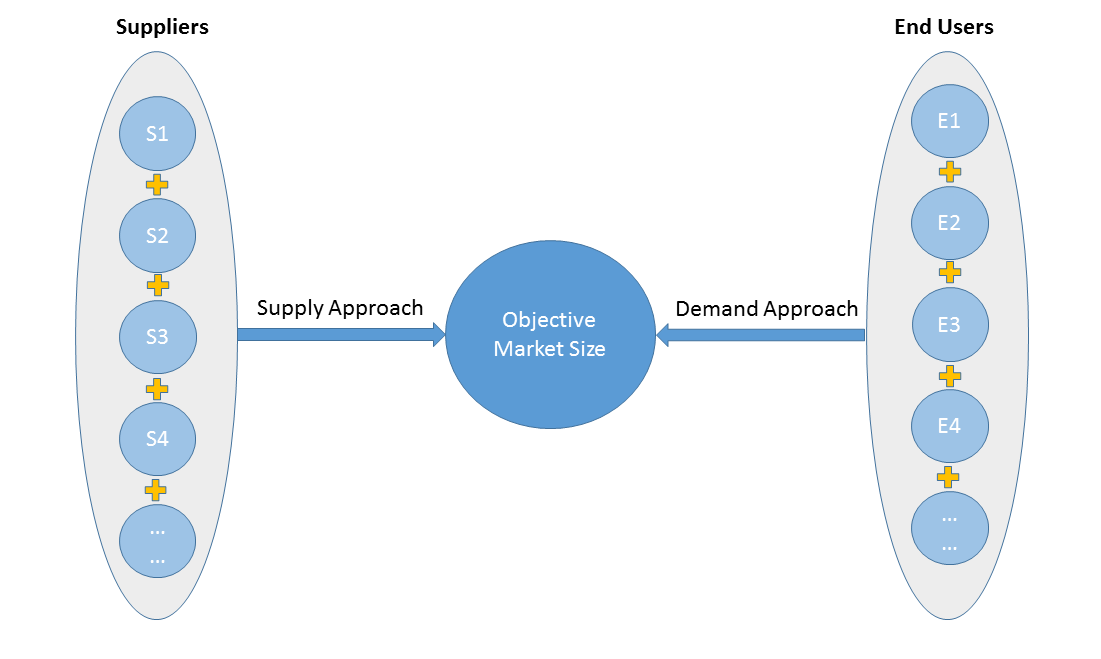
Supply approach is based on assessments of the size of each competitor supplying the objective market.
Demand approach combine end-user data within a market to estimate the objective market size. It is sometimes referred to as bottom-up approach.
- Forecasting Methodology
- Numerous factors impacting the market trend are considered for forecast model:
- New technology and application in the future;
- New project planned/under contraction;
- Global and regional underlying economic growth;
- Threatens of substitute products;
- Industry expert opinion;
- Policy and Society implication.
- Analysis Tools
1)PEST Analysis
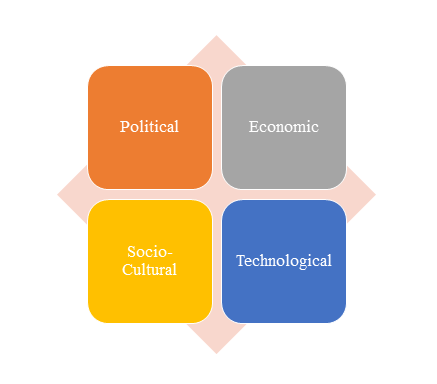
PEST Analysis is a simple and widely used tool that helps our client analyze the Political, Economic, Socio-Cultural, and Technological changes in their business environment.
- Benefits of a PEST analysis:
- It helps you to spot business opportunities, and it gives you advanced warning of significant threats.
- It reveals the direction of change within your business environment. This helps you shape what you’re doing, so that you work with change, rather than against it.
- It helps you avoid starting projects that are likely to fail, for reasons beyond your control.
- It can help you break free of unconscious assumptions when you enter a new country, region, or market; because it helps you develop an objective view of this new environment.
2)Porter’s Five Force Model Analysis
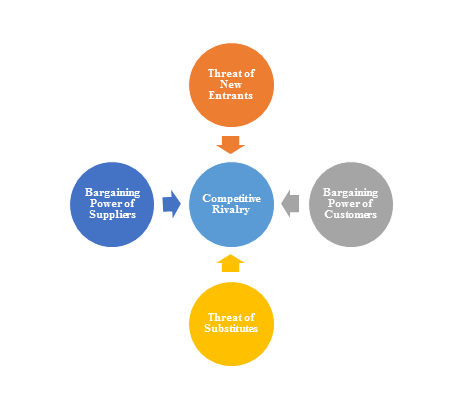
The Porter’s Five Force Model is a tool that can be used to analyze the opportunities and overall competitive advantage. The five forces that can assist in determining the competitive intensity and potential attractiveness within a specific area.
- Threat of New Entrants: Profitable industries that yield high returns will attract new firms.
- Threat of Substitutes: A substitute product uses a different technology to try to solve the same economic need.
- Bargaining Power of Customers: the ability of customers to put the firm under pressure, which also affects the customer's sensitivity to price changes.
- Bargaining Power of Suppliers: Suppliers of raw materials, components, labor, and services (such as expertise) to the firm can be a source of power over the firm when there are few substitutes.
- Competitive Rivalry: For most industries the intensity of competitive rivalry is the major determinant of the competitiveness of the industry.
3)Value Chain Analysis
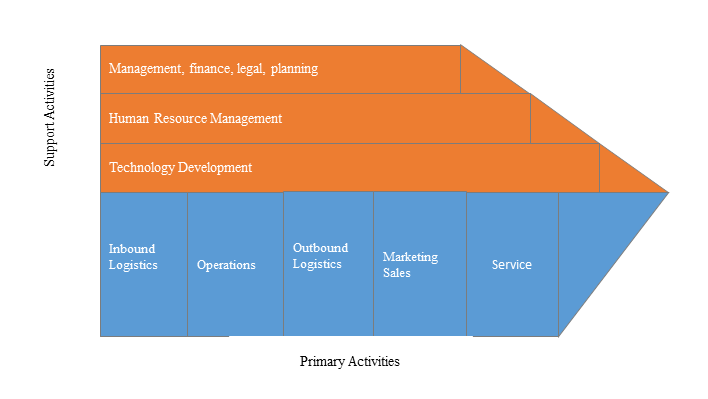
Value chain analysis is a tool to identify activities, within and around the firm and relating these activities to an assessment of competitive strength. Value chain can be analyzed by primary activities and supportive activities. Primary activities include: inbound logistics, operations, outbound logistics, marketing & sales, service. Support activities include: technology development, human resource management, management, finance, legal, planning.
4)SWOT Analysis
SWOT analysis is a tool used to evaluate a company's competitive position by identifying its strengths, weaknesses, opportunities and threats. The strengths and weakness is the inner factor; the opportunities and threats are the external factor. By analyzing the inner and external factors, the analysis can provide the detail information of the position of a player and the characteristics of the industry.
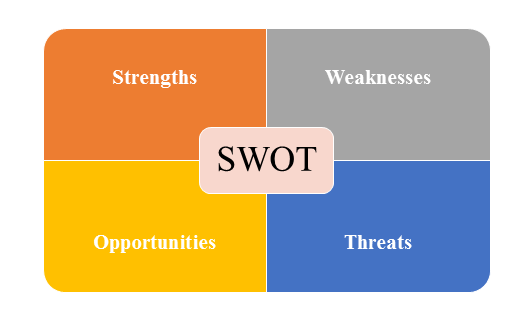
- Strengths describe what the player excels at and separates it from the competition
- Weaknesses stop the player from performing at its optimum level.
- Opportunities refer to favorable external factors that the player can use to give it a competitive advantage.
- Threats refer to factors that have the potential to harm the player.
- Data Sources
| Primary Sources | Secondary Sources |
|---|---|
| Face to face/Phone Interviews with market participants, such as: Manufactures; Distributors; End-users; Experts. Online Survey |
Government/International Organization Data: Annual Report/Presentation/Fact Book Internet Source Information Industry Association Data Free/Purchased Database Market Research Report Book/Journal/News |