Global Atomizing Copper Powder Market Strategic Outlook 2026-2031 Industry Consolidation and ASEAN Atomization Capacity Analysis
- Single User License (1 Users) $ 3,500
- Team License (2~5 Users) $ 4,500
- Corporate License (>5 Users) $ 5,500
The global atomizing copper powder market in 2026 forms the high-throughput metallurgical backbone of structural powder metallurgy (PM), industrial diamond-tool bonding matrices, electric carbon contacts, and next-generation thermal management components. Produced by disintegrating molten pure copper or pre-alloyed copper melts (such as bronze, brass, and phosphor-copper) using high-pressure water, air, or inert gas jets, atomized copper powder delivers decisive economic and technical advantages over electrolytic alternatives: superior production scalability, lower energy intensity per metric ton, tightly tunable particle sphericity and flowability, and seamless multi-element pre-alloying. As of 2026, the global market is valued between 1.2 billion USD and 1.7 billion USD, projected to expand steadily at a compound annual growth rate (CAGR) ranging from 2.1 percent to 3.7 percent through 2031.
The strategic architecture of the industry between 2024 and 2026 has been defined by a sharp structural bifurcation: defensive asset consolidation in mature Western industrial hubs paired with aggressive, high-growth regional capacity expansion in Southeast Asia. In North America, citing declining traditional market conditions, Maryville, Tennessee-based Royal Metal Powders—a producer of water- and air-atomized copper, brass, bronze, nickel-silver, tin, and phosphor-copper powders—divested the majority of its assets to specialty materials giant Kymera International in February 2024. Retaining Royal’s president Mike Lutheran as Senior Vice President, Kymera initiated a systematic operational consolidation to transition production into its flagship scale facilities in North Carolina, Pennsylvania, and Germany—illustrating how Western incumbents are rationalizing footprints to preserve kiln utilization and margin resilience.
In stark contrast, Asian leaders are deploying fresh capital to capture Southeast Asian industrialization and emerging additive-manufacturing niches. On October 13, 2026, GRIPM Advanced Materials—whose copper-based powder portfolio ranks second globally by market share—announced a capital injection of RMB 186 million of internal funds into its wholly owned Thai manufacturing subsidiary, earmarking RMB 121 million explicitly for expanding atomized powder production lines and RMB 64.8 million to bolster working capital. Having commenced operations in June 2024 producing copper-based and 3D-printing powders for Southeast Asia, GRIPM’s Thai unit achieved RMB 139 million in first-half 2026 revenue, contributing to a surging group first-half 2026 revenue of RMB 2.621 billion (up 46.39 percent year-over-year) and attributable net profit of RMB 55.35 million (up 54.79 percent). This transatlantic-versus-ASEAN divergence defines the 2026 landscape: legacy Western volume is consolidating into fewer mega-sites, while growth capital flows into modern, tariff-resilient water- and gas-atomization lines tailored for advanced thermal, electronic, and 3D-printing applications.
Regional Market Analysis
The geographical distribution of the atomizing copper powder market mirrors regional manufacturing vitality, energy cost structures, and cross-border trade alignment.
● Asia Pacific commands the largest global market share, estimated between 46 percent and 50 percent, serving as both the primary production engine and fastest-expanding demand hub. Mainland China hosts colossal water-atomized capacity led by GRIPM Advanced Materials, Anhui Xujing, Tongling Guochuan, and CNPC Powder, while Southeast Asia—spearheaded by GRIPM’s rapidly expanding Thai subsidiary—has emerged as a vital regionalized export platform for copper-based and additive-manufacturing powders. Japan (Fukuda Metal, Mitsui Kinzoku, Nippon Atomized Metal, DOWA Electronics Materials) and South Korea (Chang Sung) dominate ultra-fine, low-oxygen spherical copper powders for high-end electronics and Metal Injection Molding (MIM). Within Taiwan(China), demand concentrates heavily on tightly classified irregular and spherical atomized copper powders supporting AI server vapor-chamber thermal wicks, high-frequency magnetic inductor composites, and precision micro-bearings.
● Europe accounts for a technically sophisticated, sustainability-driven market share ranging from 24 percent to 28 percent. Anchored by Italy’s Pometon, France’s Poudmet, Germany’s Schlenk and GGP Metalpowder, and Kymera International’s expanded German production hub, European demand focuses on precision automotive sintered bearings, aerospace/EV laser-sintered copper heat exchangers, and high-spec diamond cutting tools. Strict EU circular-economy policies increasingly incentivize European atomizers to melt high-purity certified recycled copper scrap, reducing Scope 3 carbon footprints for continental industrial OEMs.
● North America captures a mature, consolidating market share between 18 percent and 22 percent. Regional supply structure has tightened significantly following Kymera International’s acquisition of Royal Metal Powders and subsequent production consolidation into North Carolina and Pennsylvania. While traditional internal-combustion automotive PM demand has moderated, robust North American investments in defense/aerospace metal 3D printing (pure copper and CuCrZr alloys), industrial brazing pastes, and heavy-equipment friction linings sustain healthy conversion margins for surviving domestic scale players.
● South America and the Middle East and Africa (MEA) collectively represent 6 percent to 10 percent of global revenue. Growth across Latin America centers on automotive PM component plants in Brazil and nearshored industrial hubs in Mexico integrated with North American supply chains, while GCC construction megaprojects and regional stone/concrete quarrying sustain steady demand for atomized bronze and copper-iron diamond-tool matrix powders.
Application and Segmentation Analysis
Atomizing copper powder serves three foundational industrial end-markets alongside a rapidly accelerating high-margin spillover into metal additive manufacturing and thermal management.
● Powder Metallurgy (PM) represents the largest global tonnage segment, absorbing roughly 55 percent to 60 percent of volume. Irregular water-atomized copper and pre-alloyed bronze (Cu-Sn) powders are indispensable for manufacturing oil-impregnated self-lubricating bearings in automotive seat/HVAC actuators and home appliances, copper-infiltrated structural steel gears, and heavy-duty copper-matrix friction plates for rail and wind-turbine brakes. Superior powder flowability enables rapid automated die filling, lowering per-part production costs relative to dendritic electrolytic powder.
● Diamond Tools constitute a technically demanding, pre-alloyed growth vertical. Industrial manufacturers of granite/concrete circular saw segments, quarry wire beads, and core drill bits rely heavily on water-atomized pre-alloyed bronze, copper-iron, and phosphor-copper powders as the metallic sintering binder holding synthetic diamonds. Pre-alloying in the molten state prior to atomization eliminates elemental segregation during hot pressing, yielding uniform hardness, reduced sintering temperatures, and extended diamond-crystal retention.
● Electric Carbon applications utilize tightly controlled air- and fine water-atomized copper powders blended with electro-graphite to form conductive carbon brushes, pantograph strips, and generator slip rings. High chemical purity and consistent apparent density ensure low electrical contact resistance and controlled mechanical wear across industrial motors, electrified railways, and utility-scale wind turbines.
● Emerging Additive Manufacturing and Thermal Management Spillover: Increasingly, inert-gas-atomized spherical copper and CuCrZr powders (explicitly targeted by GRIPM’s Thai facility and CNPC Powder) are unlocking high-margin growth in green-laser and electron-beam metal 3D printing for rocket thrust chambers, EV induction coils, and AI data-center liquid-cooling micro-channel plates, alongside fine irregular water-atomized powders forming porous capillary wicks inside server vapor chambers.
Value Chain Analysis
The atomizing copper powder value chain operates on an LME-plus-conversion economic model, where profitability hinges on furnace energy efficiency, nozzle atomization yield, and downstream alloy sophistication.
Upstream Feedstock and Melting: Value creation initiates with Grade-A refined copper cathodes or ultra-clean recycled copper busbar/wire scrap melted in high-efficiency induction furnaces alongside tin, zinc, nickel, or phosphorus alloying additions. Because raw metal constitutes roughly 75 percent to 85 percent of finished invoice value, disciplined LME hedging and ample working capital—highlighted by GRIPM committing RMB 64.8 million of its Thai capital injection solely to working capital—are decisive operational necessities.
Midstream Atomization, Reduction, and Classification: Molten metal streams are disintegrated via high-pressure deionized water (up to 150 MPa for ultra-fine irregular grades), compressed air, or inert nitrogen/argon gas (for low-oxygen spherical grades). Subsequent continuous hydrogen-atmosphere reduction annealing eliminates surface cuprous oxide, while precision ultrasonic sieving and air classification separate narrow particle-size fractions.
Pre-Alloyed Matrices, Ultra-Fine Grades, and Spherical AM Powders (Primary Value Pool): Standard coarse water-atomized copper faces intense conversion-margin compression. Highest profit pools in 2026 reside in sub-15-micron ultra-fine high-pressure water-atomized powders (for MIM and conductive pastes), inert-gas-atomized spherical copper alloys (<300 ppm oxygen) for 3D printing, and customized multi-element pre-alloyed powders for diamond tools and brazing.
Downstream Integration and Consolidation: High plant fixed costs make capacity utilization paramount. Acquiring distressed regional competitors and folding volume into centralized mega-sites—as executed by Kymera International with Royal Metal Powders—dramatically expands gross conversion margins by amortizing furnace, annealing, and QA laboratory overhead across higher throughput.
Key Market Player Deep Profiles
● Kymera International: Headquartered in Research Triangle Park, North Carolina, Kymera International stands as a premier Western specialty materials and surface-technologies titan with deep vertical strength across non-ferrous metal powders. Demonstrating decisive strategic discipline during cyclical industry softening, Kymera closed the acquisition of the majority assets of Tennessee-based Royal Metal Powders on February 27, 2024—incorporating Royal’s water- and air-atomized copper, brass, bronze, nickel-silver, tin, and phosphor-copper portfolios under incoming Senior Vice President Mike Lutheran while consolidating production into scaled hubs in North Carolina, Pennsylvania, and Germany. In 2026, Kymera leverages this rationalized transatlantic manufacturing footprint to command pricing stability across North American and European powder metallurgy, brazing, friction, and aerospace additive-manufacturing accounts.
● Pometon: Headquartered in Maerne di Martellago, Italy, Pometon ranks among Europe’s most comprehensive metallurgical powder producers, combining high-capacity water- and air-atomized copper and pre-alloyed bronze/brass lines with electrolytic and ferrous powder operations. Serving Europe’s premier automotive PM part makers, heavy friction-lining fabricators, and industrial diamond-tool manufacturers, Pometon differentiates through bespoke alloy formulation and integrated pre-mixed powder solutions that streamline customer pressing workflows. In 2026, Pometon strengthens its European sovereignty moat by scaling high-purity recycled copper scrap melting and renewable-energy furnace operations, directly addressing strict EU automotive Scope 3 decarbonization requirements.
● Poudmet: Based in France, Poudmet is a deeply respected European non-ferrous atomization specialist dedicated to engineered copper, bronze, brass, tin, and zinc alloy powders. Operating agile water- and air-atomization lines tailored for tight particle-size tolerances and custom chemical compositions, Poudmet caters extensively to specialized diamond-tool bonding matrices, industrial sintered filters, friction materials, and decorative/conductive metal-polymer composites across Western Europe. In 2026, Poudmet’s competitive advantage rests on high-touch metallurgical customization and rapid small-to-medium batch flexibility—thriving in technical specialty alloys where massive commodity atomizers lack responsiveness.
● Schlenk: Headquartered in Roth, Germany, Carl Schlenk AG combines over 140 years of metallic materials mastery across metallic effect pigments, precision metal foils, and specialty copper/bronze powders. Rather than competing in low-margin coarse structural PM tonnage, Schlenk focuses on high-value fine atomized copper and bronze alloys, flake-milled conductive pigments, and precision brazing/electronic filler materials. In 2026, Schlenk’s strategic layout capitalizes on expanding European and global demand for electromagnetic interference (EMI) shielding coatings, conductive thermal pastes, and precision automotive electronics—supported by strict German quality consistency and multi-continental technical distribution.
● GGP Metalpowder: Based in Fürth, Germany, GGP Metalpowder complements its globally renowned electrolytic copper franchise with high-precision atomized copper and bronze powder capabilities. Deeply entrenched in Europe’s electric carbon brush, rail-brake friction, and high-reliability PM bearing value chains, GGP distinguishes itself through tight oxide control, uniform apparent density, and dual-morphology blending—often combining water-atomized and electrolytic grades to deliver customized compressibility-to-flowability ratios for complex automated presses. In 2026, GGP captures resilient premium conversion margins from European OEMs prioritizing zero-defect consistency and localized EU supply security.
● Fukuda Metal: Headquartered in Kyoto, Japan, Fukuda Metal Foil & Powder represents the pinnacle of Japanese fine-metallurgy precision across both atomized and electrolytic copper powders. Operating advanced high-pressure water-atomization and inert-gas-atomization lines, Fukuda supplies ultra-consistent fine copper and pre-alloyed bronze powders for precision automotive micro-bearings, high-efficiency diamond cutting segments, and heat-pipe thermal capillary wicks. In 2026, Fukuda Metal’s relentless R&D into narrow-distribution spherical and surface-treated copper powders secures entrenched tier-one positioning across Japan, Taiwan(China), and North America’s AI server cooling and high-reliability electronics sectors.
● Mitsui Kinzoku: Formally Mitsui Mining & Smelting Co., Ltd. of Tokyo, Japan, Mitsui Kinzoku leverages massive upstream non-ferrous refining scale alongside world-leading specialty electronics-materials engineering. Within the atomizing copper powder landscape, Mitsui Kinzoku excels in ultra-fine, high-sphericity micro-copper powders engineered explicitly for high-frequency electronic substrates, multilayer ceramic capacitor (MLCC) external terminations, and conductive adhesives, alongside select high-spec PM applications. In 2026, Mitsui Kinzoku’s proprietary particle-surface passivation technologies—preventing oxidation in sub-10-micron copper powders—sustain top-tier technical margins across Asia Pacific and global semiconductor packaging ecosystems.
● Nippon Atomized Metal: Operating as Nippon Atomized Metal Powders Corporation in Japan, this pure-play specialist ranks among the world’s premier innovators in ultra-fine high-pressure water-atomized and gas-atomized metal powders. Specializing in precision copper, copper-alloy, and stainless/nickel powders down to single-digit micron sizes, Nippon Atomized Metal dominates demanding Metal Injection Molding (MIM), high-precision brazing pastes, and advanced electronic thermal-management applications. In 2026, surging miniaturization in consumer electronics, EV sensors, and AI hardware heat spreaders fuels strong global demand for their tightly classified, low-oxygen fine copper feedstocks.
● DOWA Electronics Materials: A flagship division of Japan’s DOWA Holdings, DOWA Electronics Materials combines deep non-ferrous metallurgical integration with specialized fine-powder synthesis targeting electronics, energy, and precision industrial markets. Producing ultra-high-purity fine copper and silver-coated copper powders with tightly governed tap density and dispersion properties, DOWA bridges traditional electric-carbon conductivity applications with next-generation photovoltaic metallization pastes, semiconductor die-attach sintering materials, and high-reliability automotive electronics. In 2026, DOWA’s vertically integrated precious/base-metal recycling and refining loops strengthen both cost efficiency and ESG traceability.
● Chang Sung: Headquartered in Incheon, South Korea, Chang Sung Corporation is South Korea’s premier specialty metal-powder and magnetic-core manufacturer, operating high-capacity water- and gas-atomization facilities. Serving as a critical non-Chinese East Asian supply anchor, Chang Sung supplies precision copper, pre-alloyed bronze, phosphor-copper brazing powders, and soft-magnetic composites to Korean, Japanese, and North American automotive PM, diamond-tool, and power-electronics OEMs. In 2026, Chang Sung capitalizes on heightened Western and allied supply-chain diversification—offering tariff-competitive, high-consistency atomized copper grades backed by strong Korean process automation.
● GRIPM Advanced Materials: Listed on Shanghai’s STAR Market (688456.SH), GRIPM Advanced Materials ranks second globally in copper-based metal powder market share, posting surging first-half 2026 group revenue of RMB 2.621 billion (up 46.39 percent year-over-year) and attributable net profit of RMB 55.35 million (up 54.79 percent). Demonstrating bold international execution, GRIPM announced an RMB 186 million capital injection into its wholly owned Thai subsidiary on October 13, 2026—dedicating RMB 121 million specifically to expanding atomized powder production lines and RMB 64.8 million to working capital. Having begun production in June 2024 and already generating RMB 139 million in H1 2026 revenue from copper-based and 3D-printing powders, GRIPM’s Thai hub anchors its dominant multi-regional assault on Southeast Asian and Western export markets.
● Anhui Xujing: Headquartered in Anhui Province within China’s central industrial metallurgy belt, Anhui Xujing is a major domestic specialist in water-atomized pure copper, pre-alloyed tin-bronze, and iron-copper composite powders. Focused heavily on high-volume scale efficiency and consistent compressibility, Anhui Xujing supplies foundational tonnage to China’s expansive automotive sintered-bearing factories, industrial friction-material pressers, and diamond-saw segment fabricators. In 2026, Anhui Xujing is systematically upgrading automated hydrogen reduction furnaces and fine-fraction air classifiers to defend domestic market share while expanding direct exports into Southeast Asia and South America.
● Tongling Guochuan: Strategically located in Tongling, Anhui—"China’s Copper Capital"—Tongling Guochuan New Material leverages immediate proximity to colossal regional copper smelters to operate highly cost-competitive water-atomized copper and pre-alloyed copper-matrix production alongside its electrolytic lines. Serving both domestic Chinese diamond-tool clusters and powder metallurgy component makers, Tongling Guochuan optimizes raw cathode logistics and induction-melting scale to deliver attractive conversion pricing. In 2026, the company invests in fine-particle pre-alloyed diamond matrices and tighter oxygen-control annealing to migrate steadily up the margin curve.
● CNPC Powder: Operating as an internationally oriented advanced metal-powder innovator with active North American and European commercial hubs, CNPC Powder bridges traditional water-atomized copper alloys with cutting-edge inert-gas-atomized spherical copper and CuCrZr/CuSn10 powders tailored specifically for laser and electron-beam metal 3D printing. Catering to aerospace propulsion, EV induction-motor windings, and high-efficiency industrial heat exchangers, CNPC Powder differentiates through rapid custom alloy atomization, strict low-oxygen spherical morphology (<300 ppm), and agile global technical fulfillment—capturing one of the fastest-growing high-margin pockets of the 2026 copper powder landscape.
Opportunities and Challenges
The atomizing copper powder market balances moderate baseline growth in legacy industrial applications against compelling technological expansion in thermal and additive sectors.
● Opportunities: The rapid commercialization of green-laser and blue-laser metal additive manufacturing unlocks a lucrative, high-conversion-margin tier for inert-gas-atomized spherical pure copper and CuCrZr alloys used in AI liquid-cooling cold plates, EV hairpins/coils, and aerospace heat exchangers—directly validated by GRIPM’s printing-powder expansion in Thailand. Concurrently, surging global deployment of AI data-center servers fuels sustained demand for fine, tightly classified atomized copper powders sintered into porous vapor-chamber thermal wicks. In traditional markets, pre-alloyed atomized bronze and copper-iron matrices continue gaining share over elemental blends in high-speed diamond cutting tools due to superior sintering homogeneity.
● Challenges: Structural moderation in Western internal-combustion automotive PM volume—explicitly cited by Royal Metal Powders as a catalyst for its asset divestiture to Kymera International—forces mature Western atomizers to consolidate capacity or face severe under-utilization. Financially, sharp LME copper price swings inflate inventory carrying requirements dramatically, explaining why scaling producers like GRIPM must earmark substantial working-capital infusions (RMB 64.8 million in Thailand alone) alongside equipment CAPEX. Technically, suppressing surface oxidation during ultra-fine high-pressure water atomization without incurring excessive hydrogen-annealing energy costs remains a persistent process-engineering challenge.
Macroeconomic and Geopolitical Influences
The 2026 atomizing copper powder market reflects a macroeconomic environment defined by elevated global borrowing costs and pronounced regional industrial divergence. High interest rates have magnified the working-capital burden of financing physical Grade-A copper cathode inventories—accelerating Darwinian shakeouts among subscale, debt-constrained private atomizers in North America and Europe while strengthening well-capitalized consolidators (Kymera International absorbing Royal Metal Powders) and high-growth public leaders (GRIPM Advanced Materials leveraging strong H1 2026 earnings momentum to self-fund overseas expansion).
Geopolitically, Western trade tariffs on Chinese-origin metallurgical exports and mounting emphasis on supply-chain sovereignty have permanently transformed global atomization geography. To serve tariff-sensitive North American, European, and rapidly industrializing ASEAN manufacturers seamlessly, Chinese leaders are accelerating offshore manufacturing—epitomized by GRIPM’s RMB 186 million capital injection expanding atomized powder lines in Thailand. Simultaneously, Western defense, aerospace additive-manufacturing, and EV OEMs are locking in sovereign or allied regional supply through consolidated hubs in North Carolina, Pennsylvania, and Germany (Kymera), European leaders (Pometon, Schlenk, Poudmet), Japanese/Korean ultra-fine specialists (Fukuda, Nippon Atomized Metal, Chang Sung), and precision electronics chains in Taiwan(China). Through 2031, enduring competitive leadership will belong to multi-regional atomizers mastering both low-cost recycled-copper melting and ultra-fine, low-oxygen spherical alloy engineering.
1.1 Study Scope 1
1.2 Research Methodology 2
1.2.1 Data Sources 2
1.2.2 Assumptions 3
1.3 Abbreviations and Acronyms 4
Chapter 2 Global Market Executive Summary 6
2.1 Global Atomizing Copper Powder Capacity, Production, and Utilization Rate (2021-2031) 6
2.2 Global Atomizing Copper Powder Consumption and Market Size (2021-2031) 8
2.3 Global Average Sales Price, Production Cost, and Gross Margin Trends 10
Chapter 3 Macroeconomic Environment and Geopolitical Conflict Impact Analysis 12
3.1 Global Macroeconomic Indicators and Industrial Manufacturing Trends 12
3.2 Geopolitical Conflicts and Maritime Logistics Disruptions 14
3.3 Trade Policies, Tariffs, and Copper Feedstock Price Volatility 16
Chapter 4 Manufacturing Process, Technology, and Patent Analysis 18
4.1 Water Atomization vs. Gas Atomization Process Analysis 18
4.2 Particle Morphology, Oxygen Content, and Quality Control Standards 20
4.3 Global Patent Landscape and Technology Evolution 22
Chapter 5 Global Atomizing Copper Powder Market by Type 24
5.1 Water Atomized Copper Powder 24
5.2 Gas Atomized Copper Powder 26
5.3 Other Specialty Atomized Copper Powder 28
Chapter 6 Global Atomizing Copper Powder Market by Application 29
6.1 Powder Metallurgy 29
6.2 Diamonds Tool 31
6.3 Electric Carbon 33
6.4 Other Applications 35
Chapter 7 Global Atomizing Copper Powder Production and Supply by Key Regions 36
7.1 North America 36
7.2 Europe 37
7.3 Asia-Pacific (China, Japan, South Korea, India, Taiwan (China), and Southeast Asia) 39
7.4 Latin America and Middle East & Africa 41
Chapter 8 Global Atomizing Copper Powder Consumption and Demand by Key Regions 42
8.1 North America 42
8.2 Europe 43
8.3 Asia-Pacific (China, Japan, South Korea, India, Taiwan (China), and Southeast Asia) 45
8.4 Rest of the World 47
Chapter 9 Industry Value Chain and Import/Export Analysis 48
9.1 Atomizing Copper Powder Value Chain Structure 48
9.2 Upstream Copper Scrap, Electrolytic Copper, and Atomizing Equipment Supply 49
9.3 Downstream Distribution Channels and Customer Procurement Models 50
9.4 Global Import and Export Trade Flow by Key Regions 51
Chapter 10 Market Competition Landscape 54
10.1 Global Market Concentration and Regional Capacity Distribution 54
10.2 Key Players Market Share Ranking (Capacity, Production, and Revenue) 56
10.3 Mergers, Acquisitions, and Capacity Expansion Plans 58
Chapter 11 Key Market Players Profile and Operational Analysis 60
11.1 Kymera International 60
11.1.1 Company Profile and Business Overview 60
11.1.2 SWOT Analysis 61
11.1.3 R&D Capabilities and Product Innovation 62
11.1.4 Marketing Strategy and Global Footprint 62
11.1.5 Kymera International Atomizing Copper Powder Capacity, Production, Utilization Rate, Revenue, Price, Cost, Gross Margin, and Market Share (2021-2026) 63
11.2 Pometon 65
11.2.1 Company Profile and Business Overview 65
11.2.2 SWOT Analysis 66
11.2.3 R&D Investment and Quality Control 66
11.2.4 Pometon Atomizing Copper Powder Capacity, Production, Utilization Rate, Revenue, Price, Cost, Gross Margin, and Market Share (2021-2026) 67
11.3 Poudmet 69
11.3.1 Company Profile and Business Overview 69
11.3.2 SWOT Analysis 70
11.3.3 Poudmet Atomizing Copper Powder Capacity, Production, Utilization Rate, Revenue, Price, Cost, Gross Margin, and Market Share (2021-2026) 71
11.4 Schlenk 72
11.4.1 Company Profile and Business Overview 72
11.4.2 SWOT Analysis 73
11.4.3 Marketing Strategy and Customer Network 73
11.4.4 Schlenk Atomizing Copper Powder Capacity, Production, Utilization Rate, Revenue, Price, Cost, Gross Margin, and Market Share (2021-2026) 74
11.5 GGP Metalpowder 76
11.5.1 Company Profile and Business Overview 76
11.5.2 SWOT Analysis 77
11.5.3 R&D Capabilities and Product Portfolio 77
11.5.4 GGP Metalpowder Atomizing Copper Powder Capacity, Production, Utilization Rate, Revenue, Price, Cost, Gross Margin, and Market Share (2021-2026) 78
11.6 Fukuda Metal 80
11.6.1 Company Profile and Business Overview 80
11.6.2 SWOT Analysis 81
11.6.3 R&D Investment and Atomization Expertise 81
11.6.4 Fukuda Metal Atomizing Copper Powder Capacity, Production, Utilization Rate, Revenue, Price, Cost, Gross Margin, and Market Share (2021-2026) 82
11.7 Mitsui Kinzoku 84
11.7.1 Company Profile and Business Overview 84
11.7.2 SWOT Analysis 85
11.7.3 R&D Capabilities and Downstream Integration 85
11.7.4 Mitsui Kinzoku Atomizing Copper Powder Capacity, Production, Utilization Rate, Revenue, Price, Cost, Gross Margin, and Market Share (2021-2026) 86
11.8 Nippon Atomized Metal 88
11.8.1 Company Profile and Business Overview 88
11.8.2 SWOT Analysis 89
11.8.3 Nippon Atomized Metal Atomizing Copper Powder Capacity, Production, Utilization Rate, Revenue, Price, Cost, Gross Margin, and Market Share (2021-2026) 90
11.9 DOWA Electronics Materials 91
11.9.1 Company Profile and Business Overview 91
11.9.2 SWOT Analysis 92
11.9.3 R&D Investment and Specialty Powder Focus 92
11.9.4 DOWA Electronics Materials Atomizing Copper Powder Capacity, Production, Utilization Rate, Revenue, Price, Cost, Gross Margin, and Market Share (2021-2026) 93
11.10 Chang Sung 95
11.10.1 Company Profile and Business Overview 95
11.10.2 SWOT Analysis 96
11.10.3 Chang Sung Atomizing Copper Powder Capacity, Production, Utilization Rate, Revenue, Price, Cost, Gross Margin, and Market Share (2021-2026) 97
11.11 GRIPM Advanced Materials 98
11.11.1 Company Profile and Business Overview 98
11.11.2 SWOT Analysis 99
11.11.3 R&D Capabilities and Capacity Expansion 99
11.11.4 GRIPM Advanced Materials Atomizing Copper Powder Capacity, Production, Utilization Rate, Revenue, Price, Cost, Gross Margin, and Market Share (2021-2026) 100
11.12 Anhui Xujing 102
11.12.1 Company Profile and Business Overview 102
11.12.2 SWOT Analysis 103
11.12.3 Marketing Strategy and Industrial Partnerships 103
11.12.4 Anhui Xujing Atomizing Copper Powder Capacity, Production, Utilization Rate, Revenue, Price, Cost, Gross Margin, and Market Share (2021-2026) 104
11.13 Tongling Guochuan 106
11.13.1 Company Profile and Business Overview 106
11.13.2 SWOT Analysis 107
11.13.3 Upstream Sourcing and Cost Control 107
11.13.4 Tongling Guochuan Atomizing Copper Powder Capacity, Production, Utilization Rate, Revenue, Price, Cost, Gross Margin, and Market Share (2021-2026) 108
11.14 CNPC Powder 110
11.14.1 Company Profile and Business Overview 110
11.14.2 SWOT Analysis 111
11.14.3 R&D Capabilities and Export Strategy 111
11.14.4 CNPC Powder Atomizing Copper Powder Capacity, Production, Utilization Rate, Revenue, Price, Cost, Gross Margin, and Market Share (2021-2026) 112
Chapter 12 Market Drivers, Challenges, and Future Forecast (2027-2031) 114
12.1 Market Drivers and Growth Catalysts 114
12.2 Industry Restraints and Technical Challenges 115
12.3 Global Atomizing Copper Powder Market Forecast (2027-2031) 116
12.4 Strategic Recommendations for Industry Stakeholders 118
Table 2. Global Atomizing Copper Powder Capacity and Production Forecast (2027-2031) 7
Table 3. Global Atomizing Copper Powder Consumption and Market Size (2021-2026) 8
Table 4. Global Atomizing Copper Powder Consumption and Market Size Forecast (2027-2031) 9
Table 5. Global Atomizing Copper Powder Price, Cost, and Gross Profit Margin (2021-2026) 11
Table 6. Major Geopolitical Conflicts and Supply Chain Impact Assessment 15
Table 7. Key Import Tariffs and Trade Policies Across Key Regions 17
Table 8. Technical Specifications of Atomizing Copper Powder by Process Type 20
Table 9. Major Patent Holders and Core Atomization Technologies 23
Table 10. Global Atomizing Copper Powder Consumption by Type (MT) (2021-2026) 25
Table 11. Global Atomizing Copper Powder Market Size by Type (M USD) (2021-2031) 25
Table 12. Global Atomizing Copper Powder Consumption by Application (MT) (2021-2026) 29
Table 13. Global Atomizing Copper Powder Market Size by Application Forecast (M USD) (2027-2031) 30
Table 14. Global Atomizing Copper Powder Capacity and Production by Key Regions (MT) (2021-2026) 36
Table 15. Asia-Pacific Atomizing Copper Powder Production Breakdown by Sub-Region (MT) (2021-2026) 39
Table 16. Global Atomizing Copper Powder Production Forecast by Key Regions (MT) (2027-2031) 41
Table 17. Global Atomizing Copper Powder Consumption and Market Size by Key Regions (2021-2026) 42
Table 18. Asia-Pacific Atomizing Copper Powder Consumption Breakdown by Sub-Region (MT) (2021-2026) 45
Table 19. Global Atomizing Copper Powder Consumption Forecast by Key Regions (MT) (2027-2031) 47
Table 20. Major Upstream Copper Feedstock and Equipment Suppliers 49
Table 21. Global Atomizing Copper Powder Export Volume by Key Regions (MT) (2021-2026) 52
Table 22. Global Atomizing Copper Powder Import Volume by Key Regions (MT) (2021-2026) 53
Table 23. Global Key Players Capacity, Production, and Revenue Ranking in 2026 56
Table 24. Recent Capacity Expansions and M&A Activities (2021-2026) 59
Table 25. Kymera Atomizing Copper Powder Capacity, Production, Price, Cost and Gross Profit Margin (2021-2026) 63
Table 26. Pometon Atomizing Copper Powder Capacity, Production, Price, Cost and Gross Profit Margin (2021-2026) 67
Table 27. Poudmet Atomizing Copper Powder Capacity, Production, Price, Cost and Gross Profit Margin (2021-2026) 71
Table 28. Schlenk Atomizing Copper Powder Capacity, Production, Price, Cost and Gross Profit Margin (2021-2026) 74
Table 29. GGP Metalpowder Atomizing Copper Powder Capacity, Production, Price, Cost and Gross Profit Margin (2021-2026) 78
Table 30. Fukuda Metal Atomizing Copper Powder Capacity, Production, Price, Cost and Gross Profit Margin (2021-2026) 82
Table 31. Mitsui Kinzoku Atomizing Copper Powder Capacity, Production, Price, Cost and Gross Profit Margin (2021-2026) 86
Table 32. Nippon Atomized Metal Atomizing Copper Powder Capacity, Production, Price, Cost and Gross Profit Margin (2021-2026) 90
Table 33. DOWA Atomizing Copper Powder Capacity, Production, Price, Cost and Gross Profit Margin (2021-2026) 93
Table 34. Chang Sung Atomizing Copper Powder Capacity, Production, Price, Cost and Gross Profit Margin (2021-2026) 97
Table 35. GRIPM Atomizing Copper Powder Capacity, Production, Price, Cost and Gross Profit Margin (2021-2026) 100
Table 36. Anhui Xujing Atomizing Copper Powder Capacity, Production, Price, Cost and Gross Profit Margin (2021-2026) 104
Table 37. Tongling Guochuan Atomizing Copper Powder Capacity, Production, Price, Cost and Gross Profit Margin (2021-2026) 108
Table 38. CNPC Powder Atomizing Copper Powder Capacity, Production, Price, Cost and Gross Profit Margin (2021-2026) 112
Table 39. Global Atomizing Copper Powder Market Forecast Summary (2027-2031) 116
Figure 1. Global Atomizing Copper Powder Production and Growth Rate (2021-2031) 7
Figure 2. Global Atomizing Copper Powder Market Size and Growth Rate (2021-2031) 9
Figure 3. Global Atomizing Copper Powder Average Price and Cost Trends (2021-2031) 10
Figure 4. Global GDP Growth and Industrial Manufacturing PMI Trends (2021-2026) 13
Figure 5. Copper Feedstock Price Volatility and Impact on Atomizing Copper Powder Pricing (2021-2026) 16
Figure 6. Water and Gas Atomization Manufacturing Process Flowchart 18
Figure 7. Global Atomizing Copper Powder Patent Filings Trend (2021-2025) 22
Figure 8. Global Atomizing Copper Powder Production Share by Type in 2026 24
Figure 9. Gas Atomized Copper Powder Consumption and Growth Rate (2021-2031) 26
Figure 10. Other Specialty Atomized Copper Powder Consumption and Growth Rate (2021-2031) 28
Figure 11. Global Atomizing Copper Powder Consumption Share by Application in 2026 30
Figure 12. Atomizing Copper Powder Consumption in Diamonds Tool (2021-2031) 32
Figure 13. Atomizing Copper Powder Consumption in Electric Carbon (2021-2031) 34
Figure 14. Atomizing Copper Powder Consumption in Other Applications (2021-2031) 35
Figure 15. North America Atomizing Copper Powder Production and Growth Rate (2021-2031) 36
Figure 16. Europe Atomizing Copper Powder Production and Growth Rate (2021-2031) 38
Figure 17. Asia-Pacific Atomizing Copper Powder Production and Growth Rate (2021-2031) 40
Figure 18. North America Atomizing Copper Powder Consumption and Growth Rate (2021-2031) 42
Figure 19. Europe Atomizing Copper Powder Consumption and Growth Rate (2021-2031) 44
Figure 20. Asia-Pacific Atomizing Copper Powder Consumption and Growth Rate (2021-2031) 46
Figure 21. Global Atomizing Copper Powder Consumption Share by Key Regions in 2026 47
Figure 22. Atomizing Copper Powder Industry Value Chain Structure 48
Figure 23. Global Atomizing Copper Powder Distribution Channel Share in 2026 50
Figure 24. Global Top Players Capacity Distribution by Key Regions in 2026 55
Figure 25. Global Atomizing Copper Powder Revenue Market Share by Key Players in 2026 57
Figure 26. Kymera Atomizing Copper Powder Market Share (2021-2026) 64
Figure 27. Pometon Atomizing Copper Powder Market Share (2021-2026) 68
Figure 28. Poudmet Atomizing Copper Powder Market Share (2021-2026) 71
Figure 29. Schlenk Atomizing Copper Powder Market Share (2021-2026) 75
Figure 30. GGP Metalpowder Atomizing Copper Powder Market Share (2021-2026) 79
Figure 31. Fukuda Metal Atomizing Copper Powder Market Share (2021-2026) 83
Figure 32. Mitsui Kinzoku Atomizing Copper Powder Market Share (2021-2026) 87
Figure 33. Nippon Atomized Metal Atomizing Copper Powder Market Share (2021-2026) 90
Figure 34. DOWA Atomizing Copper Powder Market Share (2021-2026) 94
Figure 35. Chang Sung Atomizing Copper Powder Market Share (2021-2026) 97
Figure 36. GRIPM Atomizing Copper Powder Market Share (2021-2026) 101
Figure 37. Anhui Xujing Atomizing Copper Powder Market Share (2021-2026) 105
Figure 38. Tongling Guochuan Atomizing Copper Powder Market Share (2021-2026) 109
Figure 39. CNPC Powder Atomizing Copper Powder Market Share (2021-2026) 113
Figure 40. Global Atomizing Copper Powder Supply and Demand Balance Forecast (2027-2031) 117
Research Methodology
- Market Estimated Methodology:
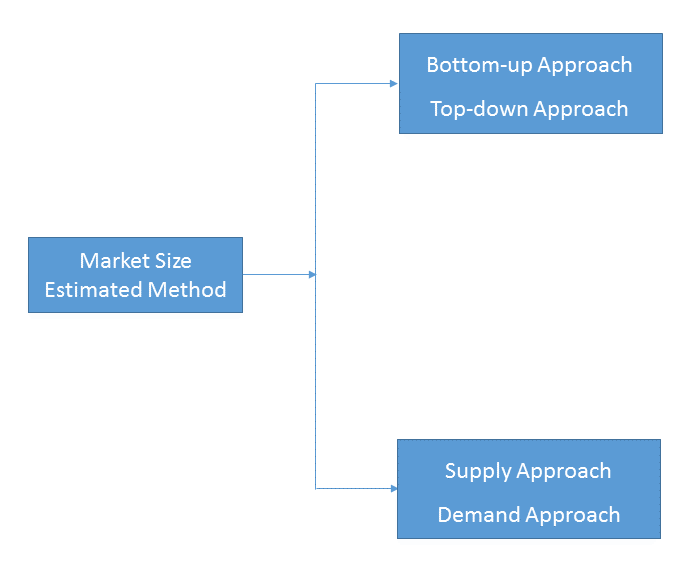
Bottom-up & top-down approach, supply & demand approach are the most important method which is used by HDIN Research to estimate the market size.
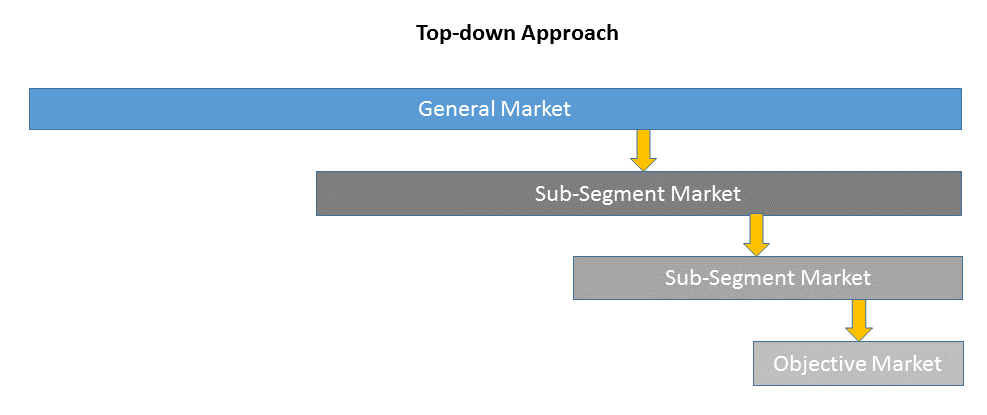
1)Top-down & Bottom-up Approach
Top-down approach uses a general market size figure and determines the percentage that the objective market represents.
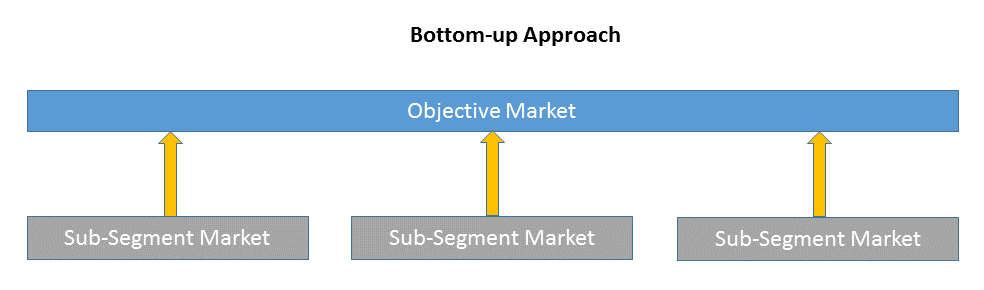
Bottom-up approach size the objective market by collecting the sub-segment information.
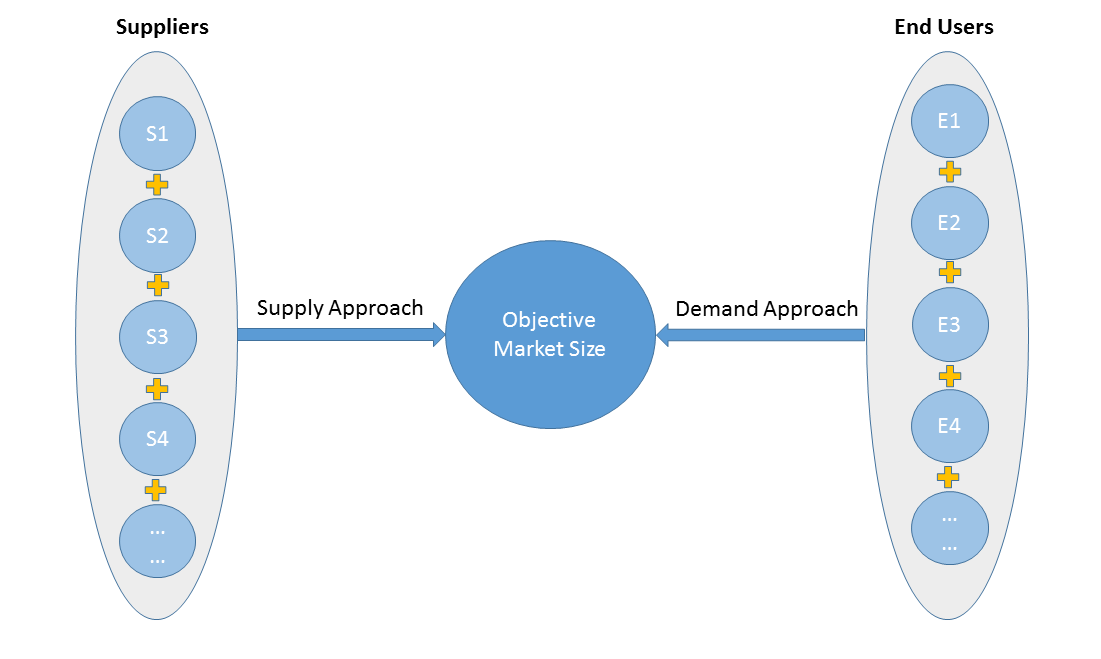
2)Supply & Demand Approach
Supply approach is based on assessments of the size of each competitor supplying the objective market.
Demand approach combine end-user data within a market to estimate the objective market size. It is sometimes referred to as bottom-up approach.
- Forecasting Methodology
- Numerous factors impacting the market trend are considered for forecast model:
- New technology and application in the future;
- New project planned/under contraction;
- Global and regional underlying economic growth;
- Threatens of substitute products;
- Industry expert opinion;
- Policy and Society implication.
- Analysis Tools
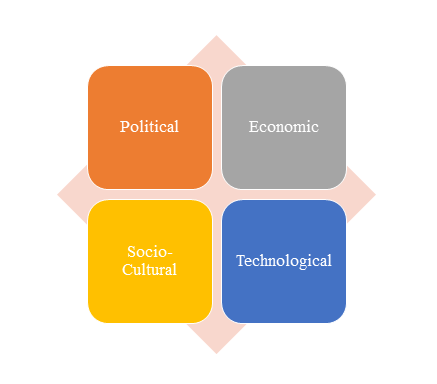
1)PEST Analysis
PEST Analysis is a simple and widely used tool that helps our client analyze the Political, Economic, Socio-Cultural, and Technological changes in their business environment.
- Benefits of a PEST analysis:
- It helps you to spot business opportunities, and it gives you advanced warning of significant threats.
- It reveals the direction of change within your business environment. This helps you shape what you’re doing, so that you work with change, rather than against it.
- It helps you avoid starting projects that are likely to fail, for reasons beyond your control.
- It can help you break free of unconscious assumptions when you enter a new country, region, or market; because it helps you develop an objective view of this new environment.
2)Porter’s Five Force Model Analysis
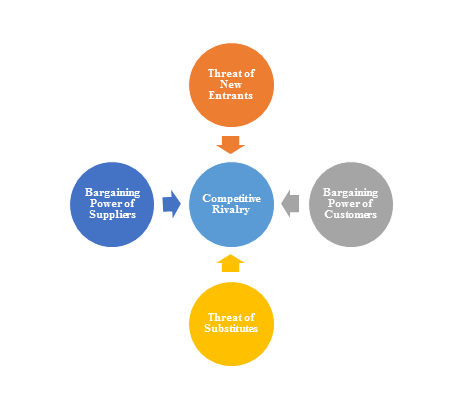
The Porter’s Five Force Model is a tool that can be used to analyze the opportunities and overall competitive advantage. The five forces that can assist in determining the competitive intensity and potential attractiveness within a specific area.
- Threat of New Entrants: Profitable industries that yield high returns will attract new firms.
- Threat of Substitutes: A substitute product uses a different technology to try to solve the same economic need.
- Bargaining Power of Customers: the ability of customers to put the firm under pressure, which also affects the customer's sensitivity to price changes.
- Bargaining Power of Suppliers: Suppliers of raw materials, components, labor, and services (such as expertise) to the firm can be a source of power over the firm when there are few substitutes.
- Competitive Rivalry: For most industries the intensity of competitive rivalry is the major determinant of the competitiveness of the industry.
3)Value Chain Analysis
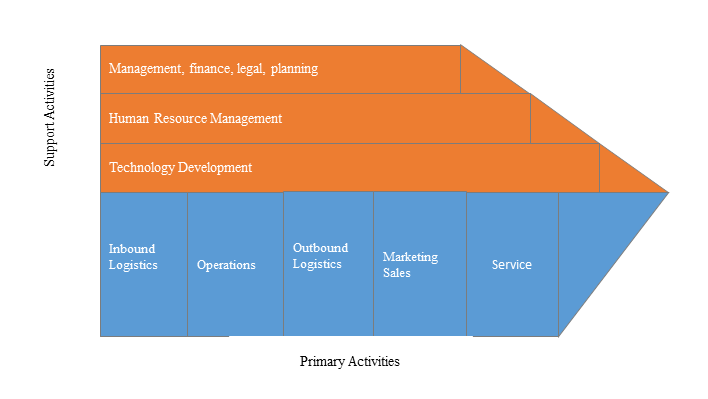
Value chain analysis is a tool to identify activities, within and around the firm and relating these activities to an assessment of competitive strength. Value chain can be analyzed by primary activities and supportive activities. Primary activities include: inbound logistics, operations, outbound logistics, marketing & sales, service. Support activities include: technology development, human resource management, management, finance, legal, planning.
4)SWOT Analysis
SWOT analysis is a tool used to evaluate a company's competitive position by identifying its strengths, weaknesses, opportunities and threats. The strengths and weakness is the inner factor; the opportunities and threats are the external factor. By analyzing the inner and external factors, the analysis can provide the detail information of the position of a player and the characteristics of the industry.
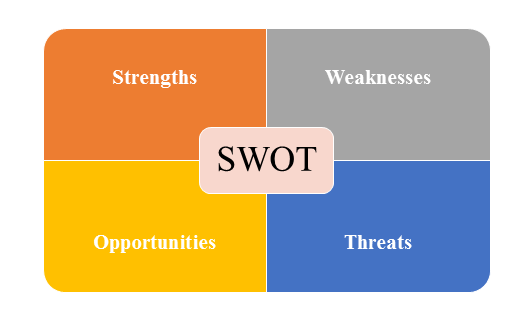
- Strengths describe what the player excels at and separates it from the competition
- Weaknesses stop the player from performing at its optimum level.
- Opportunities refer to favorable external factors that the player can use to give it a competitive advantage.
- Threats refer to factors that have the potential to harm the player.
- Data Sources
| Primary Sources | Secondary Sources |
|---|---|
| Face to face/Phone Interviews with market participants, such as: Manufactures; Distributors; End-users; Experts. Online Survey |
Government/International Organization Data: Annual Report/Presentation/Fact Book Internet Source Information Industry Association Data Free/Purchased Database Market Research Report Book/Journal/News |