Global Solid-State Transformer Market Strategic Outlook 2026-2031 800VDC AI Data Center Architectures and Wide-Bandgap Power Electronics Analysis
- Single User License (1 Users) $ 3,500
- Team License (2~5 Users) $ 4,500
- Corporate License (>5 Users) $ 5,500
The global solid-state transformer (SST) market in 2026 has crossed a historic commercialization inflection point, breaking out of decades of utility pilot demonstrations into explosive multi-sector adoption. Replacing bulky, passive 50/60 Hz iron-and-copper line-frequency transformers with active Silicon Carbide (SiC) power-electronic conversion stages coupled to compact medium-frequency magnetic isolation cores, solid-state transformers deliver bidirectional power flow, direct medium-voltage AC to high-voltage DC conversion, instantaneous voltage sag compensation, and dramatic footprint reductions. As of 2026, the global market is valued between 180 million USD and 320 million USD. Driven overwhelmingly by the megawatt-scale power crisis inside artificial intelligence data centers (AIDCs), renewable microgrid congestion, and ultra-fast electric vehicle (EV) charging hubs, the sector is projected to surge at an extraordinary compound annual growth rate (CAGR) ranging from 26.3 percent to 41.8 percent through 2031.
The defining catalyst accelerating SST deployment across 2025 and 2026 is the architectural transition toward 800VDC "Grid-to-Chip" power delivery for next-generation AI computing clusters. Traditional data center power trains suffer cascading conversion losses and massive floor-space overhead across sequential medium-voltage step-down transformers, switchgear, uninterruptible power supplies (UPS), and low-voltage rack rectifiers. Signaling early institutional commitment to this paradigm shift, ABB acquired a minority equity stake in North Carolina-based DG Matrix in March 2025 to accelerate solid-state power electronics for generative AI data centers and renewable microgrids. DG Matrix’s integrated Power Router platform replaces 10 to 20 conventional electrical devices with a single multi-port AC/DC architecture up to five times smaller in physical volume while operating at 98 percent efficiency—simultaneously mitigating utility grid bottlenecks and slashing total energy costs.
By mid-2026, tier-one global infrastructure titans converted this vision into commercial hardware launches. On June 3, 2026, at IDCE 2026 in Shanghai, Eaton unveiled its MV SST Solid-State Transformer 2.0, pioneering a "Medium-Voltage Direct Input plus DC Output" pathway engineered explicitly to anchor 800VDC Grid-to-Chip power for AI clusters, supercomputing facilities, and hyperscale campuses. Concurrently, Vertiv positioned its dedicated 800VDC power portfolio for release in the second half of 2026, timed precisely to enable the 2027 commercial rollout of NVIDIA’s Rubin Ultra platform. Across Asia, momentum matched Western pace: SIFANG launched its Digital-Intelligent SST 1.0 in April 2026 tailored squarely to AIDC architectures, while in June 2026, China XD Group subsidiary XD Power Electronics secured a landmark overseas data center contract for four 13.8kV AC to 800V DC solid-state transformers—marking a breakthrough validation of Chinese SST technology within mainstream international data center markets.
Regional Market Analysis
The geographical trajectory of the solid-state transformer market reflects intense convergence between hyperscale AI cluster construction, legacy grid transformer supply bottlenecks, and wide-bandgap semiconductor leadership.
● North America commands the leading early-commercialization share, estimated between 38 percent and 42 percent. Regional velocity is driven by massive hyperscale AI campus build-outs across the United States preparing for NVIDIA’s 2027 Rubin Ultra 800VDC architecture, paired with acute multi-year waiting lists for conventional grid transformers and utility interconnection approvals. Solutions like ABB-backed DG Matrix’s multi-port Power Router—alongside platforms from Eaton, Vertiv, and GE Vernova—enable North American data center developers to seamlessly integrate utility feeds, on-site solar, battery energy storage systems (BESS), and fuel cells while shrinking electrical room footprints fivefold.
● Asia Pacific represents the fastest-scaling manufacturing ecosystem and a powerhouse for real-world commercial deployment, holding an estimated share between 30 percent and 34 percent. Mainland China leads aggressive field commercialization of 10kV/13.8kV-to-800VDC SST hardware—highlighted by Eaton’s Shanghai IDCE 2026 launch, SIFANG’s SST 1.0 debut, China XD Group’s overseas export milestone, and an unmatched magnetic/power-electronics supply base (SUNGROW, JST Power Equipment, Eaglerise, Newonder, Shenzhen Click). Japan (Mitsubishi Electric, Fuji Electric) anchors high-voltage SiC module fabrication. Within Taiwan(China), the ecosystem wields disproportionate global strategic leverage through Delta Electronics—serving as the premier engineering bridge uniting medium-voltage solid-state conversion, 800VDC rack power shelves, and GPU-level voltage regulation for global AI hyperscalers.
● Europe accounts for a technologically sophisticated market share ranging from 20 percent to 24 percent. Anchored by Siemens, ABB, and Schneider Electric, European demand is driven by high-penetration renewable grid stabilization, railway traction solid-state conversion, urban EV megawatt charging plazas, and strict EU energy-efficiency mandates. European utilities increasingly evaluate SSTs as active distribution nodes capable of mitigating reverse power flows and voltage harmonics caused by decentralized residential solar and heat-pump electrification.
● South America and the Middle East and Africa (MEA) collectively represent 5 percent to 9 percent of global revenue, yet display rapid project-level expansion. Sovereign AI mega-campuses rising across the United Arab Emirates and Saudi Arabia represent high-value early adopters of 13.8kV AC/800V DC solid-state power blocks and renewable-integrated microgrids, while remote mining and utility-scale solar-plus-storage corridors across Chile and Brazil explore SSTs for islanded microgrid stability.
Application and Segmentation Analysis
Solid-state transformer deployment spans three primary infrastructure verticals, increasingly supercharged by direct medium-voltage-to-DC architectures inside hyperscale AI facilities.
● Smart Grid and Utility Distribution (including Direct MV-to-800VDC AIDC Interfaces) represents the fastest-accelerating revenue engine in 2026. Within utility distribution networks, SSTs deliver autonomous reactive power compensation, harmonic suppression, active fault-current limiting, and seamless AC/DC hybrid distribution routing. Crucially, the commercial breakout of 800VDC Grid-to-Chip architectures for AI data centers (championed by Eaton MV SST 2.0, Vertiv’s H2 2026 suite, SIFANG SST 1.0, and China XD’s 13.8kV/800VDC units) eliminates intermediate low-voltage AC distribution stages—cutting copper busbar mass dramatically, recovering valuable whitespace for revenue-generating GPU racks, and elevating end-to-end power efficiency toward 98 percent.
● Renewable and Micro-Grid Integration leverages multi-port solid-state power routers (exemplified by DG Matrix) to interface medium-voltage utility grids directly with DC-native generation and storage assets—including photovoltaic arrays, lithium-ion BESS, wind turbines, and solid-oxide fuel cells. By consolidating 10 to 20 separate inverters, step-up transformers, and switchgear cabinets into a single software-defined SST node, microgrid operators achieve seamless islanding, ultra-fast load balancing, and dramatically simplified site commissioning.
● EV Fast-Charging Infrastructure demands compact, high-power DC delivery directly from medium-voltage utility feeders (10kV–35kV) to 800V–1,000V passenger superchargers and Megawatt Charging Systems (MCS) for electric heavy-duty trucks. Solid-state transformers eliminate massive pad-mounted line-frequency transformers in constrained urban corridors while permitting direct DC coupling of stationary battery buffers to shave peak utility demand charges.
Value Chain Analysis
The solid-state transformer value chain shifts capital intensity decisively away from bulk electrical steel and copper windings toward wide-bandgap power semiconductors, nanocrystalline high-frequency magnetics, and real-time control firmware.
Upstream Wide-Bandgap Semiconductors and Advanced Magnetics: Value originates with high-voltage Silicon Carbide (SiC) MOSFET dies and modules (1.7kV, 3.3kV, and emerging 6.5kV–10kV classes), high-frequency amorphous and nanocrystalline magnetic cores operating at 10 kHz to 50 kHz (slashing core volume up to 80 percent versus 50/60 Hz silicon steel), high-dielectric insulation systems, and liquid-cooling cold plates.
Midstream Modular Power Cells and Isolation Transformers: OEMs assemble Cascaded H-Bridge (CHB) or Modular Multilevel Converter (MMC) power-electronic building blocks (PEBBs) paired with ultra-high-isolation Medium-Frequency Transformers (MFITs). Specialized magnetic component manufacturers (such as Eaglerise, Newonder, and Shenzhen Click) occupy a crucial technical bottleneck ensuring minimal core loss and high partial-discharge endurance under steep SiC switching edges.
Grid-to-Chip System Integration and Control Firmware (Primary Value Pool): The deepest profit pools in 2026 belong to full-stack power-management leaders (Eaton, Vertiv, ABB, Delta Electronics, Schneider Electric, Siemens) that own both modular SST hardware and high-speed DSP/FPGA control software capable of orchestrating millisecond fault ride-through, thermal load sharing, and native integration with AI rack power management.
Downstream Channels and Qualification: Commercial scaling flows through direct engineering co-development with hyperscale cloud operators and GPU ecosystem architects (notably NVIDIA Rubin Ultra reference specifications), alongside utility framework tenders and turnkey microgrid EPCs.
Key Market Player Deep Profiles
● ABB: Headquartered in Zurich, Switzerland, ABB stands as a foundational global pioneer in solid-state power electronics spanning railway traction transformers, maritime DC grids, and modular distribution SSTs. Demonstrating keen strategic timing in March 2025, ABB acquired a minority stake in North Carolina-based DG Matrix to accelerate commercialization of its multi-port Power Router platform—a breakthrough solid-state system delivering 98 percent efficiency at one-fifth the volume while consolidating 10 to 20 discrete electrical devices for generative AI data centers and renewable microgrids. In 2026, ABB leverages its colossal global medium-voltage switchgear footprint and utility credibility to scale hybrid AC/DC solid-state architectures across North American, European, and Asian hyperscale campuses.
● Eaton: Operating as a global intelligent power-management powerhouse across North America, Europe, and Asia, Eaton achieved a watershed industry milestone on June 3, 2026 at IDCE 2026 in Shanghai with the flagship debut of its MV SST Solid-State Transformer 2.0. Built on a direct "Medium-Voltage Input plus DC Output" architecture, Eaton’s MV SST 2.0 pioneers end-to-end "Grid-to-Chip" 800VDC power delivery tailored for AI computing, supercomputing, and mega-campus data centers—redefining "Computing-Power Synergy." Backed by deep existing relationships across utility distribution, medium-voltage switchgear, and hyperscale UPS systems, Eaton is aggressively positioned to capture massive first-mover share as AI campuses transition off legacy AC power trains.
● Siemens: Headquartered in Munich, Germany, Siemens combines decades of ultra-high-voltage HVDC/FACTS power-electronics mastery with premier industrial automation and smart-grid software (Gridscale X). Within the solid-state transformer arena, Siemens builds upon extensive European rail-traction power-electronic transformer engineering and advanced medium-voltage SiC converter platforms to address active utility distribution nodes, industrial DC microgrids, and high-power EV depot charging. In 2026, Siemens’ strategic focus emphasizes software-defined grid resilience and digital-twin power simulation, enabling European utilities and industrial campuses to integrate bidirectional solid-state conversion safely alongside legacy substation protection schemes.
● GE Vernova: Operating as an independent global energy and grid electrification titan headquartered in Cambridge, Massachusetts, GE Vernova anchors North American transmission and distribution modernization through its Electrification segment and GridOS orchestration software. Leveraging deep R&D heritage in high-voltage SiC solid-state breakers, flexible AC transmission systems, and modular power conversion, GE Vernova targets high-reliability utility distribution SSTs and renewable-heavy microgrids designed to resolve North American grid congestion. In 2026, acute US transformer bottlenecks and massive AI load growth create strong institutional pull for GE Vernova’s solid-state power-flow control and hybrid substation solutions.
● Schneider Electric: Headquartered in Rueil-Malmaison, France, Schneider Electric commands unrivaled commercial reach across data center white-space/grey-space power infrastructure and EcoStruxure digital energy management. Collaborating closely with AI silicon leaders on next-generation high-density reference architectures, Schneider Electric is advancing modular medium-voltage-to-DC power conversion and microgrid controller ecosystems tailored to megawatt-class liquid-cooled AI racks. In 2026, Schneider’s core competitive advantage rests in holistic thermal-electrical co-design—coupling high-efficiency power conversion directly with automated building/grid software and sustainable SF6-free medium-voltage switchgear across global enterprise and colocation data centers.
● Mitsubishi Electric: Headquartered in Tokyo, Japan, Mitsubishi Electric holds a formidable vertically integrated advantage rooted in its world-leading fabrication of high-voltage SiC power semiconductor modules (3.3kV to 6.5kV classes). Because high-voltage SiC chips govern SST switching efficiency, thermal reliability, and unit cost, Mitsubishi Electric’s upstream silicon mastery underpins compact solid-state traction transformers for high-speed rail alongside industrial DC microgrid converters. In 2026, Mitsubishi Electric supplies both proprietary Japanese/Asian solid-state power equipment and critical high-voltage SiC modules to global SST integrators scaling 800VDC and megawatt EV charging infrastructure.
● Fuji Electric: Based in Tokyo, Japan, Fuji Electric pairs proprietary wide-bandgap SiC semiconductor manufacturing with extensive expertise in industrial power electronics, uninterruptible power systems, and utility substation equipment. Focusing intensely on high-efficiency modular power conversion for Asian data centers, factory DC microgrids, and ultra-fast EV charging plazas, Fuji Electric excels in compact thermal engineering and ultra-high MTBF (Mean Time Between Failures) reliability standards. In 2026, Fuji Electric leverages its strong foothold across Japanese, Southeast Asian, and North American industrial power markets to capture steady adoption of SiC-based medium-voltage solid-state converters.
● Delta Electronics: Headquartered in Taiwan(China), Delta Electronics stands as one of the world’s most strategically advantaged titans in the 2026–2031 solid-state transformer boom. Uniquely positioned across the entire "Grid-to-Chip" power continuum—commanding dominant global share in AI server power shelves, 800VDC rack architectures, EV fast-charging stacks, and industrial microgrid power electronics—Delta possesses unmatched visibility into GPU transient load profiles. By integrating solid-state medium-voltage-to-800VDC front-ends directly with its high-efficiency DC-DC rack conversion and liquid-cooling thermal portfolios, Delta Electronics serves as an indispensable turnkey partner for Tier-1 global hyperscalers preparing for 2027 Rubin Ultra deployments.
● Vertiv: Headquartered in Westerville, Ohio, Vertiv is a global powerhouse in critical digital infrastructure spanning thermal management, power distribution, and integrated data center racks. Anchoring its 2026 strategic roadmap explicitly to AI silicon evolution, Vertiv scheduled the release of its dedicated 800VDC power portfolio for the second half of 2026 to align seamlessly with the 2027 commercial rollout of NVIDIA’s Rubin Ultra platform. Combining medium-voltage solid-state rectification/transformation concepts with high-density DC busways and direct-to-chip liquid cooling, Vertiv converts its massive global hyperscale installed base and field-service fleet into an extraordinary growth engine.
● SIFANG: Formally Beijing Sifang Automation Co., Ltd., SIFANG is a premier Chinese power-grid automation, relay protection, and power-electronics specialist with deep historical leadership in DC distribution networks and microgrid control. Capitalizing aggressively on the booming AI infrastructure wave, SIFANG launched its Digital-Intelligent SST 1.0 in April 2026—a flagship solid-state transformer platform purpose-built for AI Data Center (AIDC) power supply. Combining decades of utility-grade fault-protection mastery with modular high-frequency DC conversion, SIFANG provides domestic and regional data center operators with ultra-reliable, grid-friendly 800VDC solid-state power foundations.
● SUNGROW: Headquartered in Hefei, China, SUNGROW Power Supply stands as the world’s premier photovoltaic inverter and energy storage system (ESS) power-electronics juggernaut. Extending its unmatched gigawatt-scale power conversion, SiC topology optimization, and grid-forming control algorithms beyond solar/BESS, SUNGROW is aggressively targeting solid-state medium-voltage DC coupling for utility-scale renewable microgrids, megawatt EV charging hubs, and green-powered AIDC campuses. In 2026, SUNGROW’s colossal manufacturing scale, rapid R&D cadence, and expansive global service footprint across Europe, the Americas, and the Middle East position it as a formidable cost-and-efficiency disruptor in renewable SST integration.
● China XD Group: As China’s flagship state-owned ultra-high-voltage power transmission and transformation conglomerate, China XD Group possesses immense engineering depth across heavy grid equipment and high-voltage power electronics. In June 2026, its subsidiary XD Power Electronics achieved a landmark commercial milestone by securing an overseas data center contract for four 13.8kV AC to 800V DC solid-state transformers—delivering a high-efficiency, low-carbon, intelligent DC power architecture abroad. This breakthrough validates Chinese solid-state transformer reliability under demanding international data center specifications, opening a lucrative global export corridor across Middle Eastern, Southeast Asian, and international hyperscale markets.
● JST Power Equipment: Operating as Hainan Jinpan Smart Technology (JST), this leading Chinese global supplier of dry-type transformers has built entrenched tier-one commercial ties across international wind power, utility grids, and North American/global data centers. Recognizing the structural migration toward 800VDC AIDC architectures, JST Power Equipment is aggressively advancing up the technology stack—investing in high-frequency magnetic isolation cores, modular SST power skids, and digitally monitored smart-factory production lines. In 2026, JST leverages its established global certifications (UL/CE) and deep data-center customer trust to offer seamless transition pathways from conventional dry-type transformers to hybrid and solid-state power blocks.
● Eaglerise Electric & Electronic: Headquartered in Foshan, China, Eaglerise Electric & Electronic is a global leader in precision magnetic components, photovoltaic transformers, and specialized power-conversion assemblies with expanding international manufacturing footprints. Within the rapidly scaling SST ecosystem, Eaglerise captures high-margin upstream value as a premier engineering partner for Medium-Frequency Isolation Transformers (MFITs) and high-frequency resonant inductors essential to compact SiC solid-state power cells. In 2026, surging orders across 800VDC AIDC power shelves, renewable microgrids, and EV ultra-fast chargers solidify Eaglerise’s critical component role inside tier-one SST builds.
● Newonder Special Electric: Based in Shenzhen, China, Newonder Special Electric specializes intensely in custom high-frequency special transformers, planar magnetics, and high-voltage isolation reactors tailored for demanding power-electronic environments. Unlike commodity 50/60 Hz transformer shops, Newonder’s engineering moat centers on managing extreme dv/dt switching stresses, minimized parasitic capacitance, and compact liquid/forced-air thermal extraction inside modular SST power cells, railway traction converters, and megawatt EV chargers. In 2026, accelerating domestic and export AIDC SST orders directly fuel Newonder’s high-value specialty magnetics growth.
● Shenzhen Click Technology: Headquartered in Shenzhen, China, Shenzhen Click Technology is a prominent specialist in high-efficiency magnetic components, switching power supplies, and automotive/new-energy power-conversion magnetics. Serving leading global EV charging, solar inverter, and data-center power OEMs, Click Technology delivers tightly engineered high-frequency transformers and inductors critical to maximizing the 98 percent efficiency targets of modern solid-state power modules. In 2026, its agile automated winding facilities and dual-sector exposure across EV fast charging and emerging 800VDC AIDC power platforms anchor resilient multi-year component pull-through.
Opportunities and Challenges
The solid-state transformer market is experiencing rare hyper-growth momentum (26.3 percent to 41.8 percent CAGR), balanced against rigorous high-voltage reliability and cost-reduction imperatives.
● Opportunities: The 800VDC AI Data Center revolution—catalyzed explicitly by NVIDIA’s 2027 Rubin Ultra roadmap, Eaton’s MV SST 2.0, Vertiv’s H2 2026 portfolio, SIFANG’s SST 1.0, and China XD’s overseas contract—provides the first commercial, high-margin beachhead capable of scaling SST production volumes rapidly enough to bend the SiC cost curve downward. Concurrently, multi-port AC/DC microgrid power routers (exemplified by ABB and DG Matrix replacing 10 to 20 devices at one-fifth the volume) unlock massive adoption wherever urban real estate and utility grid queues throttle energy expansion, including megawatt EV heavy-truck charging hubs.
● Challenges: Upfront capital cost remains a substantial hurdle outside space- and efficiency-constrained AI campuses, as active SiC solid-state transformers still command a 2x to 4x unit premium over traditional passive oil- or dry-type transformers. Technically, guaranteeing multi-decade reliability and instantaneous millisecond short-circuit fault ride-through across hundreds of series-connected high-voltage SiC switches under harsh utility lightning surges requires sophisticated redundancy and thermal management. Additionally, fragmented international utility grid-interconnection codes and evolving 800VDC DC-arc-flash protection standards create certification friction across global regions.
Macroeconomic and Geopolitical Influences
The 2026 solid-state transformer market demonstrates extraordinary insulation from broader macroeconomic cyclicality. While elevated global interest rates have moderated traditional regulated utility grid replacement cycles and commercial real estate builds, capital expenditure directed toward AI computing infrastructure by global cloud hyperscalers and sovereign AI programs has proven virtually interest-rate inelastic. Furthermore, severe structural shortages and two-to-four-year delivery backlogs for legacy grain-oriented electrical steel (GOES) utility transformers across North America and Europe have transformed compact, rapidly deployable SSTs from an expensive novelty into a time-to-power strategic enabler that accelerates hyperscale revenue generation by months or years.
Geopolitically, power-grid infrastructure and AI data center electrical backbones sit squarely within national security and industrial-sovereignty frameworks. Strict North American and European scrutiny over foreign-controlled power-grid electronics favors domestic and allied ecosystems—propelling Western capital into ABB/DG Matrix, Eaton, Vertiv, GE Vernova, Siemens, and Taiwan(China)’s Delta Electronics—alongside sovereign investments in domestic SiC wafer fabs. Simultaneously, China’s world-leading high-voltage power electronics and specialty magnetics ecosystem (China XD Group, SIFANG,
1.1 Study Scope 1
1.2 Research Methodology 2
1.2.1 Data Sources 2
1.2.2 Assumptions 4
1.3 Abbreviations and Acronyms 5
Chapter 2 Global Solid-State Transformer Market Context and Macroeconomic Impact 6
2.1 Product Development Background 6
2.2 Global Macroeconomic Environment Analysis 7
2.2.1 Global GDP Trends and Clean Energy Grid Infrastructure Investment 7
2.2.2 Impact of Inflation and Wide-Bandgap Semiconductor Cost Volatility 8
2.3 Impact of Geopolitical Conflicts on the Solid-State Transformer Market 9
2.3.1 Energy Sovereignty and Critical Grid Resilience Policies 9
2.3.2 Supply Chain Disruptions for SiC/IGBT Modules and Magnetic Core Materials 10
2.4 Global Solid-State Transformer Market Volume and Market Size (2021-2026) 11
Chapter 3 Global Solid-State Transformer Market by Type 12
3.1 Market Volume and Size Analysis by Type (2021-2026) 12
3.2 Distribution Solid-State Transformers 13
3.3 Power Solid-State Transformers 14
3.4 Traction and Specialty Solid-State Transformers 15
Chapter 4 Global Solid-State Transformer Market by Application 16
4.1 Market Volume and Size Analysis by Application (2021-2026) 16
4.2 Smart Grid & Utility Distribution 17
4.3 Renewable & Micro-Grid Integration 18
4.4 EV Fast-Charging Infrastructure 19
4.5 Data Centers and Industrial Power Systems 20
Chapter 5 Global Solid-State Transformer Market by Region 21
5.1 Market Volume and Size Analysis by Region (2021-2026) 21
5.2 North America Solid-State Transformer Market Analysis 22
5.2.1 North America Market Volume and Market Size (2021-2026) 22
5.2.2 North America Market by Key Regions (United States, Canada, Mexico) 23
5.3 Europe Solid-State Transformer Market Analysis 25
5.3.1 Europe Market Volume and Market Size (2021-2026) 25
5.3.2 Europe Market by Key Regions (Germany, United Kingdom, France, Italy, Nordics) 26
5.4 Asia-Pacific Solid-State Transformer Market Analysis 29
5.4.1 Asia-Pacific Market Volume and Market Size (2021-2026) 29
5.4.2 Asia-Pacific Market by Key Regions (China, Japan, India, South Korea, Taiwan (China)) 30
5.5 Latin America Solid-State Transformer Market Analysis 32
5.5.1 Latin America Market Volume and Market Size (2021-2026) 32
5.5.2 Latin America Market by Key Regions (Brazil, Argentina) 33
5.6 Middle East & Africa Solid-State Transformer Market Analysis 34
5.6.1 Middle East & Africa Market Volume and Market Size (2021-2026) 34
5.6.2 Middle East & Africa Market by Key Regions (UAE, Saudi Arabia, South Africa) 35
Chapter 6 Solid-State Transformer Manufacturing Process and Patent Analysis 36
6.1 Production Flow: High-Frequency Transformer Winding, Power Converter Assembly, and Isolation Testing 36
6.2 Core Technologies: SiC/GaN Switching Topologies, Bi-Directional Power Flow, and Liquid Cooling 37
6.3 Global Solid-State Transformer Patent Landscape Analysis 39
Chapter 7 Industry Chain and Value Chain Analysis 40
7.1 Value Chain Overview 40
7.2 Upstream Raw Materials and Components (SiC MOSFETs, Nanocrystalline Cores, Copper, Capacitors) 41
7.3 Midstream System Integration and High-Voltage Qualification 42
7.4 Downstream Distribution Channels (Utilities, EPC Contractors, EV Charging Operators) 43
Chapter 8 Global Solid-State Transformer Import and Export Analysis 44
8.1 Global Import Volume and Value (2021-2026) 44
8.2 Global Export Volume and Value (2021-2026) 45
Chapter 9 Competitive Landscape and Concentration Rate 47
9.1 Market Concentration Rate (CR3, CR5) 47
9.2 Competitive Ranking of Key Players (2025) 48
9.3 Strategic Alliances, Pilot Grid Projects, and M&A Activity 50
Chapter 10 Key Players Analysis 51
10.1 ABB 51
10.1.1 Company Overview and Grid Modernization Portfolio 51
10.1.2 SWOT Analysis 52
10.1.3 ABB Solid-State Transformer Sales, Price, Cost and Gross Profit Margin (2021-2026) 53
10.1.4 R&D Investment and Medium-Voltage DC Strategy 54
10.2 Eaton 55
10.2.1 Company Overview and Power Management Portfolio 55
10.2.2 SWOT Analysis 56
10.2.3 Eaton Solid-State Transformer Sales, Price, Cost and Gross Profit Margin (2021-2026) 57
10.2.4 Microgrid and Energy Transition Strategy 58
10.3 Siemens 59
10.3.1 Company Overview and Smart Infrastructure Portfolio 59
10.3.2 SWOT Analysis 60
10.3.3 Siemens Solid-State Transformer Sales, Price, Cost and Gross Profit Margin (2021-2026) 61
10.3.4 Rail Traction and Utility Distribution Strategy 62
10.4 GE Vernova 63
10.4.1 Company Overview and Grid Solutions Portfolio 63
10.4.2 SWOT Analysis 64
10.4.3 GE Vernova Solid-State Transformer Sales, Price, Cost and Gross Profit Margin (2021-2026) 65
10.4.4 Renewable Grid Integration Strategy 66
10.5 Schneider Electric 67
10.5.1 Company Overview and Energy Automation Portfolio 67
10.5.2 SWOT Analysis 68
10.5.3 Schneider Electric Solid-State Transformer Sales, Price, Cost and Gross Profit Margin (2021-2026) 69
10.5.4 Data Center and Commercial Microgrid Strategy 70
10.6 Mitsubishi Electric 71
10.6.1 Company Overview and Power Electronics Portfolio 71
10.6.2 SWOT Analysis 72
10.6.3 Mitsubishi Electric Solid-State Transformer Sales, Price, Cost and Gross Profit Margin (2021-2026) 73
10.6.4 SiC Semiconductor Vertical Integration Strategy 74
10.7 Fuji Electric 75
10.7.1 Company Overview 75
10.7.2 SWOT Analysis 76
10.7.3 Fuji Electric Solid-State Transformer Sales, Price, Cost and Gross Profit Margin (2021-2026) 77
10.8 Delta Electronics 78
10.8.1 Company Overview and EV/Data Center Power Portfolio 78
10.8.2 SWOT Analysis 79
10.8.3 Delta Electronics Solid-State Transformer Sales, Price, Cost and Gross Profit Margin (2021-2026) 80
10.8.4 High-Efficiency Power Conversion Strategy 81
10.9 Vertiv 82
10.9.1 Company Overview 82
10.9.2 SWOT Analysis 83
10.9.3 Vertiv Solid-State Transformer Sales, Price, Cost and Gross Profit Margin (2021-2026) 84
10.10 SIFANG 85
10.10.1 Company Overview 85
10.10.2 SWOT Analysis 86
10.10.3 SIFANG Solid-State Transformer Sales, Price, Cost and Gross Profit Margin (2021-2026) 87
10.11 SUNGROW 88
10.11.1 Company Overview and Renewable Energy Storage Portfolio 88
10.11.2 SWOT Analysis 89
10.11.3 SUNGROW Solid-State Transformer Sales, Price, Cost and Gross Profit Margin (2021-2026) 90
10.11.4 Utility-Scale Solar and Hydrogen Power Strategy 91
10.12 China XD Group 92
10.12.1 Company Overview and Ultra-High Voltage Portfolio 92
10.12.2 SWOT Analysis 93
10.12.3 China XD Group Solid-State Transformer Sales, Price, Cost and Gross Profit Margin (2021-2026) 94
10.12.4 National Smart Grid Demonstration Strategy 95
10.13 JST Power Equipment 96
10.13.1 Company Overview 96
10.13.2 SWOT Analysis 97
10.13.3 JST Power Equipment Solid-State Transformer Sales, Price, Cost and Gross Profit Margin (2021-2026) 98
10.14 Eaglerise Electric & Electronic 99
10.14.1 Company Overview 99
10.14.2 SWOT Analysis 100
10.14.3 Eaglerise Electric & Electronic Solid-State Transformer Sales, Price, Cost and Gross Profit Margin (2021-2026) 101
10.15 Newonder Special Electric 102
10.15.1 Company Overview 102
10.15.2 SWOT Analysis 103
10.15.3 Newonder Special Electric Solid-State Transformer Sales, Price, Cost and Gross Profit Margin (2021-2026) 104
10.16 Shenzhen Click Technology 105
10.16.1 Company Overview 105
10.16.2 SWOT Analysis 106
10.16.3 Shenzhen Click Technology Solid-State Transformer Sales, Price, Cost and Gross Profit Margin (2021-2026) 107
Chapter 11 Global Solid-State Transformer Market Forecast (2027-2031) 108
11.1 Market Volume and Size Forecast 108
11.2 Forecast by Type (2027-2031) 109
11.3 Forecast by Application (2027-2031) 111
11.4 Forecast by Key Regions (2027-2031) 112
Chapter 12 Market Dynamics 114
12.1 Industry Drivers (Bi-Directional EV/Renewable Power Flow, Compact Footprint for Data Centers) 114
12.2 Industry Restraints (High Upfront Cost vs. Conventional Transformers, Reliability Validation) 115
12.3 Industry Opportunities and Trends (10kV+ SiC Power Modules, AI-Driven Grid Fault Isolation) 116
Chapter 13 Research Findings and Conclusion 117
Table 2 Global Solid-State Transformer Market Volume by Type (2021-2026) 12
Table 3 Global Solid-State Transformer Market Size by Type (2021-2026) 13
Table 4 Global Solid-State Transformer Market Volume by Application (2021-2026) 16
Table 5 Global Solid-State Transformer Market Size by Application (2021-2026) 17
Table 6 North America Solid-State Transformer Market Volume and Size by Key Regions (2021-2026) 24
Table 7 Europe Solid-State Transformer Market Volume and Size by Key Regions (2021-2026) 28
Table 8 Asia-Pacific Solid-State Transformer Market Volume and Size by Key Regions (2021-2026) 31
Table 9 Latin America Solid-State Transformer Market Volume and Size by Key Regions (2021-2026) 33
Table 10 Middle East & Africa Solid-State Transformer Market Volume and Size by Key Regions (2021-2026) 35
Table 11 Global Solid-State Transformer Major Patents List 39
Table 12 Global Solid-State Transformer Import and Export Data (2021-2026) 44
Table 13 Competitive Ranking of Key Players by Revenue (2025) 48
Table 14 ABB Solid-State Transformer Sales, Price, Cost and Gross Profit Margin (2021-2026) 53
Table 15 Eaton Solid-State Transformer Sales, Price, Cost and Gross Profit Margin (2021-2026) 57
Table 16 Siemens Solid-State Transformer Sales, Price, Cost and Gross Profit Margin (2021-2026) 61
Table 17 GE Vernova Solid-State Transformer Sales, Price, Cost and Gross Profit Margin (2021-2026) 65
Table 18 Schneider Electric Solid-State Transformer Sales, Price, Cost and Gross Profit Margin (2021-2026) 69
Table 19 Mitsubishi Electric Solid-State Transformer Sales, Price, Cost and Gross Profit Margin (2021-2026) 73
Table 20 Fuji Electric Solid-State Transformer Sales, Price, Cost and Gross Profit Margin (2021-2026) 77
Table 21 Delta Electronics Solid-State Transformer Sales, Price, Cost and Gross Profit Margin (2021-2026) 80
Table 22 Vertiv Solid-State Transformer Sales, Price, Cost and Gross Profit Margin (2021-2026) 84
Table 23 SIFANG Solid-State Transformer Sales, Price, Cost and Gross Profit Margin (2021-2026) 87
Table 24 SUNGROW Solid-State Transformer Sales, Price, Cost and Gross Profit Margin (2021-2026) 90
Table 25 China XD Group Solid-State Transformer Sales, Price, Cost and Gross Profit Margin (2021-2026) 94
Table 26 JST Power Equipment Solid-State Transformer Sales, Price, Cost and Gross Profit Margin (2021-2026) 98
Table 27 Eaglerise Electric & Electronic Solid-State Transformer Sales, Price, Cost and Gross Profit Margin (2021-2026) 101
Table 28 Newonder Special Electric Solid-State Transformer Sales, Price, Cost and Gross Profit Margin (2021-2026) 104
Table 29 Shenzhen Click Technology Solid-State Transformer Sales, Price, Cost and Gross Profit Margin (2021-2026) 107
Table 30 Global Solid-State Transformer Market Volume Forecast by Type (2027-2031) 109
Table 31 Global Solid-State Transformer Market Size Forecast by Application (2027-2031) 111
Table 32 Global Solid-State Transformer Market Size Forecast by Key Regions (2027-2031) 113
Figure 1 Global Solid-State Transformer Market Size Growth Rate (2021-2026) 11
Figure 2 Impact of Geopolitical Conflicts on Power Semiconductor Supply Chain 10
Figure 3 Global Solid-State Transformer Market Size Share by Type (2021-2026) 13
Figure 4 Global Solid-State Transformer Market Size Share by Application (2021-2026) 17
Figure 5 Global Solid-State Transformer Market Size Share by Region (2021-2026) 21
Figure 6 Solid-State Transformer Manufacturing Process Flowchart 36
Figure 7 Solid-State Transformer Industry Chain Mapping 40
Figure 8 Global Market Concentration Rate (CR5) in 2025 47
Figure 9 ABB Solid-State Transformer Market Share (2021-2026) 54
Figure 10 Eaton Solid-State Transformer Market Share (2021-2026) 58
Figure 11 Siemens Solid-State Transformer Market Share (2021-2026) 62
Figure 12 GE Vernova Solid-State Transformer Market Share (2021-2026) 66
Figure 13 Schneider Electric Solid-State Transformer Market Share (2021-2026) 70
Figure 14 Mitsubishi Electric Solid-State Transformer Market Share (2021-2026) 74
Figure 15 Fuji Electric Solid-State Transformer Market Share (2021-2026) 77
Figure 16 Delta Electronics Solid-State Transformer Market Share (2021-2026) 81
Figure 17 Vertiv Solid-State Transformer Market Share (2021-2026) 84
Figure 18 SIFANG Solid-State Transformer Market Share (2021-2026) 87
Figure 19 SUNGROW Solid-State Transformer Market Share (2021-2026) 91
Figure 20 China XD Group Solid-State Transformer Market Share (2021-2026) 95
Figure 21 JST Power Equipment Solid-State Transformer Market Share (2021-2026) 98
Figure 22 Eaglerise Electric & Electronic Solid-State Transformer Market Share (2021-2026) 101
Figure 23 Newonder Special Electric Solid-State Transformer Market Share (2021-2026) 104
Figure 24 Shenzhen Click Technology Solid-State Transformer Market Share (2021-2026) 107
Figure 25 Global Solid-State Transformer Market Size Forecast (2027-2031) 108
Research Methodology
- Market Estimated Methodology:
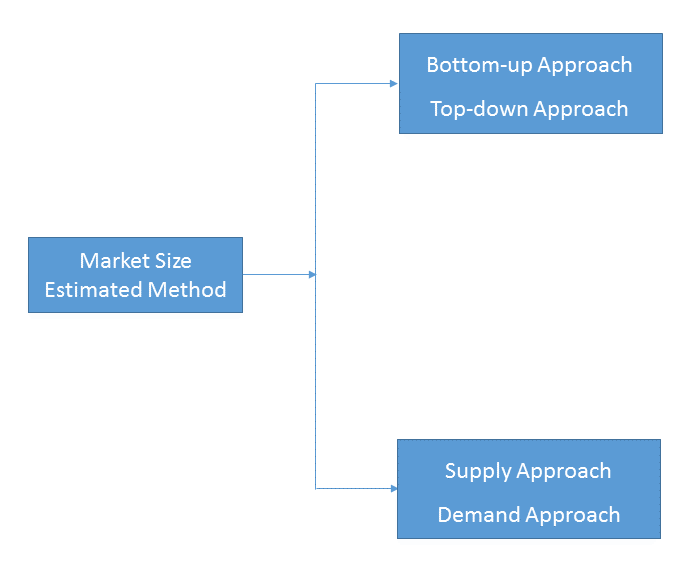
Bottom-up & top-down approach, supply & demand approach are the most important method which is used by HDIN Research to estimate the market size.
1)Top-down & Bottom-up Approach
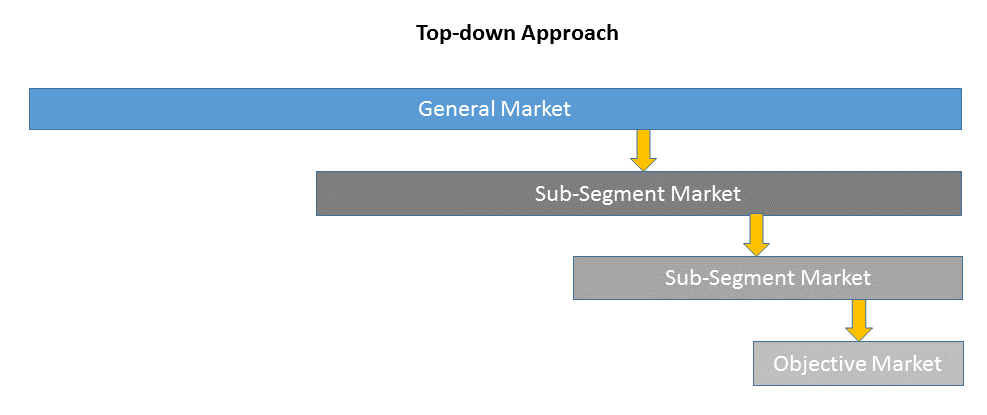
Top-down approach uses a general market size figure and determines the percentage that the objective market represents.
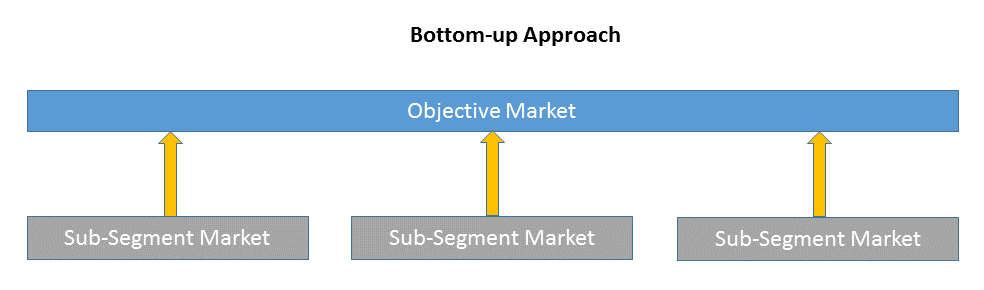
Bottom-up approach size the objective market by collecting the sub-segment information.
2)Supply & Demand Approach
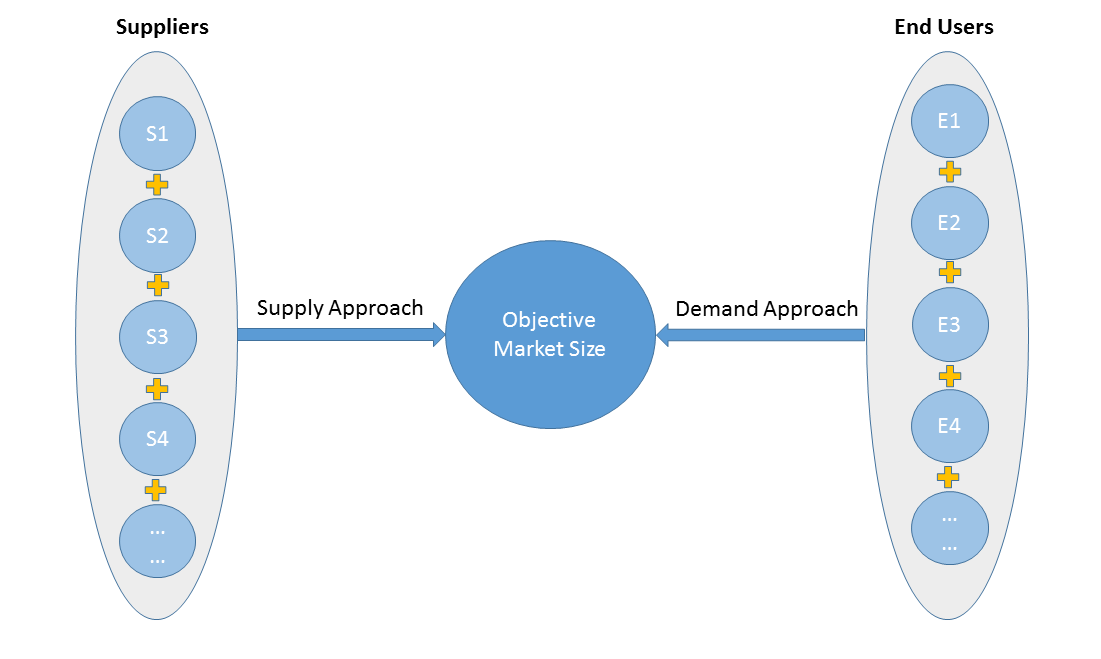
Supply approach is based on assessments of the size of each competitor supplying the objective market.
Demand approach combine end-user data within a market to estimate the objective market size. It is sometimes referred to as bottom-up approach.
- Forecasting Methodology
- Numerous factors impacting the market trend are considered for forecast model:
- New technology and application in the future;
- New project planned/under contraction;
- Global and regional underlying economic growth;
- Threatens of substitute products;
- Industry expert opinion;
- Policy and Society implication.
- Analysis Tools
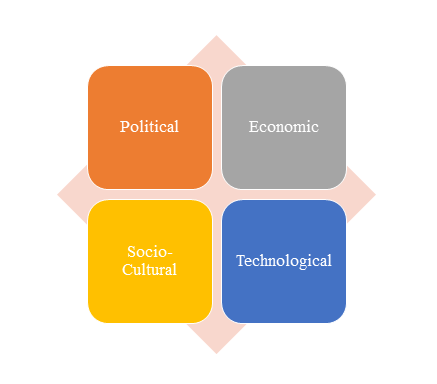
1)PEST Analysis
PEST Analysis is a simple and widely used tool that helps our client analyze the Political, Economic, Socio-Cultural, and Technological changes in their business environment.
- Benefits of a PEST analysis:
- It helps you to spot business opportunities, and it gives you advanced warning of significant threats.
- It reveals the direction of change within your business environment. This helps you shape what you’re doing, so that you work with change, rather than against it.
- It helps you avoid starting projects that are likely to fail, for reasons beyond your control.
- It can help you break free of unconscious assumptions when you enter a new country, region, or market; because it helps you develop an objective view of this new environment.
2)Porter’s Five Force Model Analysis
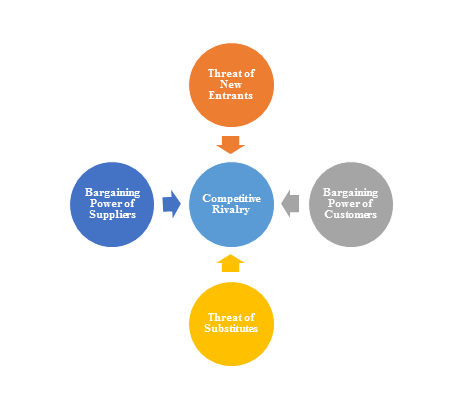
The Porter’s Five Force Model is a tool that can be used to analyze the opportunities and overall competitive advantage. The five forces that can assist in determining the competitive intensity and potential attractiveness within a specific area.
- Threat of New Entrants: Profitable industries that yield high returns will attract new firms.
- Threat of Substitutes: A substitute product uses a different technology to try to solve the same economic need.
- Bargaining Power of Customers: the ability of customers to put the firm under pressure, which also affects the customer's sensitivity to price changes.
- Bargaining Power of Suppliers: Suppliers of raw materials, components, labor, and services (such as expertise) to the firm can be a source of power over the firm when there are few substitutes.
- Competitive Rivalry: For most industries the intensity of competitive rivalry is the major determinant of the competitiveness of the industry.
3)Value Chain Analysis
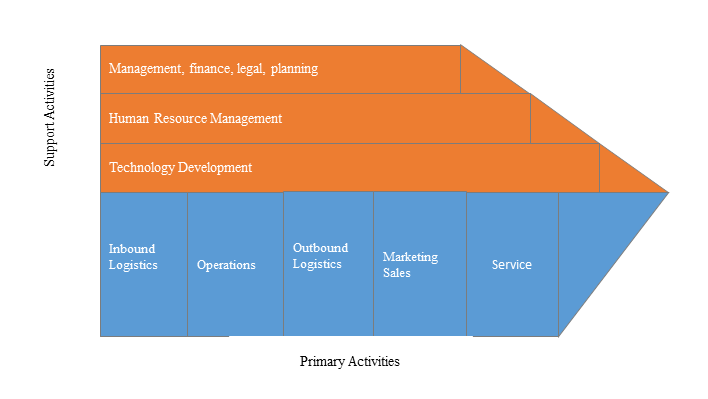
Value chain analysis is a tool to identify activities, within and around the firm and relating these activities to an assessment of competitive strength. Value chain can be analyzed by primary activities and supportive activities. Primary activities include: inbound logistics, operations, outbound logistics, marketing & sales, service. Support activities include: technology development, human resource management, management, finance, legal, planning.
4)SWOT Analysis
SWOT analysis is a tool used to evaluate a company's competitive position by identifying its strengths, weaknesses, opportunities and threats. The strengths and weakness is the inner factor; the opportunities and threats are the external factor. By analyzing the inner and external factors, the analysis can provide the detail information of the position of a player and the characteristics of the industry.
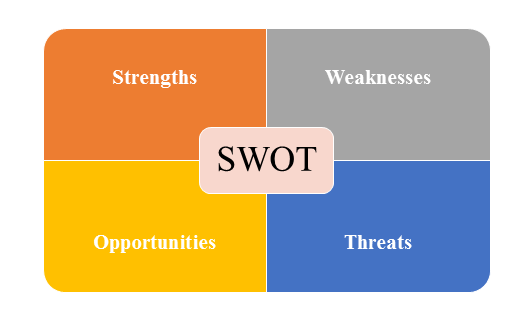
- Strengths describe what the player excels at and separates it from the competition
- Weaknesses stop the player from performing at its optimum level.
- Opportunities refer to favorable external factors that the player can use to give it a competitive advantage.
- Threats refer to factors that have the potential to harm the player.
- Data Sources
| Primary Sources | Secondary Sources |
|---|---|
| Face to face/Phone Interviews with market participants, such as: Manufactures; Distributors; End-users; Experts. Online Survey |
Government/International Organization Data: Annual Report/Presentation/Fact Book Internet Source Information Industry Association Data Free/Purchased Database Market Research Report Book/Journal/News |