Global Spatial Light Modulator Market Strategic Outlook 2026-2031 LCOS Wavefront Engineering and AI Semiconductor Photonics Analysis
- Single User License (1 Users) $ 3,500
- Team License (2~5 Users) $ 4,500
- Corporate License (>5 Users) $ 5,500
The global spatial light modulator (SLM) market in 2026 occupies a pivotal electro-optical control layer across modern photonics, semiconductor metrology, telecommunications switching, quantum computing, and holographic visualization. By dynamically modulating the spatial phase, amplitude, or polarization of an incident light wave across a high-density two-dimensional pixel array—primarily via Liquid Crystal on Silicon (LCOS-SLM), Micro-Electro-Mechanical Systems Digital Micromirror Devices (MEMS DMD), or MEMS Deformable Mirrors—SLMs replace static glass optics with software-programmable wavefront shaping. As of 2026, the global market is valued between 1.3 billion USD and 2.1 billion USD, projected to expand steadily at a compound annual growth rate (CAGR) ranging from 3.8 percent to 6.9 percent through 2031.
A defining commercial trend across 2026 is the deepening entanglement between programmable photonics ecosystems and the surging metrology demands of advanced artificial intelligence (AI) semiconductors. Exemplifying this structural convergence, on October 1, 2026, Japanese photonics leader Hamamatsu Photonics—simultaneously the world’s premier supplier of high-power phase-only LCOS spatial light modulators—unveiled the iPHEMOS-DDX, a next-generation inverted emission microscope purpose-built to streamline defect failure analysis in increasingly complex AI chips. Consolidating seven distinct optical, laser, and thermal analysis modalities—PEM, Thermal/LIT, LSM, OBIRCH, DALS, EOP/EOFM, and TD Imaging—onto a single platform engineered for direct three-directional docking to existing automated testers, the iPHEMOS-DDX made its public debut at ISTFA 2026 in San Antonio, Texas from October 4 through October 8, 2026.
For the broader SLM industry, Hamamatsu’s AI-chip failure-analysis launch underscores a critical demand engine: as 2nm gate-all-around (GAA) logic nodes and 3D-stacked high-bandwidth memory (HBM) chiplets push optical inspection, maskless direct-write lithography, and ultrafast laser wafer dicing toward physical diffraction limits, semiconductor equipment OEMs increasingly depend on high-precision SLMs for real-time aberration correction, structured-light 3D metrology, and multi-beam laser shaping. Simultaneously, outside the cleanroom, hyperscale AI data-center optical circuit switching (WSS), neutral-atom quantum optical tweezers, and automotive holographic Augmented Reality Head-Up Displays (AR-HUD) are transitioning SLM volumes from boutique laboratory instruments into scalable OEM hardware platforms.
Regional Market Analysis
The geographical landscape of the spatial light modulator market reflects tight specialization across MEMS semiconductor fabs, LCOS backplane foundries, and advanced optical systems integration.
● North America commands the largest global revenue share, estimated between 36 percent and 40 percent. Regional dominance is anchored by Texas Instruments’ undisputed global leadership in MEMS Digital Micromirror Devices (DLP technology), alongside specialized high-speed phase and deformable-mirror pioneers Meadowlark Optics, Boston Micromachines, and catalog leader Thorlabs. Demand in 2026 is driven by United States defense laser beam steering, maskless semiconductor/PCB lithography, quantum computing optical tweezer arrays, and AI chip testing workflows highlighted at venues such as ISTFA 2026 in Texas.
● Asia Pacific represents the premier LCOS silicon-backplane manufacturing powerhouse and fastest-scaling semiconductor photonics market, holding an estimated share between 32 percent and 36 percent. Japan leads globally in ultra-high-LIDT phase-only LCOS-SLMs and telecom Wavelength Selective Switch (WSS) modules via Hamamatsu Photonics and Santec. Crucially, Taiwan(China) holds indispensable strategic leverage within the global SLM value chain: anchored in Hsinchu by Jasper Display and supported by world-class CMOS wafer foundries and liquid-crystal packaging clusters, Taiwan(China) supplies ultra-small-pixel-pitch 4K LCOS-SLMs powering next-generation holographic AR waveguides, optical data-center switches, and automotive HUDs. Mainland China and South Korea drive strong consumption across laser display-panel repair, wafer dicing, and optical metrology.
● Europe accounts for a technologically elite market share ranging from 22 percent and 26 percent. Centered in Germany (HOLOEYE Photonics, Jenoptik) and Scotland, UK (Forth Dimension Displays), European innovation leads in ultrafast femtosecond laser parallel beam shaping, structured-light 3D solder-paste/semiconductor inspection, high-end multiphoton biophotonics, and luxury automotive holographic HUD engineering.
● South America and the Middle East and Africa (MEA) collectively represent 4 percent to 8 percent of global revenue. Adoption concentrates primarily in academic quantum-optics and astronomy laboratories in Brazil and Chile (utilizing adaptive-optics MEMS mirrors for giant terrestrial telescopes) alongside sovereign AI optical-networking initiatives in the GCC states.
Application and Segmentation Analysis
Spatial light modulator architectures diverge significantly by end-user vertical depending on optical power threshold, switching frequency, phase depth, and pixel pitch.
● Beam Shaping represents one of the fastest-growing industrial verticals, centered on high-power picosecond and femtosecond laser material processing. Phase-only LCOS-SLMs dynamically split a single high-brightness industrial laser into dozens of simultaneous, independently corrected focal spots or flattop energy profiles—accelerating brittle glass cutting, silicon carbide wafer stealth dicing, EV battery foil texturing, and metal additive manufacturing without mechanical beam splitters.
● Display constitutes the largest historical unit-volume vertical, led by MEMS DMDs (Texas Instruments) and ultra-compact LCOS panels (Jasper Display, Forth Dimension Displays). Beyond high-lumen digital cinema and industrial projection, 2026 growth centers on phase-only holographic Augmented Reality (AR) near-eye glasses and wide-field automotive AR-HUDs that project true multi-depth 3D navigational cues without vergence-accommodation eye fatigue.
● Optical (Microscopy, Metrology, and Quantum Optics) commands top-tier technical margins. Applications span real-time adaptive aberration compensation in deep-tissue multiphoton microscopy, structured illumination 3D semiconductor wafer inspection (AOI/SPI), multi-modal AI chip optical analysis ecosystems (paralleled by Hamamatsu’s iPHEMOS-DDX platform), and programmable optical tweezer traps manipulating hundreds of individual rubidium or strontium atoms inside neutral-atom quantum computers.
● Laser Beam Steering leverages non-mechanical, vibration-free solid-state beam deflection across telecommunications Wavelength Selective Switches (WSS) inside AI cloud optical backbones (championed by Santec and Jasper Display), free-space optical (FSO) satellite-to-ground tracking, and solid-state defense/autonomous LiDAR.
● Holographic Data Storage represents an emerging high-capacity frontier addressing exponential AI archival cloud storage demands. Page-based 3D holographic storage encodes megabits of binary data per light pulse into photopolymer media—requiring ultra-high-frame-rate, high-contrast binary SLMs (such as Forth Dimension Displays’ FLCOS and TI’s DLP arrays) to achieve enterprise write/read throughput.
Value Chain Analysis
The spatial light modulator value chain concentrates profit pools tightly in high-voltage CMOS/MEMS silicon foundry IP, sub-micron cleanroom liquid-crystal assembly, and high-power dielectric mirror coatings.
Upstream CMOS Backplanes, MEMS Silicon, and Liquid Crystals: Value creation initiates with specialized high-voltage CMOS silicon backplane wafers (heavily fabricated in Taiwan(China), the United States, and Japan), MEMS micro-mirror aluminum/silicon structures, fast-response nematic or ferroelectric liquid-crystal mixtures, and ultra-high-reflectivity dielectric mirrors engineered to withstand >100 W to 500 W average laser power without thermal phase distortion.
Midstream Cleanroom Cell Fabrication and Wavefront Calibration: Achieving uniform sub-micron liquid-crystal cell gaps across 4K pixel arrays while eliminating backplane curvature demands cleanroom bonding precision and per-pixel interferometric Lookup Table (LUT) phase calibration.
High-Power Phase-Only LCOS, High-Speed MEMS, and Holography Software (Primary Value Pool): The deepest profit margins in 2026 reside in water-cooled high-LIDT phase-only LCOS-SLMs (Hamamatsu, Santec), sub-millisecond overdrive SLMs and continuous-surface MEMS deformable mirrors (Meadowlark, Boston Micromachines), monopolistic DLP MEMS chipsets (Texas Instruments), and real-time GPU-accelerated Computer-Generated Holography (CGH) SDK ecosystems.
Downstream OEM Integration: Hardware flows predominantly through long-term OEM engineering co-development agreements with semiconductor metrology/lithography toolmakers, telecom WSS module builders, automotive HUD Tier-1s, and quantum computing startups, supplemented by high-velocity scientific catalog channels (Thorlabs, HOLOEYE).
Key Market Player Deep Profiles
● Hamamatsu Photonics: Headquartered in Hamamatsu, Japan, Hamamatsu Photonics stands as a premier global photonics powerhouse and the undisputed industrial benchmark in high-power phase-only LCOS spatial light modulators (X15213 and X15223 series). Engineered with proprietary dielectric high-reflectivity mirrors and optional water-cooled heat sinks, Hamamatsu’s LCOS-SLMs handle multi-hundred-watt ultrafast lasers with minimal phase flicker—dominating industrial laser stealth dicing, multiphoton microscopy, and neutral-atom quantum computing. Underscoring its profound semiconductor-ecosystem synergy, Hamamatsu announced the iPHEMOS-DDX inverted emission microscope on October 1, 2026 (debuting at ISTFA 2026 in San Antonio, Texas), consolidating seven optical/laser/thermal AI-chip failure-analysis techniques with three-directional tester docking—reinforcing its unmatched technical authority across advanced AI semiconductor photonics.
● HOLOEYE Photonics: Headquartered in Berlin, Germany, HOLOEYE Photonics is one of the world’s premier pure-play specialists dedicated exclusively to reflective phase-only LCOS and transmissive LCD spatial light modulators. Renowned globally across academic research and industrial OEMs for its PLUTO, LETO, and 4K-resolution GAEA microdisplay platforms spanning ultraviolet through near-infrared bands, HOLOEYE excels in accessible plug-and-play control interfaces, low-phase-flicker digital addressing, and comprehensive Computer-Generated Holography (CGH) software suites. In 2026, HOLOEYE strengthens its European and international commercial reach across ultrafast laser beam splitting, holographic optical tweezers, biophotonics, and maskless micro-lithography R&D.
● Meadowlark Optics: Based in Frederick, Colorado, Meadowlark Optics is a globally respected United States pioneer in precision liquid-crystal polarization optics and ultra-high-speed spatial light modulators. Differentiating sharply from standard video-rate LCOS vendors, Meadowlark’s HSP-series phase-only SLMs employ proprietary overdrive liquid-crystal chemistry and custom high-speed CMOS backplanes to achieve sub-millisecond frame transitions with zero phase ripple. In 2026, Meadowlark Optics commands premier positioning within North America’s rapidly scaling neutral-atom quantum computing sector, defense adaptive-optics laser beam steering, and high-speed two-photon optogenetics—benefiting directly from sovereign US funding in quantum and defense photonics.
● Texas Instruments: Headquartered in Dallas, Texas, Texas Instruments (TI) holds a formidable global technological monopoly in MEMS-based Digital Micromirror Devices (DMD) marketed under its iconic DLP platform. Operating arrays of up to millions of microscopically hinged aluminum mirrors capable of tilting at tens of kilohertz across deep-UV to short-wave infrared wavelengths, TI’s DMDs anchor massive commercial scale across digital cinema, 3D structured-light industrial metrology, maskless PCB/semiconductor direct-imaging lithography, automotive adaptive headlamps/AR-HUDs, and high-throughput 3D printing. In 2026, TI continues leveraging massive domestic 300mm wafer-fab scale to defend unmatched cost-per-pixel economics across commercial and industrial spatial light modulation.
● Jenoptik: Headquartered in Jena, Germany, Jenoptik operates as a premier European photonics and precision opto-electronics group delivering high-precision micro-optics, beam-shaping assemblies, and integrated optical-modulation subsystems. Rather than competing strictly as a catalog LCOS chip vendor, Jenoptik captures high-margin OEM system value by co-engineering bespoke beam-shaping optics, spatial light modulation integration modules, and ultra-precise optical sensors for Tier-1 semiconductor lithography/inspection toolmakers, biophotonics analyzers, and industrial laser processing OEMs. In 2026, surging capital expenditure across advanced AI semiconductor manufacturing equipment directly propels Jenoptik’s Advanced Photonic Solutions division globally.
● Santec: Headquartered in Komaki, Aichi, Japan, Santec Holdings is a world-renowned innovator in tunable lasers, optical communications components, and high-precision phase-only LCOS spatial light modulators (SLM-200 and SLM-300 series). Engineered with true 10-bit (1,024-level) phase resolution, ultra-low ripple, and exceptional long-term phase stability at telecom C/L-bands and industrial laser wavelengths, Santec’s SLMs serve as core optical engines inside Wavelength Selective Switches (WSS), spatial-division-multiplexing (SDM) multi-core fiber research, and precision laser material processing. In 2026, accelerating AI data-center optical switching bandwidth drives strong global telecom and industrial demand for Santec’s LCOS modules.
● Thorlabs: Headquartered in Newton, New Jersey, Thorlabs stands as the global photonics industry’s quintessential vertically integrated R&D catalog powerhouse, supplying accessible phase-only LCOS-SLMs (Exulus series), MEMS deformable mirror adaptive-optics kits, and turnkey optical wavefront-shaping subsystems. Thorlabs’ unmatched competitive moat lies in end-to-end laboratory ecosystem integration—allowing researchers and early-stage OEM engineers to pair SLMs seamlessly with precision opto-mechanics, Shack-Hartmann wavefront sensors, and open-source Python/LabVIEW/MATLAB SDKs delivered next-day worldwide. In 2026, Thorlabs remains the primary global incubator capturing early academic breakthroughs in quantum optics and microscopy that later scale into commercial OEM architectures.
● Forth Dimension Displays: Headquartered in Dalgety Bay, Scotland (UK) as a subsidiary of United States display innovator Kopin Corporation, Forth Dimension Displays is the world’s premier specialist in ultra-fast binary Ferroelectric Liquid Crystal on Silicon (FLCOS) spatial light modulators. Unlike slower nematic liquid-crystal SLMs constrained to tens or hundreds of hertz, FLCOS microdisplays execute full binary switching in tens of microseconds with near-100 percent fill factors. This extreme temporal precision makes Forth Dimension Displays a dominant OEM supplier for high-speed structured-light 3D semiconductor wafer and solder-paste inspection (AOI/SPI), holographic data storage prototyping, and defense near-eye optical systems in 2026.
● Jasper Display: Headquartered in Hsinchu, Taiwan(China), Jasper Display Corp (JDC) stands as one of the world’s most agile pure-play phase-only LCOS-SLM silicon backplane innovators, leveraging Taiwan(China)’s unrivaled CMOS semiconductor foundry and opto-electronic packaging ecosystem. Renowned for pushing LCOS pixel pitch down to an industry-leading 3.74 micrometers across 4K resolutions (eKass and JD-series backplanes), Jasper Display enables dramatically wider diffraction angles essential for compact holographic Augmented Reality (AR) glasses, wide-field automotive AR-HUDs, high-port-count telecom WSS modules, and next-generation holographic storage. In 2026, Jasper Display’s fabless silicon scalability positions it as a pivotal Tier-1 partner for global consumer-electronics and optical-networking giants.
● Boston Micromachines: Headquartered in Cambridge, Massachusetts, Boston Micromachines Corporation (BMC) is the world’s preeminent pioneer in high-actuator-count MEMS Deformable Mirrors (spanning Multi-DM, Kilo-DM, and 4K-DM platforms up to 4,096 actuators). Unlike wavelength- and polarization-sensitive liquid-crystal SLMs, Boston Micromachines’ continuous and segmented gold/aluminum-coated MEMS mirrors provide broadband, polarization-independent phase modulation at multi-kilohertz speeds with sub-nanometer surface precision. In 2026, BMC dominates space/astronomical exoplanet coronagraphy, cellular-resolution retinal adaptive-optics imaging, defense free-space optical atmospheric turbulence correction, and advanced microscopy across North America and Europe.
Opportunities and Challenges
The spatial light modulator market is navigating a compelling transition from scientific instrumentation toward embedded OEM scalability across AI, quantum, and display verticals.
● Opportunities: Escalating transistor density and 3D stacking in AI semiconductors create sustained demand for advanced optical metrology, maskless lithography, and laser failure-analysis workflows—illustrated vividly by Hamamatsu Photonics’ October 2026 iPHEMOS-DDX platform launch at ISTFA 2026. Simultaneously, scaling neutral-atom quantum processors from hundreds to thousands of qubits unlocks a lucrative niche for ultra-low-ripple, high-speed phase SLMs (Meadowlark, Hamamatsu, HOLOEYE), while AI cloud optical circuit switches pull high-reliability telecom LCOS backplanes (Santec, Jasper Display). Longer term, holographic automotive AR-HUDs and lightweight AR glasses represent the first multi-million-unit consumer volume frontier for sub-4-micron LCOS and MEMS modulators.
● Challenges: Shrinking LCOS pixel pitch below 4 micrometers to widen holographic diffraction angles introduces severe inter-pixel electric fringing-field crosstalk that degrades phase linearity and diffraction efficiency. In high-power industrial beam shaping, thermal absorption inside silicon backplanes and liquid-crystal layers causes focal drift above 100 W–500 W average laser power, requiring costly sapphire/SiC thermal submounts and precision water cooling. Furthermore, real-time 4K computer-generated holography (CGH) phase-retrieval algorithms remain computationally intensive, constraining battery-powered wearable AR deployment until dedicated holographic ASICs mature.
Macroeconomic and Geopolitical Influences
The 2026 spatial light modulator market exhibits high-margin resilience despite elevated global interest rates and cyclical softness in general consumer projection electronics. While tighter capital markets have tempered discretionary academic grant expansions in select regions, three structurally interest-rate-inelastic investment megacycles—AI semiconductor fabrication and optical failure analysis (exemplified by Hamamatsu’s iPHEMOS-DDX debut), hyperscale AI data-center optical switching, and sovereign quantum computing and defense adaptive optics—anchor steady multi-year order growth across the 1.3 billion USD to 2.1 billion USD global market.
Geopolitically, high-speed spatial light modulators, adaptive-optics MEMS mirrors, and ultra-high-LIDT laser beam shapers sit directly under international dual-use export control regimes (ITAR, EAR, and Wassenaar controls) due to critical defense applications in directed-energy atmospheric compensation, tactical free-space laser links, and military head-up displays. Simultaneously, the global LCOS-SLM ecosystem relies heavily on advanced high-voltage CMOS silicon wafer fabrication centered in Taiwan(China) (exemplified by Jasper Display’s Hsinchu hub), Japan (Hamamatsu, Santec), and the United States (Texas Instruments’ domestic MEMS fabs). As semiconductor-photonics decoupling persists, Western and allied OEMs are actively fortifying multi-regional backplane sourcing and cleanroom LC assembly across North America, Europe, Japan, and Taiwan(China) to guarantee sovereign access to programmable wavefront technology through 2031.
1.1 Study Scope 1
1.2 Research Methodology 2
1.2.1 Data Sources 2
1.2.2 Assumptions 4
1.3 Abbreviations and Acronyms 5
Chapter 2 Global Spatial Light Modulator Market Context and Macroeconomic Impact 6
2.1 Product Development Background 6
2.2 Global Macroeconomic Environment Analysis 7
2.2.1 Global GDP Trends and Photonics/Optoelectronics R&D Investment 7
2.2.2 Impact of Inflation and Semiconductor Backplane Cost Volatility 8
2.3 Impact of Geopolitical Conflicts on the Spatial Light Modulator Market 9
2.3.1 Supply Chain Disruptions for CMOS Wafers and Specialty Liquid Crystals 9
2.3.2 Export Controls on Advanced Photonics and Defense Optical Components 10
2.4 Global Spatial Light Modulator Market Volume and Market Size (2021-2026) 11
Chapter 3 Global Spatial Light Modulator Market by Type 12
3.1 Market Volume and Size Analysis by Type (2021-2026) 12
3.2 Liquid Crystal on Silicon (LCoS) Spatial Light Modulators 13
3.3 Digital Micromirror Device (DMD) Spatial Light Modulators 14
3.4 MEMS and Deformable Mirror Spatial Light Modulators 15
Chapter 4 Global Spatial Light Modulator Market by Application 16
4.1 Market Volume and Size Analysis by Application (2021-2026) 16
4.2 Beam Shaping 17
4.3 Display 18
4.4 Optical (Microscopy, Tweezers, and Optical Computing) 19
4.5 Laser Beam Steering 20
4.6 Holographic Data Storage 21
Chapter 5 Global Spatial Light Modulator Market by Region 22
5.1 Market Volume and Size Analysis by Region (2021-2026) 22
5.2 North America Spatial Light Modulator Market Analysis 23
5.2.1 North America Market Volume and Market Size (2021-2026) 23
5.2.2 North America Market by Key Regions (United States, Canada, Mexico) 24
5.3 Europe Spatial Light Modulator Market Analysis 26
5.3.1 Europe Market Volume and Market Size (2021-2026) 26
5.3.2 Europe Market by Key Regions (Germany, United Kingdom, France, Italy, Switzerland) 27
5.4 Asia-Pacific Spatial Light Modulator Market Analysis 30
5.4.1 Asia-Pacific Market Volume and Market Size (2021-2026) 30
5.4.2 Asia-Pacific Market by Key Regions (China, Japan, India, South Korea, Taiwan (China)) 31
5.5 Latin America Spatial Light Modulator Market Analysis 33
5.5.1 Latin America Market Volume and Market Size (2021-2026) 33
5.5.2 Latin America Market by Key Regions (Brazil, Argentina) 34
5.6 Middle East & Africa Spatial Light Modulator Market Analysis 35
5.6.1 Middle East & Africa Market Volume and Market Size (2021-2026) 35
5.6.2 Middle East & Africa Market by Key Regions (UAE, Saudi Arabia, South Africa) 36
Chapter 6 Spatial Light Modulator Manufacturing Process and Patent Analysis 37
6.1 Production Flow: CMOS Backplane Fabrication, Liquid Crystal Alignment, and MEMS Packaging 37
6.2 Core Technologies: High-Power Laser Damage Thresholds, Phase-Only Modulation, and Refresh Speeds 38
6.3 Global Spatial Light Modulator Patent Landscape Analysis 40
Chapter 7 Industry Chain and Value Chain Analysis 41
7.1 Value Chain Overview 41
7.2 Upstream Raw Materials and Components (Silicon Wafers, Liquid Crystal Materials, Dielectric Coatings) 42
7.3 Midstream Module Manufacturing and Optical Calibration 43
7.4 Downstream System Integrators, Research Institutes, and OEMs 44
Chapter 8 Global Spatial Light Modulator Import and Export Analysis 45
8.1 Global Import Volume and Value (2021-2026) 45
8.2 Global Export Volume and Value (2021-2026) 46
Chapter 9 Competitive Landscape and Concentration Rate 48
9.1 Market Concentration Rate (CR3, CR5) 48
9.2 Competitive Ranking of Key Players (2025) 49
9.3 Strategic Alliances, Mergers, and Photonics Ecosystem Partnerships 51
Chapter 10 Key Players Analysis 52
10.1 Hamamatsu Photonics 52
10.1.1 Company Overview and LCoS-SLM Portfolio 52
10.1.2 SWOT Analysis 53
10.1.3 Hamamatsu Photonics Spatial Light Modulator Sales, Price, Cost and Gross Profit Margin (2021-2026) 54
10.1.4 High-Power Laser Processing R&D Strategy 55
10.2 HOLOEYE Photonics 56
10.2.1 Company Overview and Phase/Amplitude SLM Portfolio 56
10.2.2 SWOT Analysis 57
10.2.3 HOLOEYE Photonics Spatial Light Modulator Sales, Price, Cost and Gross Profit Margin (2021-2026) 58
10.2.4 European Research and OEM Integration Strategy 59
10.3 Meadowlark Optics 60
10.3.1 Company Overview and High-Speed SLM Portfolio 60
10.3.2 SWOT Analysis 61
10.3.3 Meadowlark Optics Spatial Light Modulator Sales, Price, Cost and Gross Profit Margin (2021-2026) 62
10.3.4 Polarization and Custom Optics Synergy 63
10.4 Texas Instruments 64
10.4.1 Company Overview and DLP Technology Ecosystem 64
10.4.2 SWOT Analysis 65
10.4.3 Texas Instruments Spatial Light Modulator Sales, Price, Cost and Gross Profit Margin (2021-2026) 66
10.4.4 Global Automotive, Projection, and Industrial Lithography Strategy 67
10.5 Jenoptik 68
10.5.1 Company Overview 68
10.5.2 SWOT Analysis 69
10.5.3 Jenoptik Spatial Light Modulator Sales, Price, Cost and Gross Profit Margin (2021-2026) 70
10.6 Santec 71
10.6.1 Company Overview and Optical Communications/SLM Portfolio 71
10.6.2 SWOT Analysis 72
10.6.3 Santec Spatial Light Modulator Sales, Price, Cost and Gross Profit Margin (2021-2026) 73
10.6.4 Wavelength Selective Switching and R&D Strategy 74
10.7 Thorlabs 75
10.7.1 Company Overview and Photonics Instrumentation Portfolio 75
10.7.2 SWOT Analysis 76
10.7.3 Thorlabs Spatial Light Modulator Sales, Price, Cost and Gross Profit Margin (2021-2026) 77
10.7.4 Academic Research Distribution and Fulfillment Strategy 78
10.8 Forth Dimension Displays 79
10.8.1 Company Overview 79
10.8.2 SWOT Analysis 80
10.8.3 Forth Dimension Displays Spatial Light Modulator Sales, Price, Cost and Gross Profit Margin (2021-2026) 81
10.9 Jasper Display 82
10.9.1 Company Overview 82
10.9.2 SWOT Analysis 83
10.9.3 Jasper Display Spatial Light Modulator Sales, Price, Cost and Gross Profit Margin (2021-2026) 84
10.10 Boston Micromachines 85
10.10.1 Company Overview and MEMS Deformable Mirror Portfolio 85
10.10.2 SWOT Analysis 86
10.10.3 Boston Micromachines Spatial Light Modulator Sales, Price, Cost and Gross Profit Margin (2021-2026) 87
10.10.4 Adaptive Optics and Astronomy/Defense Strategy 88
Chapter 11 Global Spatial Light Modulator Market Forecast (2027-2031) 89
11.1 Market Volume and Size Forecast 89
11.2 Forecast by Type (2027-2031) 90
11.3 Forecast by Application (2027-2031) 91
11.4 Forecast by Key Regions (2027-2031) 92
Chapter 12 Market Dynamics 94
12.1 Industry Drivers (AR/VR Waveguide Displays, Quantum Optical Computing, Laser Additive Manufacturing) 94
12.2 Industry Restraints (High Cost of Custom Silicon Backplanes, Optical Losses) 95
12.3 Industry Opportunities and Trends (Sub-Millisecond Refresh Rates, AI-Driven Wavefront Shaping) 96
Chapter 13 Research Findings and Conclusion 97
Table 2 Global Spatial Light Modulator Market Volume by Type (2021-2026) 12
Table 3 Global Spatial Light Modulator Market Size by Type (2021-2026) 13
Table 4 Global Spatial Light Modulator Market Volume by Application (2021-2026) 16
Table 5 Global Spatial Light Modulator Market Size by Application (2021-2026) 17
Table 6 North America Spatial Light Modulator Market Volume and Size by Key Regions (2021-2026) 25
Table 7 Europe Spatial Light Modulator Market Volume and Size by Key Regions (2021-2026) 29
Table 8 Asia-Pacific Spatial Light Modulator Market Volume and Size by Key Regions (2021-2026) 32
Table 9 Latin America Spatial Light Modulator Market Volume and Size by Key Regions (2021-2026) 34
Table 10 Middle East & Africa Spatial Light Modulator Market Volume and Size by Key Regions (2021-2026) 36
Table 11 Global Spatial Light Modulator Major Patents List 40
Table 12 Global Spatial Light Modulator Import and Export Data (2021-2026) 45
Table 13 Competitive Ranking of Key Players by Revenue (2025) 49
Table 14 Hamamatsu Photonics Spatial Light Modulator Sales, Price, Cost and Gross Profit Margin (2021-2026) 54
Table 15 HOLOEYE Photonics Spatial Light Modulator Sales, Price, Cost and Gross Profit Margin (2021-2026) 58
Table 16 Meadowlark Optics Spatial Light Modulator Sales, Price, Cost and Gross Profit Margin (2021-2026) 62
Table 17 Texas Instruments Spatial Light Modulator Sales, Price, Cost and Gross Profit Margin (2021-2026) 66
Table 18 Jenoptik Spatial Light Modulator Sales, Price, Cost and Gross Profit Margin (2021-2026) 70
Table 19 Santec Spatial Light Modulator Sales, Price, Cost and Gross Profit Margin (2021-2026) 73
Table 20 Thorlabs Spatial Light Modulator Sales, Price, Cost and Gross Profit Margin (2021-2026) 77
Table 21 Forth Dimension Displays Spatial Light Modulator Sales, Price, Cost and Gross Profit Margin (2021-2026) 81
Table 22 Jasper Display Spatial Light Modulator Sales, Price, Cost and Gross Profit Margin (2021-2026) 84
Table 23 Boston Micromachines Spatial Light Modulator Sales, Price, Cost and Gross Profit Margin (2021-2026) 87
Table 24 Global Spatial Light Modulator Market Volume Forecast by Type (2027-2031) 90
Table 25 Global Spatial Light Modulator Market Size Forecast by Application (2027-2031) 91
Table 26 Global Spatial Light Modulator Market Size Forecast by Key Regions (2027-2031) 93
Figure 1 Global Spatial Light Modulator Market Size Growth Rate (2021-2026) 11
Figure 2 Impact of Geopolitical Conflicts on Photonics Supply Chain 10
Figure 3 Global Spatial Light Modulator Market Size Share by Type (2021-2026) 13
Figure 4 Global Spatial Light Modulator Market Size Share by Application (2021-2026) 17
Figure 5 Global Spatial Light Modulator Market Size Share by Region (2021-2026) 22
Figure 6 Spatial Light Modulator Manufacturing Process Flowchart 37
Figure 7 Spatial Light Modulator Industry Chain Mapping 41
Figure 8 Global Market Concentration Rate (CR5) in 2025 48
Figure 9 Hamamatsu Photonics Spatial Light Modulator Market Share (2021-2026) 55
Figure 10 HOLOEYE Photonics Spatial Light Modulator Market Share (2021-2026) 59
Figure 11 Meadowlark Optics Spatial Light Modulator Market Share (2021-2026) 63
Figure 12 Texas Instruments Spatial Light Modulator Market Share (2021-2026) 67
Figure 13 Jenoptik Spatial Light Modulator Market Share (2021-2026) 70
Figure 14 Santec Spatial Light Modulator Market Share (2021-2026) 74
Figure 15 Thorlabs Spatial Light Modulator Market Share (2021-2026) 78
Figure 16 Forth Dimension Displays Spatial Light Modulator Market Share (2021-2026) 81
Figure 17 Jasper Display Spatial Light Modulator Market Share (2021-2026) 84
Figure 18 Boston Micromachines Spatial Light Modulator Market Share (2021-2026) 88
Figure 19 Global Spatial Light Modulator Market Size Forecast (2027-2031) 89
Research Methodology
- Market Estimated Methodology:
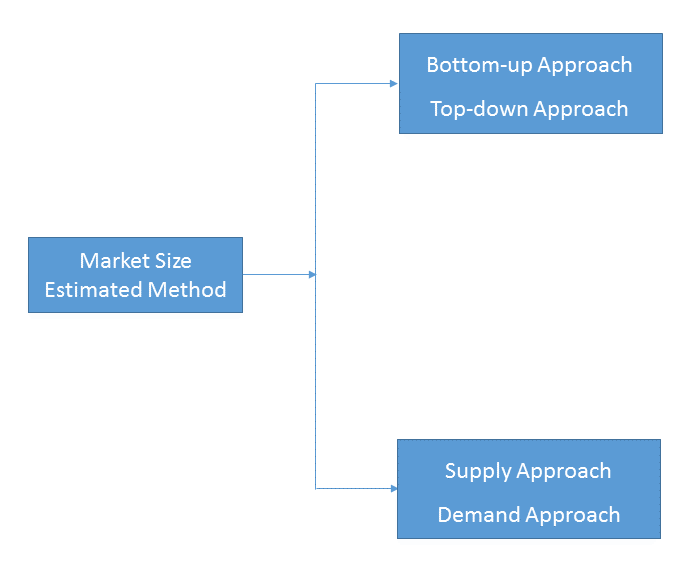
Bottom-up & top-down approach, supply & demand approach are the most important method which is used by HDIN Research to estimate the market size.
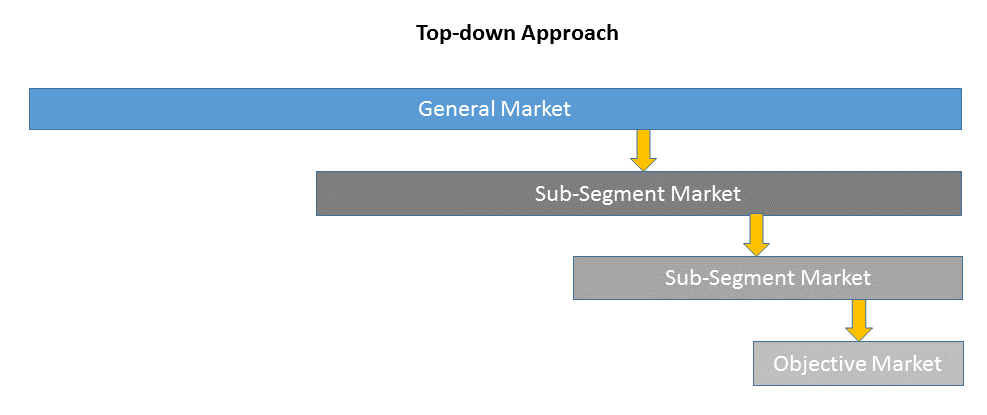
1)Top-down & Bottom-up Approach
Top-down approach uses a general market size figure and determines the percentage that the objective market represents.
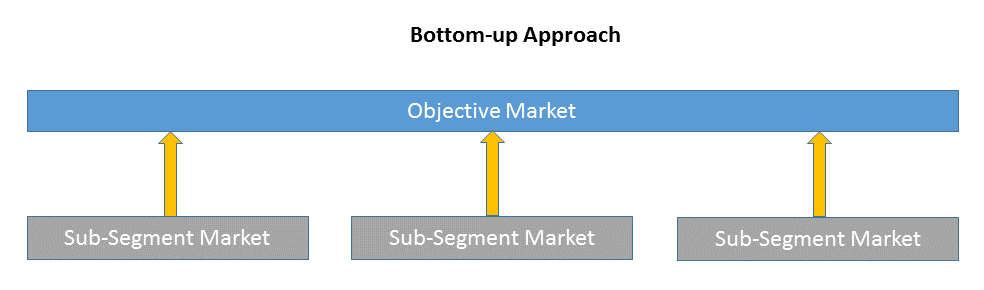
Bottom-up approach size the objective market by collecting the sub-segment information.
2)Supply & Demand Approach
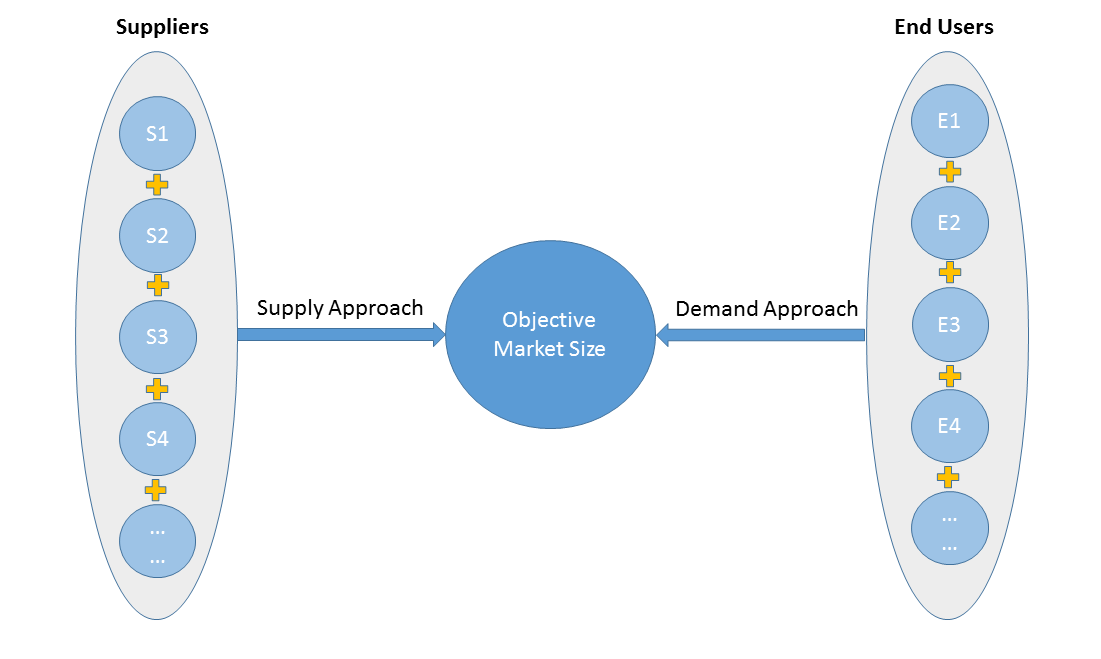
Supply approach is based on assessments of the size of each competitor supplying the objective market.
Demand approach combine end-user data within a market to estimate the objective market size. It is sometimes referred to as bottom-up approach.
- Forecasting Methodology
- Numerous factors impacting the market trend are considered for forecast model:
- New technology and application in the future;
- New project planned/under contraction;
- Global and regional underlying economic growth;
- Threatens of substitute products;
- Industry expert opinion;
- Policy and Society implication.
- Analysis Tools
1)PEST Analysis
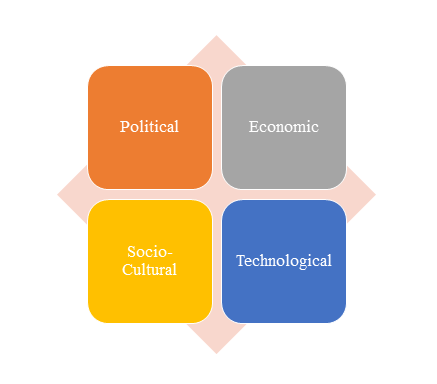
PEST Analysis is a simple and widely used tool that helps our client analyze the Political, Economic, Socio-Cultural, and Technological changes in their business environment.
- Benefits of a PEST analysis:
- It helps you to spot business opportunities, and it gives you advanced warning of significant threats.
- It reveals the direction of change within your business environment. This helps you shape what you’re doing, so that you work with change, rather than against it.
- It helps you avoid starting projects that are likely to fail, for reasons beyond your control.
- It can help you break free of unconscious assumptions when you enter a new country, region, or market; because it helps you develop an objective view of this new environment.
2)Porter’s Five Force Model Analysis
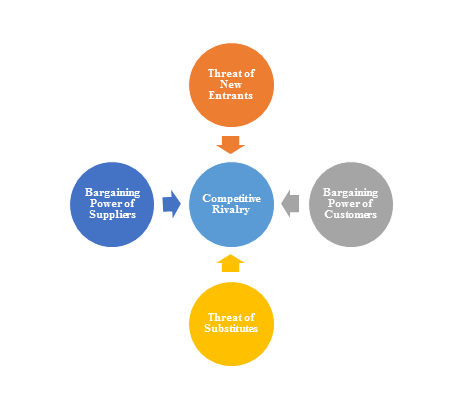
The Porter’s Five Force Model is a tool that can be used to analyze the opportunities and overall competitive advantage. The five forces that can assist in determining the competitive intensity and potential attractiveness within a specific area.
- Threat of New Entrants: Profitable industries that yield high returns will attract new firms.
- Threat of Substitutes: A substitute product uses a different technology to try to solve the same economic need.
- Bargaining Power of Customers: the ability of customers to put the firm under pressure, which also affects the customer's sensitivity to price changes.
- Bargaining Power of Suppliers: Suppliers of raw materials, components, labor, and services (such as expertise) to the firm can be a source of power over the firm when there are few substitutes.
- Competitive Rivalry: For most industries the intensity of competitive rivalry is the major determinant of the competitiveness of the industry.
3)Value Chain Analysis
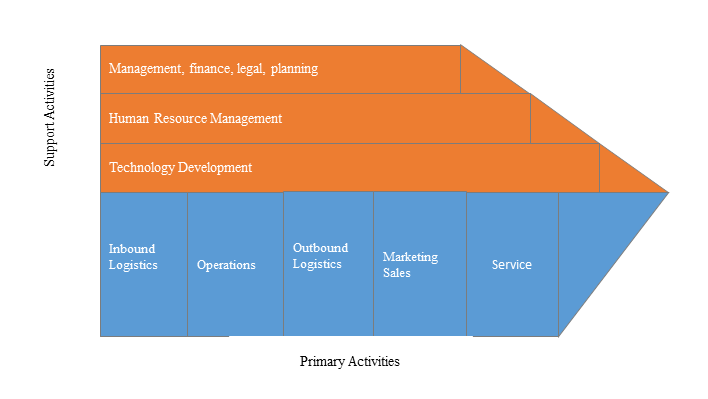
Value chain analysis is a tool to identify activities, within and around the firm and relating these activities to an assessment of competitive strength. Value chain can be analyzed by primary activities and supportive activities. Primary activities include: inbound logistics, operations, outbound logistics, marketing & sales, service. Support activities include: technology development, human resource management, management, finance, legal, planning.
4)SWOT Analysis
SWOT analysis is a tool used to evaluate a company's competitive position by identifying its strengths, weaknesses, opportunities and threats. The strengths and weakness is the inner factor; the opportunities and threats are the external factor. By analyzing the inner and external factors, the analysis can provide the detail information of the position of a player and the characteristics of the industry.
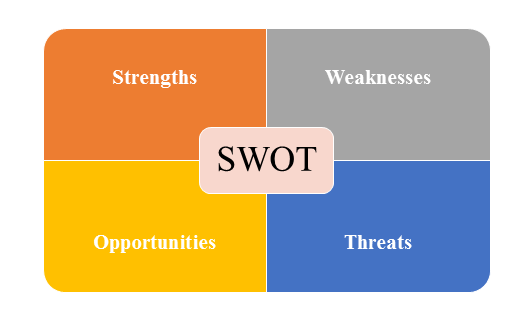
- Strengths describe what the player excels at and separates it from the competition
- Weaknesses stop the player from performing at its optimum level.
- Opportunities refer to favorable external factors that the player can use to give it a competitive advantage.
- Threats refer to factors that have the potential to harm the player.
- Data Sources
| Primary Sources | Secondary Sources |
|---|---|
| Face to face/Phone Interviews with market participants, such as: Manufactures; Distributors; End-users; Experts. Online Survey |
Government/International Organization Data: Annual Report/Presentation/Fact Book Internet Source Information Industry Association Data Free/Purchased Database Market Research Report Book/Journal/News |