Global Cold Spray Market Strategic Outlook 2026-2031 Solid-State Additive Manufacturing and Point-of-Need Defense Sustainment Analysis
- Single User License (1 Users) $ 3,500
- Team License (2~5 Users) $ 4,500
- Corporate License (>5 Users) $ 5,500
The global cold spray market in 2026 represents a rapidly maturing frontier in solid-state surface engineering, dimensional repair, and Cold Spray Additive Manufacturing (CSAM). By accelerating fine metallic powders—including copper, aluminum, titanium, nickel superalloys, and tantalum—through a convergent-divergent De Laval supersonic nozzle using heated nitrogen or helium gas at velocities between 300 and 1,200 meters per second, cold spray achieves dense metallurgical bonding via severe plastic deformation well below the feedstock’s melting temperature. Unlike legacy thermal spray or laser-based fusion additive manufacturing, this solid-state kinetic process eliminates oxidation, thermal distortion, phase transformations, and tensile cracking while imparting beneficial compressive residual stresses at deposition rates reaching several kilograms per hour. As of 2026, the global market is valued between 0.8 billion USD and 1.5 billion USD, projected to expand steadily at a compound annual growth rate (CAGR) ranging from 3.7 percent to 5.9 percent through 2031.
The fourth quarter of 2026 delivered two transformative strategic milestones illuminating how capital and infrastructure are aligning across both ends of the cold spray value chain. Downstream, on November 12, 2026, Melbourne-headquartered SPEE3D launched Phase One of NodeZERO in Darwin, Australia—the first of fifty rapidly deployable advanced manufacturing factories planned across the Asia Pacific region under its CriticalSPEE3D network. Purpose-built to produce critical metal replacement parts directly at the point of need for remote gas plants, mines, ports, and defense bases, NodeZERO directly neutralizes multi-month overseas spare-part lead times where a single failed component can halt multimillion-dollar operations.
Upstream, reinforcing the foundational criticality of specialized metal powder feedstocks, on October 5, 2026, Mimir Capital—joined by Nasdaq Stockholm-listed investment firm NAXS AB co-investing 604.4 thousand USD—completed a carve-out acquisition of Osprey from Sandvik. Bringing over 50 years of gas-atomization leadership, Osprey operates as a premier global platform supplying tightly classified spherical metal powders feeding metal 3D printing, metal injection molding (MIM), hot isostatic pressing (HIP), and cold spray. Together, independent private-equity scaling of elite powder atomizers and rapid proliferation of deployable CSAM factory nodes define the 2026 industry transition: cold spray is shifting from a specialized aerospace laboratory coating into mission-critical distributed industrial sustainment.
Regional Market Analysis
The geographical trajectory of the cold spray market reflects sharp convergence between sovereign defense depot modernization, Indo-Pacific resource logistics, and high-voltage industrial electrification.
● North America commands the largest market share, estimated between 38 percent and 42 percent. Regional leadership is anchored by entrenched defense and industrial coating specialists including VRC Metal Systems, CenterLine (Windsor) Limited, ASB Industries (Hannecard Roller Coatings), Praxair S.T. Technology, Concurrent Technologies Corporation (CTC), and Bodycote’s North American network. Growth in 2026 is propelled by United States Department of Defense adoption of MIL-STD-3021 cold spray repair specifications for aging military aircraft and naval vessels, alongside surging automotive EV copper-on-aluminum thermal-plate coating and nuclear spent-fuel cask remediation.
● Asia Pacific represents the fastest-expanding distributed manufacturing and electronics-metallization hub, holding an estimated share between 28 percent and 32 percent. Australia anchors global Cold Spray Additive Manufacturing disruption through SPEE3D—initiating its 50-factory CriticalSPEE3D NodeZERO network in Darwin—and Titomic Limited, while Japan’s Plasma Giken leads globally in ultra-high-pressure cold spray systems and Singapore’s WWG Engineering anchors regional marine/offshore restoration. Within Taiwan(China), demand centers on zero-oxide, ultra-conductive pure copper cold-spray metallization onto aluminum and ceramic substrates supporting high-power semiconductor equipment, AI server thermal heat spreaders, sputtering targets, and EV power modules.
● Europe accounts for a technically premier market share ranging from 22 percent to 26 percent. Centered in Germany (Impact Innovations), the Netherlands (Flame Spray Technologies), the United Kingdom (Bodycote), and Sweden/UK’s newly carved-out Osprey gas-atomised powder platform (now backed by Mimir Capital and NAXS AB), European innovation leads in ultra-high-pressure deposition hardware (5–7 MPa), Euro 7 low-particulate automotive brake-disc coatings, aviation MRO dimensional restoration, and copper corrosion barriers for geological nuclear waste repositories.
● South America and the Middle East and Africa (MEA) collectively represent 5 percent to 9 percent of global revenue. Regional demand concentrates heavily in remote mining operations across Chile and Brazil and sprawling LNG, petrochemical, and desalination complexes across the GCC nations—environments mirroring the exact multi-month spare-part vulnerability targeted by point-of-need cold spray repair and deployable CSAM factories.
Application and Segmentation Analysis
Cold spray deployment spans five core industrial verticals where solid-state metallurgy unlocks repair and multi-material bonding capabilities physically impossible with fusion welding or thermal spray.
● Aerospace represents the highest-certification legacy revenue vertical. Commercial aviation MROs and helicopter OEMs deploy high-pressure cold spray to execute dimensional restoration on thin-walled, heat-sensitive magnesium and aluminum gearboxes, titanium structural frames, and engine compressor housings without inducing thermal warping—recovering components worth hundreds of thousands of dollars at a fraction of replacement cost. Concurrently, CSAM accelerates rapid near-net-shape fabrication of bimetallic copper-Inconel rocket combustion liners and brackets.
● Defense constitutes the most urgent strategic growth vertical in 2026. Aging military fleets, expeditionary naval logistics, and vulnerable maritime supply chains are driving rapid adoption of containerized point-of-need CSAM factories (epitomized by SPEE3D’s Darwin NodeZERO hub serving strategic Indo-Pacific defense bases) and portable high-pressure repair carts (VRC Metal Systems, CenterLine) capable of fabricating obsolete cast/forged metal spares on-site within hours rather than waiting months for overseas shipments.
● Automotive is undergoing rapid volume expansion catalyzed by powertrain electrification and emissions regulation. Cold spray enables direct solid-state bonding of pure, oxygen-free copper busbars and heat spreaders onto lightweight aluminum EV inverter housings and battery cooling plates, while hard carbide-reinforced metallic cold-spray brake-disc coatings emerge as a clean, distortion-free compliance pathway for stringent Euro 7 brake-dust particulate limits.
● Electrical and Electronics applications exploit cold spray’s ability to deposit ultra-dense, zero-oxide pure copper and silver layers (>95 percent IACS conductivity) directly onto aluminum, ceramics (AlN/Al2O3), and semiconductor submounts—replacing costly Direct Bonded Copper (DBC) brazing in high-voltage power modules, switchgear contacts, and sputtering target assemblies.
● Utility (Power Generation, Oil and Gas, Mining, and Nuclear) represents a resilient asset-extension market. Nuclear operators deploy nickel-chromium cold spray to seal and prevent chloride-induced stress-corrosion cracking on dry spent-fuel storage canisters, while remote LNG gas plants, mines, ports, and hydroelectric utilities rely on cold spray restoration and CriticalSPEE3D-style local manufacturing to eliminate catastrophic unplanned downtime.
Value Chain Analysis
The cold spray value chain spans high-precision metallurgical atomization, supersonic fluid-dynamics hardware, certified MRO service centers, and emerging distributed factory networks.
Upstream Specialty Powders and Process Gases: Deposition efficiency and mechanical ductility depend acutely on narrow particle-size distributions (5–45 µm), low oxygen content, and spherical morphology—underscoring the strategic rationale behind Mimir Capital and NAXS AB’s October 2026 carve-out of Osprey’s 50-year gas-atomization platform from Sandvik. Concurrently, high-pressure nitrogen and helium supply (anchored by Praxair/Linde) and closed-loop helium gas-recycling scrubbers directly govern per-kilogram operating economics.
Midstream Supersonic Hardware and Nozzles: Equipment leaders divide between High-Pressure Cold Spray (HPCS, 3–7 MPa, up to 1,100°C—Impact Innovations, Plasma Giken, Titomic, VRC) required for dense titanium, nickel, and stainless-steel structures, and Low-Pressure Cold Spray (LPCS—CenterLine) prized for economical, portable aluminum, copper, and zinc restoration. Wear-resistant tungsten-carbide and silicon-carbide De Laval nozzles represent recurring midstream consumables.
Certified Repair Specs, Distributed CSAM Networks, and Tailored Powders (Primary Value Pool): Highest operating margins in 2026 reside not in bare spray guns, but in FAA/MIL-STD qualified aerospace/defense repair intellectual property, outsourced high-reliability coating service centers (Bodycote, ASB Industries, WWG Engineering), distributed subscription/factory-network models (SPEE3D’s NodeZERO CriticalSPEE3D blueprint), and cold-spray-engineered specialty alloys (Osprey).
Downstream End-Users: Systems and parts flow through direct military depot transition programs (CTC), commercial aviation MROs, Tier-1 EV/electronics factories, and remote energy/mining asset operators.
Key Market Player Deep Profiles
● ASB Industries (Hannecard Roller Coatings, Inc): Headquartered in Barberton, Ohio and operating within the global Hannecard Group, ASB Industries ranks among North America’s premier independent thermal and cold spray surface-engineering service providers. Operating advanced high-pressure cold spray cells alongside precision grinding and machining, ASB delivers ultra-dense pure copper, titanium, tantalum, aluminum, and superalloy deposits serving aerospace structural repair, high-voltage electrical/electronics thermal spreaders, utility boiler/turbine components, and specialized industrial rollers. In 2026, ASB Industries leverages deep metallurgical testing capabilities and multi-process flexibility to capture North American OEMs outsourcing high-spec solid-state metallization without incurring internal equipment CAPEX.
● Bodycote: Headquartered in Macclesfield, United Kingdom and listed on the London Stock Exchange, Bodycote stands as the world’s largest provider of thermal processing, Hot Isostatic Pressing (HIP), and specialist surface-technology services across over 160 global facilities. Integrating high-pressure cold spray seamlessly with post-spray vacuum annealing and HIP densification—a critical synergy that restores full forged-equivalent ductility to cold-sprayed titanium and nickel components—Bodycote commands unmatched Nadcap and Tier-1 aerospace/defense certifications. In 2026, Bodycote capitalizes on commercial aviation maintenance backlogs and European/North American energy-utility refurbishment cycles requiring turnkey, fully certified metallurgical restoration.
● Flame Spray Technologies: Headquartered in Duiven, Netherlands with operations in the United States and the Middle East, Flame Spray Technologies (FST) is a premier European specialist in turnkey thermal and cold spray equipment engineering, robotic spray cells, precision powder feeders, and acoustic/dust-extraction enclosures. Rather than competing strictly as a job-shop coater, FST empowers aerospace OEMs, automotive component makers, and university research hubs to install integrated, PLC-controlled cold spray production booths tailored to strict EU safety and environmental mandates. In 2026, FST benefits from growing industrial automation of EV copper-coating and Euro 7 brake-disc lines across Europe and North America.
● Plasma Giken: Headquartered in Saitama, Japan, Plasma Giken Co., Ltd. is globally recognized as one of the premier engineering pioneers in ultra-high-pressure cold spray technology, anchored by its flagship PCS series (capable of operating up to 5–7 MPa and temperatures exceeding 1,000°C). Excelling in dense, near-zero-porosity deposition of difficult metals including titanium, tantalum, niobium, and thick oxygen-free copper directly onto aluminum and ceramic plates, Plasma Giken serves leading Japanese, Taiwanese, and global automotive EV power-electronics firms, semiconductor sputtering-target makers, and aerospace primes. In 2026, Plasma Giken’s relentless R&D in high-velocity nozzle longevity sustains top-tier margins across Asia Pacific and Western research hubs.
● VRC Metal Systems: Headquartered in Box Elder, South Dakota, VRC Metal Systems stands as the United States’ foremost specialist in portable, expeditionary high-pressure cold spray hardware (VRC Gen III and Raptor systems) and military-qualified repair development. Holding deep operational integration across United States Air Force, Navy, and Army maintenance depots, VRC pioneered numerous MIL-STD-3021 structural repair procedures restoring corroded magnesium and aluminum aircraft housings, submarine valves, and armored vehicle assemblies in the field. In 2026, VRC Metal Systems expands aggressively into commercial aviation MRO, utility asset repair, and automated robotic CSAM cells backed by unmatched United States defense qualification moats.
● CenterLine (Windsor) Limited: Headquartered in Windsor, Ontario, Canada, CenterLine dominates the global Low-Pressure Cold Spray (LPCS) landscape through its globally deployed Supersonic Spray Technologies (SST) division. Operating safely at lower gas pressures using standard compressed air or economical nitrogen, CenterLine’s SST systems excel in rapid dimensional restoration of aluminum castings, automotive tooling molds, corrosion-resistant zinc/aluminum coatings, and high-conductivity copper busbar metallization for EV batteries and electrical switchgear. In 2026, CenterLine’s robust integration into North American automotive manufacturing and global utility MRO drives high unit volume across cost-sensitive industrial and portable repair applications.
● WWG Engineering Pte. Ltd: Headquartered in Singapore, WWG Engineering Pte. Ltd. operates as Southeast Asia’s premier turnkey surface-engineering, precision remanufacturing, and cold/thermal spray specialist serving the maritime, offshore oil-and-gas, aerospace, and power-utility sectors. Strategically positioned at the nexus of global Indo-Pacific shipping and LNG logistics, WWG utilizes advanced cold spray and laser cladding to rapidly refurbish corroded marine propulsion shafts, subsea valves, compressor rotors, and refinery heat exchangers—eliminating catastrophic dry-dock delays. In 2026, WWG Engineering captures rising ASEAN energy-transition and maritime-fleet maintenance budgets seeking rapid, certified regional component restoration.
● Praxair S.T. Technology, Inc: Operating from Indianapolis, Indiana within Linde Advanced Material Technologies (formerly Praxair Surface Technologies), Praxair S.T. Technology occupies a uniquely commanding vertically integrated position spanning industrial carrier gases (high-purity nitrogen and helium), engineered metallic powders, and certified aerospace/utility coating services. Because carrier gas consumption and powder consistency constitute the two largest variable costs in high-pressure cold spray, Praxair/Linde’s integrated supply footprint provides unmatched operating-cost optimization for global jet-engine primes, industrial gas-turbine utilities, and semiconductor equipment builders across North America, Europe, and Asia in 2026.
● Impact Innovations: Headquartered in Rattenkirchen, Germany, Impact Innovations GmbH sets the global industrial benchmark for High-Pressure Cold Spray equipment via its flagship Impact Spray System 5/11 (delivering 5 MPa and 1,100°C continuous performance with proprietary water-cooled silicon-carbide nozzles). Serving as the preferred hardware platform for premier global aerospace OEMs, automotive R&D centers, nuclear waste-canister coating lines, and additive integrators worldwide, Impact Innovations excels in extreme deposition efficiency, software-controlled repeatability, and long continuous-run thermal stability. In 2026, accelerating industrial scaling of thick copper EV/electronics coatings and heavy aerospace CSAM drives robust European and global system deliveries.
● Concurrent Technologies Corporation: Headquartered in Johnstown, Pennsylvania, Concurrent Technologies Corporation (CTC) is an independent, non-profit applied scientific research and engineering powerhouse serving as a pivotal transition bridge for United States defense cold spray adoption. Rather than competing in mass-market commercial equipment, CTC develops, validates, and qualifies rigorous cold spray metallurgical standards, robotic path-planning algorithms, non-destructive evaluation (NDE) protocols, and expeditionary additive tooling directly for the United States Navy, Air Force, Army, and Marine Corps. In 2026, CTC’s engineering validations continue unlocking new accredited defense MRO budgets across North America’s cold spray supplier base.
● Effusiontech Pty Ltd (SPEE3D): Headquartered in Melbourne, Australia, Effusiontech Pty Ltd—globally renowned as SPEE3D—pioneered high-speed Cold Spray Additive Manufacturing (CSAM) using patented robotic multi-axis part manipulation beneath stationary supersonic nozzles (WarpSPEE3D and deployable containerized XSPEE3D units). On November 12, 2026, SPEE3D achieved a landmark commercial milestone by launching Phase One of NodeZERO in Darwin—the first of fifty rapidly deployable advanced manufacturing factories planned across Asia Pacific under its CriticalSPEE3D network. By fabricating critical copper, aluminum, and bronze replacement parts directly at gas plants, mines, ports, and defense bases, SPEE3D is pioneering distributed point-of-need industrial resilience.
● Titomic Limited: Headquartered in Melbourne, Australia with expanding North American and European commercial operations, Titomic Limited is a publicly traded global pioneer in industrial-scale Kinetic Fusion Cold Spray Additive Manufacturing and D523/D623 portable coating systems. Combining high-pressure supersonic deposition with oversized multi-robot gantry cells, Titomic fabricates massive seamless titanium aerospace/defense structures, radiation/ballistic shielding panels, and high-wear industrial coatings for glass-bottle molds and mining/utility pipelines without vacuum chambers or part-size limits. In 2026, Titomic’s strategic pivot toward recurring commercial coating system sales alongside Tier-1 defense and aerospace partnerships strengthens its multi-regional commercialization trajectory.
Opportunities and Challenges
The cold spray market sits at a strategic inflection point, transitioning from isolated niche coatings toward distributed industrial manufacturing and high-volume EV/electronics metallization.
● Opportunities: Point-of-need distributed manufacturing networks—explicitly validated by SPEE3D’s November 2026 Phase One NodeZERO launch in Darwin as the vanguard of 50 Asia Pacific factories—unlock massive new budgets across mining, LNG/gas processing, maritime ports, and expeditionary defense sustainment where overseas shipping delays cost millions per day. Simultaneously, EV inverter busbars, battery cooling plates, AI server thermal spreaders, and Euro 7 low-dust brake discs represent the first true multi-million-unit commercial manufacturing wave for pure copper and wear-resistant cold spray. Upstream, specialized standalone powder platforms (exemplified by Mimir Capital and NAXS AB’s October 2026 carve-out of Osprey from Sandvik) are accelerating custom cold-spray alloy development.
● Challenges: Operating economics for hard, high-strength alloys (titanium, Inconel, tungsten) remain heavily constrained by the cost and periodic scarcity of helium carrier gas required to hit critical supersonic particle velocities—necessitating high-CAPEX closed-loop helium recovery units. Metallurgically, as-sprayed cold spray deposits exhibit lower tensile ductility than wrought forgings, often requiring secondary vacuum annealing or HIP post-processing (benefiting integrated processors like Bodycote) for flight-critical structural parts. Furthermore, slow non-destructive testing (NDE) standardization and lengthy FAA/EASA regulatory qualification timelines continue to temper penetration into primary load-bearing commercial aircraft structures.
Macroeconomic and Geopolitical Influences
The 2026 cold spray market exhibits exceptional strategic insulation from broader macroeconomic cyclicality. Although elevated global interest rates have moderated discretionary manufacturing CapEx in conventional metalworking, prolonged global supply-chain lead times for heavy industrial castings and forgings—frequently stretching months from overseas foundries—create compelling immediate ROI for cold spray restoration and point-of-need CSAM deployment. For remote gas plants, mines, ports, and utility power stations, preventing a single week of unplanned outage easily pays back an entire deployable cold spray unit. Concurrently, active private-equity carve-outs of specialty metallurgical leaders—highlighted by Mimir Capital and Nasdaq Stockholm-listed NAXS AB acquiring Osprey from Sandvik—underscore institutional financial conviction in high-barrier advanced manufacturing feedstocks.
Geopolitically, defense readiness, sovereign maritime sustainment, and Indo-Pacific strategic resilience have elevated cold spray to a Tier-1 national security technology. SPEE3D’s selection of Darwin, Australia for Phase One of its 50-factory CriticalSPEE3D NodeZERO rollout reflects direct alignment with AUKUS and Indo-Pacific defense-logistics priorities demanding autonomous on-site spare-parts production independent of contested sea lanes. Across North America (VRC, CenterLine, Praxair/Linde, CTC), Europe (Impact Innovations, Bodycote, Osprey), Australia (SPEE3D, Titomic), Japan (Plasma Giken), Singapore (WWG Engineering), and precision electronics hubs in Taiwan(China), allied industrial ecosystems are tightly coordinating powder atomization, supersonic hardware, and qualified repair standards—positioning cold spray as an indispensable pillar of resilient sovereign manufacturing through 2031.
1.1 Study Scope 1
1.2 Research Methodology 2
1.2.1 Data Sources 2
1.2.2 Assumptions 3
1.3 Abbreviations and Acronyms 5
Chapter 2 Global Cold Spray Market Dynamics 6
2.1 Market Drivers 6
2.2 Market Restraints 7
2.3 Macroeconomic Factors and Their Impact on Industrial Manufacturing Spend 8
2.4 Geopolitical Conflicts, Defense Budgets, and Carrier Gas Supply Chain Implications 9
2.5 Industry Trends: Additive Manufacturing Integration and Automated Robotics 10
2.6 Regulatory Landscape and Aerospace/Defense Qualification Standards (MIL-STD) 11
Chapter 3 Global Cold Spray Market by Type 12
3.1 High-Pressure Cold Spray (HPCS) Systems 12
3.2 Low-Pressure Cold Spray (LPCS) Systems 13
3.3 Cold Spray Coating Services and Metal Powder Feedstock 14
Chapter 4 Global Cold Spray Market by Application 16
4.1 Aerospace 16
4.2 Automotive 17
4.3 Defense 18
4.4 Electrical & Electronics 19
4.5 Utility 20
Chapter 5 Global Cold Spray Market by Region 22
5.1 Global Cold Spray Market Size by Region (2021-2031) 22
5.2 North America Cold Spray Market Share 23
5.3 Europe Cold Spray Market Share 24
5.4 Asia-Pacific Cold Spray Market Share 25
5.5 Latin America Cold Spray Market Share 26
5.6 Middle East & Africa Cold Spray Market Share 26
Chapter 6 North America Cold Spray Market Analysis 27
6.1 North America Market Overview 27
6.2 North America Market by Type 28
6.3 North America Market by Application 29
6.4 North America Market by Key Regions 30
6.4.1 United States 30
6.4.2 Canada 31
6.4.3 Mexico 31
Chapter 7 Europe Cold Spray Market Analysis 32
7.1 Europe Market Overview 32
7.2 Europe Market by Type 33
7.3 Europe Market by Application 34
7.4 Europe Market by Key Regions 35
7.4.1 Germany 35
7.4.2 United Kingdom 35
7.4.3 France 36
7.4.4 Italy 36
7.4.5 Spain 37
Chapter 8 Asia-Pacific Cold Spray Market Analysis 38
8.1 Asia-Pacific Market Overview 38
8.2 Asia-Pacific Market by Type 39
8.3 Asia-Pacific Market by Application 40
8.4 Asia-Pacific Market by Key Regions 41
8.4.1 China 41
8.4.2 Japan 42
8.4.3 India 42
8.4.4 South Korea 43
8.4.5 Taiwan (China) 43
Chapter 9 Latin America & Middle East and Africa Cold Spray Market Analysis 44
9.1 Latin America Market Overview 44
9.2 Latin America Market by Key Regions 45
9.2.1 Brazil 45
9.2.2 Argentina 45
9.3 Middle East and Africa Market Overview 46
9.4 Middle East and Africa Market by Key Regions 47
9.4.1 GCC 47
9.4.2 South Africa 47
Chapter 10 Industry Value Chain, Spraying Process and Patent Analysis 48
10.1 Cold Spray Value Chain Analysis 48
10.2 Metal Powder Feedstock and Carrier Gas (Helium/Nitrogen) Analysis 49
10.3 Cold Spray Process, Nozzle Design, and Patent Landscape 50
10.4 Sales, OEM Contracts, and Service Distribution Channels 52
Chapter 11 Competitive Landscape 53
11.1 Market Concentration Rate 53
11.2 Global Cold Spray Market Share by Company (2021-2026) 54
11.3 Tier 1, Tier 2, and Tier 3 Companies 56
11.4 Mergers, Acquisitions, and Strategic Partnerships 57
Chapter 12 Company Profiles 58
12.1 ASB Industries (Hannecard Roller Coatings, Inc) 58
12.1.1 Company Introduction 58
12.1.2 ASB Industries Cold Spray Revenue, Cost and Gross Profit Margin (2021-2026) 59
12.1.3 SWOT Analysis 60
12.1.4 Industrial Coating Capabilities and Marketing Strategies 61
12.2 Bodycote 62
12.2.1 Company Introduction 62
12.2.2 Bodycote Cold Spray Revenue, Cost and Gross Profit Margin (2021-2026) 63
12.2.3 SWOT Analysis 64
12.2.4 Thermal Processing Network and R&D Investments 65
12.3 Flame Spray Technologies 67
12.3.1 Company Introduction 67
12.3.2 Flame Spray Technologies Cold Spray Revenue, Cost and Gross Profit Margin (2021-2026) 68
12.3.3 SWOT Analysis 69
12.3.4 Turnkey Spray Systems and Marketing Strategies 70
12.4 Plasma Giken 71
12.4.1 Company Introduction 71
12.4.2 Plasma Giken Cold Spray Revenue, Cost and Gross Profit Margin (2021-2026) 72
12.4.3 SWOT Analysis 73
12.4.4 High-Pressure Equipment R&D and Asian Market Strategies 74
12.5 VRC Metal Systems 76
12.5.1 Company Introduction 76
12.5.2 VRC Metal Systems Cold Spray Revenue, Cost and Gross Profit Margin (2021-2026) 77
12.5.3 SWOT Analysis 78
12.5.4 Defense MRO Applications and Portable System Strategies 79
12.6 CenterLine (Windsor) Limited 80
12.6.1 Company Introduction 80
12.6.2 CenterLine Cold Spray Revenue, Cost and Gross Profit Margin (2021-2026) 81
12.6.3 SWOT Analysis 82
12.6.4 Supersonic Spray Technologies (SST) and Automotive Strategies 83
12.7 WWG Engineering Pte. Ltd 84
12.7.1 Company Introduction 84
12.7.2 WWG Engineering Cold Spray Revenue, Cost and Gross Profit Margin (2021-2026) 85
12.7.3 SWOT Analysis 85
12.7.4 Marine, Oil & Gas Repair Services and Marketing Strategies 86
12.8 Praxair S.T. Technology, Inc 87
12.8.1 Company Introduction 87
12.8.2 Praxair S.T. Technology Cold Spray Revenue, Cost and Gross Profit Margin (2021-2026) 88
12.8.3 SWOT Analysis 89
12.8.4 Gas Supply Synergies, Powder Manufacturing and R&D Strategies 90
12.9 Impact Innovations 92
12.9.1 Company Introduction 92
12.9.2 Impact Innovations Cold Spray Revenue, Cost and Gross Profit Margin (2021-2026) 93
12.9.3 SWOT Analysis 94
12.9.4 High-Pressure Gun Technology and European Industrial Strategies 95
12.10 Concurrent Technologies Corporation 96
12.10.1 Company Introduction 96
12.10.2 Concurrent Technologies Cold Spray Revenue, Cost and Gross Profit Margin (2021-2026) 97
12.10.3 SWOT Analysis 97
12.10.4 Applied Research and Government Contract Strategies 98
12.11 Effusiontech Pty Ltd (SPEE3D) 99
12.11.1 Company Introduction 99
12.11.2 Effusiontech (SPEE3D) Cold Spray Revenue, Cost and Gross Profit Margin (2021-2026) 100
12.11.3 SWOT Analysis 101
12.11.4 Cold Spray Additive Manufacturing (CSAM) and Expeditionary Strategies 102
12.12 Titomic Limited 103
12.12.1 Company Introduction 103
12.12.2 Titomic Limited Cold Spray Revenue, Cost and Gross Profit Margin (2021-2026) 104
12.12.3 SWOT Analysis 105
12.12.4 Titomic Kinetic Fusion (TKF) and Large-Scale Part Strategies 106
Chapter 13 Global Cold Spray Market Forecast (2027-2031) 107
13.1 Global Cold Spray Market Size Forecast (2027-2031) 107
13.2 Global Cold Spray Market Forecast by Type (2027-2031) 108
13.3 Global Cold Spray Market Forecast by Application (2027-2031) 110
13.4 Global Cold Spray Market Forecast by Region (2027-2031) 111
Chapter 14 Research Findings and Conclusion 113
Table 2 Global Cold Spray Market Size by Application (2021-2026) 17
Table 3 Global Cold Spray Market Size by Region (2021-2026) 23
Table 4 North America Cold Spray Market Size by Type (2021-2026) 28
Table 5 North America Cold Spray Market Size by Application (2021-2026) 29
Table 6 North America Cold Spray Market Size by Key Regions (2021-2026) 30
Table 7 Europe Cold Spray Market Size by Type (2021-2026) 33
Table 8 Europe Cold Spray Market Size by Application (2021-2026) 34
Table 9 Europe Cold Spray Market Size by Key Regions (2021-2026) 35
Table 10 Asia-Pacific Cold Spray Market Size by Type (2021-2026) 39
Table 11 Asia-Pacific Cold Spray Market Size by Application (2021-2026) 40
Table 12 Asia-Pacific Cold Spray Market Size by Key Regions (2021-2026) 41
Table 13 Latin America Cold Spray Market Size by Key Regions (2021-2026) 45
Table 14 Middle East and Africa Cold Spray Market Size by Key Regions (2021-2026) 47
Table 15 Global Cold Spray Revenue by Company (2021-2026) 54
Table 16 Global Cold Spray Market Share by Company (2021-2026) 55
Table 17 ASB Industries Cold Spray Revenue, Cost and Gross Profit Margin (2021-2026) 59
Table 18 Bodycote Cold Spray Revenue, Cost and Gross Profit Margin (2021-2026) 63
Table 19 Flame Spray Technologies Cold Spray Revenue, Cost and Gross Profit Margin (2021-2026) 68
Table 20 Plasma Giken Cold Spray Revenue, Cost and Gross Profit Margin (2021-2026) 72
Table 21 VRC Metal Systems Cold Spray Revenue, Cost and Gross Profit Margin (2021-2026) 77
Table 22 CenterLine Cold Spray Revenue, Cost and Gross Profit Margin (2021-2026) 81
Table 23 WWG Engineering Cold Spray Revenue, Cost and Gross Profit Margin (2021-2026) 85
Table 24 Praxair S.T. Technology Cold Spray Revenue, Cost and Gross Profit Margin (2021-2026) 88
Table 25 Impact Innovations Cold Spray Revenue, Cost and Gross Profit Margin (2021-2026) 93
Table 26 Concurrent Technologies Cold Spray Revenue, Cost and Gross Profit Margin (2021-2026) 97
Table 27 Effusiontech (SPEE3D) Cold Spray Revenue, Cost and Gross Profit Margin (2021-2026) 100
Table 28 Titomic Limited Cold Spray Revenue, Cost and Gross Profit Margin (2021-2026) 104
Table 29 Global Cold Spray Market Size Forecast by Type (2027-2031) 108
Table 30 Global Cold Spray Market Size Forecast by Application (2027-2031) 110
Table 31 Global Cold Spray Market Size Forecast by Region (2027-2031) 111
Figure 1 Research Methodology Flowchart 2
Figure 2 Global Cold Spray Market Size (2021-2031) 6
Figure 3 Macroeconomic Indicators and Global Industrial Capex Trends 8
Figure 4 Impact of Geopolitical Conflicts on Defense Spending and Helium Supply Chains 9
Figure 5 Global Cold Spray Market Share by Type in 2026 12
Figure 6 Global Cold Spray Market Share by Application in 2026 16
Figure 7 Global Cold Spray Market Share by Region in 2026 22
Figure 8 North America Cold Spray Market Size and Growth (2021-2031) 27
Figure 9 Europe Cold Spray Market Size and Growth (2021-2031) 32
Figure 10 Asia-Pacific Cold Spray Market Size and Growth (2021-2031) 38
Figure 11 Latin America Cold Spray Market Size and Growth (2021-2031) 44
Figure 12 Middle East and Africa Cold Spray Market Size and Growth (2021-2031) 46
Figure 13 Cold Spray Industry Value Chain 48
Figure 14 Global Cold Spray Patent Filings by Year (2021-2026) 50
Figure 15 Market Concentration Rate (CR5 and CR10) in 2026 53
Figure 16 ASB Industries Cold Spray Market Share (2021-2026) 59
Figure 17 Bodycote Cold Spray Market Share (2021-2026) 63
Figure 18 Flame Spray Technologies Cold Spray Market Share (2021-2026) 68
Figure 19 Plasma Giken Cold Spray Market Share (2021-2026) 72
Figure 20 VRC Metal Systems Cold Spray Market Share (2021-2026) 77
Figure 21 CenterLine Cold Spray Market Share (2021-2026) 81
Figure 22 WWG Engineering Cold Spray Market Share (2021-2026) 85
Figure 23 Praxair S.T. Technology Cold Spray Market Share (2021-2026) 88
Figure 24 Impact Innovations Cold Spray Market Share (2021-2026) 93
Figure 25 Concurrent Technologies Cold Spray Market Share (2021-2026) 97
Figure 26 Effusiontech (SPEE3D) Cold Spray Market Share (2021-2026) 100
Figure 27 Titomic Limited Cold Spray Market Share (2021-2026) 104
Figure 28 Global Cold Spray Market Forecast by Type (2027-2031) 108
Figure 29 Global Cold Spray Market Forecast by Application (2027-2031) 110
Research Methodology
- Market Estimated Methodology:
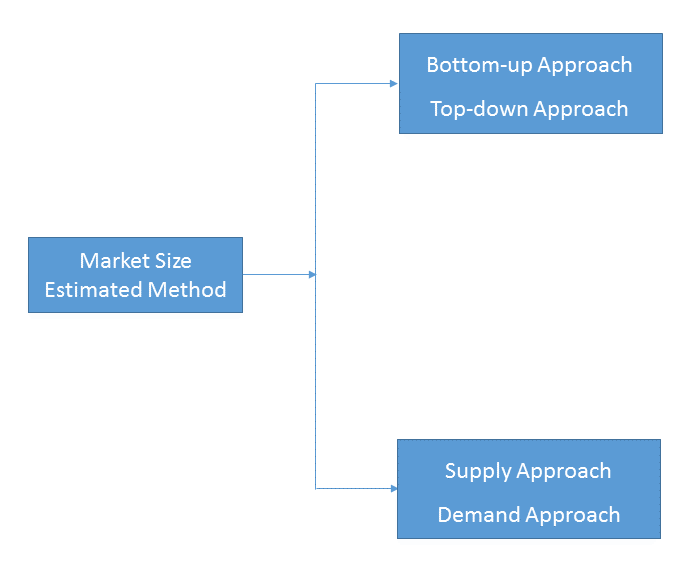
Bottom-up & top-down approach, supply & demand approach are the most important method which is used by HDIN Research to estimate the market size.
1)Top-down & Bottom-up Approach
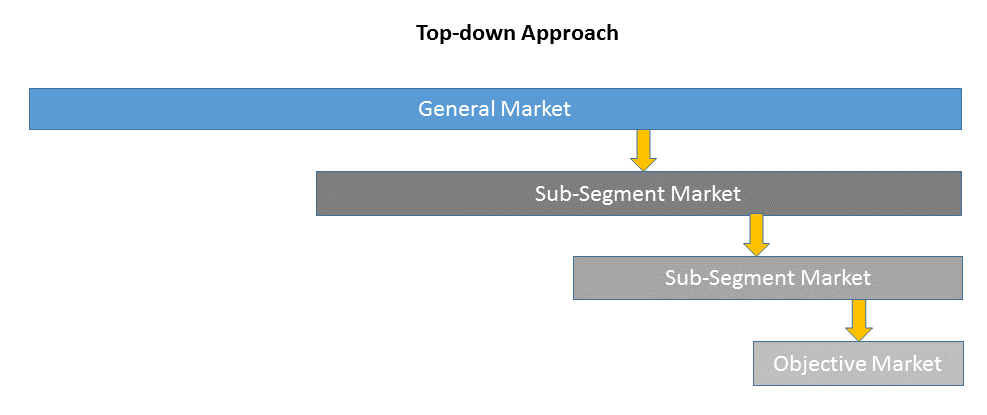
Top-down approach uses a general market size figure and determines the percentage that the objective market represents.
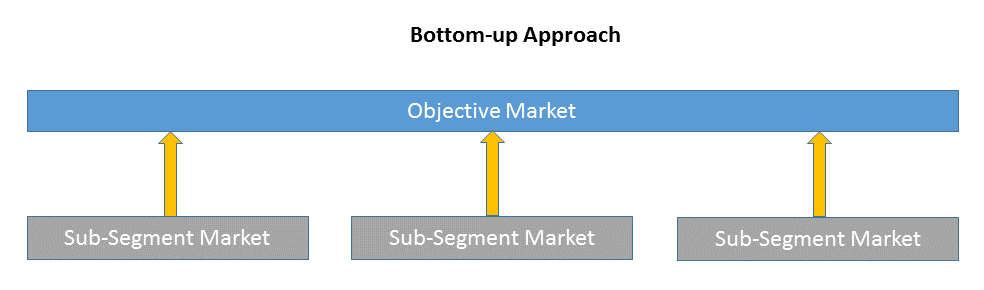
Bottom-up approach size the objective market by collecting the sub-segment information.
2)Supply & Demand Approach
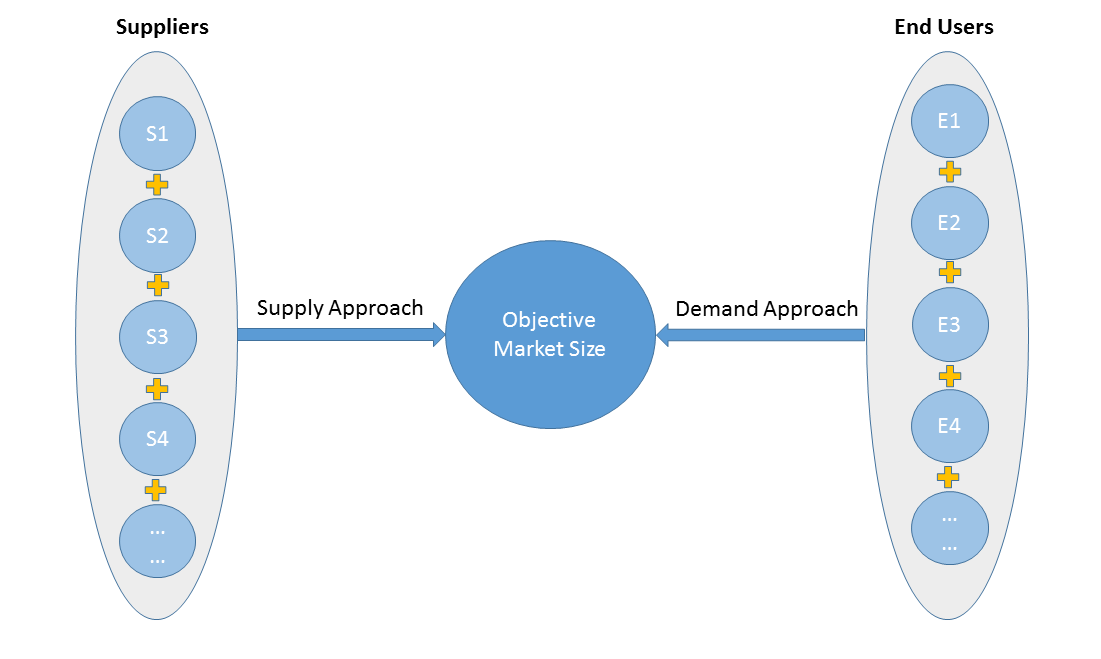
Supply approach is based on assessments of the size of each competitor supplying the objective market.
Demand approach combine end-user data within a market to estimate the objective market size. It is sometimes referred to as bottom-up approach.
- Forecasting Methodology
- Numerous factors impacting the market trend are considered for forecast model:
- New technology and application in the future;
- New project planned/under contraction;
- Global and regional underlying economic growth;
- Threatens of substitute products;
- Industry expert opinion;
- Policy and Society implication.
- Analysis Tools
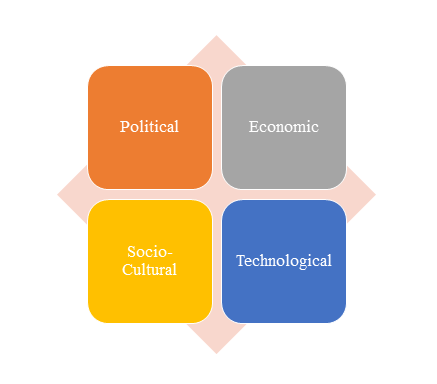
1)PEST Analysis
PEST Analysis is a simple and widely used tool that helps our client analyze the Political, Economic, Socio-Cultural, and Technological changes in their business environment.
- Benefits of a PEST analysis:
- It helps you to spot business opportunities, and it gives you advanced warning of significant threats.
- It reveals the direction of change within your business environment. This helps you shape what you’re doing, so that you work with change, rather than against it.
- It helps you avoid starting projects that are likely to fail, for reasons beyond your control.
- It can help you break free of unconscious assumptions when you enter a new country, region, or market; because it helps you develop an objective view of this new environment.
2)Porter’s Five Force Model Analysis
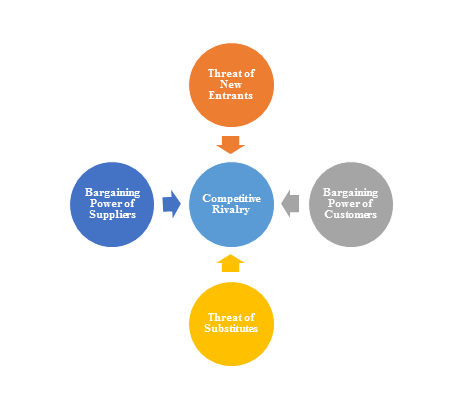
The Porter’s Five Force Model is a tool that can be used to analyze the opportunities and overall competitive advantage. The five forces that can assist in determining the competitive intensity and potential attractiveness within a specific area.
- Threat of New Entrants: Profitable industries that yield high returns will attract new firms.
- Threat of Substitutes: A substitute product uses a different technology to try to solve the same economic need.
- Bargaining Power of Customers: the ability of customers to put the firm under pressure, which also affects the customer's sensitivity to price changes.
- Bargaining Power of Suppliers: Suppliers of raw materials, components, labor, and services (such as expertise) to the firm can be a source of power over the firm when there are few substitutes.
- Competitive Rivalry: For most industries the intensity of competitive rivalry is the major determinant of the competitiveness of the industry.
3)Value Chain Analysis
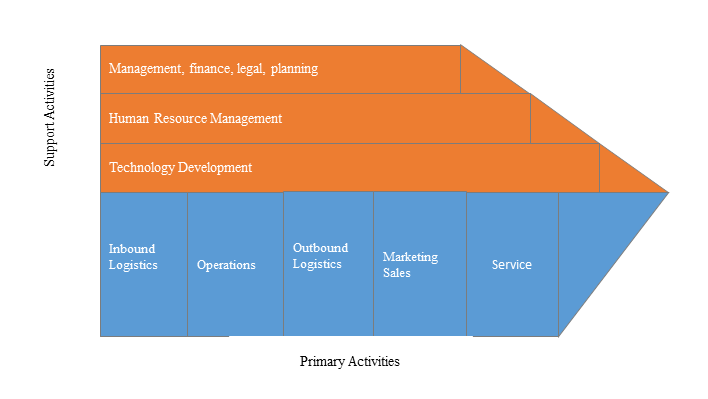
Value chain analysis is a tool to identify activities, within and around the firm and relating these activities to an assessment of competitive strength. Value chain can be analyzed by primary activities and supportive activities. Primary activities include: inbound logistics, operations, outbound logistics, marketing & sales, service. Support activities include: technology development, human resource management, management, finance, legal, planning.
4)SWOT Analysis
SWOT analysis is a tool used to evaluate a company's competitive position by identifying its strengths, weaknesses, opportunities and threats. The strengths and weakness is the inner factor; the opportunities and threats are the external factor. By analyzing the inner and external factors, the analysis can provide the detail information of the position of a player and the characteristics of the industry.
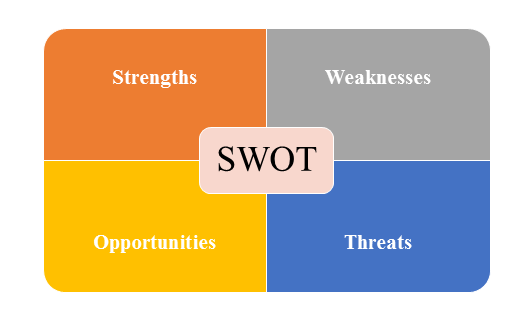
- Strengths describe what the player excels at and separates it from the competition
- Weaknesses stop the player from performing at its optimum level.
- Opportunities refer to favorable external factors that the player can use to give it a competitive advantage.
- Threats refer to factors that have the potential to harm the player.
- Data Sources
| Primary Sources | Secondary Sources |
|---|---|
| Face to face/Phone Interviews with market participants, such as: Manufactures; Distributors; End-users; Experts. Online Survey |
Government/International Organization Data: Annual Report/Presentation/Fact Book Internet Source Information Industry Association Data Free/Purchased Database Market Research Report Book/Journal/News |