Pocket Spring Machine Market Summary: 2026–2031 Outlook, Automation Shifts, and OEM Strategy
- Single User License (1 Users) $ 3,500
- Team License (2~5 Users) $ 4,500
- Corporate License (>5 Users) $ 5,500
Market Overview
Capital equipment investment in the global bedding sector rarely moves in lockstep with mattress unit volume. Instead, it follows architectural transitions in sleep products and factory floor economics. The global pocket spring machine market—encompassing integrated automated systems that execute wire coiling, induction heat treatment, non-woven fabric pocketing, and sealing—is valued at an estimated $190 million to $270 million in 2026. Through 2031, the sector is projected to expand at a compound annual growth rate (CAGR) of 4.8% to 6.5%.
The single most consequential structural shift defining the next five years is the transition from standalone, labor-assisted coiling hardware toward fully synchronized, adhesive-free smart production cells. Bedding and upholstery converters can no longer rely on low-cost manual assembly to feed multi-zone spring cores into high-speed finishing lines. Persistent factory labor shortages in Western economies, rising wage baselines across Asian manufacturing hubs, and tightening circular-economy mandates are forcing manufacturers to rethink their capital expenditure blueprints. Legacy spring architectures—specifically interconnected Bonnell units and continuous single-wire systems—continue to cede floor space to independent pocketed coils capable of superior motion isolation and ergonomic zoning. For machinery original equipment manufacturers (OEMs), capturing growth now requires solving downstream bottlenecks in ultrasonic assembly, multi-gauge wire agility, and compressed roll-pack durability rather than simply selling faster coiling heads.
Macroeconomic and Industry Context
Demand for pocket spring machinery operates at the intersection of residential real estate cycles, consumer replacement economics, and global hospitality reinvestment. Elevated borrowing costs and subdued home-buying activity in mature Western markets have periodically tempered discretionary spending on big-ticket home furnishings. Yet capital spending on pocket spring equipment has proven more resilient than broad furniture indices because of two compounding structural tailwinds.
First, the direct-to-consumer e-commerce disruption has matured past its all-foam phase. Early bed-in-a-box brands relied almost exclusively on polyurethane and memory foam to simplify vacuum compression and parcel shipping. Consumer dissatisfaction with heat retention, edge collapse, and premature sagging has triggered a decisive pivot toward hybrid mattresses that pair foam comfort layers with pocketed steel coil cores. Producing coils that survive extreme vacuum compression and recover their full loft months later requires tight metallurgical tolerances and precision inline heat tempering—capabilities that aging mechanical coilers cannot reliably deliver.
Second, regulatory frameworks are actively reshaping machine design. Across Western Europe, Extended Producer Responsibility (EPR) schemes and eco-design directives are penalizing difficult-to-recycle composite mattresses. Traditional pocket spring assembly relies heavily on hot-melt adhesives to bond rows of fabric-encased coils together, contaminating downstream recycling streams when facilities attempt to separate high-carbon steel wire from polypropylene non-woven textiles. Machinery buyers are consequently accelerating investments in ultrasonic welding systems that eliminate glue entirely. While the directional shift toward adhesive-free production is unmistakable, the exact capital payback periods and unit-cost sensitivities of retrofitting legacy lines versus commissioning greenfield ultrasonic cells are modeled in detail within the full report's capital-efficiency assessment.
Regional Market Dynamics
Equipment purchasing patterns diverge sharply across major geographies, driven by trade policy, labor cost arbitrage, and domestic sleep-culture maturity:
* Asia-Pacific: APAC remains both the global manufacturing epicenter for spring machinery and the fastest-growing demand center, consistently outpacing the global average. Domestic bedding brands in China are rapidly upgrading mid-tier product lines from Bonnell and all-foam formats toward multi-zone pocketed systems to defend margins. Simultaneously, export-oriented furniture clusters across Vietnam, Indonesia, and India are deploying automated spring lines to fulfill contract manufacturing orders for Western retailers.
* North America: North America represents a mature, replacement-driven machinery market characterized by steady mid-single-digit momentum and intense operational consolidation. Successive anti-dumping and countervailing duty regimes targeting imported finished mattresses have catalyzed localized production capacity across the United States and nearshoring corridors in Mexico. Major branded groups—including Sealy, Serta, Simmons, and King Koil—alongside large private-label contract producers are prioritizing high-throughput, low-operator-ratio lines to offset domestic wage inflation.
* Europe: European demand exhibits modest volumetric expansion but commands the highest average selling prices per machine. Sustainability compliance, energy-efficient servo-drive architectures, and glue-free ultrasonic bonding dictate procurement specifications. The region spans a wide operational spectrum, from ultra-automated retail supply chains serving mass-market chains to heritage luxury producers such as Hästens and Vi-Spring, where specialized coiling tolerances support bespoke, multi-layer natural-fiber craftsmanship.
* South America: Market expansion trails the global average in absolute equipment value, reflecting periodic currency volatility and high import financing costs. Demand centers on semi-automated and modular coiling equipment as regional producers in Brazil and neighboring markets gradually migrate entry-level consumers away from rigid foam slabs and interconnected wire springs.
* Middle East and Africa: MEA is emerging as a targeted pocket of high-growth demand, fueled by large-scale hospitality infrastructure build-outs in the Gulf Cooperation Council states and urban residential expansion. Regional mattress converters increasingly procure turnkey production lines to meet international hotel-brand specifications for independent coil motion isolation.
Navigating these contrasting demand regimes requires granular visibility into trade-adjusted equipment economics; country-level demand elasticity and tariff-impacted landed machine costs are quantified across key importing hubs in the full study's regional benchmarking model.
Application and Type Segmentation
Divergent performance across end-use applications and equipment architectures reflects where bedding and furniture converters are concentrating capital budgets
By Application:
* Mattress: Mattresses constitute the overwhelming anchor of equipment demand and remain the primary testing ground for advanced engineering. Competition among global sleep brands—ranging from mainstream orthopedic leaders like Sealy, Serta, Simmons, and King Koil to ultra-luxury houses like Kluft, Vi-Spring, and Hästens—has shifted toward micro-coil comfort layers, nested honeycomb coil arrangements, and multi-zone firmness profiles. Equipment capable of switching wire diameters and coil heights automatically without manual retooling is capturing disproportionate share of new capital allocations.
* Sofa: Although operating from a substantially smaller installed base, the sofa and upholstered seating segment is posting strong directional momentum. Furniture manufacturers are steadily replacing traditional sinuous zig-zag springs and thick high-density foam blocks with pocketed coil seat cushions to improve structural longevity, reduce foam chemical content, and enhance ergonomic recovery in both residential sectionals and commercial contract seating. Machinery serving this application prioritizes compact unit footprints and flexible irregular-shape assembly capabilities.
By Machine Type:
* Pocket Spring Coiling Machines: As the foundational throughput engine, coiling machinery accounts for the largest baseline installed volume. Innovation is centered on servo-driven wire feeding precision, higher operating cycles per minute, integrated optical quality inspection, and closed-loop induction tempering. However, standalone standard-speed coilers face growing commoditization, compressing margins for suppliers lacking proprietary control software.
* Pocket Spring Assembly Machines: Automated assembly systems—which align, cut, bond, and frame pocketed coil strings into finished spring cores—are expanding at a pace outstripping standalone coilers. Historically, downstream assembly represented the primary manual bottleneck in mattress plants. The shift toward robotic perimeter framing, automated multi-zone row sequencing, and glue-free ultrasonic bonding has elevated assembly equipment into a high-value strategic differentiator.
Value Chain and Supply Chain
Value capture across the pocket spring machinery ecosystem is migrating away from pure mechanical fabrication toward mechatronic integration and lifecycle services.
Upstream, machinery performance is tightly constrained by two material ecosystems: precision motion-control components (programmable logic controllers, high-torque servo motors, and ultrasonic generators) and downstream consumable consistency. Even the most sophisticated coiling machine suffers yield losses if fed inconsistent high-carbon steel wire tensile strength or variable-weight spunbond polypropylene non-woven fabric, both of which trigger web breaks and coil-jam downtime at elevated speeds.
Midstream equipment OEMs increasingly compete on total cost of ownership rather than upfront hardware price. Margin compression on standard coiling machinery is pushing Tier-1 builders to bundle predictive maintenance telemetry, automated material-handling conveyors, and upstream roll-packing interfaces into single-vendor turnkey contracts. Meanwhile, recurring revenue from proprietary wear parts, ultrasonic horns, tooling kits, and remote diagnostics is becoming essential to stabilizing cash flows during cyclical residential downturns. While aggregate value pools are shifting toward integrated automation providers, the exact margin spread between Tier-1 full-line integrators and Tier-2 standalone equipment assemblers—alongside aftermarket service attach rates—is unpacked in the full report's cost-curve and value-pool analysis.
Downstream, consolidation among North American and European mattress brands has concentrated purchasing leverage. Large multi-plant bedding groups increasingly standardize on uniform machinery platforms across geographically dispersed factories to simplify spare-parts inventory and cross-train maintenance technicians, raising switching costs once an OEM establishes an installed footprint.
Competitive Landscape
The global competitive arena reflects a clear structural bifurcation between heritage European precision engineering and scaled Chinese intelligent manufacturing ecosystems.
* Spühl GmbH: Operating from its Swiss engineering base, Spühl occupies the premium tier of the global market. Its strategic moat rests on ultra-high mechanical durability, precision ultrasonic welding technology, and deeply entrenched relationships with major Western bedding conglomerates. Spühl competes on uptime, minimal scrap rates, and full-line European engineering standards rather than upfront capital cost, insulating its core franchise in labor-scarce, heavily regulated jurisdictions.
* Zhejiang Huajian Intelligent Equipment Ltd.: As a flagship Chinese industrial manufacturer, Zhejiang Huajian has built substantial scale through vertical integration, broad R&D investments, and an expansive catalog spanning high-speed coiling, multi-zone assembly, and automated mattress production lines. The company leverages strong domestic cluster advantages while aggressively expanding its global export footprint through competitive price-to-performance ratios and turnkey factory solutions.
* Guangzhou Lianrou Machinery and Equipment Co. Ltd.: Recognized as an early pioneer in Chinese pocket spring equipment, Lianrou has carved out a distinct strategic advantage by pairing pocket spring machinery with automated mattress compression, roll-packing, and automated packaging systems. This downstream integration resonates strongly with e-commerce hybrid mattress producers and high-volume contract exporters seeking unified end-of-line automation.
* Foshan Yuantian Mattress Machinery Co. Ltd.: Anchored within Guangdong's dense furniture manufacturing ecosystem, Foshan Yuantian focuses on integrated mattress machinery lines tailored for agile, multi-SKU production environments. Proximity to thousands of regional upholstery and bedding factories provides tight feedback loops for rapid mechanical iteration and cost-engineered automation upgrades.
* Nanjing Square Mattress Machinery Co. Ltd. and Shaoxing Stann Machinery Co. Ltd.: Both enterprises represent agile, specialized contenders within China's eastern industrial corridor. By focusing on targeted engineering reliability, accessible maintenance architectures, and competitive capital entry points, they effectively capture mid-tier domestic converters and emerging-market buyers transitioning from manual assembly to automated pocket spring production.
Across the competitive spectrum, the primary strategic pivot is service localization. As Chinese OEMs move upmarket into Europe and the Americas to challenge incumbent Western brands, establishing regional spare-parts depots and rapid-response field engineering teams has become the decisive prerequisite for winning Tier-1 corporate accounts.
Strategic Imperatives: Opportunities and Challenges
Executive teams across equipment OEMs and private-equity sponsors evaluating the pocket spring machinery landscape face a sharply defined set of commercial tailwinds and operational headwinds.
Key Commercial Opportunities:
* Circularity-Driven Retooling: Mandatory recyclability frameworks and brand-level ESG pledges are turning adhesive-free ultrasonic assembly from an optional upgrade into a compliance necessity, opening a multi-year retrofit cycle across Europe and progressive North American accounts.
* Complex Spring Architectures: Rising consumer willingness to invest in sleep ergonomics favors micro-coil layers, variable-tension zoned cores, and pocket-in-pocket designs. OEMs that deliver software-controlled, zero-downtime changeovers between coil geometries will command pricing power.
* Data-Enabled Lifecycle Services: Embedding edge sensors to monitor wire tension, ultrasonic weld integrity, and bearing fatigue enables OEMs to transition from transactional equipment vendors into recurring-revenue uptime partners.
Structural Risks and Challenges:
* Macro-Cyclical Capital Deferrals: Because mattress purchases track housing turnover and consumer confidence, prolonged real estate sluggishness can prompt bedding manufacturers to defer fleet replacements, creating sharp order-book volatility for machinery builders.
* Mid-Tier Hardware Commoditization: Rapid engineering convergence among Asian equipment makers has eroded differentiation in standard single-wire coiling machines, triggering persistent price pressure across emerging markets.
* Technical Talent Scarcity: Both machinery OEMs and their mattress-factory customers struggle to recruit and retain skilled mechatronics technicians capable of maintaining high-speed servo and ultrasonic production lines, risking underutilization of advanced capital assets.
Ultimately, C-suite leaders in the pocket spring machinery sector must resolve a fundamental capital-allocation dilemma: whether to commit engineering budgets toward ultra-automated, circularity-compliant smart cells targeting high-margin, slow-volume Western replacement markets, or to architect modular, rapid-payback equipment platforms engineered to capture structural first-time automation across price-sensitive emerging manufacturing hubs.
1.1 Study Scope 1
1.2 Research Methodology 2
1.2.1 Data Sources 2
1.2.2 Assumptions 3
1.3 Abbreviations and Acronyms 4
Chapter 2 Executive Summary 6
2.1 Key Market Findings and Highlights 6
2.2 Global Pocket Spring Machine Market Volume and Market Size Overview (2021-2031) 7
2.3 Market Snapshot by Type, Application, and Region 8
Chapter 3 Geopolitical Impact and Macroeconomic Environment Analysis 10
3.1 Global Macroeconomic Indicators and Manufacturing Trends 10
3.2 Geopolitical Impact on the Global Macroeconomy 11
3.3 Geopolitical Impact on the Pocket Spring Machine Industry 12
3.3.1 Supply Chain Restructuring and Regionalization 12
3.3.2 Trade Tariffs, Export Controls, and Compliance Risks 13
3.4 Market Dynamics 13
3.4.1 Market Drivers 13
3.4.2 Market Restraints 14
3.4.3 Market Opportunities and Challenges 14
Chapter 4 Industry Chain, Value Chain and Cost Structure Analysis 15
4.1 Pocket Spring Machine Industry Chain Overview 15
4.2 Upstream Key Components and Raw Materials Supply Analysis 16
4.3 Midstream Manufacturing and Value Chain Analysis 17
4.4 Downstream Demand Analysis 18
4.5 Manufacturing Cost Structure and Pricing Mechanism Analysis 19
Chapter 5 Manufacturing Process, Technology Trends and Patent Analysis 20
5.1 Core Manufacturing Process and Assembly Workflow 20
5.2 Key Technological Trends and Automation Upgrades 21
5.3 Global Patent Landscape and Filing Trends (2021-2026) 22
5.4 Top Patent Applicants and Core Technology Hotspots 23
Chapter 6 Global Pocket Spring Machine Market Analysis by Type 25
6.1 Global Pocket Spring Machine Market Volume and Market Size by Type (2021-2026) 25
6.2 Global Pocket Spring Machine Market Volume and Market Size Forecast by Type (2027-2031) 26
6.3 Pocket Spring Coiling Machines Market Analysis 27
6.4 Pocket Spring Assembly Machines Market Analysis 28
6.5 Average Selling Price (ASP) Trend Analysis by Type (2021-2031) 29
Chapter 7 Global Pocket Spring Machine Market Analysis by Application 30
7.1 Global Pocket Spring Machine Market Volume and Market Size by Application (2021-2026) 30
7.2 Global Pocket Spring Machine Market Volume and Market Size Forecast by Application (2027-2031) 31
7.3 Mattress Application Market Analysis 32
7.4 Sofa Application Market Analysis 33
7.5 Other Applications Market Analysis 34
Chapter 8 Global Pocket Spring Machine Import and Export Analysis 35
8.1 Global Pocket Spring Machine Trade Flow Overview 35
8.2 Major Exporting Countries Analysis 36
8.3 Major Importing Countries Analysis 37
8.4 Customs Tariffs, Trade Policies, and Logistics Considerations 38
Chapter 9 Global Pocket Spring Machine Market Analysis by Region and Key Countries 39
9.1 Global Pocket Spring Machine Market Volume and Market Size by Region (2021-2031) 39
9.2 North America Pocket Spring Machine Market Analysis 41
9.2.1 United States 42
9.2.2 Canada 42
9.2.3 Mexico 43
9.3 Europe Pocket Spring Machine Market Analysis 44
9.3.1 Germany 45
9.3.2 Switzerland 45
9.3.3 Italy 46
9.3.4 United Kingdom 46
9.3.5 France 47
9.3.6 Poland 47
9.3.7 Turkey 48
9.4 Asia-Pacific Pocket Spring Machine Market Analysis 49
9.4.1 China 50
9.4.2 India 50
9.4.3 Vietnam 51
9.4.4 Japan 51
9.4.5 South Korea 52
9.4.6 Malaysia 52
9.4.7 Indonesia 53
9.5 South America Pocket Spring Machine Market Analysis 54
9.5.1 Brazil 54
9.5.2 Argentina 55
9.6 Middle East and Africa Pocket Spring Machine Market Analysis 56
9.6.1 UAE 56
9.6.2 Saudi Arabia 57
9.6.3 South Africa 57
Chapter 10 Competitive Landscape and Market Share Analysis 58
10.1 Competitive Landscape Overview and Market Concentration (CR3, CR5) 58
10.2 Major Players Pocket Spring Machine Sales Volume and Market Share (2021-2026) 59
10.3 Major Players Pocket Spring Machine Revenue and Market Share (2021-2026) 60
10.4 Product Portfolio, Speed Specifications, and Pricing Positioning 61
10.5 Key Strategic Developments (M&A, Partnerships, Capacity Expansion, New Products) 62
Chapter 11 Key Market Players Profiles 64
11.1 Spühl GmbH 64
11.1.1 Company Overview 64
11.1.2 Product Portfolio and R&D Capabilities 65
11.1.3 SWOT Analysis 65
11.1.4 Pocket Spring Machine Business Data Analysis 66
11.1.5 Recent Developments and Market Strategy 67
11.2 Zhejiang Huajian Intelligent Equipment Ltd. 68
11.2.1 Company Overview 68
11.2.2 Product Portfolio and Manufacturing Capacity 69
11.2.3 SWOT Analysis 69
11.2.4 Pocket Spring Machine Business Data Analysis 70
11.2.5 R&D Investment and Marketing Strategy 71
11.3 Foshan Yuantian Mattress Machinery Co. Ltd. 72
11.3.1 Company Overview 72
11.3.2 Product Portfolio and Technological Advantages 73
11.3.3 SWOT Analysis 73
11.3.4 Pocket Spring Machine Business Data Analysis 74
11.3.5 Sales Network and Strategic Developments 75
11.4 Guangzhou Lianrou Machinery and Equipment Co. Ltd. 76
11.4.1 Company Overview 76
11.4.2 Product Portfolio and Key Equipment Models 77
11.4.3 R&D Investment and Patent Portfolio 77
11.4.4 SWOT Analysis 78
11.4.5 Pocket Spring Machine Business Data Analysis 79
11.4.6 Global Marketing Strategy and Recent Developments 80
11.5 Nanjing Square Mattress Machinery Co. Ltd. 81
11.5.1 Company Overview 81
11.5.2 Product Portfolio and Service Capabilities 82
11.5.3 SWOT Analysis 82
11.5.4 Pocket Spring Machine Business Data Analysis 83
11.5.5 Market Expansion Strategy 84
11.6 Shaoxing Stann Machinery Co. Ltd. 85
11.6.1 Company Overview 85
11.6.2 SWOT Analysis 85
11.6.3 Pocket Spring Machine Business Data Analysis 86
11.6.4 Marketing Strategy and Outlook 87
Chapter 12 Marketing Channels, Distribution and Sales Strategy Analysis 88
12.1 Sales Channel Structure (Direct Sales vs. Authorized Distributors) 88
12.2 After-Sales Service, Installation, and Remote Diagnostics 89
12.3 Key Customer Acquisition and Trade Exhibition Strategies 90
Chapter 13 Market Forecast and Strategic Recommendations 91
13.1 Global Pocket Spring Machine Market Outlook (2027-2031) 91
13.2 High-Growth Segments and Emerging Market Opportunities 92
13.3 Strategic Recommendations for Equipment Manufacturers and Stakeholders 93
13.4 Research Conclusions 94
Table 2 List of Abbreviations and Acronyms 4
Table 3 Global Pocket Spring Machine Market Snapshot (2026 vs. 2031) 6
Table 4 Impact Assessment of Geopolitical Events on Pocket Spring Machine Supply Chain 12
Table 5 Summary of Key Market Drivers, Restraints, and Opportunities 14
Table 6 Key Upstream Component Suppliers and Raw Material Cost Breakdown 16
Table 7 Pocket Spring Machine Manufacturing Cost Structure Breakdown (2026) 19
Table 8 Technical Comparison of Ultrasonic Welding vs. Hot-Melt Gluing Pocket Spring Machines 21
Table 9 Top Global Patent Holders in Pocket Spring Machine Technology (2021-2026) 24
Table 10 Global Pocket Spring Machine Market Volume (Units) by Type (2021-2026) 25
Table 11 Global Pocket Spring Machine Market Size (USD Million) by Type (2021-2026) 25
Table 12 Global Pocket Spring Machine Market Volume (Units) Forecast by Type (2027-2031) 26
Table 13 Global Pocket Spring Machine Market Size (USD Million) Forecast by Type (2027-2031) 26
Table 14 Global Pocket Spring Machine Average Selling Price (USD/Unit) by Type (2021-2031) 29
Table 15 Global Pocket Spring Machine Market Volume (Units) by Application (2021-2026) 30
Table 16 Global Pocket Spring Machine Market Size (USD Million) by Application (2021-2026) 30
Table 17 Global Pocket Spring Machine Market Volume (Units) Forecast by Application (2027-2031) 31
Table 18 Global Pocket Spring Machine Market Size (USD Million) Forecast by Application (2027-2031) 31
Table 19 Global Pocket Spring Machine Export Volume and Value by Major Exporting Countries (2021-2026) 36
Table 20 Global Pocket Spring Machine Import Volume and Value by Major Importing Countries (2021-2026) 37
Table 21 Import Tariff Rates and Trade Compliance Requirements in Key Markets (2026) 38
Table 22 Global Pocket Spring Machine Market Volume (Units) by Region (2021-2026) 39
Table 23 Global Pocket Spring Machine Market Size (USD Million) by Region (2021-2026) 39
Table 24 Global Pocket Spring Machine Market Volume (Units) Forecast by Region (2027-2031) 40
Table 25 Global Pocket Spring Machine Market Size (USD Million) Forecast by Region (2027-2031) 40
Table 26 North America Pocket Spring Machine Market Volume and Market Size by Country (2021-2031) 41
Table 27 Europe Pocket Spring Machine Market Volume and Market Size by Country (2021-2031) 44
Table 28 Asia-Pacific Pocket Spring Machine Market Volume and Market Size by Country (2021-2031) 49
Table 29 South America Pocket Spring Machine Market Volume and Market Size by Country (2021-2031) 54
Table 30 Middle East and Africa Pocket Spring Machine Market Volume and Market Size by Country (2021-2031) 56
Table 31 Global Major Players Pocket Spring Machine Sales Volume (Units) (2021-2026) 59
Table 32 Global Major Players Pocket Spring Machine Revenue (USD Million) (2021-2026) 60
Table 33 Major Players Product Portfolio and Key Technical Specifications Comparison 61
Table 34 Recent Mergers, Acquisitions, and Strategic Expansions (2021-2026) 62
Table 35 Spühl GmbH Pocket Spring Machine Sales, Price, Cost and Gross Profit Margin (2021-2026) 66
Table 36 Zhejiang Huajian Intelligent Equipment Ltd. Pocket Spring Machine Sales, Price, Cost and Gross Profit Margin (2021-2026) 70
Table 37 Foshan Yuantian Mattress Machinery Co. Ltd. Pocket Spring Machine Sales, Price, Cost and Gross Profit Margin (2021-2026) 74
Table 38 Guangzhou Lianrou Machinery and Equipment Co. Ltd. Pocket Spring Machine Sales, Price, Cost and Gross Profit Margin (2021-2026) 79
Table 39 Nanjing Square Mattress Machinery Co. Ltd. Pocket Spring Machine Sales, Price, Cost and Gross Profit Margin (2021-2026) 83
Table 40 Shaoxing Stann Machinery Co. Ltd. Pocket Spring Machine Sales, Price, Cost and Gross Profit Margin (2021-2026) 86
Table 41 Comparison of Direct Sales and Distributor Models in the Pocket Spring Machine Industry 88
Table 42 Global Pocket Spring Machine Market Summary Forecast (2027-2031) 91
Figure 1 Research Methodology Flowchart 2
Figure 2 Global Pocket Spring Machine Market Volume (Units) and Growth Rate (2021-2031) 7
Figure 3 Global Pocket Spring Machine Market Size (USD Million) and Growth Rate (2021-2031) 7
Figure 4 Global Pocket Spring Machine Market Share by Type, Application, and Region (2026) 9
Figure 5 Global GDP Growth Rate and Industrial Production Index (2021-2026) 10
Figure 6 Geopolitical Risk Transmission Mechanism to the Bedding Machinery Sector 11
Figure 7 Pocket Spring Machine Industry Chain Structure 15
Figure 8 Value Chain Profit Margin Distribution Across Segments 17
Figure 9 Manufacturing Cost Structure Share of Pocket Spring Machines (2026) 19
Figure 10 Pocket Spring Machine Manufacturing and Quality Inspection Process Flow 20
Figure 11 Global Patent Applications and Grants for Pocket Spring Machines (2021-2026) 22
Figure 12 Patent Distribution by Technical Domain (2021-2026) 23
Figure 13 Global Pocket Spring Machine Market Size Share by Type (2021-2031) 26
Figure 14 Global Pocket Spring Coiling Machines Market Volume and Market Size (2021-2031) 27
Figure 15 Global Pocket Spring Assembly Machines Market Volume and Market Size (2021-2031) 28
Figure 16 Global Pocket Spring Machine ASP Trend by Type (2021-2031) 29
Figure 17 Global Pocket Spring Machine Market Size Share by Application (2021-2031) 31
Figure 18 Mattress Application Market Volume and Market Size (2021-2031) 32
Figure 19 Sofa Application Market Volume and Market Size (2021-2031) 33
Figure 20 Other Applications Market Volume and Market Size (2021-2031) 34
Figure 21 Global Pocket Spring Machine Trade Flow Map (2026) 35
Figure 22 Export Value Share of Top Exporting Countries (2026) 36
Figure 23 Import Value Share of Top Importing Countries (2026) 37
Figure 24 Global Pocket Spring Machine Market Size Share by Region (2026 vs. 2031) 40
Figure 25 North America Pocket Spring Machine Market Volume and Market Size (2021-2031) 41
Figure 26 United States Pocket Spring Machine Market Size (2021-2031) 42
Figure 27 Europe Pocket Spring Machine Market Volume and Market Size (2021-2031) 44
Figure 28 Germany and Poland Pocket Spring Machine Market Size Comparison (2021-2031) 47
Figure 29 Asia-Pacific Pocket Spring Machine Market Volume and Market Size (2021-2031) 49
Figure 30 China Pocket Spring Machine Market Volume and Market Size (2021-2031) 50
Figure 31 India and Vietnam Pocket Spring Machine Market Size Growth Comparison (2021-2031) 51
Figure 32 South America Pocket Spring Machine Market Size (2021-2031) 54
Figure 33 Middle East and Africa Pocket Spring Machine Market Size (2021-2031) 56
Figure 34 Global Pocket Spring Machine Market Concentration Rate (CR3 and CR5) (2026) 58
Figure 35 Global Major Players Sales Volume Market Share (2026) 59
Figure 36 Global Major Players Revenue Market Share (2026) 60
Figure 37 Competitive Positioning Matrix of Leading Manufacturers (2026) 63
Figure 38 Spühl GmbH Pocket Spring Machine Market Share (2021-2026) 67
Figure 39 Zhejiang Huajian Intelligent Equipment Ltd. Pocket Spring Machine Market Share (2021-2026) 71
Figure 40 Foshan Yuantian Mattress Machinery Co. Ltd. Pocket Spring Machine Market Share (2021-2026) 75
Figure 41 Guangzhou Lianrou Machinery and Equipment Co. Ltd. Pocket Spring Machine Market Share (2021-2026) 80
Figure 42 Nanjing Square Mattress Machinery Co. Ltd. Pocket Spring Machine Market Share (2021-2026) 84
Figure 43 Shaoxing Stann Machinery Co. Ltd. Pocket Spring Machine Market Share (2021-2026) 87
Figure 44 Global Pocket Spring Machine Sales Share by Distribution Channel (2026) 89
Figure 45 Emerging Market Growth Potential Matrix (2027-2031) 92
Research Methodology
- Market Estimated Methodology:
Bottom-up & top-down approach, supply & demand approach are the most important method which is used by HDIN Research to estimate the market size.
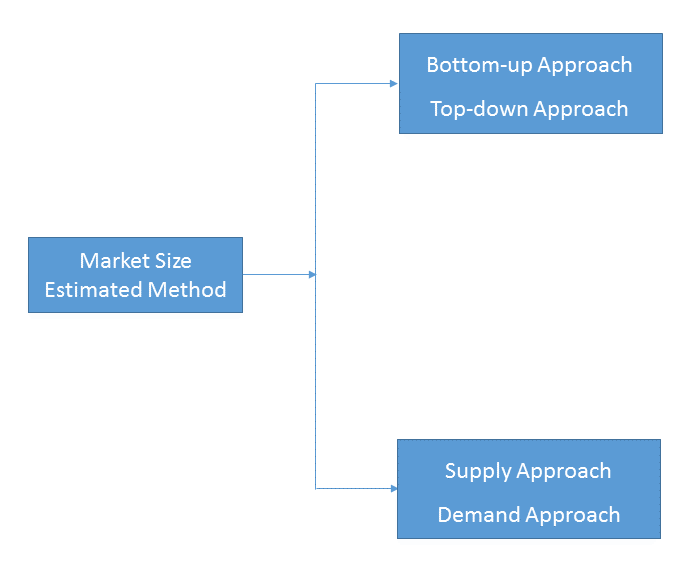
1)Top-down & Bottom-up Approach
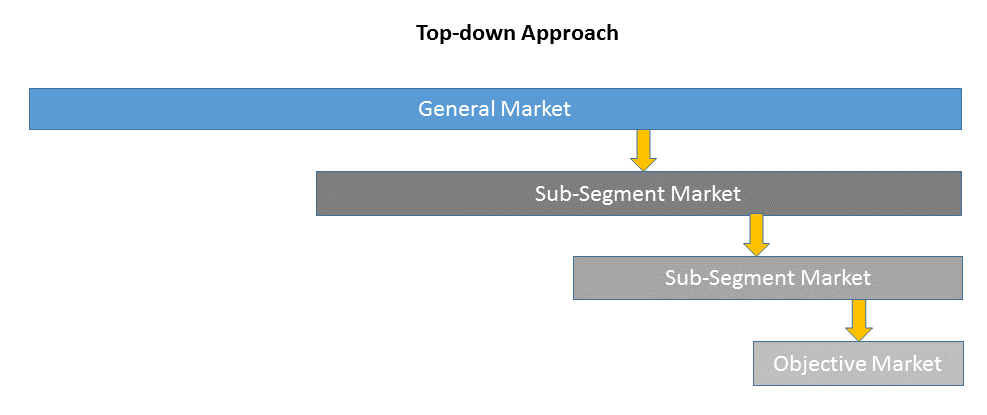
Top-down approach uses a general market size figure and determines the percentage that the objective market represents.
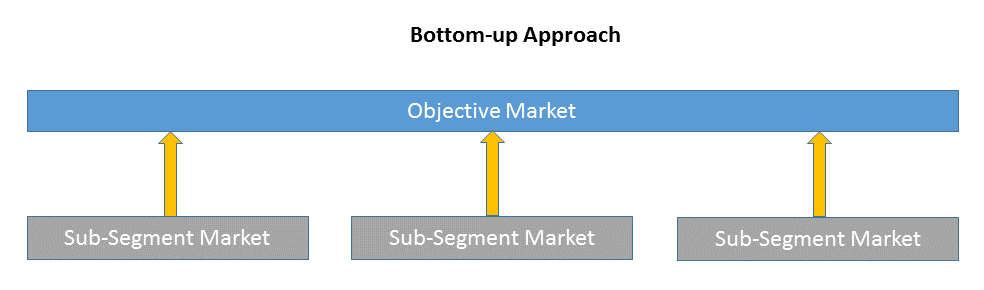
Bottom-up approach size the objective market by collecting the sub-segment information.
2)Supply & Demand Approach
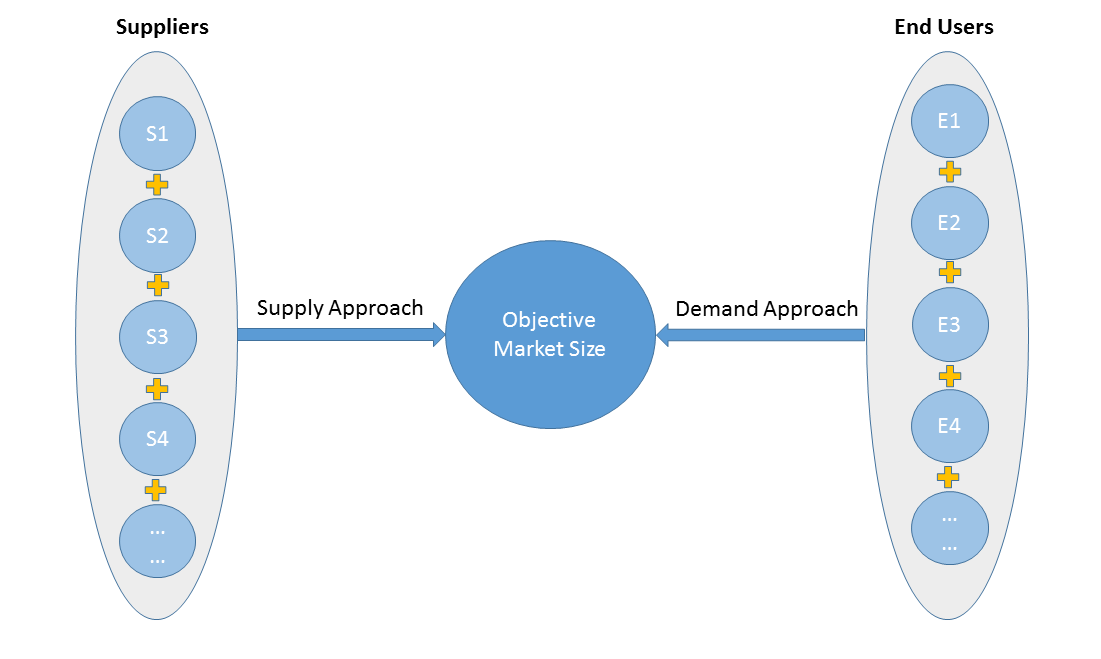
Supply approach is based on assessments of the size of each competitor supplying the objective market.
Demand approach combine end-user data within a market to estimate the objective market size. It is sometimes referred to as bottom-up approach.
- Forecasting Methodology
- Numerous factors impacting the market trend are considered for forecast model:
- New technology and application in the future;
- New project planned/under contraction;
- Global and regional underlying economic growth;
- Threatens of substitute products;
- Industry expert opinion;
- Policy and Society implication.
- Analysis Tools
1)PEST Analysis
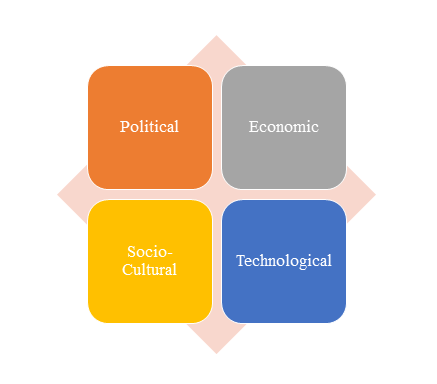
PEST Analysis is a simple and widely used tool that helps our client analyze the Political, Economic, Socio-Cultural, and Technological changes in their business environment.
- Benefits of a PEST analysis:
- It helps you to spot business opportunities, and it gives you advanced warning of significant threats.
- It reveals the direction of change within your business environment. This helps you shape what you’re doing, so that you work with change, rather than against it.
- It helps you avoid starting projects that are likely to fail, for reasons beyond your control.
- It can help you break free of unconscious assumptions when you enter a new country, region, or market; because it helps you develop an objective view of this new environment.
2)Porter’s Five Force Model Analysis
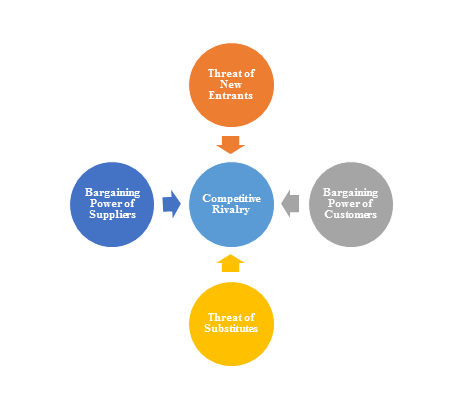
The Porter’s Five Force Model is a tool that can be used to analyze the opportunities and overall competitive advantage. The five forces that can assist in determining the competitive intensity and potential attractiveness within a specific area.
- Threat of New Entrants: Profitable industries that yield high returns will attract new firms.
- Threat of Substitutes: A substitute product uses a different technology to try to solve the same economic need.
- Bargaining Power of Customers: the ability of customers to put the firm under pressure, which also affects the customer's sensitivity to price changes.
- Bargaining Power of Suppliers: Suppliers of raw materials, components, labor, and services (such as expertise) to the firm can be a source of power over the firm when there are few substitutes.
- Competitive Rivalry: For most industries the intensity of competitive rivalry is the major determinant of the competitiveness of the industry.
3)Value Chain Analysis
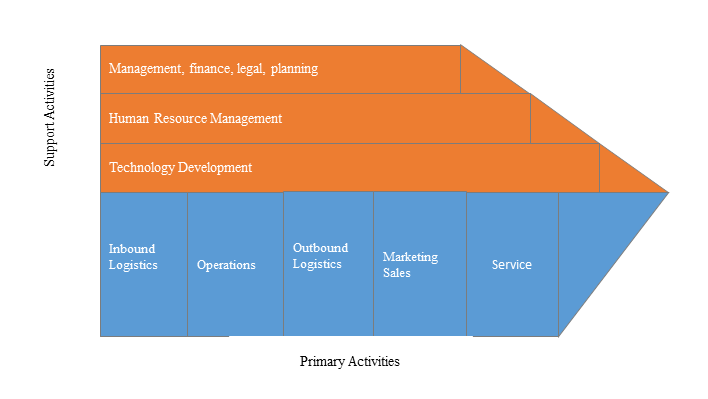
Value chain analysis is a tool to identify activities, within and around the firm and relating these activities to an assessment of competitive strength. Value chain can be analyzed by primary activities and supportive activities. Primary activities include: inbound logistics, operations, outbound logistics, marketing & sales, service. Support activities include: technology development, human resource management, management, finance, legal, planning.
4)SWOT Analysis
SWOT analysis is a tool used to evaluate a company's competitive position by identifying its strengths, weaknesses, opportunities and threats. The strengths and weakness is the inner factor; the opportunities and threats are the external factor. By analyzing the inner and external factors, the analysis can provide the detail information of the position of a player and the characteristics of the industry.
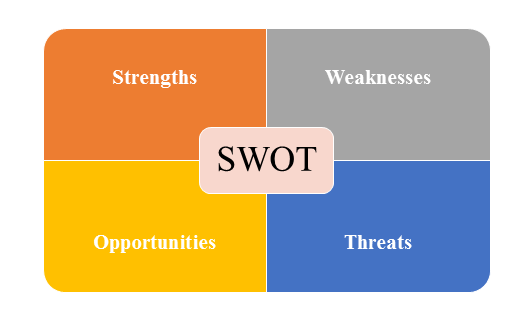
- Strengths describe what the player excels at and separates it from the competition
- Weaknesses stop the player from performing at its optimum level.
- Opportunities refer to favorable external factors that the player can use to give it a competitive advantage.
- Threats refer to factors that have the potential to harm the player.
- Data Sources
| Primary Sources | Secondary Sources |
|---|---|
| Face to face/Phone Interviews with market participants, such as: Manufactures; Distributors; End-users; Experts. Online Survey |
Government/International Organization Data: Annual Report/Presentation/Fact Book Internet Source Information Industry Association Data Free/Purchased Database Market Research Report Book/Journal/News |